
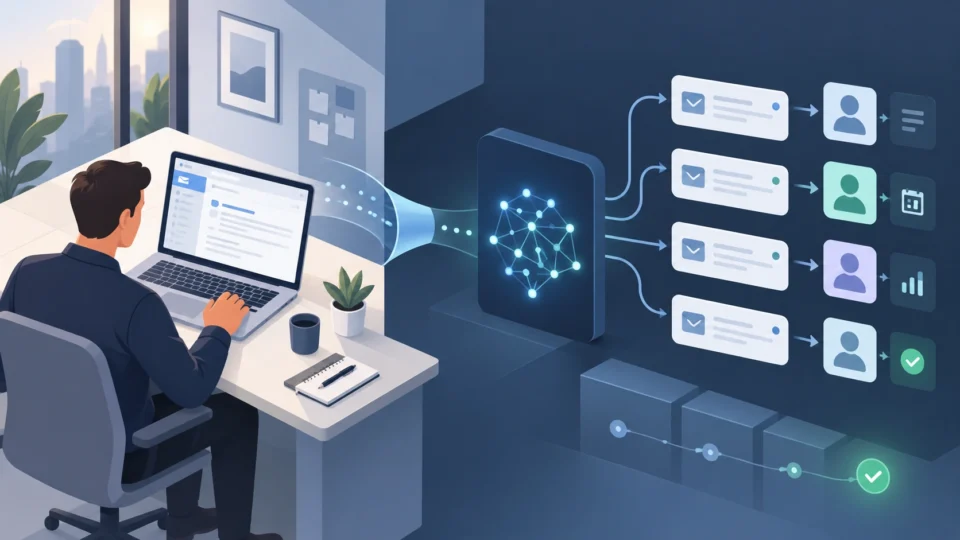
Every software category eventually gets its “will this replace the human job” moment, and outbound sales is having one right now. Vendors promise AI sales agents that find your ideal buyers, write personalized emails, chase people down without needing to be nagged, and hand you a booked meeting, all for a fraction of what a junior rep costs. Some of that’s real. A lot of it isn’t. And the gap between the pitch and what’s actually happening inside sales teams right now is wider than most vendors want you to notice.
So, let’s look at what these tools genuinely automate well, where they quietly break things, what they cost, and whether handing prospecting over to one makes sense in 2026.
What Is an AI Sales Agent, truly?
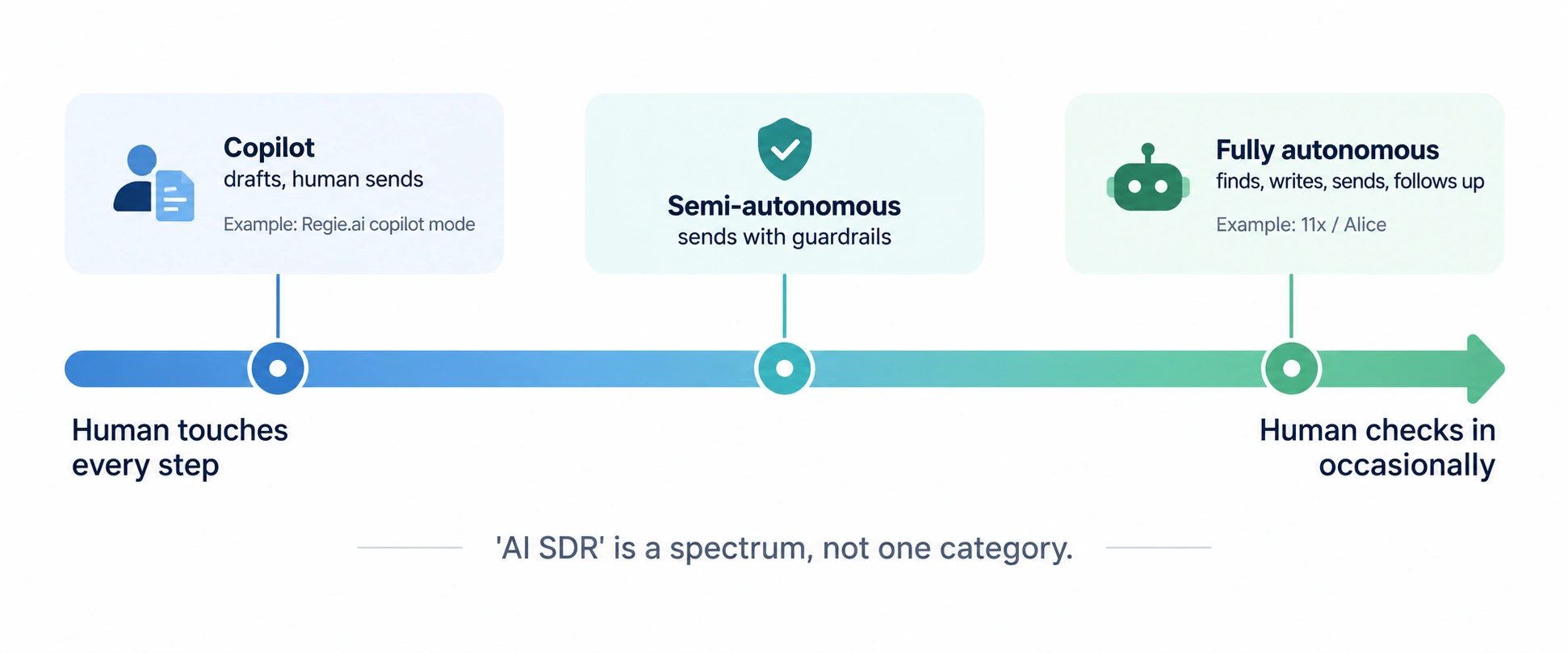
Strip away the pitch deck and an AI sales agent is software doing SDR-style work: finding prospects, researching them, writing outreach, sending it, following up. How much of that a human still touches varies wildly, and that range matters more than any feature comparison chart will show you.
Some tools are copilots. They draft an email, human hits send. Others are genuinely autonomous, they find the account, write the message, send it, run the follow-up sequence, and no human touches a single step. “AI SDR” isn’t really one category. Think of it as a spectrum instead. Regie.ai in copilot mode sits on one end, drafting content a rep reviews before it goes anywhere. 11x’s Alice sits on the other, running full campaigns with a human checking in occasionally rather than approving every send. Knowing where a vendor actually sits on that line tells you more than their feature list ever will.
AI SDR: What the Category Looks Like Right Now
The market’s split into three rough camps. Fully autonomous platforms (11x, Artisan) running the whole pipeline, priced accordingly at $1,500 to $5,000+ a month or more. Semi-autonomous services (AiSDR) that send but keep more guardrails around it, usually $750 to $2,500 monthly. There are three copilot layers: Regie.ai, Apollo’s Jason AI, and Reply.io. They bolted onto tools a team already uses, priced per seat, built to speed up a human rather than replace one.
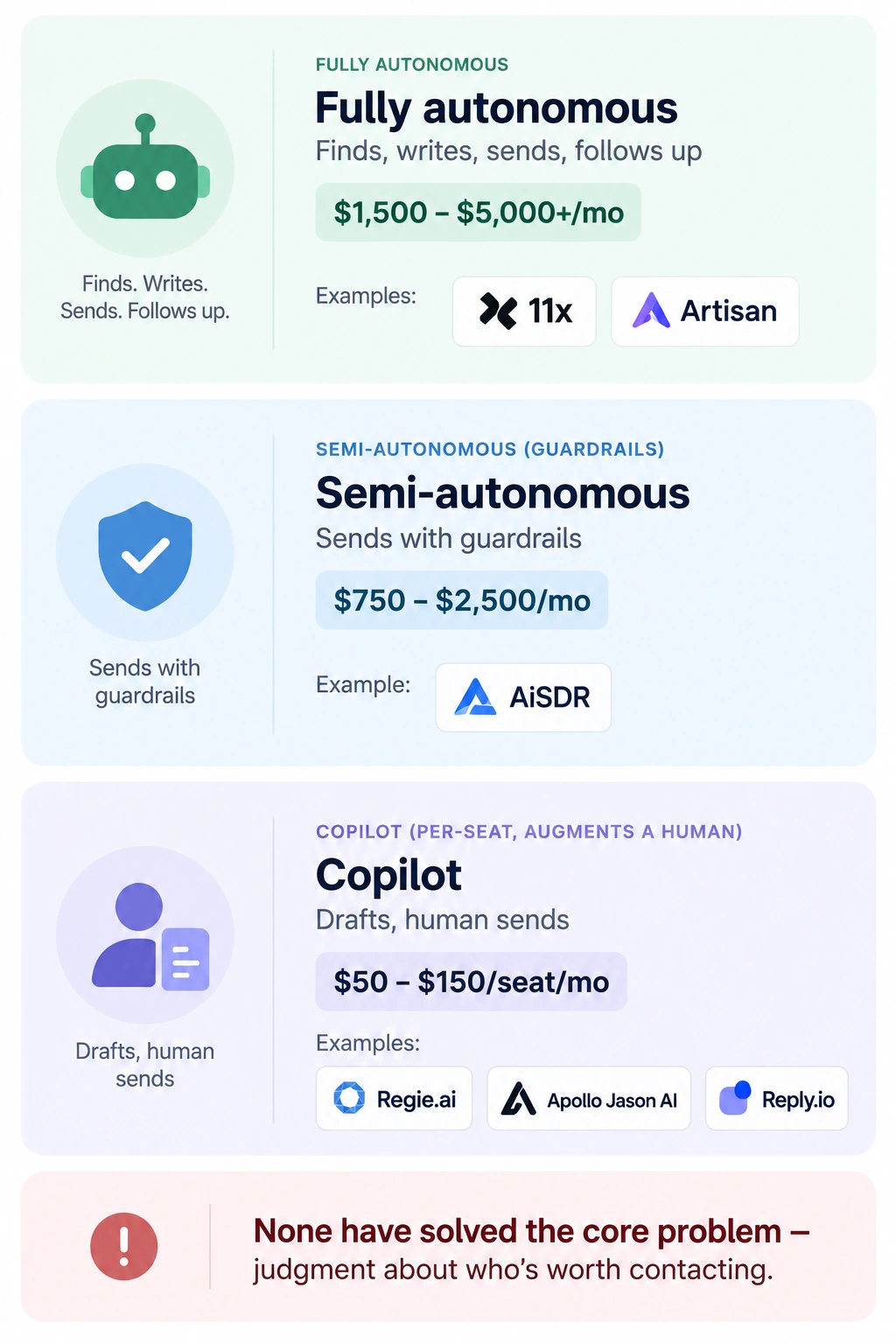
None of these three camps have actually solved the core problem yet. It’s worth saying that plainly instead of dancing around it. Good prospecting needs judgment about who’s genuinely worth contacting. AI right now is much better at generating volume than exercising that judgment. That gap is where most of the category’s problems live.
Prospecting: Where AI Genuinely Earns Its Keep
Finding the right accounts is where AI prospecting actually pulls its weight. Clay and Apollo pull from huge contact and firmographic databases, then layer on intent signals, hiring activity, funding rounds, tech stack changes, to flag accounts that look ready to buy instead of just accounts matching a static filter. That beats a rep scrolling LinkedIn Sales Navigator for three hours, no argument there.
But signal-based targeting only works if the signals actually mean something, and a lot of intent data is noisier than the vendors let on. One audit across 14 B2B SaaS sales orgs found agentic prospecting fed by intent-data inputs running a 31 to 47% false-positive rate. Meaning: nearly half the accounts flagged as “in-market” weren’t. Feed the system noisy signals and you just get expensive, confident-sounding noise back.
Research: The One Part That’s Genuinely Solved
This is where these tools have clearly beaten manual work, no real debate. Pulling a prospect’s job history, recent LinkedIn activity, company news, tech stack, and turning it into a usable brief used to eat 15-20 minutes per prospect for a human researcher. Tools built on enrichment layers like Clay do this in seconds now, and the accuracy on basic firmographic facts, company size, industry, funding stage, holds up well.
Where it gets shakier is anything requiring actual interpretation. An AI can tell you a company raised a Series B six weeks ago. What it can’t reliably tell you is whether that means they’re expanding headcount or freezing spending while they figure out how to deploy the money responsibly. That distinction is exactly the kind of judgment call still needing a human eyeballing it before it drives outreach.
Personalization: Convincing on the Surface, Thin Underneath
AI personalization has gotten noticeably better at sounding specific. “Saw you’re scaling your support team after the Series B” reads like real research went into it. The problem shows up at scale. Once an AI’s writing a thousand of these a week, patterns emerge that a human reader clocks almost unconsciously. It happens even when they can’t quite say why an email feels off.
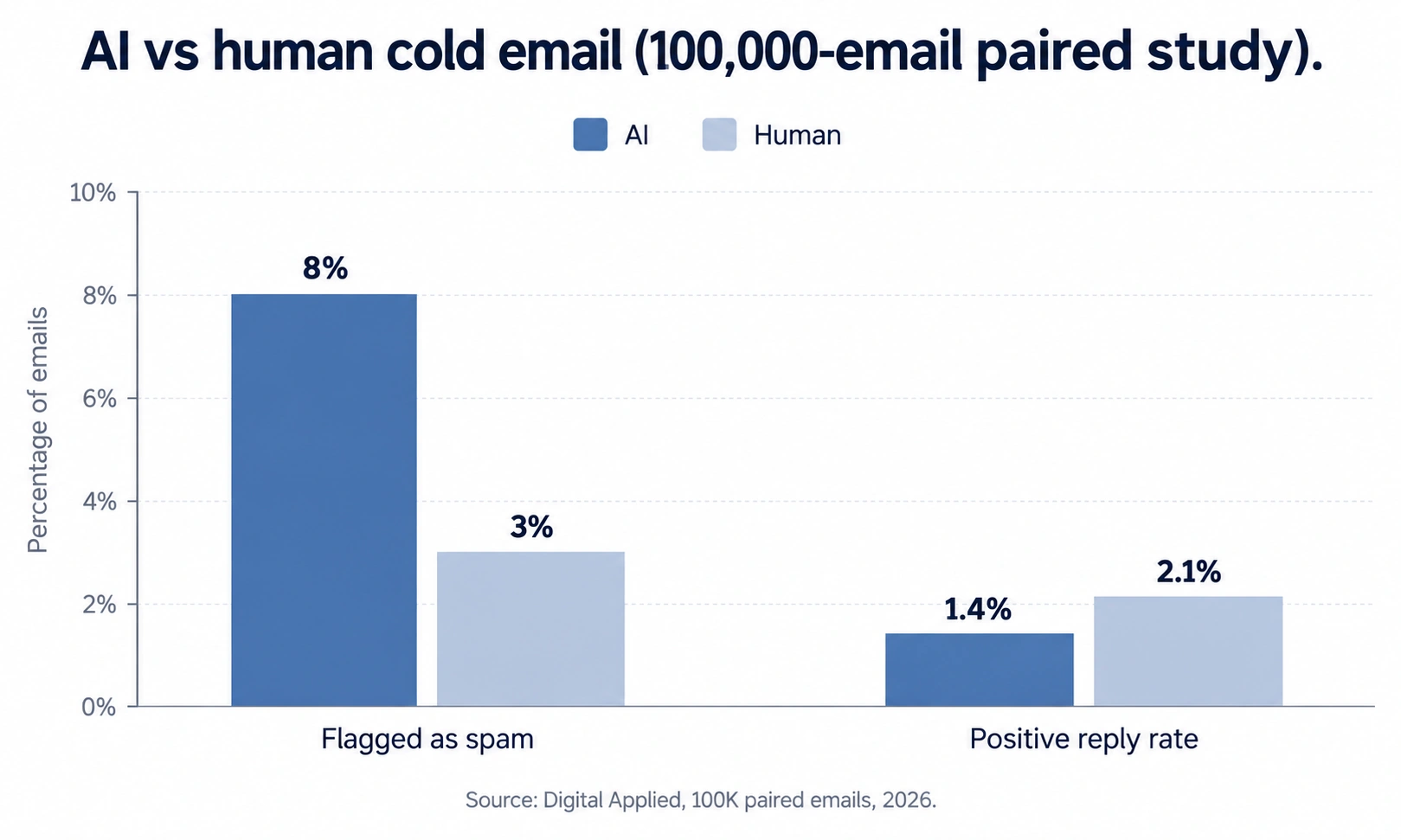
A 100,000-email paired study (50,000 AI-generated, 50,000 human-written, matched on persona and sequence stage) found AI emails getting flagged as spam around 8% of the time, against 3% for human-written ones. Optimistic reply rates told the same story: 1.4% AI versus 2.1% human. That’s a real gap on the metric that actually matters, not just raw response count.
Outreach: Where Vendors Undersell the Risk
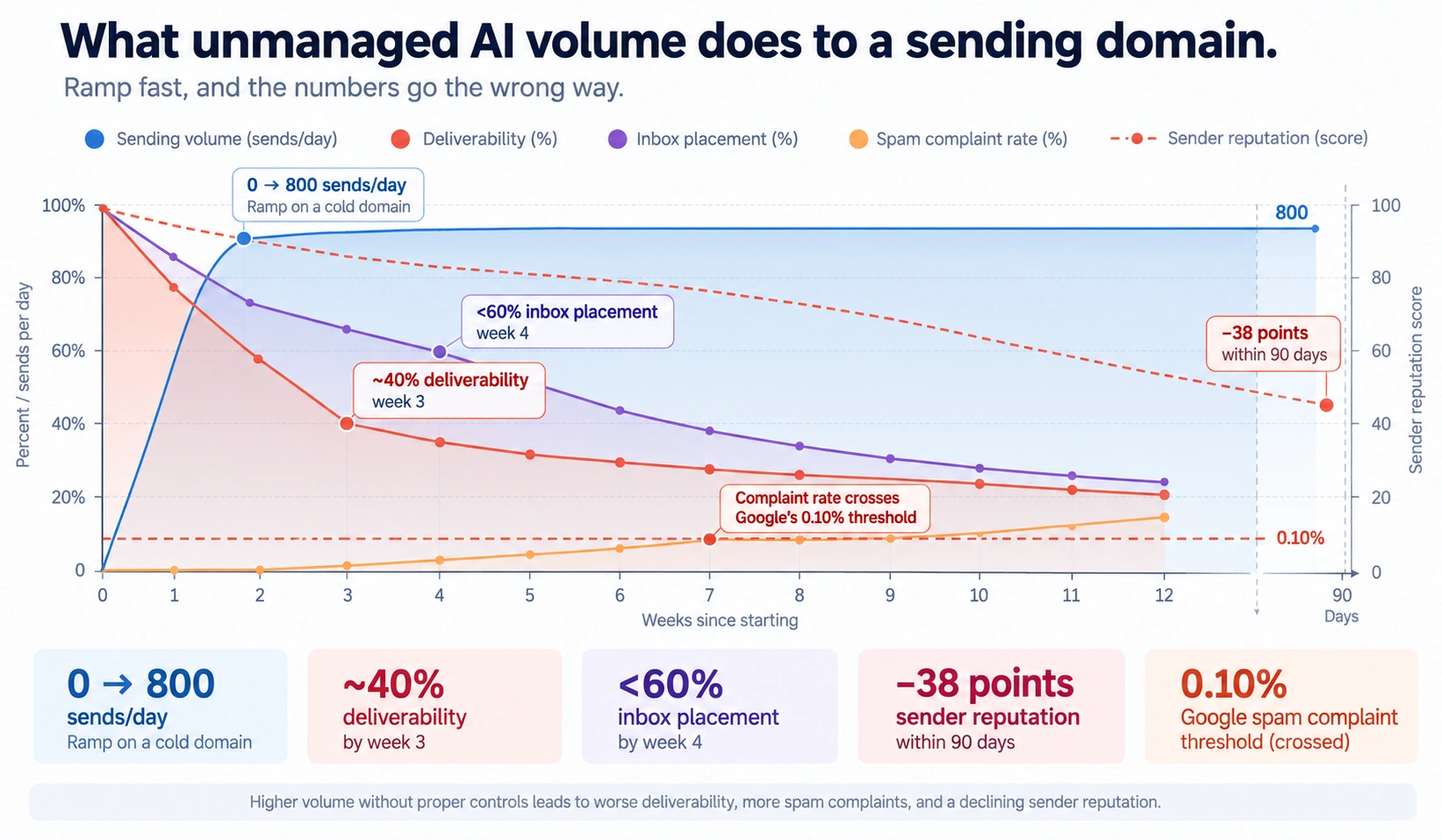
This is the part that’s actually damaged the category’s reputation. Automated sales agents are built to send at volume, and volume happens to be exactly what spam filters at Google and Microsoft are trained to catch. One tracked deployment went from zero to 800 sends a day on a cold domain. Deliverability collapsed to 40% by week three. Recovery took eight weeks and a brand new domain.
That pattern shows up over and over across independent studies: sender reputation dropping roughly 38 points within 90 days of scaling to AI-agent volume, inbox placement falling below 60% by week four in the worst cases, complaint rates blowing past Google’s 0.10% threshold well before anyone notices something’s gone wrong. A sending domain takes years to build trust. It takes about a quarter of unmanaged AI outbound to wreck it completely.
Follow-Up: Actually Reliable, for Once
Unlike prospecting or personalization, automated follow-up is a genuinely mature use case, this is where the technology has caught up to the pitch. An agent remembering to nudge someone on day 3, day 7, and day 14, adjusting tone based on whether the first email got opened, stopping the second someone replies, that’s exactly the kind of repetitive, rules-based task software should own. Reps forget to follow up constantly. Software doesn’t forget, ever.
One catch worth noting though. Follow-up quality only rides as high as what happened first. A well-timed nudge on top of a generic opening email doesn’t fix a bad first impression. It just annoys the same person a second and third time.
Qualification: Still a Filter, Not a Judge
AI agents handle basic qualification decently, checking company size, industry, job title against your ICP, and routing obvious mismatches out before a human ever sees them. Genuine time saver, worth having.
What they’re still bad at is the nuanced call a real SDR makes on a discovery conversation. Does this person actually control budget, or are they just curious? Is the timeline really this quarter, or did they say that to get a rep off the phone politely? That kind of read still needs a live conversation, which is exactly why most serious deployments route a qualified lead to a human for that step rather than letting the AI book the meeting on its own.
CRM: The Integration Layer Nobody Talks About
An AI agent that isn’t logging activity back into your CRM properly is quietly creating a data problem that outlives whatever pipeline it generates. The stronger platforms, Regie.ai, Apollo, Artisan, sync replies and qualification data into Salesforce or HubSpot automatically, and that matters a lot for forecasting accuracy down the road.
The failure mode here is subtle and easy to miss until it’s already caused damage: duplicate contact records, lead scoring in the AI tool that doesn’t match what your CRM’s own model expects, activity logs that don’t look like what a human rep would’ve recorded. If you’re evaluating a platform, ask specifically how bidirectional the sync actually is. Don’t just confirm an integration exists and assume that settles it.
Failure Points: The Numbers Vendors Leave Off the Landing Page
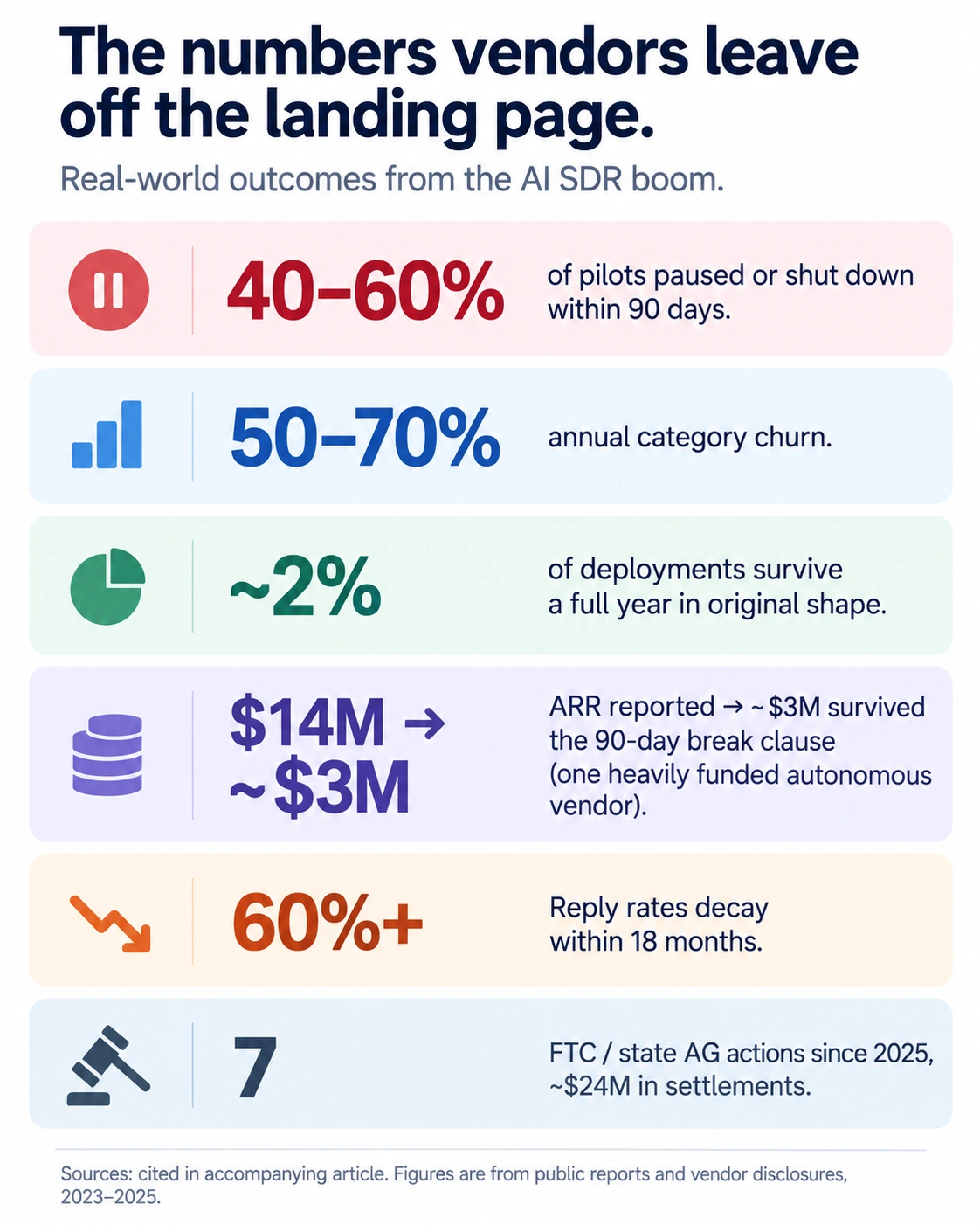
Worth its own section, because the reality here is rougher than most buyers expect walking in. Somewhere between 40 and 60% of AI SDR pilots get paused or shut down within 90 days. Annual churn across the category runs 50 to 70%, meaning roughly 2% of deployments actually survive a full year in their original shape. One heavily funded autonomous vendor reported around $14 million in ARR. Only about $3 million of that survived once customers actually tested the 90-day break clause against real performance.
The mechanism behind most of these failures is consistent, and it’s almost boring in how predictable it is. Teams scale send volume faster than their deliverability infrastructure can handle. Reply rates fall as recipients start pattern-matching the AI’s prose and cadence, decaying more than 60% within 18 months as that recognition sets in. Nobody notices domain reputation cratering until pipeline’s already dried up and someone finally checks. There have also been 7 FTC and state attorney general actions around AI-outreach claims since 2025, with settlements totaling roughly $24 million. Regulators are paying closer attention to this space than the marketing suggests.
Human + AI: What Actually Works Right Now
Teams getting real results aren’t running fully autonomous outbound, full stop. They’re running a hybrid: AI handles research, enrichment, and drafting, a human review before anything sends, and targeting stays signal-based instead of list-based. One comparison of signal-triggered workflows against untargeted AI-volume sending found the signal-based approach hitting a 2.3% positive reply rate (above the 2.1% human baseline) while sending a fraction of the volume, against 1.1-1.3% for untargeted autonomous sending running roughly 7,360 emails per rep per month.
What this actually means in practice: AI’s excellent at removing grunt work, research, drafting, sequencing, logging, and genuinely bad at replacing the judgment calls that decide whether outbound lands well or lands in spam. Keep a human at the decision points, sending, qualifying, reading ambiguous signals, and these tools earn their cost. Pull the human out entirely and mostly what you’ve bought is a faster way to torch a sending domain.
What This Actually Costs
Pricing swings wildly depending on how autonomous the tool really is:
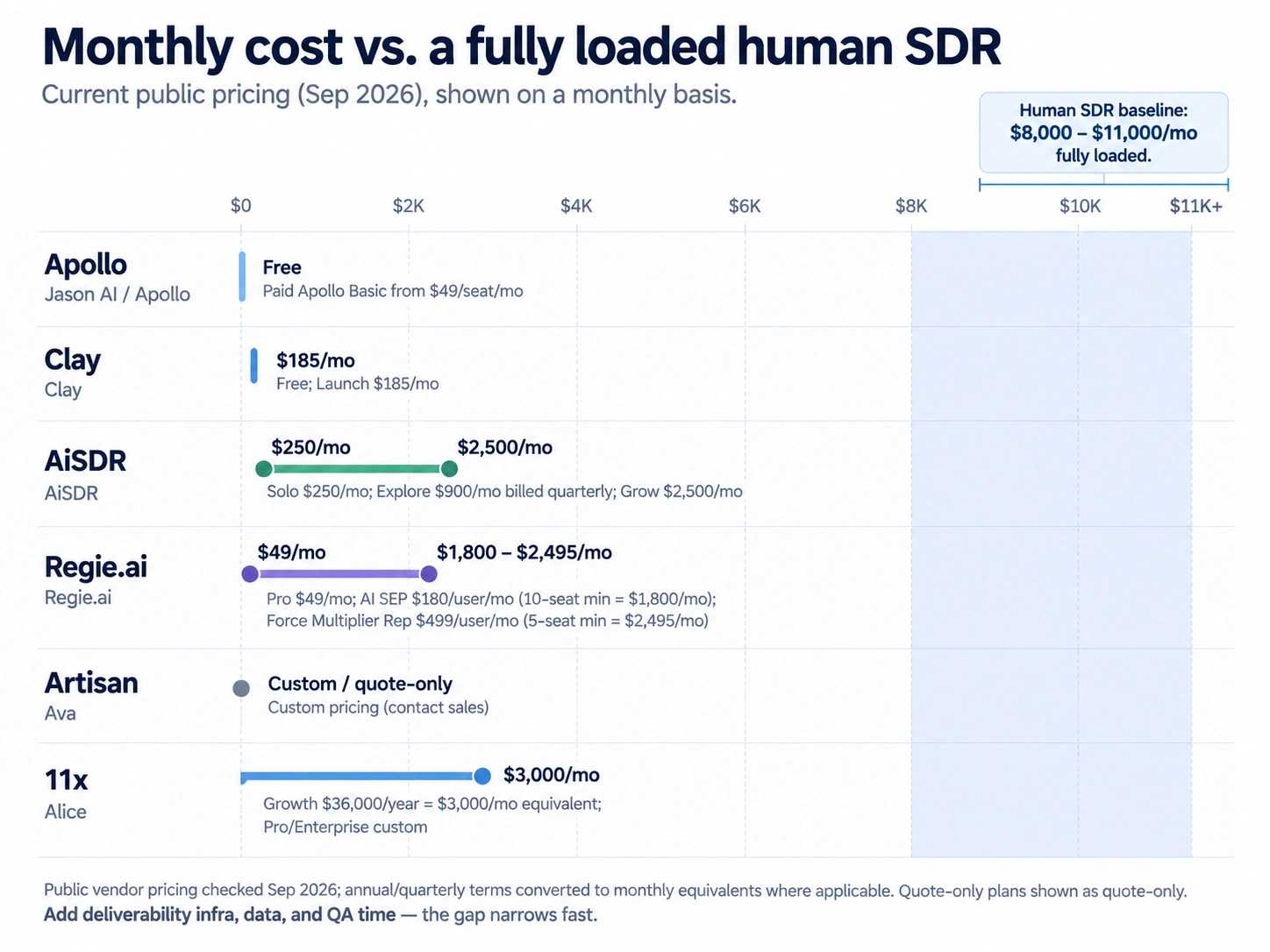
– Regie.ai: $59-$89/seat/month for the copilot and content tier; the Force Multiplier autonomous tier runs $180-$499/seat/month with a 5-10 seat minimum, so real entry cost lands around $1,800-$2,500/month
– AiSDR: $250/month (Solo, 200 contacts) up to $2,500/month (Grow/Scale), quarterly billing, the shortest commitment in the category by a wide margin
– 11x (Alice)*: Roughly $3,750-$5,500/month billed annually, though real-world costs (per Vendr data) tend to land closer to $40,000+/year once negotiated terms come into play
– Apollo.io (Jason AI): Free tier available; paid plans from roughly $49/seat/month, the most affordable entry points that bundles both data and a copilot layer
– Clay: From about $149/month for the data orchestration layer that a lot of the other tools on this list actually run on top of
– Artisan (Ava): Published tiers start at $1,500/month for 1,000 outbound contacts, climbing to $3,000+/month for 3,000, generally on annual contracts
A sanity checks worth doing before signing anything: a fully loaded human SDR usually runs $8,000-$11,000/month once salary, benefits, and tools are counted. Most AI SDR platforms come in well under that on paper. But once you add the deliverability infrastructure, the data costs, and the QA time a real deployment needs, that gap narrows a lot faster than the pricing page implies.
Tools Worth Knowing in 2026
Copilot layer: Regie.ai and Apollo’s Jason AI. Best fit if AI drafting and sequencing sounds right, but you still want a human hitting send.
Data and orchestration layer: Clay, which powers a lot of the enrichment and signal data behind the tools above.
Bundled into an existing CRM: HubSpot’s Breeze Prospecting Agent (roughly $1 per recommended lead, needs Sales Hub Starter or above) and Salesforce’s Agentforce SDR agent (consumption-priced, needs Data Cloud). Worth a look if you’re already deep in either platform and would rather the AI layer be native than bolted on from outside.
Semi-autonomous, guardrails included: AiSDR, the lowest-commitment entry point out there and the only major platform still offering quarterly billing instead of annual lock-in.
Fully autonomous: Artisan (Ava) and 11x (Alice). Highest cost, highest risk tier, best suited to teams that already have deliverability infrastructure sorted and a genuine appetite for testing rather than an expectation of guaranteed results.
Implementation: How to Roll This Out Without Torching Your Domain
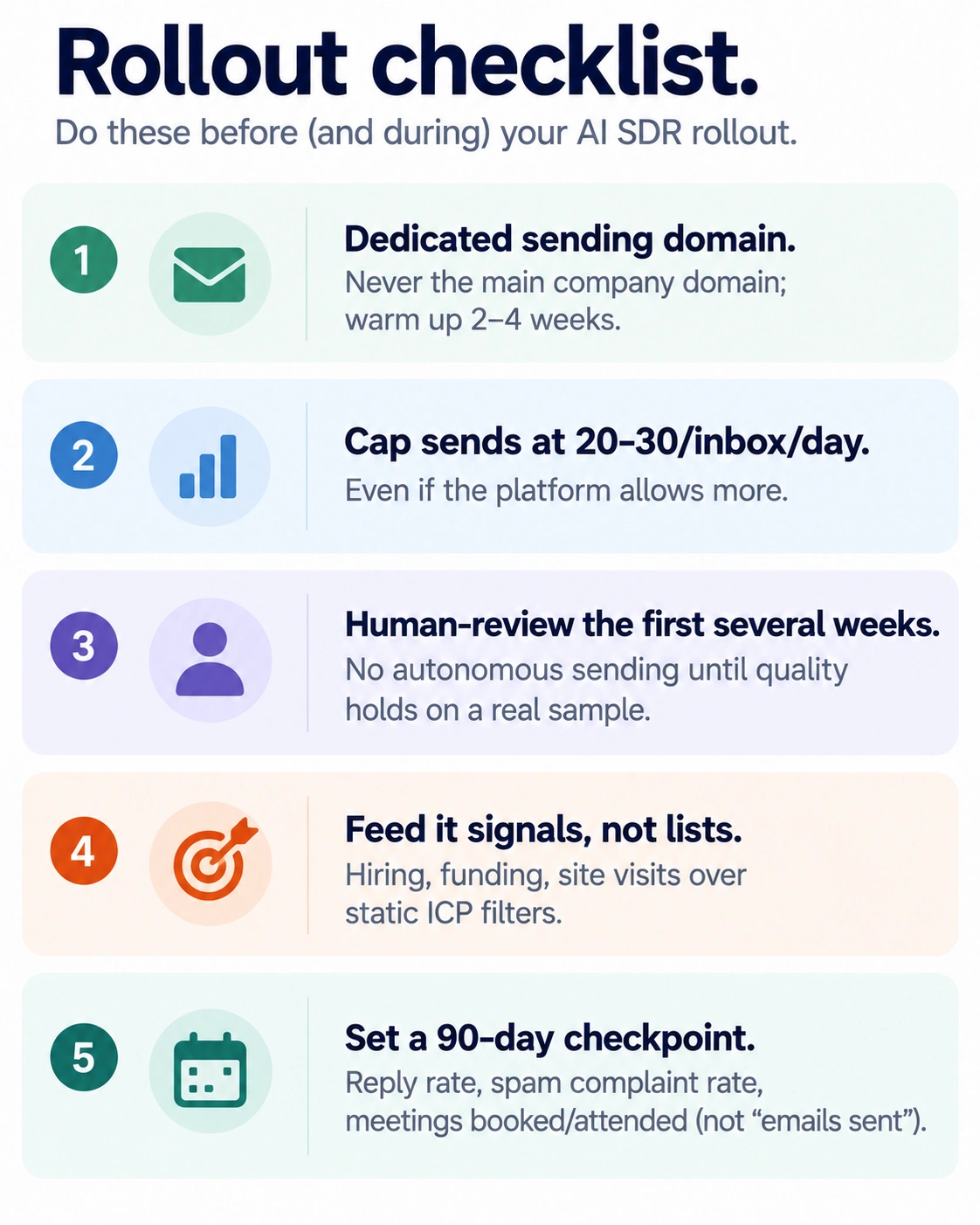
- Start with a dedicated sending domain, never your main company domain, and warm it up for 2-4 weeks before any agent touches real volume.
- Cap sends per inbox at 20-30 a day, even if the platform technically allows more, and check your Google Postmaster Tools reputation score weekly, not monthly, that cadence matters.
- Have a human review the first several weeks of AI-drafted messages before anything goes out, and don’t flip on fully autonomous sending until you’ve seen consistent quality across a real sample, not a demo.
- Feed it signals, not just lists. Hiring activity, funding events, and website visits produce noticeably better reply rates than a static ICP filter run against a purchased list.
- Set a 90-day checkpoint with actual numbers on the table, positive reply rate, spam complaint rate, meetings booked and attended, not just “emails sent” as a vanity metric. Most pilots that fail do so because nobody set this checkpoint up front, and the problems just compounded quietly for months until someone finally looked.
FAQs
Q. Can AI sales agents fully replace an SDR in 2026?
A. Not reliably, not yet. They’re genuinely strong at research, drafting, and follow-up sequencing, but qualification judgment and deliverability management still need a human in the loop, and the platforms skipping that oversight are exactly the ones turning up in the 40-60% pilot failure numbers.
Q. Is 11x or Artisan worth paying more for over AiSDR or Regie.ai?
A. Only if you already have the deliverability infrastructure and internal bandwidth to manage a fully autonomous system closely. Both are priced and built for larger outbound operations, and the higher price tag doesn’t actually buy you lower risk of the same volume-driven failures smaller platforms run into.
Q. How would I know if my AI SDR setup is already causing damage?
A. Watch your Google Postmaster Tools sender reputation score and spam complaint rate weekly. A reputation score sliding to “Low,” or a complaint rate above 0.10%, shows up well before reply rates visibly tank, so those two numbers are your early warning, not the pipeline report.
Q. Is AI lead generation actually cheaper than hiring an SDR?
A. On the sticker price, usually yes. Once you count deliverability infrastructure, data subscriptions, and the QA time a real deployment needs, the gap between an AI sales agent and a fully loaded human SDR shrinks more than most pricing pages let on.
Q. What’s the cheapest way to test AI sales automation without a big commitment?
A. AiSDR’s quarterly billing, starting around $750-$925/month, is the lowest-risk entry point in this category. Most other serious platforms lock you into annual contracts from day one.
Q. Why do these tools get flagged as spam so much more than a human-sent email?
A. Mailbox providers like Google and Microsoft train their filters to catch template homogeneity and sudden volume spikes, which is exactly what unmanaged AI outreach produces. AI-written cold email gets flagged as spam at roughly 8% versus 3% for human-written email in independent testing.

Praveen Kumar Panjiar is the founder of CompareBizTech.com, where he cuts through the noise in B2B tools with sharp, no-fluff comparisons. His work focuses on breaking down features, pricing, and real-world use cases, built specifically for high-intent buyers evaluating tools and looking to choose the right solution, fast.