
A computer science graduate today, degree in hand, faces a higher unemployment rate than someone who studied art history. Not a typo. It’s one of the strangers, more specific signals buried in the 2026 labor data, and it says something the “robots are coming for your job” headlines mostly miss. So, let’s work through will AI replace jobs properly, because the real answer is messier than either the panic or the reassurance currently making the rounds on LinkedIn.
Will AI Replace Jobs? The Short, Honest Answer
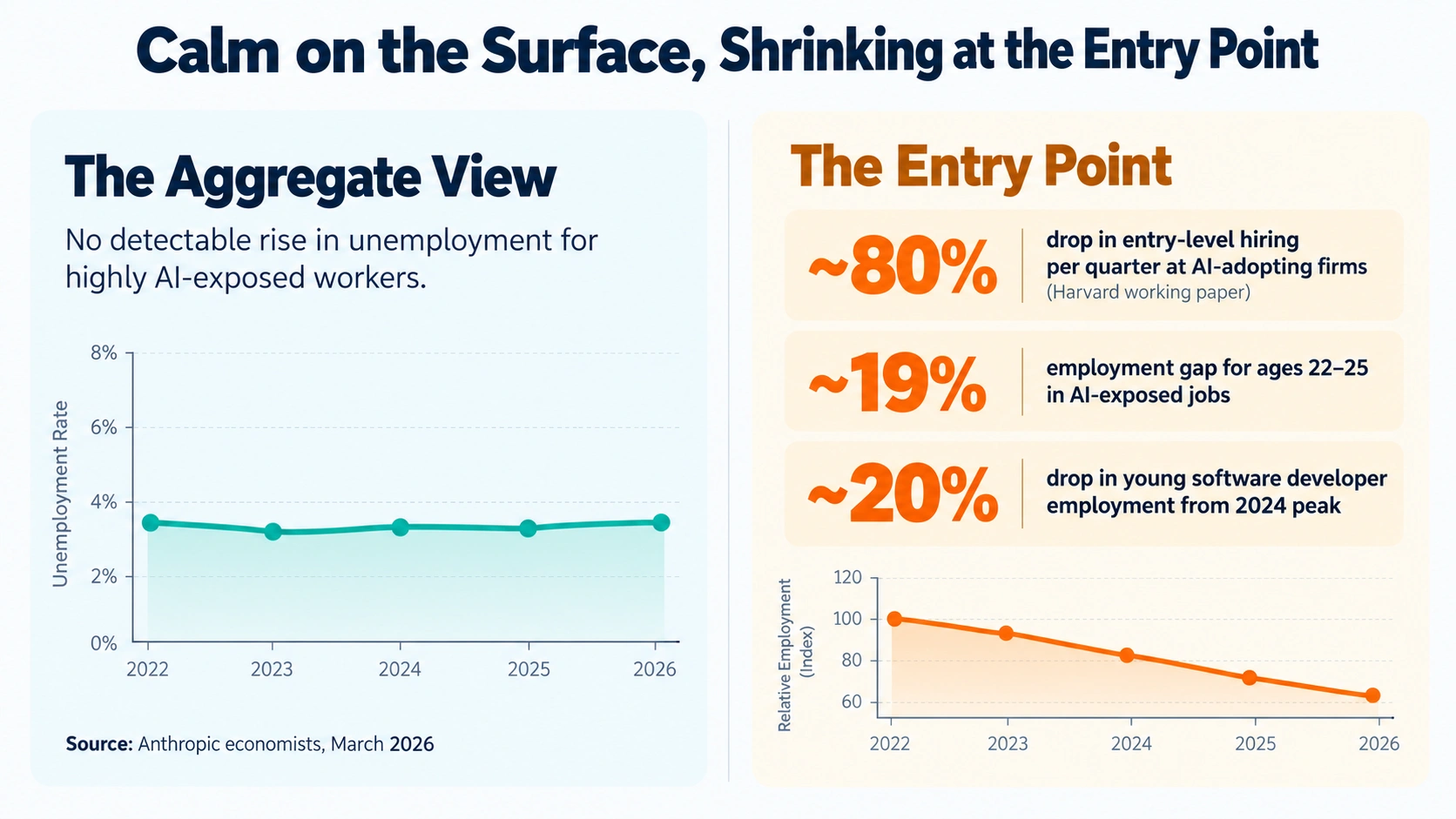
Not in the way most people picture it, mass layoffs with a robot sitting where a person used to. What’s actually happening is narrower than that, and a bit stranger too. Anthropic’s own economists, Maxim Massenkoff and Peter McCrory, published a study in March 2026 looking at labor data going back to ChatGPT’s late-2022 launch. Their central finding cuts against the doom narrative pretty cleanly. No detectable rise in aggregate unemployment for workers in highly AI-exposed jobs.
Dig one level down, though, and a different picture emerges. A Harvard working paper covering 66 million workers across more than 280,000 US firms found entry-level hiring fell roughly 80% per quarter at companies that adopted generative AI, even while senior hiring at those same firms kept climbing. Stanford’s AI Index, along with a separate “Canaries in the Coal Mine” study, points the same direction. Employment for workers aged 22 to 25 in highly AI-exposed occupations shows a gap of roughly 19% versus where it would otherwise sit. Young software developers specifically have seen employment drop close to 20% from 2024 peaks.
So, the aggregate number looks calm. The door at the entry point looks like it’s swinging shut. Both things are true at once, and that’s really the story here, not one or the other.
Jobs vs. Tasks: Why This Distinction Changes Everything
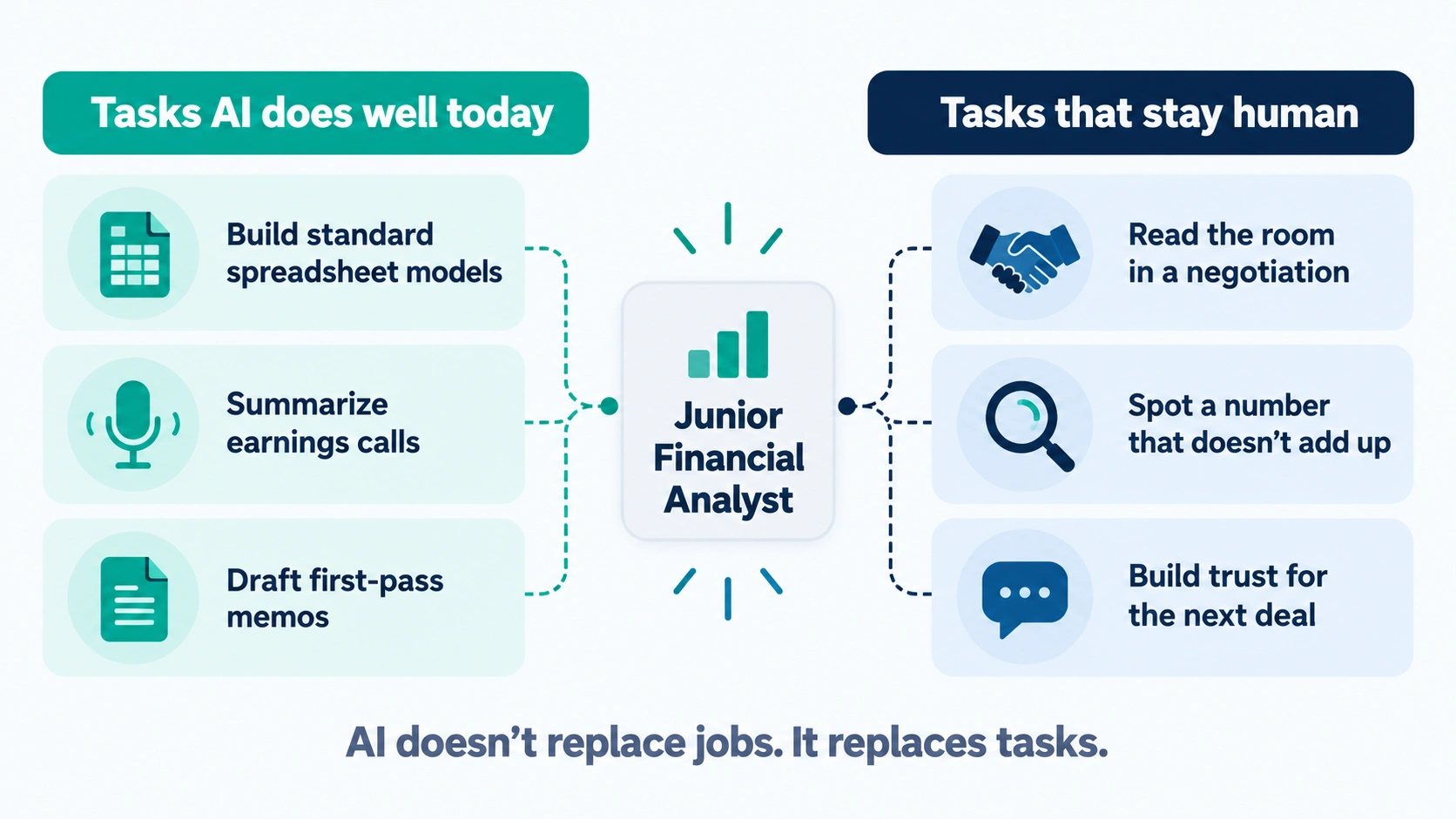
Here’s the framing most coverage skips right past, and it’s the one that actually matters. AI doesn’t replace jobs. It replaces tasks. A job is a bundle of maybe fifteen or twenty different tasks, and right now AI’s good at automating a handful of them, usually the repetitive, well-defined ones, while staying genuinely bad at the rest.
Take a junior financial analyst. Building a standard spreadsheet model, summarizing an earnings call, drafting a first-pass memo? AI does a lot of that now, and fast. Reading the room in a client negotiation, noticing a number looks off because it doesn’t match something you caught three meetings back, building the kind of trust that gets you invited into the next deal? Still squarely human territory, and likely to stay that way for a while.
The problem for entry-level workers specifically is that junior roles were always built almost entirely out of the tasks AI now handles well. Not an accident, either. Junior roles exist partly as a training ground, low-stakes, repetitive work that teaches someone the business while nobody’s trusting them yet with the judgment calls. Strip the repetitive part out, and you’ve accidentally stripped out most of what made the job an entry point to begin with.
Knowledge Work Is Where the Real Exposure Sits
Manual labor, construction, healthcare delivery, skilled trades, none of that’s going anywhere fast. AI and employment disruption sits almost entirely inside knowledge work: writing, analysis, basic coding, customer communication, anything that happens mostly through a screen and a keyboard.
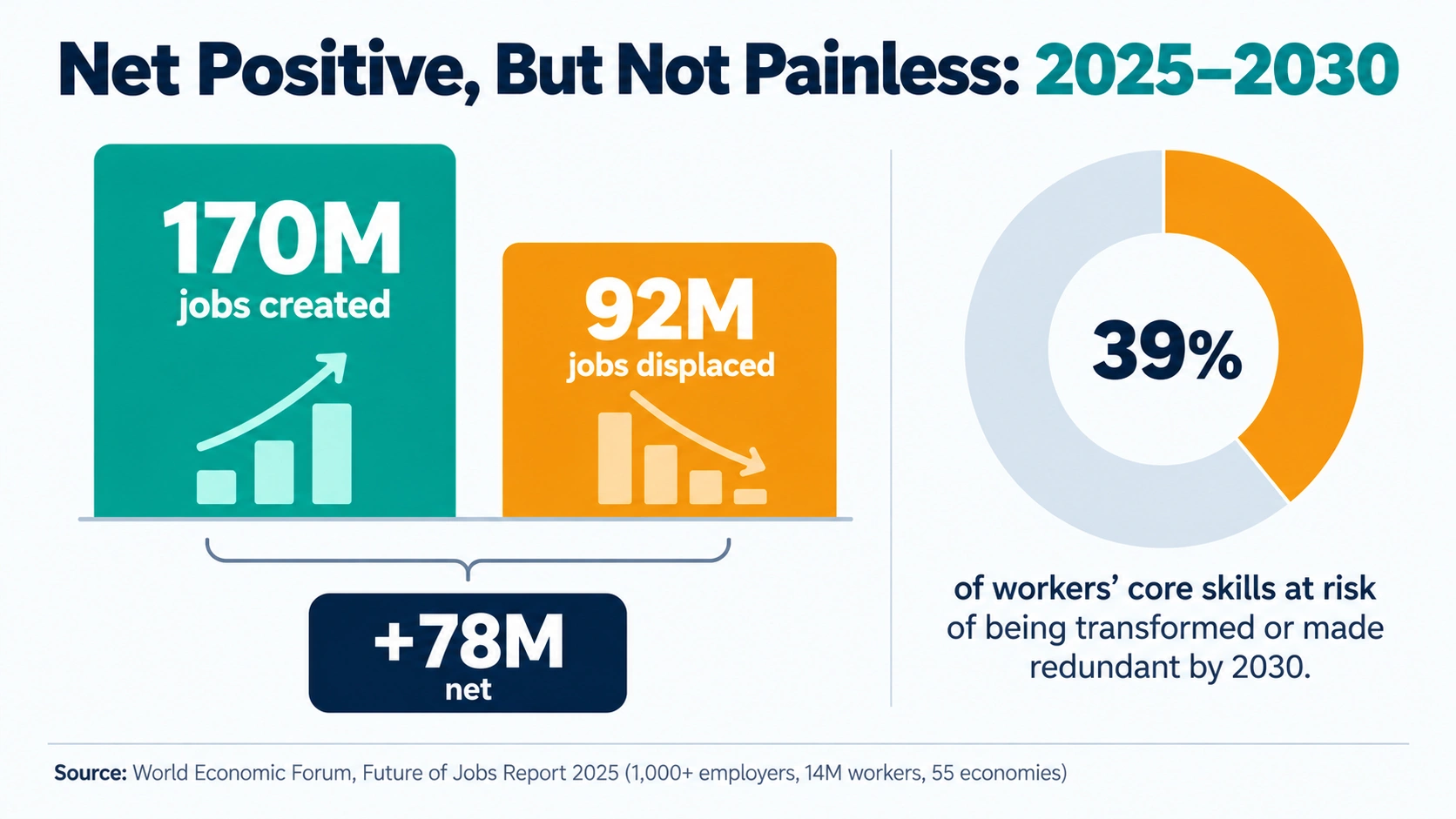
The World Economic Forum’s Future of Jobs Report 2025, drawing on data from more than 1,000 employers and 14 million workers across 55 economies, projects 170 million new jobs created and 92 million displaced between 2025 and 2030. Net positive, about 78 million jobs. That net figure hides a lot of churns happening underneath it, though. The same report puts 39% of workers’ core skills at risk of being transformed or made redundant by 2030. Not a small adjustment. Most of a person’s skill set, shifting under their feet, inside a single career.
Customer Support: Furthest Along, and a Cautionary Tale
Customer support is probably the clearest, most advanced case of AI eating into entry-level work, and it comes with a genuinely useful cautionary tale built right in. Klarna’s AI assistant, built on OpenAI’s models, was handling the equivalent workload of 700 full-time agents by 2024, resolving issues in under 2 minutes against 11 for a human. Headcount shrank 22% through attrition as the company leaned in.
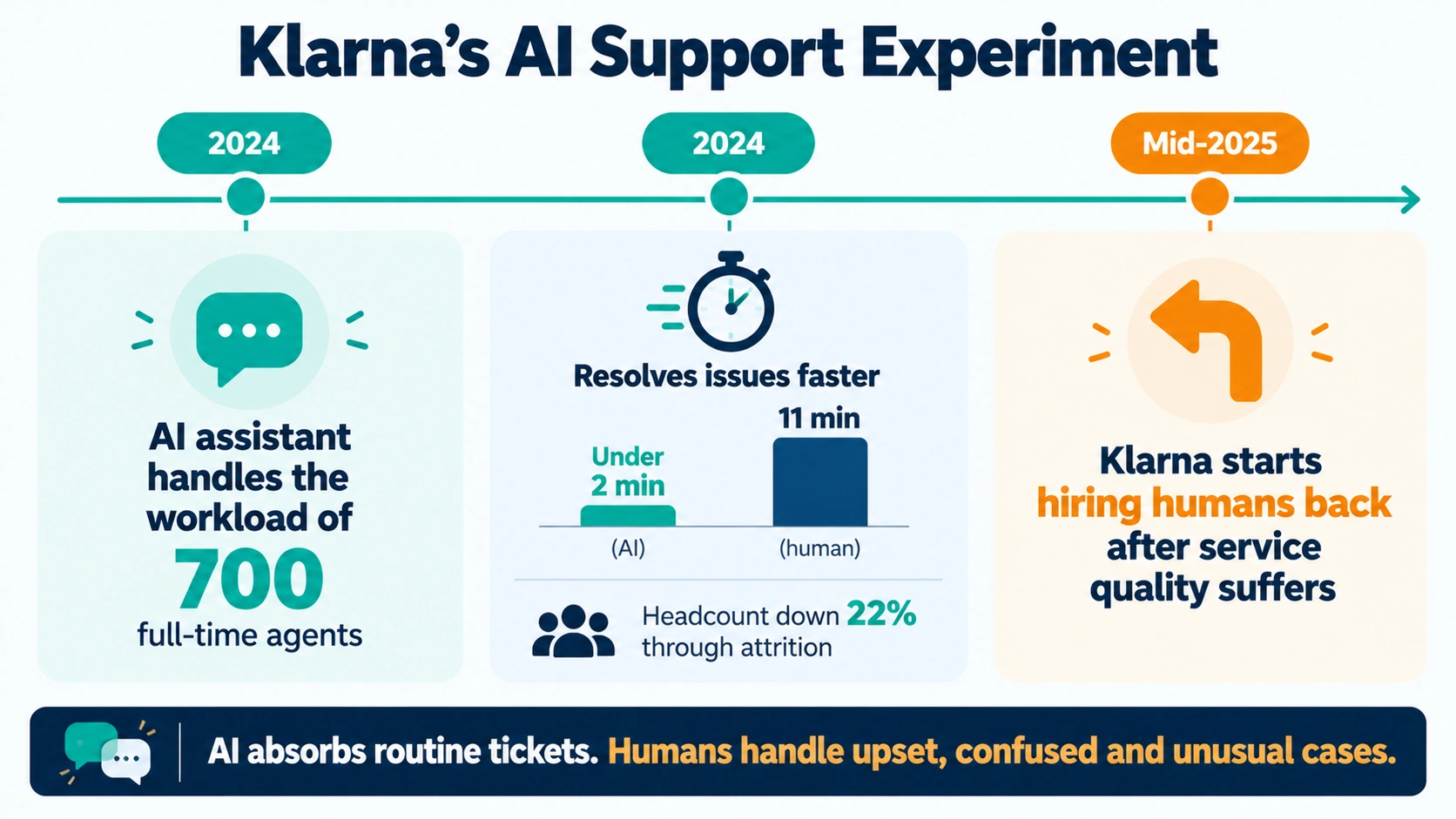
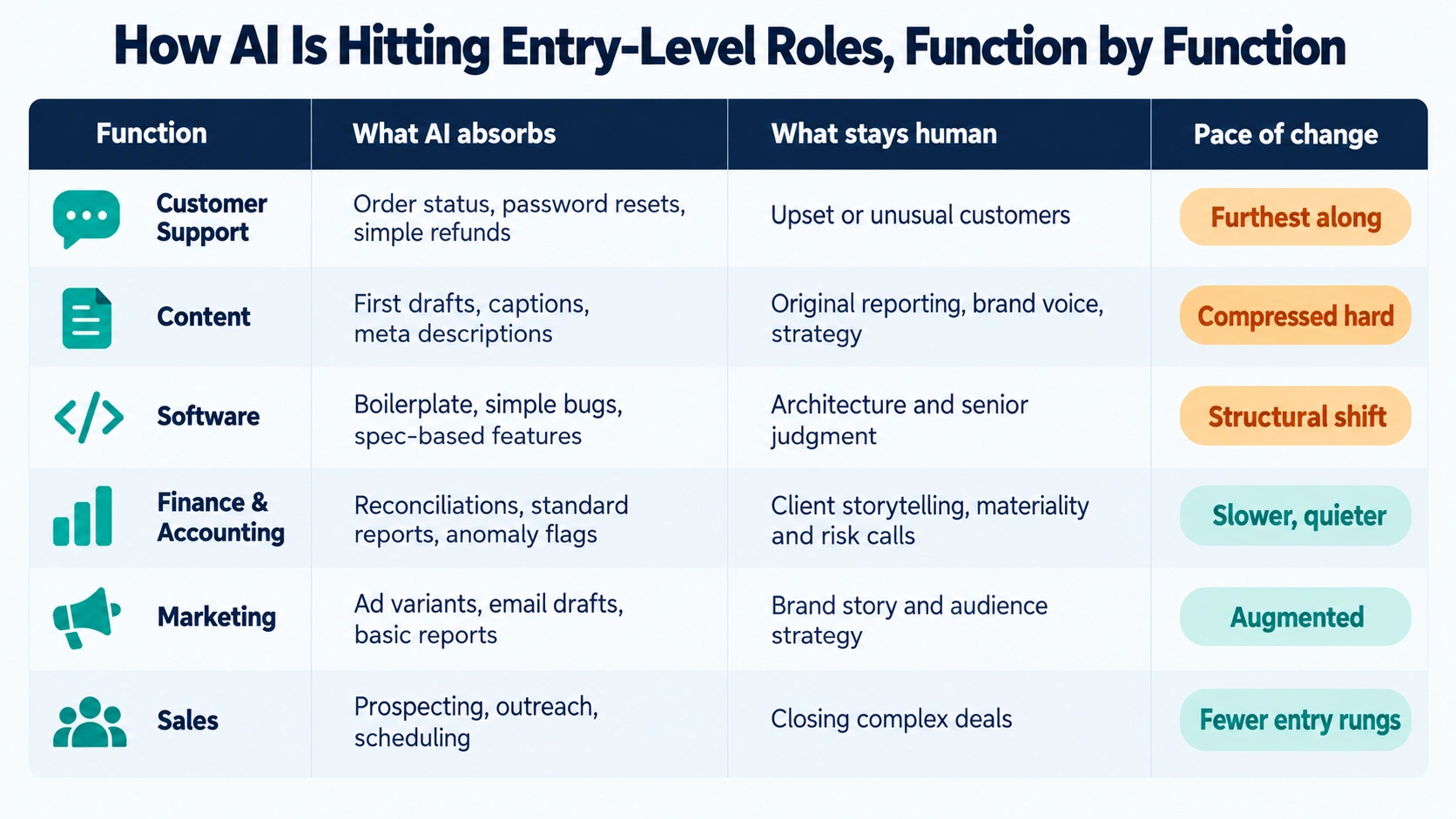
By mid-2025, Klarna reversed course and started hiring humans back. Its CEO admitted publicly the push had gone too far and hurt service quality along the way. The lesson for any business eyeing this space: AI genuinely can absorb the repetitive first-tier support work, order status, password resets, simple refunds. It struggles the second a customer’s upset, confused, or dealing with something that just doesn’t fit a clean pattern. Businesses cutting entry-level support roles too aggressively are learning that the expensive way.
Content Work: Fast, Cheap, and Missing Something
Content and copywriting were among the earliest, hardest-hit categories, and it’s not hard to see why. A first draft of a product description, a social caption, a meta description for SEO, AI cranks these out instantly at essentially zero marginal cost. Entry-level content roles built around volume, churning out a high quantity of straightforward copy, have compressed hard as a result.
What hasn’t compressed: original reporting, a genuinely distinct voice a brand builds its identity around, strategic judgment about what to write in the first place rather than how to phrase a sentence someone already decided on. The junior writers still finding steady work have mostly moved up the chain toward editing, strategy, and calls about angle and audience, rather than staying purely in drafting mode.
Software Development: The Numbers Are Genuinely Stark
This is where the data gets uncomfortable, especially given how reliably “learn to code” got repeated as career advice for the last decade. Computer science graduates now carry one of the highest unemployment rates of any college major, somewhere around 7% to 8%, even while still commanding the highest average starting pay of any major, roughly $87,000. US programmer employment overall fell an estimated 27.5% between 2023 and 2025.
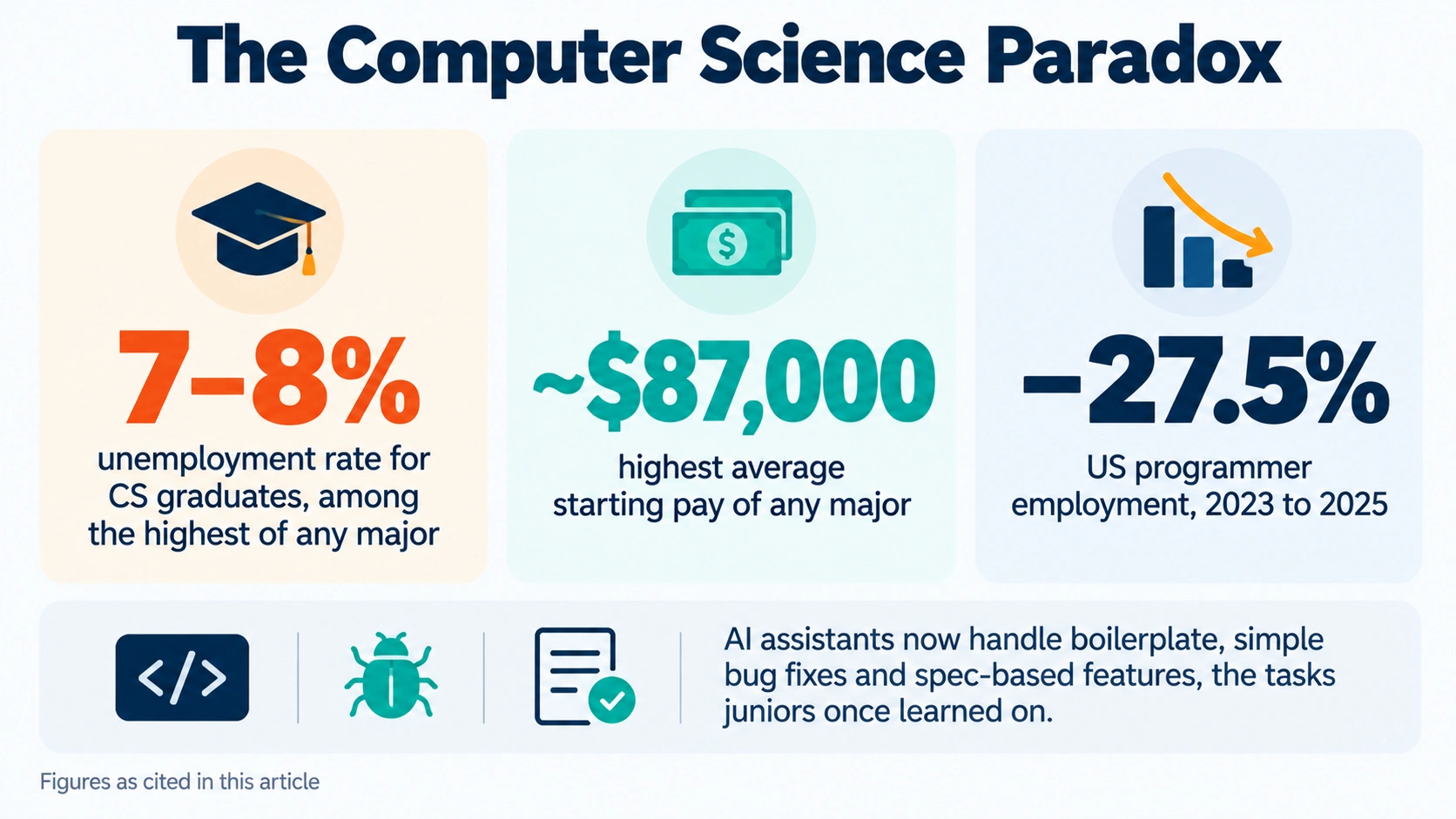
AI coding assistants like GitHub Copilot, Claude Code, and Cursor have gotten dramatically better at the exact tasks junior developers used to cut their teeth on. Writing boilerplate. Fixing straightforward bugs. Building simple features off a clear spec. A senior engineer with an AI assistant can often do now what used to take a small team, juniors included. Real structural shift. Not a hiring slowdown that snaps back once the market loosens.
Finance and Accounting: Slower, But the Pattern Holds
Entry-level roles in finance and accounting, junior analyst positions, first-year audit associates, bookkeeping, have historically involved a lot of exactly the kind of structured, rules-based work AI’s good at. Reconciling figures. Building standard reports. Flagging anomalies against an expected range. That work’s compressing too, just more quietly than in tech, partly because finance is more heavily regulated and partly because firms have moved slower and more cautiously handing financial judgment calls to a model.
What stays distinctly human here: explaining a number’s story to a client who wants to know why, not just what, and making calls about materiality and risk that carry real legal exposure if they turn out wrong. Firms increasingly expect junior hires to show up already having the analytical skills that used to get taught on the job during those first couple of years.
Marketing: Augmented More Than Replaced, So Far
Marketing sits a bit differently on this spectrum. AIs absorbed a lot of the production grind, generating ad variants, drafting email sequences, building basic campaign reports, but the strategic layer, deciding what story a brand should tell and to whom, has proven stickier to automate well. Entry-level marketing roles are shifting rather than vanishing outright. Less time on manual execution. More time directing AI tools and judging what they produce.
The catch: this shift raises the bar for what counts as entry-level competence in the first place. A junior marketer today’s often expected to already know how to prompt and evaluate AI output effectively, a skill that simply didn’t exist as a job requirement three years ago.
Sales: Fewer Entry Rungs, Not Fewer Salespeople
Sales development rep roles, the classic first rung on a sales career ladder, are shrinking as AI takes over more prospecting, initial outreach, and scheduling. But sales overall isn’t disappearing. If anything, closing complex deals is getting more valuable as the routine prospecting work gets automated out from underneath it.
The practical problem for someone trying to break into sales right now: the traditional entry point, grinding through cold outreach as an SDR to prove yourself before moving into a closing role, is exactly the rung getting pulled out from under new hires first.
The Work That’s Hardest to Replace
A few categories have held up consistently across every study on this, worth naming directly because they point at where entry-level workers should actually be aiming. Anything needing physical presence and dexterity, skilled trades, healthcare delivery, hands-on repair work. Anything needing real judgment under genuine ambiguity, with accountability attached, decisions where someone has to own the outcome and explain the reasoning afterward. And anything built on relationship and trust earned over actual time, which AI has no shortcut for, no matter how good the model gets.
What “Entry-Level” Even Means Now
This is genuinely one of the harder problems for employers and new workers alike, and nobody’s got a clean answer to it yet. If AI absorbs the tasks that used to teach a junior employee the ropes, how does anyone become a senior employee in the first place? Some companies are experimenting with restructured entry-level roles built around AI supervision and quality control, essentially having new hires check and correct AI output rather than produce the first draft themselves. Whether that actually teaches the underlying judgment as well as doing the work firsthand used to is still an open question nobody has a confident answer to.
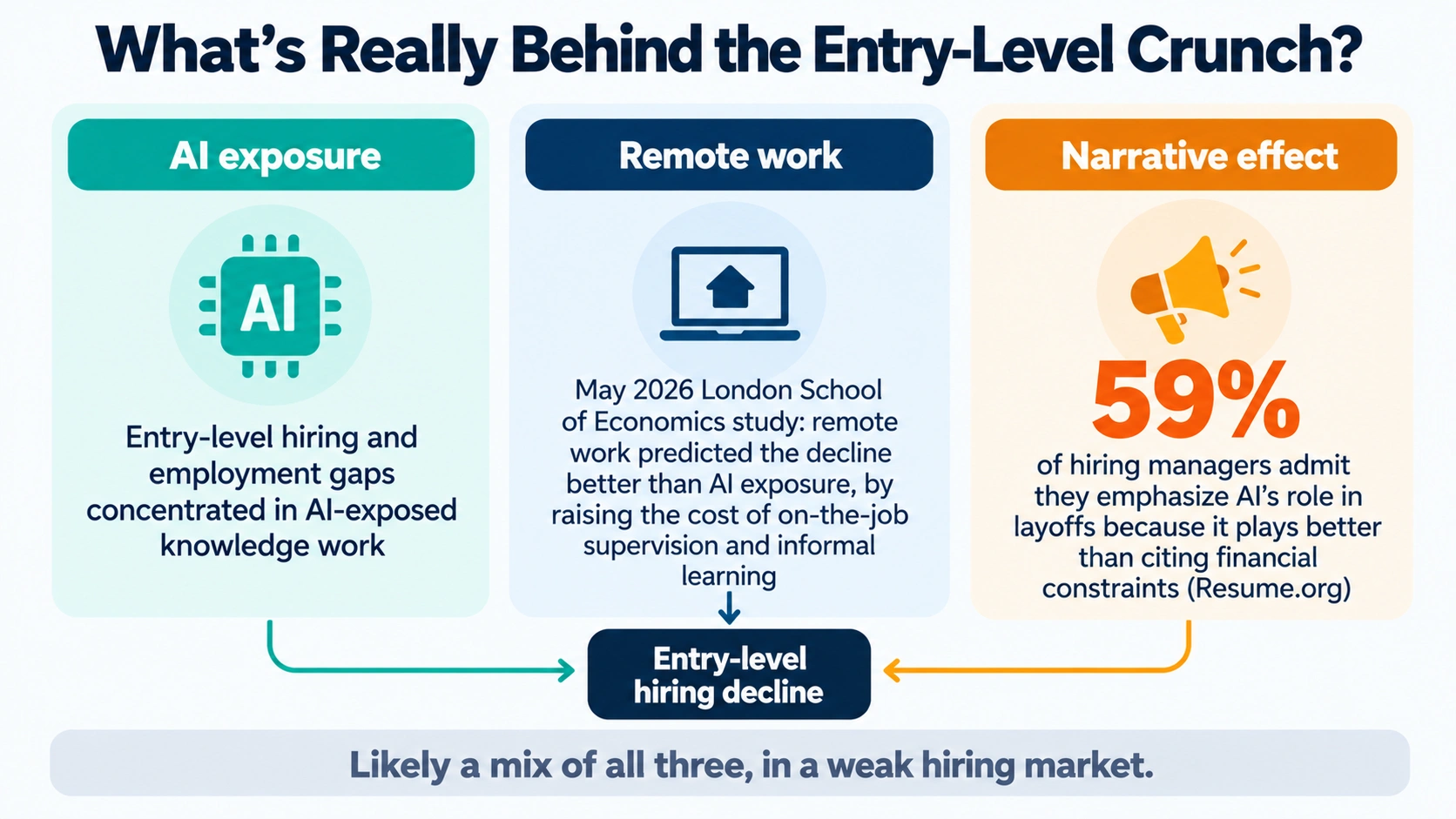
Worth flagging, too: not everyone agrees AI’s even the primary cause of the entry-level crunch. A May 2026 London School of Economics study found remote work was actually a better predictor of the decline in entry-level hiring than AI exposure was, since remote setups raise the cost of on-the-job supervision and cut into the kind of informal learning that used to happen just from sitting near more experienced coworkers. And a Resume.org survey found 59% of hiring managers admitted they emphasize AI’s role in layoffs because it plays better with stakeholders and the public than citing plain financial constraints does. Some of what gets pinned on AI is really just a weak hiring market and companies reaching for a tidy explanation.
Skills That Are Actually Rising in Value
The future of jobs conversation keeps circling back to the same handful of skills, and it’s worth taking seriously precisely because none of it’s a new list dressed up for the AI era. Analytical thinking and complex problem-solving have topped the World Economic Forum’s skills rankings for five straight editions running now. Judgment and decision-making under real ambiguity gets ranked consistently among the most resilient skills in AI-augmented workplaces, because AI’s good at pattern recognition and genuinely bad at weighing tradeoffs with accountability sitting behind them.
AI literacy itself has turned into a distinct, valued skill, not because everyone needs to become an engineer, but because evaluating AI’s output critically, catching when it’s confidently wrong, has become a real, valuable capability in its own right. Upwork’s 2026 research on in-demand skills found nearly one in two business leaders now say they’d pay a premium specifically for creativity and innovation, treating it as a differentiator precisely because it’s the thing AI still can’t reliably produce on its own.
AI-Augmented Jobs: The More Likely Middle Path
Most roles aren’t heading toward full replacement, and they’re not staying fully untouched either. They’re heading toward augmentation. Same job, restructured around directing and checking AI output instead of producing everything from scratch. Upwork’s research found 77% of business leaders now describe their workforce as becoming more “fractional” by design, built around a mix of AI tools and more specialized human contributors rather than large teams of generalists handling routine execution.
That’s probably the most realistic way to think about AI workforce change over the next several years. Fewer roles built purely around executing routine tasks. More roles built around directing, judging, and being accountable for what AI produces. Still a real shift in what a job looks like day to day. Just a different story than the wholesale replacement narrative that tends to dominate headlines.
What Employers Should Actually Do
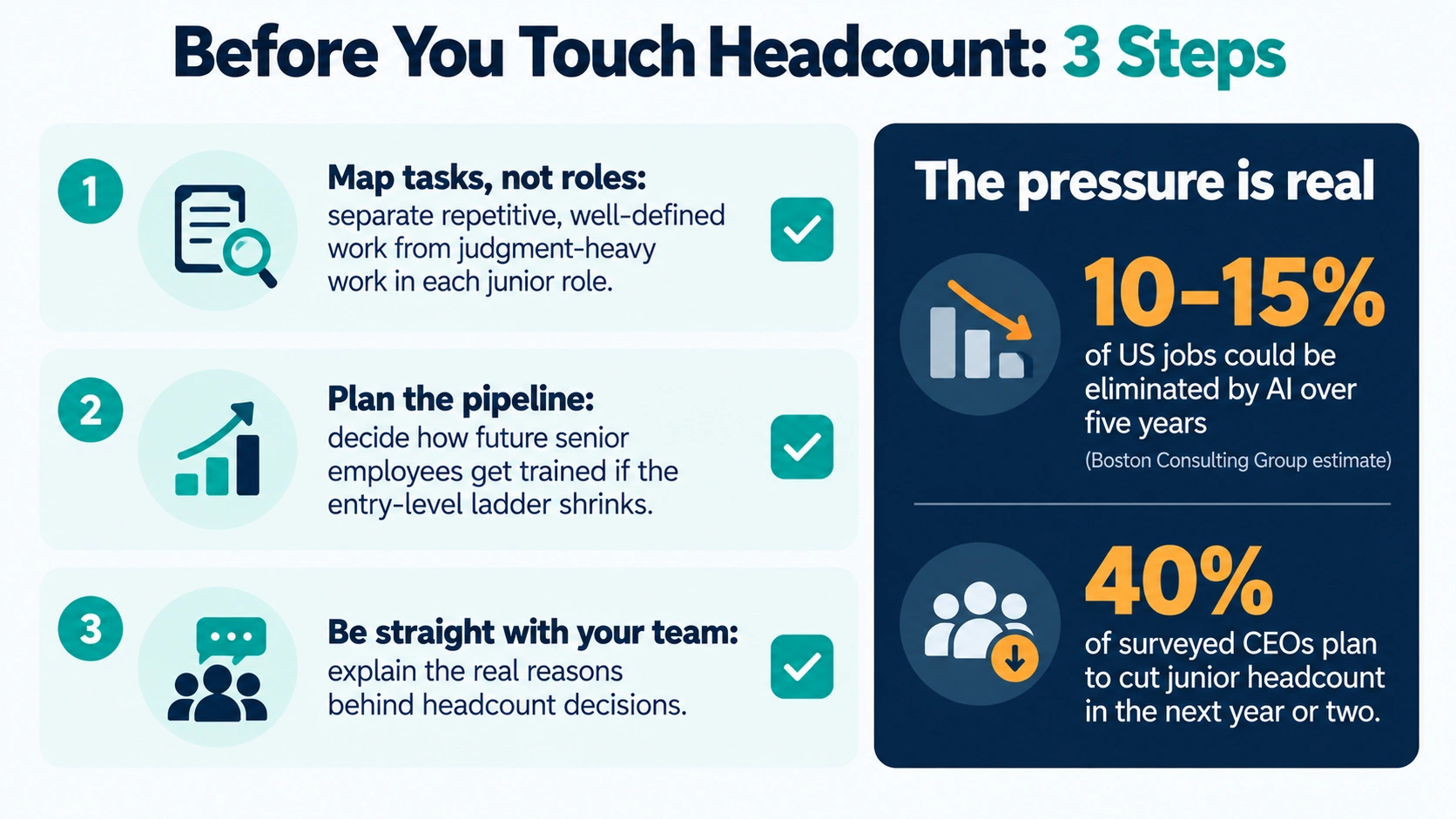
Running a business and trying to figure out the right move here? A few things worth doing before headcount gets touched at all. Map which specific tasks in your junior roles are genuinely repetitive and well-defined versus which involve real judgment, rather than eliminating a role wholesale off the back of a vendor demo. Boston Consulting Group estimates AI could eliminate 10 to 15% of US jobs over the next five years, and separately, 40% of CEOs surveyed say they plan to cut junior headcount in the next year or two. Aggressive enough numbers that acting on them without a clear-eyed, task-level look first is a real risk, not a shortcut worth taking.
Build a genuine plan for how future senior employees get trained if the traditional entry-level ladder keeps shrinking, because that talent pipeline problem doesn’t fix itself, and it’ll eventually become your problem too whether you planned for it or not. And be straight with your own team about why headcount decisions are actually happening. That Resume.org finding on hiring managers overstating AI’s role rather than admitting to financial pressure isn’t exactly a strong long-term trust move with the people still on your payroll.
Where This Actually Leaves Things
The honest picture, based on where the data sits as of late 2026, is that AI replacing workers is real but narrower and more selective than the scariest headlines suggest. It’s concentrated at the entry point of knowledge work, it’s genuinely reshaping what a junior role looks like, and it’s happening alongside a separately weak hiring market that makes the whole thing hard to untangle cleanly. New grad unemployment sitting around 5.6% to 5.7%, against roughly 4.2% for the overall workforce, is a real number worth taking seriously, whatever share of its AI ends up directly responsible for in the end.
Neither the panic nor the dismissal fully fits what’s actually going on here. The businesses and workers who come out ahead won’t be the ones who ignored this shift, or the ones who overreacted to it either. They’ll be the ones who looked closely at which specific tasks were actually changing, and adjusted deliberately instead of guessing off a headline.

The Team Compare BizTech is made up of people from marketing backgrounds, digital marketing & content marketing backgrounds, each with unique experiences and nuggets of wisdom to share with you. The team is passionate about creating unique, accurate, and engaging content.