
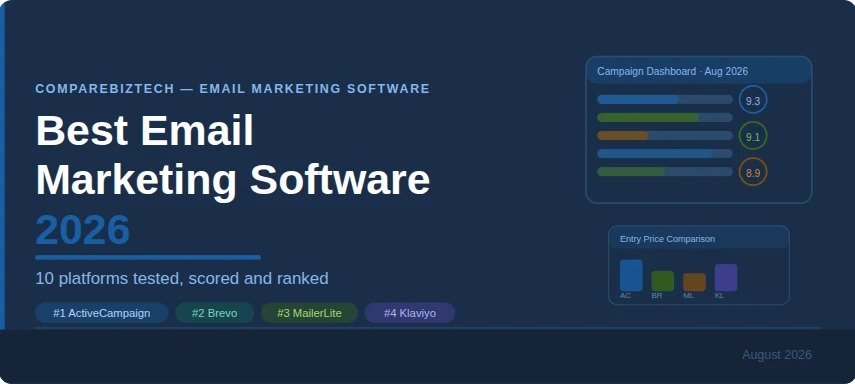
The best email marketing software in 2026 is ActiveCampaign (best overall for automation and B2B), followed by Brevo (best value and all-in-one, with send-based pricing), MailerLite (best for small businesses and ease of use), and Klaviyo (best for ecommerce). The right platform depends on list size, whether the priority is automation depth, budget, or store integration, and how much of the work should be automated versus sent manually. A full scored comparison of ten platforms follows.
Quick comparison: all 10 platforms at a glance
Scores are weighted across eight criteria, with deliverability and automation carrying the most weight — the methodology is explained below. Pricing and free-tier limits were verified in August 2026; confirm current figures before purchase, as they change often.
| Platform | Best for | Free plan | Starting price | CBT score |
|---|---|---|---|---|
| ActiveCampaign | Automation & B2B | No (14-day trial) | $15/mo annual ($19 monthly) | 9.3 / 10 |
| Brevo | Value & all-in-one | Yes — 300 emails/day, unlimited contacts | $9/mo (send-based) | 9.1 / 10 |
| MailerLite | Small business & ease of use | Yes — up to 250 subscribers | ~$12/mo | 8.9 / 10 |
| Klaviyo | Ecommerce | Yes — up to 250 contacts | $20/mo (scales steeply) | 8.8 / 10 |
| Mailchimp | Best-known all-rounder | Yes — up to 250 contacts | $13/mo | 8.5 / 10 |
| HubSpot Email | Integrated CRM + marketing | Yes — 2,000 sends/mo | $15/mo/seat (Marketing Starter) | 8.4 / 10 |
| Omnisend | Ecommerce alternative | Yes — up to 250 contacts | $16/mo | 8.2 / 10 |
| GetResponse | All-in-one with funnels/webinars | Yes — up to 500 contacts | ~$16/mo | 8.1 / 10 |
| Kit (ConvertKit) | Creators & newsletters | Yes — up to 10,000 subscribers | $39/mo ($33 annual) | 8.0 / 10 |
| Constant Contact | Beginners & local business | No (free trial) | $12/mo (Lite) | 7.6 / 10 |
Free-plan limits and starting prices were verified in August 2026 and change frequently. Confirm the billing basis (contacts vs sends) and current figures on each vendor's website before purchasing.
How were these platforms evaluated and scored?
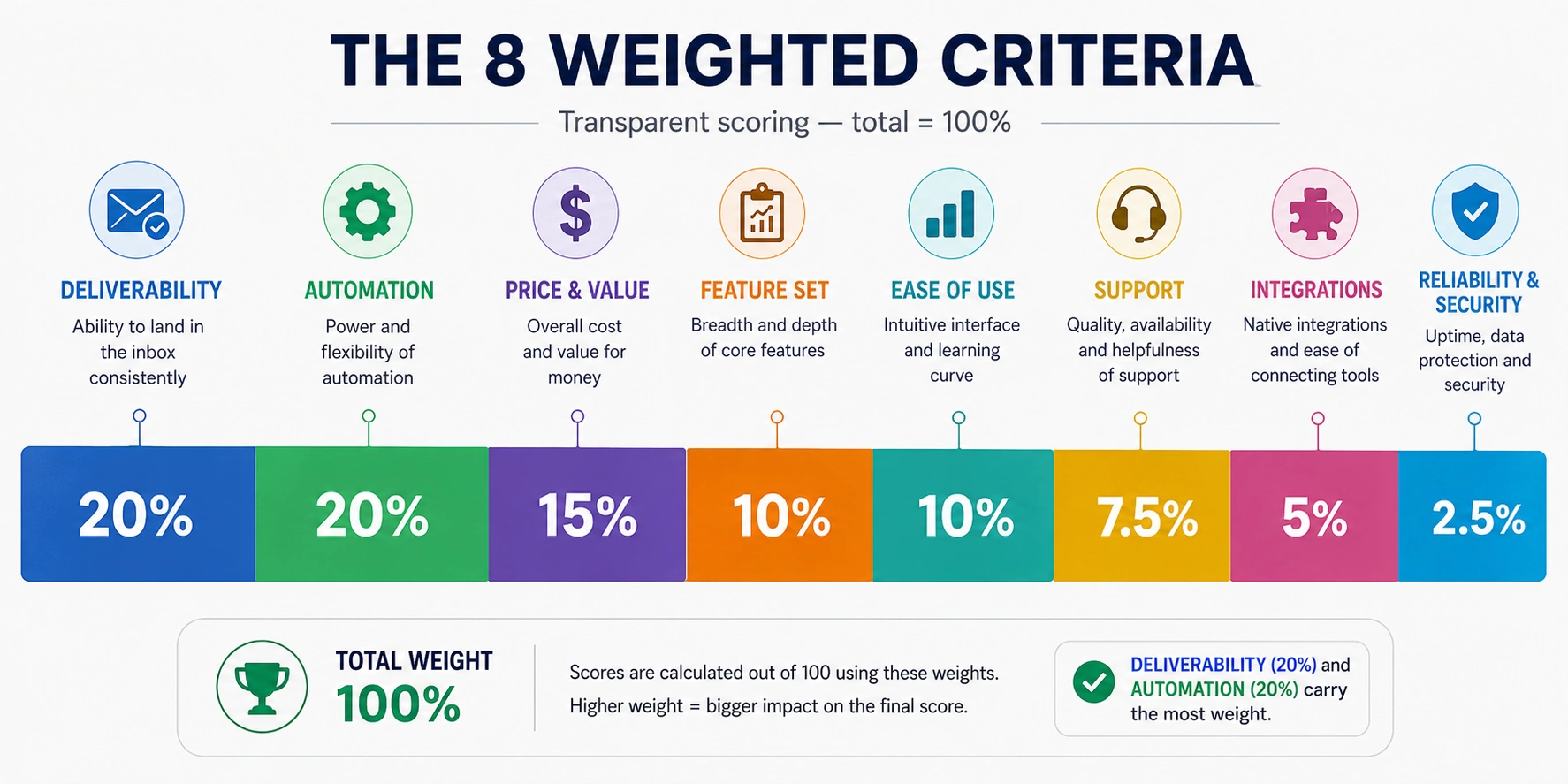
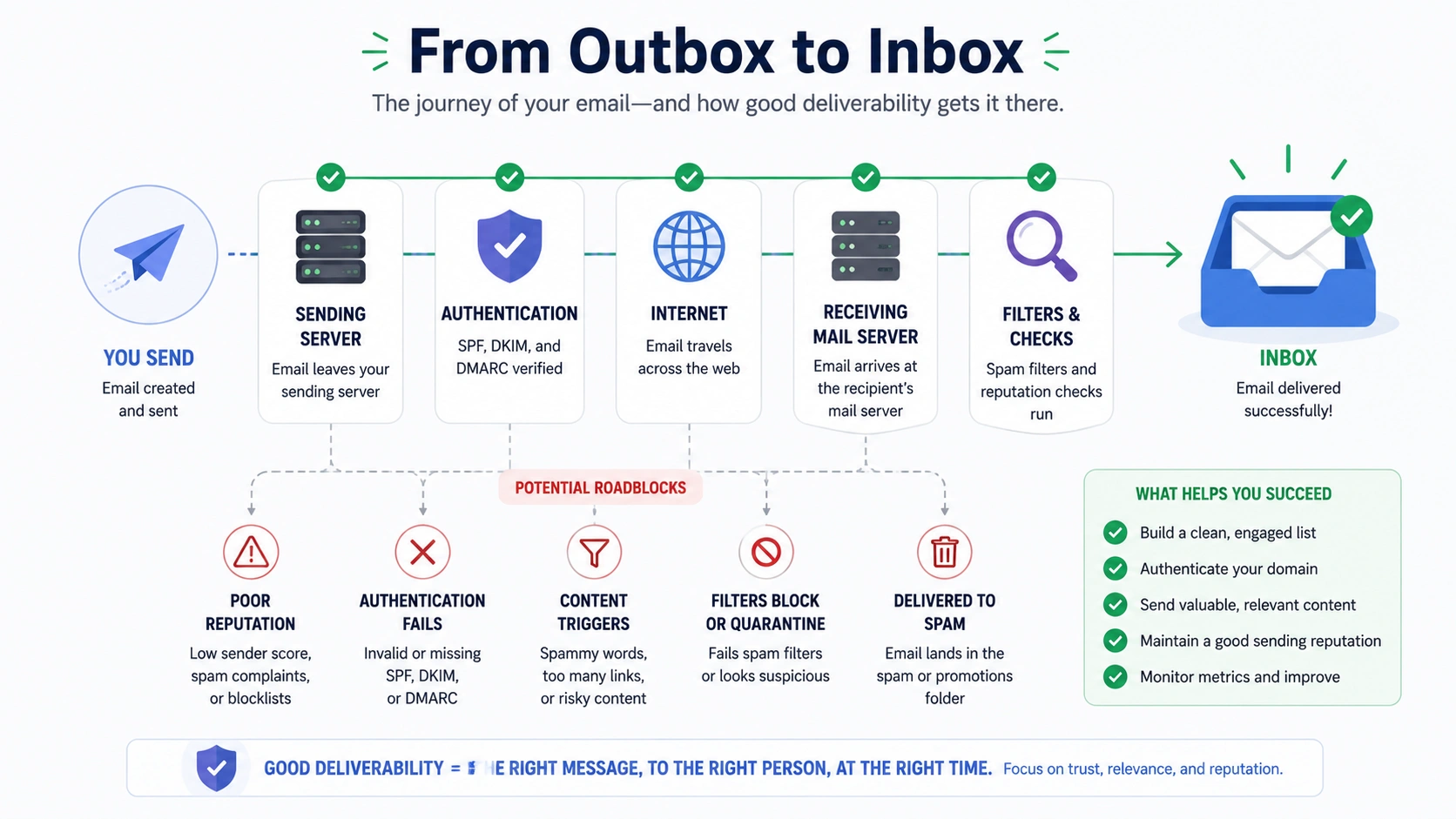
Every platform in this guide was assessed against eight criteria, weighted to reflect how businesses actually choose an email marketing platform. Feature count is not the deciding factor — deliverability and automation are, because an email that never reaches the inbox has no value and a platform that cannot automate the routine sends is a platform a growing team quickly outgrows.
| # | Criterion | Weight | What CBT measured |
|---|---|---|---|
| 1 | Deliverability & sending infrastructure | 20% | Inbox placement reputation, dedicated IP options, SPF/DKIM/DMARC support, deliverability tooling |
| 2 | Automation & workflows | 20% | Visual builder depth, triggers, conditions and branching, pre-built journeys, behaviour-based automation |
| 3 | Ease of use & email builder | 15% | Drag-and-drop editor, template quality, time to first campaign, learning curve |
| 4 | Segmentation & list management | 15% | Dynamic segments, tags, custom fields, list hygiene, suppression handling |
| 5 | Pricing transparency & value | 10% | Clear tiers, contacts-vs-sends model, overage and list-size behaviour, free-tier depth |
| 6 | Integrations & ecosystem | 10% | Ecommerce (Shopify, WooCommerce), CRM, forms, native API and Zapier, app marketplace |
| 7 | Analytics & reporting | 5% | Open, click and revenue reporting, A/B testing, attribution, exportability |
| 8 | Support & onboarding | 5% | Support channels, response times, migration help, documentation and academies, G2 and Capterra support scores |
ActiveCampaign — Best Email Marketing Software for Automation
ActiveCampaign is the most complete automation platform in the category, and that is why it leads this ranking. Its visual builder handles multi-step, branching journeys that react to subscriber behaviour — the logic that turns a flat newsletter list into a system that follows up automatically. A built-in CRM with lead scoring makes it especially strong for B2B and considered-purchase cycles, where what a contact does over several weeks matters more than any single send. The 2026 AI additions suggest send times and content, shortening the gap between building a workflow and seeing results.
The trade-offs are real and worth weighing. There is no free plan, only a trial; pricing is contact-based and rises as the list grows; and the depth that makes the platform powerful also gives it the steepest learning curve here. A team that only needs to send an occasional broadcast will not use enough of it to justify the cost.
- Deepest automation and workflow logic in the category
- Built-in CRM with lead scoring for B2B nurturing
- Strong, well-managed deliverability
- AI send-time and content assistance (2026)
- 900+ integrations
- No free plan — trial only
- Contact-based pricing climbs as the list grows
- Steepest learning curve of the platforms here
- Email design tools are less polished than some rivals
Brevo — Best Value All-in-One Email Marketing Software
Brevo's defining advantage is its send-based pricing: cost is tied to how many emails go out, not how many contacts are stored. For a business with a large but low-frequency list, that model can be dramatically cheaper than the contact-based pricing every other platform here uses. On top of that, Brevo bundles email, SMS, WhatsApp, and a light CRM into one workspace, so a small team can run several channels without stitching together separate tools.
The unlimited-contacts free tier (capped by a daily send limit) makes it one of the most accessible starting points in the category. The trade-offs are a template editor that feels a step behind MailerLite's polish, and that daily send cap on the free plan, which rules the free tier out for time-sensitive launch campaigns.
- Send-based pricing — cheaper for large, low-frequency lists
- Email, SMS, WhatsApp and CRM in one platform
- Free tier with unlimited contacts
- Solid automation for the price
- Strong fit for GDPR-conscious EU and UK senders
- Email editor less refined than MailerLite or Mailchimp
- Daily send cap on the free plan
- Advanced automation trails ActiveCampaign
- Support responsiveness varies by plan tier
MailerLite — Best Email Marketing Software for Small Businesses
MailerLite wins on the balance of simplicity, design quality, and price. Its drag-and-drop editor is one of the cleanest here, and most users are sending a well-designed first campaign within an hour rather than a week. Its paid plans are among the most affordable in the category and stay reasonable as the list grows, which makes it a natural first platform for a business moving off a basic tool or a spreadsheet. Note that the free plan was cut in 2025 and again in 2026 and now covers only 250 subscribers, so it suits testing rather than running a real list.
Where it gives ground is automation depth: MailerLite covers the common workflows — welcome series, follow-ups, simple segmentation — but it is not built for the branching, multi-condition journeys ActiveCampaign specialises in. New accounts also go through an approval step before sending, which can briefly delay a first campaign.
- One of the cleanest editors in the category
- Fast setup — first campaign within the hour
- Among the most affordable paid plans in the category
- Bills by active subscribers, not total contacts
- Landing pages and forms included
- Automation lighter than ActiveCampaign or Brevo
- New accounts face an approval step before sending
- Fewer native integrations than the larger platforms
- Reporting is solid but not advanced
Klaviyo — Best Email Marketing Software for Ecommerce
Klaviyo is purpose-built for ecommerce, and for online stores it is hard to beat. Its deep integration with Shopify and WooCommerce pulls in purchase and browsing behaviour, so automations can be triggered by the actions that actually drive revenue — abandoned carts, post-purchase sequences, win-back flows, and product-specific recommendations. Its reporting ties email directly to revenue, which is exactly the number an ecommerce marketer needs to see.
That focus is also its limitation. Pricing scales steeply as the contact list grows, making it an expensive choice at scale, and for a business that is not running a store, most of what justifies the price goes unused. The platform rewards stores that will genuinely use its behavioural data; it is overkill for a simple newsletter.
- Best-in-class ecommerce automation and data
- Native Shopify and WooCommerce integration
- Revenue attribution built into reporting
- Strong pre-built ecommerce flows
- SMS available alongside email
- Expensive as the contact list scales
- Overkill for non-ecommerce senders
- Steeper learning curve than general tools
- Contact-based pricing counts all profiles
Mailchimp — Best-Known All-Round Email Marketing Software
Mailchimp remains the most recognisable name in email marketing, and that familiarity brings real advantages: an enormous template library, one of the widest integration ecosystems, and a mature interface that most marketers already understand. For a small business that wants a capable, well-documented all-rounder without evaluating a dozen alternatives, it is a safe and productive choice.
The reservations are around pricing and automation. Costs rise noticeably as the list grows, and the jumps between tiers can catch teams out at exactly the point they are scaling. Its automation, while improved, is not as deep as ActiveCampaign's, and heavy senders sometimes find the value proposition weaker as their needs mature.
- Largest template and integration ecosystem
- Familiar, well-documented interface
- Free plan for very small lists
- Strong brand trust and support resources
- Pricing climbs sharply with list size
- Tier jumps can surprise scaling teams
- Automation trails the specialists
- Value weakens for high-volume senders
HubSpot Email — Best for Integrated CRM and Marketing
HubSpot's strength is context: email lives inside a complete CRM and marketing platform, so every send is tied to a full record of the contact's history, deals, and interactions. For a business that already runs sales and marketing on HubSpot, that unified view makes email far more targeted than a standalone tool can manage, and the free tier is a genuine on-ramp.
The catch is cost and scope. Beyond the entry tiers, HubSpot becomes expensive quickly, and a business that only needs to send email will pay for — and underuse — a great deal of platform. Its value is highest when the wider CRM and marketing tools are actually in use.
- Email fully integrated with CRM and sales data
- Strong segmentation from unified contact records
- Usable free tier within the free CRM
- Excellent documentation and academy
- Gets expensive quickly beyond entry tiers
- Underutilised if used for email alone
- More platform than many small teams need
Omnisend — Best Ecommerce Alternative to Klaviyo
Omnisend offers much of what makes Klaviyo compelling for ecommerce — pre-built store automations, product-aware emails, and combined email and SMS — but with an easier on-ramp and a gentler entry price. For small and mid-sized stores that want abandoned-cart and post-purchase flows working quickly without Klaviyo's cost curve, it is a strong, practical fit.
Its narrower focus is the trade-off: outside an ecommerce context, Omnisend has less to offer than a general-purpose platform, and its ceiling for very large or highly complex stores is lower than Klaviyo's. It is best understood as the value option in ecommerce email, not a general newsletter tool.
- Ecommerce automations ready out of the box
- Email and SMS in one platform
- Gentler entry price than Klaviyo
- Quick setup for common store flows
- Limited value outside ecommerce
- Lower ceiling than Klaviyo for complex stores
- Fewer general-purpose features
GetResponse — All-in-One Email Marketing with Funnels and Webinars
GetResponse bundles more than email: landing pages, conversion funnels, and — unusually — webinars sit inside the same platform. For a solopreneur or small marketing team that wants to run an entire funnel, from opt-in page to nurture sequence to live webinar, without buying separate tools, that breadth is genuinely useful and cost-effective.
The compromise that comes with breadth is that no single component is best-in-class. The email automation is capable but mid-tier next to ActiveCampaign, and the design tools are solid rather than exceptional. GetResponse rewards marketers who will use several of its modules; those who only need email can find sharper value elsewhere.
- Email, landing pages, funnels and webinars in one place
- Good value for full-funnel marketing
- Capable automation for most needs
- Usable free tier
- Jack-of-all-trades — no standout module
- Automation mid-tier versus specialists
- Design tools solid but not exceptional
Kit (formerly ConvertKit) — Best for Creators and Newsletters
Kit is built for creators rather than corporate marketers, and it shows in the priorities. Its tag-based subscriber model suits an audience that grows organically, and its monetisation tools — paid newsletters, digital products, and tip jars — let a writer or coach sell directly from the same platform that sends the emails. The generous free tier makes it an easy place to start building a list before it earns anything.
The aesthetic is deliberately plain-text and personal, which is a strength for newsletters but a limitation for brands that want richly designed campaigns. It is not built for ecommerce or complex corporate automation; its sweet spot is the individual or small team turning an audience into income.
- Built-in monetisation for paid newsletters and products
- Tag-based subscribers suit growing audiences
- Generous free tier for new creators
- Clean, personal newsletter feel
- Limited design templates versus mainstream tools
- Not suited to ecommerce
- Lighter on corporate-grade automation
Constant Contact — Best for Beginners and Local Business
Constant Contact is the most beginner-friendly platform here, and that is its reason to exist. Step-by-step wizards, industry templates, and strong live support make it approachable for non-technical users and small local businesses that want to run email without a learning curve. Built-in event registration and survey tools make it a particularly natural fit for community organisations, non-profits, and local marketing.
The trade-off is that ease comes at the expense of depth and value. Its automation is limited next to modern alternatives, and its pricing tends to run higher for what is delivered. It is a fine starting point for a beginner, but many teams outgrow it as their needs become more sophisticated.
- Very approachable for non-technical users
- Strong live support and guided setup
- Built-in event and survey tools
- Good fit for local and non-profit marketing
- Limited automation versus modern rivals
- Pricing runs high for the feature set
- No free plan — trial only
- Many teams outgrow it
Mailchimp vs Brevo — detailed head-to-head
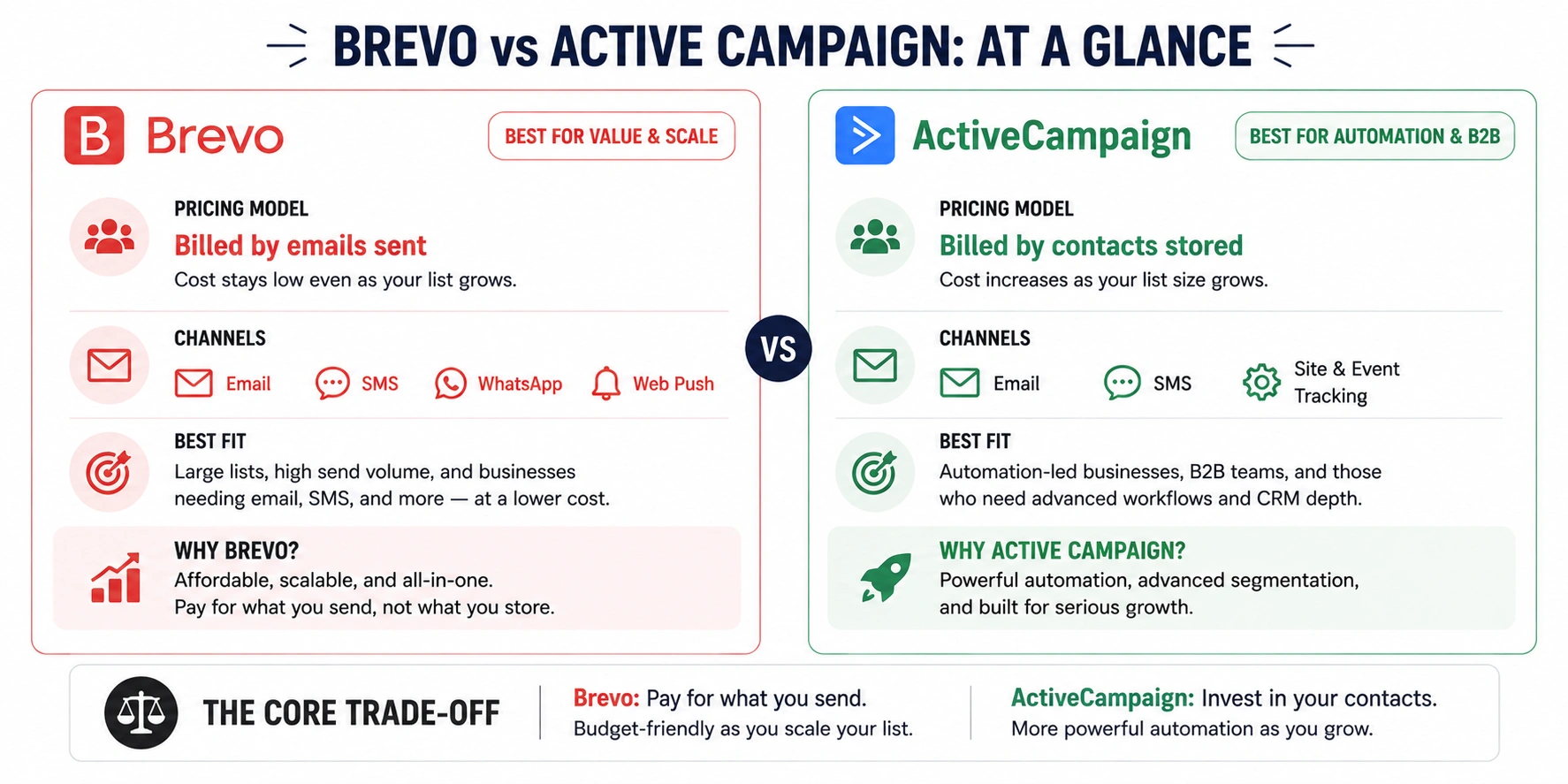
Mailchimp wins on brand familiarity, template breadth, and its integration ecosystem. Brevo wins on pricing model, multichannel messaging, and value at scale — because it charges for emails sent rather than contacts stored. For a small list that sends often, the two are close; for a large list that sends occasionally, Brevo's send-based pricing is usually the more economical choice.
| Factor | Mailchimp | Brevo |
|---|---|---|
| Pricing model | Contact-based — cost rises with list size | Send-based — cost tied to emails sent |
| Free plan | Yes — up to ~250 contacts | Yes — 300 emails/day, unlimited contacts |
| Channels | Email, with add-on marketing tools | Email, SMS, WhatsApp, light CRM |
| Automation | Capable; improved but mid-tier | Capable; strong for the price |
| Templates & design | Largest library in the category | Good, slightly less polished |
| Best for large, low-frequency lists | Costlier — pays to store contacts | More economical — pays only to send |
| Ecosystem & integrations | Very broad | Solid, narrower than Mailchimp |
| Best fit | SMBs valuing familiarity and templates | Large lists, multichannel, budget focus |
Best email marketing software by use case
Best for small businesses and solo marketers
MailerLite is the clearest pick for small teams: a clean editor, fast setup, a usable free plan, and pricing that stays affordable as the list grows. Brevo is the strong alternative when a business wants SMS alongside email or expects a large list, since its send-based pricing avoids paying simply to store contacts.
Best for ecommerce
Klaviyo is the default for online stores that will use behavioural data to drive revenue, with native Shopify and WooCommerce integration and revenue-tied reporting. Omnisend is the value alternative for small and mid-sized stores that want store-ready automation at a gentler entry price.
Best for creators and newsletters
Kit (formerly ConvertKit) is built for creators, with tag-based subscribers, a generous free tier, and monetisation tools for paid newsletters and digital products. MailerLite is a good second option for creators who want more design flexibility than Kit's deliberately plain style.
Best for B2B and automation-led marketing
ActiveCampaign leads for B2B and any team where automation and lead nurturing are central, thanks to its branching workflows, built-in CRM, and lead scoring. HubSpot Email is the choice for teams already running their sales and marketing inside HubSpot who want email tied to full contact records.
Best free email marketing software
No platform offers a fully unlimited free tier, but a few stand out. Kit has the most generous free plan in the category, supporting up to 10,000 subscribers with unlimited sends (though only a single automation). Brevo allows unlimited stored contacts, capped by a 300-email daily send limit, which suits large lists that send occasionally. The free plans from Mailchimp, MailerLite, Klaviyo, and Omnisend were all trimmed over 2025–2026 and now cover only around 250 contacts or subscribers, making them better suited to testing than to running a live list.
Best email marketing software for UK and EU businesses
Brevo (headquartered in the EU) and MailerLite are natural fits for UK and EU senders that prioritise GDPR alignment, EU data handling, and clear pricing. Businesses with specific UK compliance or support requirements should also shortlist established UK and EU providers and confirm data-hosting terms directly before committing.
Email marketing software pricing in 2026 — complete guide
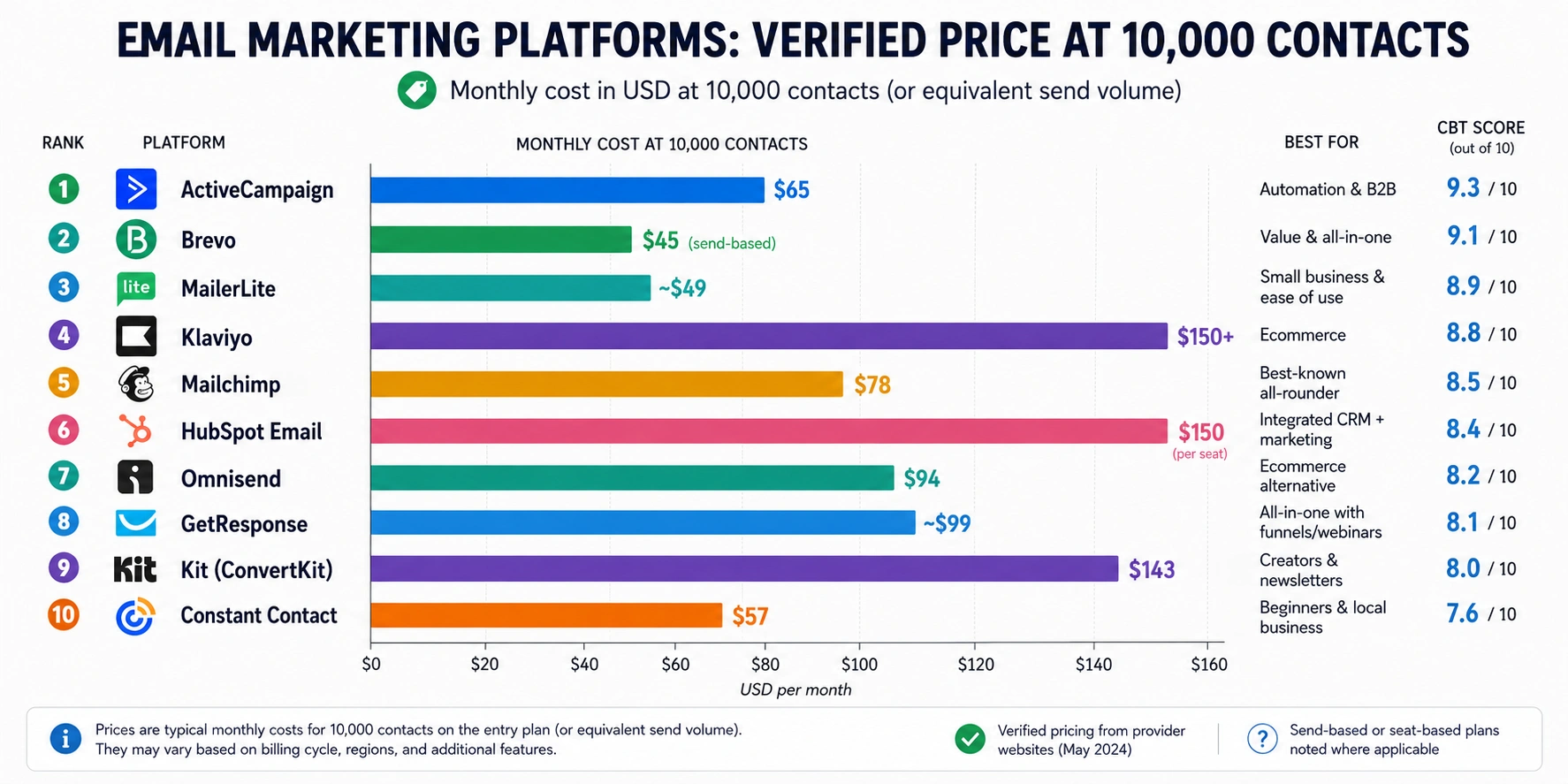
Email marketing software pricing in 2026 ranges from free (limited plans from Brevo, MailerLite, Mailchimp, Kit, and others) to roughly $9–$20 per month for most entry paid tiers — the creator-focused Kit is the main exception, starting at $39/month after its 2025 price increase. Costs then rise substantially as the list or send volume grows. The single most important thing to understand before comparing prices is the billing model.
Contacts vs sends — the pricing model that decides cost
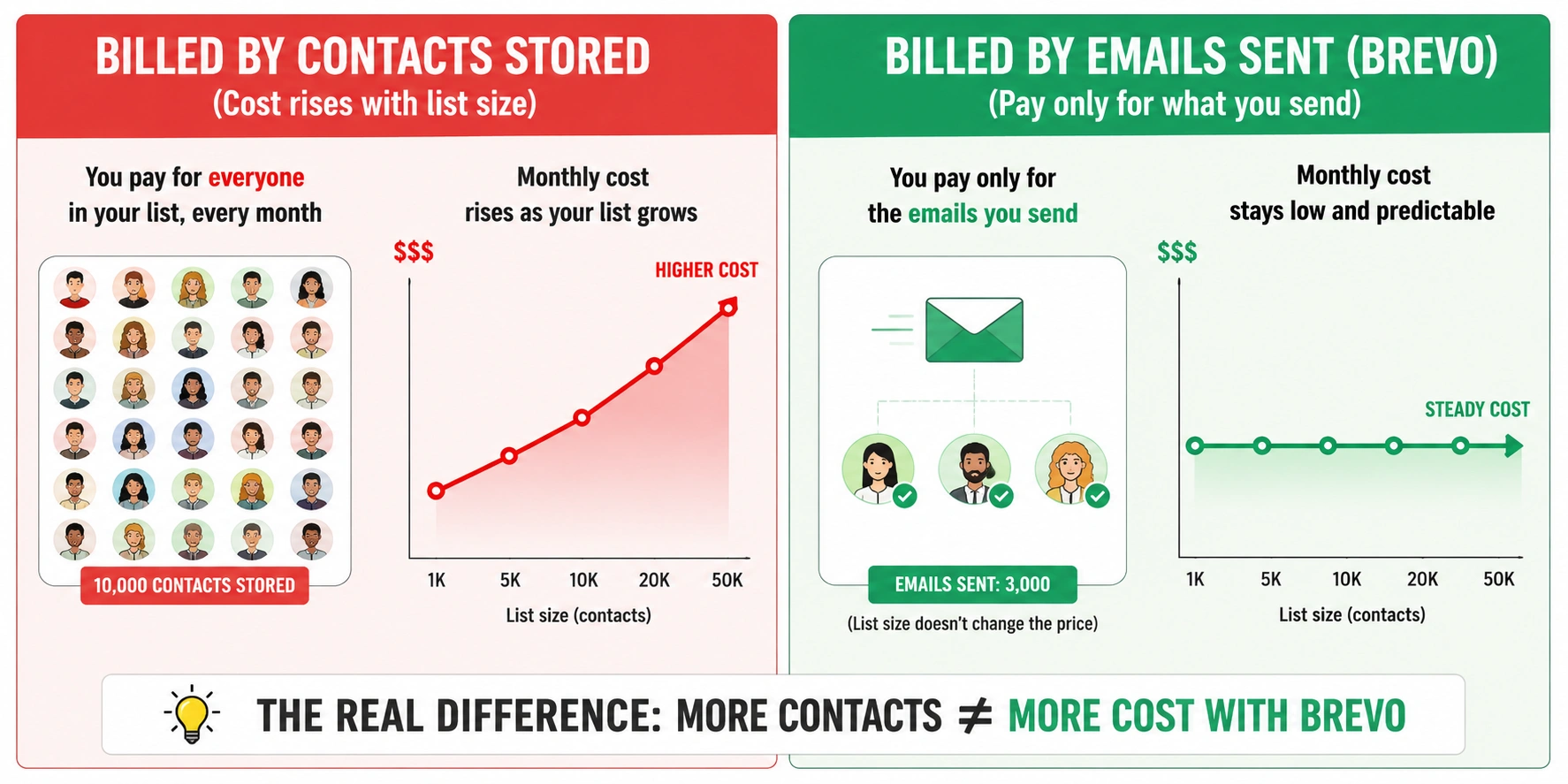
Most platforms charge by the number of contacts stored, so cost rises with list size regardless of how often campaigns are sent. Brevo is the notable exception, charging by emails sent. The difference is decisive for certain businesses: a company with a large list that emails occasionally will usually pay far less on a send-based model, while a business with a small list that emails frequently may prefer contact-based pricing. Match the model to the sending pattern, not just the headline price.
| Platform | Model | ~1,000 contacts | ~10,000 contacts | ~50,000 contacts |
|---|---|---|---|---|
| MailerLite | Contacts | Low | Moderate | Moderate–High |
| Brevo | Sends | Low | Low–Moderate* | Moderate* |
| Mailchimp | Contacts | Low–Moderate | High | High |
| ActiveCampaign | Contacts | Moderate | High | High |
| Klaviyo | Contacts | Moderate | High | Very High |
*Brevo's cost depends on emails sent, not list size, so its position varies with sending frequency. This table is directional; replace with verified figures at each vendor's current tiers before publishing.
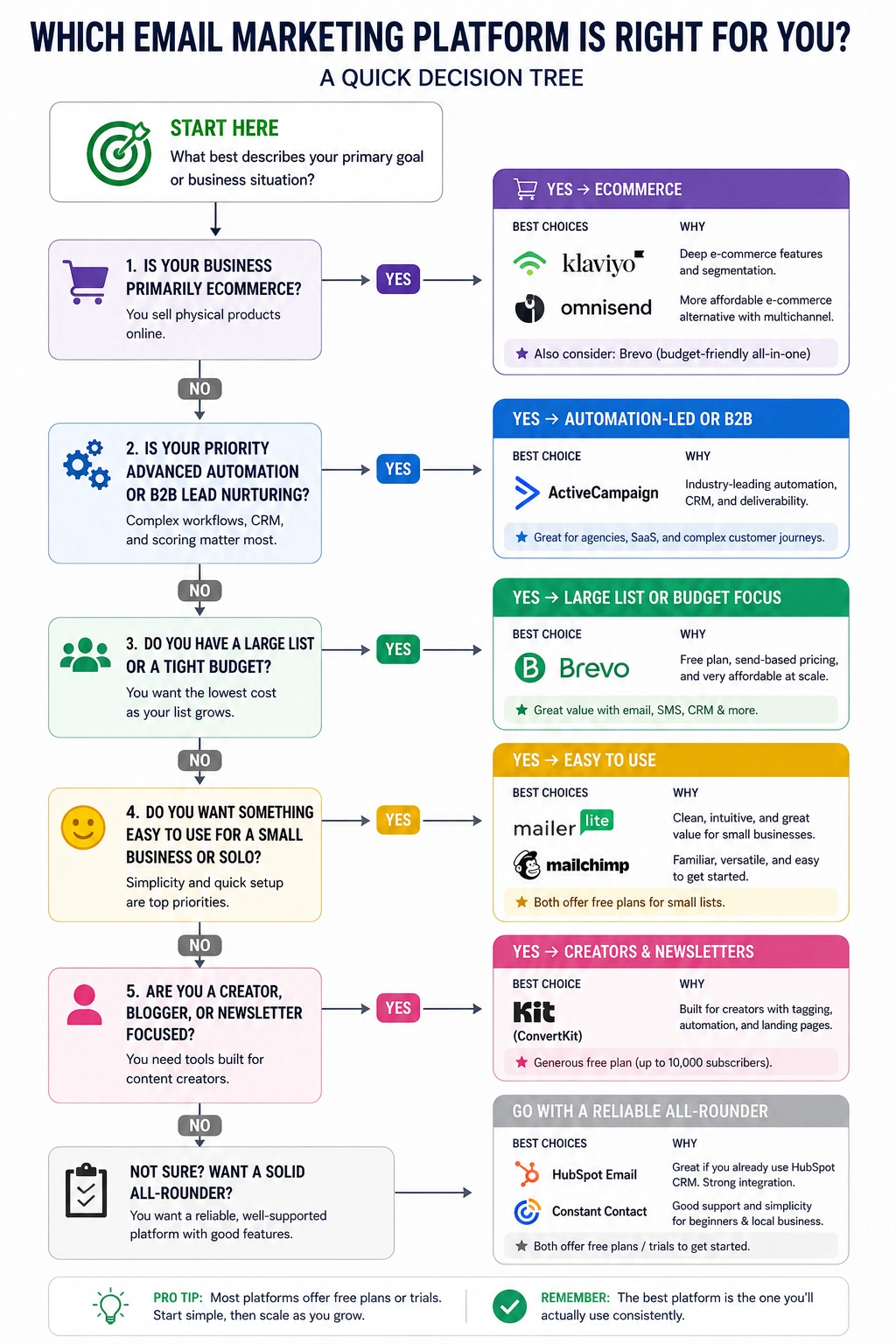
Which email marketing software should you choose?
Compare every email marketing platform on CompareBizTech
Browse the full directory with feature details, pricing tiers, and user reviews for every platform in the category.
Browse all email marketing platforms →Frequently asked questions
The verdict — which platform wins in 2026?
The email marketing market in 2026 is mature and well differentiated, and the right choice is decided mainly by the priority — automation depth, budget, ease of use, or store integration — rather than by which platform lists the most features.
ActiveCampaign is the strongest all-round platform for businesses that treat automation and lead nurturing as core, and the natural choice for B2B. Brevo is the best value and the smartest option for large lists and multichannel messaging, thanks to send-based pricing. MailerLite is the best starting point for small businesses that want professional results without complexity, and Klaviyo is the default for ecommerce brands that will put behavioural data to work.
Beyond those four, Mailchimp remains a dependable all-rounder, HubSpot excels for teams inside its ecosystem, Omnisend offers ecommerce value, GetResponse suits full-funnel marketers, Kit is built for creators, and Constant Contact is the friendliest entry point for beginners.
The mistake to avoid is choosing on headline price alone. The billing model matters as much as the sticker figure: a contact-based plan can become expensive as a list grows, while a send-based plan rewards large, low-frequency lists. Match the platform to how the business will actually send, and confirm current pricing before committing.
Find the right email marketing platform faster
Compare features, pricing tiers, and reviews for every platform in the category on the CompareBizTech directory.
See the full comparison → Best free email marketing software →Related categories: Email Management Software · Email Tracking Software · Marketing Software

Praveen Kumar Panjiar is the founder of CompareBizTech.com, where he cuts through the noise in B2B tools with sharp, no-fluff comparisons. His work focuses on breaking down features, pricing, and real-world use cases, built specifically for high-intent buyers evaluating tools and looking to choose the right solution, fast.