
Last updated: 30 September 2026. All pricing below was re-checked on vendor pricing pages between 29 and 30 September 2026. Prices exclude GST and other taxes, and vendors change plans often, so confirm on the linked pricing page before you buy.
The best marketing software for most small businesses in 2026 is HubSpot Marketing Hub if you want email, CRM and automation in one place, Brevo if you want low-cost email and SMS, and AiSensy if WhatsApp is your main channel in India.
Add Canva for design, Buffer for social scheduling and the free Google Analytics 4 + Search Console pair for measurement, and most small teams have everything they need. B2B teams with long sales cycles and a Salesforce CRM should look at Salesforce Account Engagement (formerly Pardot) or Adobe Marketo Engage.
"Marketing software" covers a lot of ground: email, WhatsApp, social scheduling, SEO research, analytics, design and the automation that ties them together. No single tool is the best at all of it, and most small businesses don't need a dozen subscriptions either. This guide groups 22 tools by the job they do, shows what each one costs today, and says plainly who should skip it.
It's written for founders and marketing teams at small and mid-sized businesses, with extra detail for Indian businesses: INR pricing where vendors publish it, WhatsApp marketing, and the compliance points (DLT, DPDP) that global roundups leave out.
- Best marketing software at a glance
- What is marketing software?
- How we chose these tools
- Best all-in-one marketing platform
- Best email marketing software
- Best WhatsApp and SMS marketing tools
- Best social media management tools
- Best SEO and content research tools
- Best analytics tools
- Best design tool
- Best automation and project management tools
- Best marketing automation for B2B and enterprise
- Recommended marketing stacks by stage
- How to choose marketing software (India checklist)
- How much does marketing software cost?
- What changed since the previous version
- FAQs
Best marketing software at a glance
Starting prices are the lowest paid tier listed on each vendor's site, in the currency the vendor shows. "Annual" means billed yearly.
| Tool | Category | Best for | Free plan or trial | Paid plans start at |
|---|---|---|---|---|
| HubSpot Marketing Hub | All-in-one | Email + CRM + automation in one system | Free tools (up to 2 users) | $20/seat/mo (Starter) |
| Brevo | Email, SMS (WhatsApp on Professional) | Large lists on a budget | Free: 300 emails/day | $9/mo (Starter) |
| Mailchimp | Beginners who want a familiar tool | Free up to 250 contacts | $13/mo (Essentials) | |
| ActiveCampaign | Email automation | Automation-heavy B2B nurturing | 14-day trial | $15/mo, annual |
| Zoho Campaigns | Teams on Zoho; INR billing | Free up to 2,000 contacts | Contact-based, from 500 contacts | |
| AiSensy | Indian SMBs, WhatsApp-first | Free forever plan | ₹1,500/mo + message charges | |
| Interakt | Shopify and D2C brands | 14-day trial | ₹2,499/mo for WhatsApp (monthly) | |
| Wati | Agencies, multi-channel inbox | 7-day trial | ₹999 one-time pay-as-you-go | |
| Textedly | SMS (US) | Businesses texting US customers | Free account, 50 texts | $29/mo |
| Buffer | Social | Simple scheduling, small teams | Free: 3 channels | $5/channel/mo, annual |
| Hootsuite | Social | Larger teams, inbox + listening | 14-day trial | $99/user/mo, annual |
| MeetEdgar | Social | Recycling evergreen posts | 30-day trial | $24.91/mo, annual |
| Semrush | SEO + AI search | All-round SEO and competitor research | Free plan (limited reports) | $139/mo ($117.33 annual) |
| Ahrefs | SEO | Backlinks and content research | Ahrefs Free (own site) | $29/mo (Starter) |
| Google Analytics 4 + Search Console | Analytics | Every website, from day one | Free | Free |
| Microsoft Clarity | Behaviour analytics | Heatmaps and session recordings | Free | Free |
| Canva | Design | Social, ad and print creatives | Free plan | ₹1,590/yr (Pro Lite) |
| Zapier | Integration | Connecting tools without code | Free: 100 tasks/mo | $19.99/mo (Professional) |
| Asana | Work management | Campaign planning and approvals | Free for 2 users | $10.99/user/mo, annual |
| monday.com | Work management | Visual boards for marketing teams | Free up to 2 seats | $9/seat/mo, annual |
| Salesforce Account Engagement | B2B automation | Salesforce CRM users | Demo | About $1,250/mo (10,000 contacts) |
| Adobe Marketo Engage | B2B automation | Enterprise ABM programmes | Demo | Quote-based |
Microsoft Dynamics 365 Customer Insights – Journeys is covered in the enterprise section but left out of the table because Microsoft sells it through licence bundles rather than a single entry price.
What is marketing software?
Marketing software is any application that helps a business attract, convert and keep customers by planning, running, automating or measuring marketing. That includes email platforms, WhatsApp and SMS tools, social media schedulers, SEO research tools, analytics, design apps and the automation platforms that connect them to your CRM.
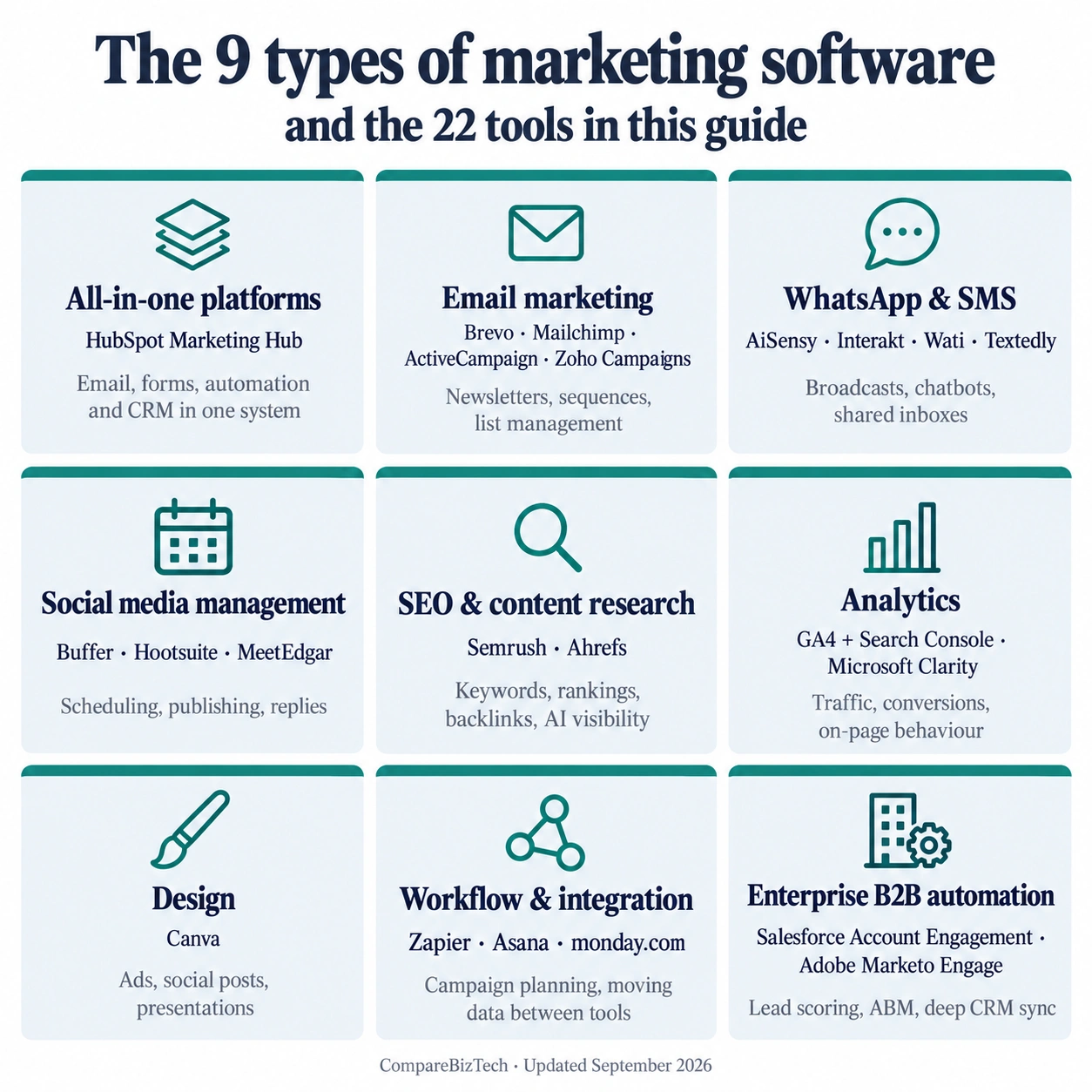
Types of marketing software
- All-in-one marketing platforms: email, forms, landing pages, automation and a CRM in one system. Example: HubSpot.
- Email marketing software: newsletters, automated sequences and list management. Examples: Brevo, Mailchimp, ActiveCampaign.
- Messaging tools: WhatsApp Business API and SMS broadcasts, chatbots and shared inboxes. Examples: AiSensy, Interakt, Wati.
- Social media management: scheduling, publishing, comment replies and reporting. Examples: Buffer, Hootsuite.
- SEO and content research: keyword research, rank tracking, backlinks and, increasingly, AI search visibility. Examples: Semrush, Ahrefs.
- Analytics: traffic, conversions and on-page behaviour. Examples: Google Analytics 4, Microsoft Clarity.
- Design: ads, social posts and presentations. Example: Canva.
- Workflow and integration: campaign planning and moving data between tools. Examples: Asana, Zapier.
- Enterprise marketing automation: lead scoring, account-based marketing and deep CRM sync. Examples: Salesforce Account Engagement, Adobe Marketo Engage.
How we chose these tools
We started from the 25 tools in the 2020 version of this article, removed the ones that are no longer marketing software or have changed identity (details below), and added the categories small businesses now rely on, especially WhatsApp. Every tool on this list had to meet five tests:
- Active and supported in 2026, with its current product name verified on the vendor's own site.
- Published pricing or a clear pricing model. Where a vendor only quotes on request, we say so.
- A free plan or trial, or a clear reason to consider it without one (mostly the enterprise tools).
- A genuine small-business use case, or a clearly labelled enterprise one.
- India readiness weighed where relevant: INR billing, WhatsApp support, and fit with local rules such as DLT registration for SMS.
Pricing and plan limits come from each vendor's pricing page, checked on 29–30 September 2026. The WhatsApp platform notes draw on CompareBizTech's six-week hands-on test of Wati, AiSensy and Interakt. We did not run paid trials of the enterprise suites (Account Engagement, Marketo Engage, Dynamics 365); those entries are based on vendor documentation and are labelled accordingly.
Best all-in-one marketing platform
1. HubSpot Marketing Hub: best all-in-one platform for growing SMBs
HubSpot's advantage is that marketing, sales and service data live in one CRM, so a form fill, an email click and a sales call all land on the same contact record. That makes segmentation and reporting far easier than stitching separate tools together. The free tools cover forms, basic email (2,000 sends a month with HubSpot branding) and a CRM, which is enough to start.
Starter is priced per seat and includes 1,000 marketing contacts. At the time of checking, HubSpot was also showing a new-customer promotional Starter price well below the $20 list rate. Professional adds omnichannel automation, lead scoring and custom reporting. See HubSpot pricing.
Watch out for: the jump from Starter to Professional is steep. Professional starts at $800 a month and HubSpot adds a one-time $3,000 onboarding fee. Marketing contacts also drive cost, so clean your list before upgrading.
If you already use HubSpot, our HubSpot growth marketing and sales toolkit covers workflows worth setting up first.
Best email marketing software
Email is still the channel most small businesses own outright. The four tools below cover the main buying situations; for a full scored comparison of ten platforms, see our best email marketing software guide.
2. Brevo: best value email and multichannel platform
Brevo charges for the emails you send rather than the contacts you store, which makes it one of the cheapest options for businesses with a big list and an occasional newsletter. Starter covers email and SMS (SMS credits are bought separately). The Standard plan adds automation and A/B testing, and WhatsApp campaigns sit in the Professional plan. See Brevo pricing.
Watch out for: WhatsApp isn't in the entry plans, and the free plan's daily cap makes it unsuitable for time-sensitive launches.
3. Mailchimp: best known option for beginners
Mailchimp (owned by Intuit) has a large template library, 300+ integrations and an interface most marketers already know. Standard adds up to 200 automation flows and generative AI features. It lets you choose INR among other currencies on its pricing page. See Mailchimp pricing.
Watch out for: the free plan is now small (250 contacts), and cost rises quickly as your list grows because pricing is contact-based.
4. ActiveCampaign: best for automation-led and B2B email
ActiveCampaign's automation builder handles multi-step, branching journeys that react to what contacts do, which is what B2B and considered-purchase businesses need. Plans run Starter, Plus, Pro and Enterprise; WhatsApp messaging is sold as an add-on or a combined email + WhatsApp plan. See ActiveCampaign pricing.
Watch out for: the entry Starter plan limits automations to five actions each, so most teams that choose ActiveCampaign for automation end up on Plus or higher.
5. Zoho Campaigns: best for Indian businesses already on Zoho
Zoho Campaigns has the most generous free plan of the email tools here by contact count, and its paid plans include unlimited emails. It syncs natively with Zoho CRM and the wider Zoho suite, and WhatsApp and SMS are available as add-ons. The pricing page lets you switch to INR, which suits businesses that want rupee invoices. See Zoho Campaigns pricing.
Watch out for: the free plan has no automation workflows, and the integration advantage matters much less if you don't use other Zoho apps.
Best WhatsApp and SMS marketing tools
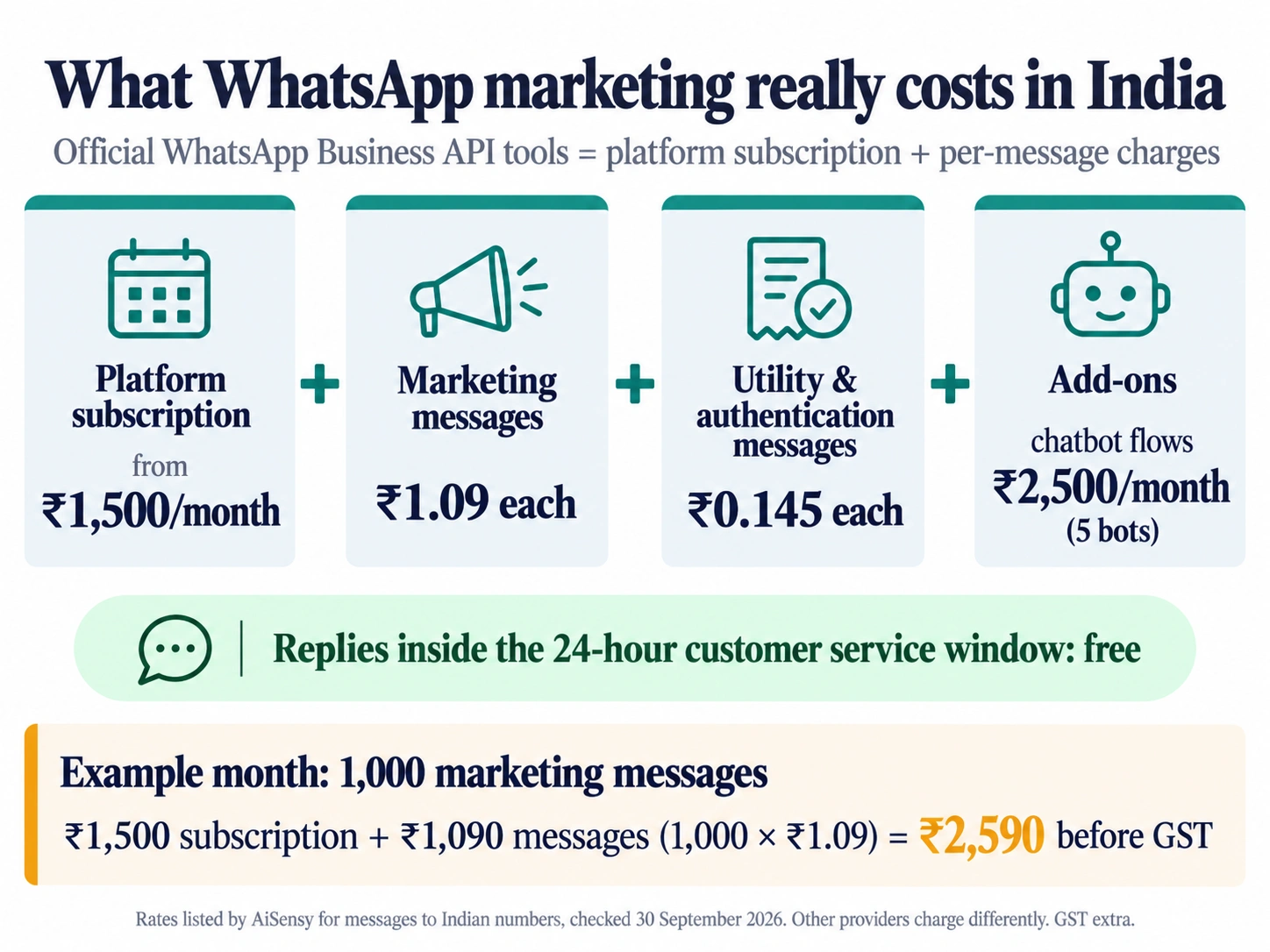
For many Indian businesses, WhatsApp does the job that email does elsewhere: order updates, offers, lead follow-ups and support. Official WhatsApp Business API tools charge a platform subscription plus per-message fees, so compare total cost, not just the plan price. Our Wati vs AiSensy vs Interakt comparison breaks this down, and the best WhatsApp CRM software for Indian businesses covers the CRM side.
6. AiSensy: best WhatsApp marketing platform for most Indian SMBs
AiSensy was the overall pick in our hands-on WhatsApp test for its low entry price, unlimited agents and India-hours phone support. Its pricing page lists per-message charges for Indian users alongside the plans, and replies inside the 24-hour customer service window are free. See AiSensy pricing.
Watch out for: chatbots and AI agents are paid add-ons on top of the subscription, and message credits are prepaid.
7. Interakt: best for Shopify and D2C brands
Interakt's Shopify integration was the deepest of the three platforms we tested: catalogue sync, abandoned-cart flows and COD-to-prepaid nudges work natively. See Interakt pricing.
Watch out for: in our July 2026 check, the widely advertised ₹999 Starter plan was Instagram-only; WhatsApp needed quarterly billing or a higher plan. Interakt's site blocked our automated check on 30 September, so confirm current plans directly.
8. Wati: best for agencies and multi-channel inboxes
Wati's inbox brings WhatsApp, Facebook, Instagram and TikTok messages together, and its higher plans add AI agents and multiple WhatsApp numbers. The pay-as-you-go plan suits businesses that only send occasional bulk campaigns. See Wati pricing.
Watch out for: the Growth plan is capped at three users with no option to add more, so growing support teams have to move to Pro.
9. Textedly: SMS marketing for businesses texting US customers
Textedly was on the original version of this list and remains a straightforward SMS tool: every plan includes all features, incoming messages are free, and price scales only with message volume. See Textedly pricing.
India note: Textedly is built around US phone numbers (toll-free and 10DLC), so it isn't a fit for texting Indian customers. Promotional SMS in India requires DLT registration under TRAI rules, which Indian SMS gateways handle.
Best social media management tools
For a tested ranking of the category, see our best social media management tools guide. Here are three picks for different budgets.
10. Buffer: best simple scheduler for small teams
Buffer charges per connected channel, so you only pay for the accounts you manage. It supports the major networks including Instagram, LinkedIn, TikTok, YouTube Shorts, Threads and Google Business Profile, and the Team plan adds unlimited users and approval workflows. See Buffer pricing.
Watch out for: no social listening, and approvals are Team-plan only.
11. Hootsuite: best for larger teams that need inbox and listening
Hootsuite combines scheduling, a shared social inbox, brand monitoring and AI drafting in one dashboard. It's built for teams handling social as both marketing and customer service. See Hootsuite pricing.
Watch out for: per-user pricing adds up fast; a three-person team on Standard pays roughly $300 a month.
12. MeetEdgar: best for recycling evergreen content
MeetEdgar, also on the original list, stores your posts in a content library and re-shares them automatically by category, so the queue doesn't run dry. It now supports TikTok, Threads, Bluesky and YouTube Shorts alongside the usual networks. See MeetEdgar pricing.
Watch out for: the social inbox is only on the Edgar plan, and the model suits evergreen content better than news-driven posting.
Best SEO and content research tools
SEO tools now track AI search visibility as well as Google rankings. For a longer list, including budget options such as SpyFu, see our SEO tools guide. If you're deciding where to invest between SEO and AI search, our explainer on GEO vs AEO vs SEO is a useful starting point.
13. Semrush: best all-round SEO and competitor research platform
Semrush covers keyword research, site audits, rank tracking and competitor analysis, and its newer plans track how your brand appears in ChatGPT, Perplexity, Gemini and Google AI results. Adobe completed its acquisition of Semrush on 28 April 2026. See Semrush pricing.
Watch out for: daily tracking of your own AI prompts and MCP access start on the $199 Starter plan, and extra users cost from $45/month each.
14. Ahrefs: best for backlink and content research
Ahrefs is known for its backlink index and Site Explorer. The low-cost Starter plan is useful for occasional keyword and competitor checks, while Lite and above add rank tracking, site audits and AI prompt tracking. See Ahrefs pricing.
Watch out for: Lite includes only one user, and additional users cost extra on every plan.
Best analytics tools
15. Google Analytics 4 + Google Search Console: best free measurement stack
Set these up before you pay for anything else. GA4 shows where visitors come from and what they do, and Search Console shows which Google searches bring them in and flags indexing problems. Both connect to most of the tools in this guide. Google Analytics · Search Console.
Watch out for: GA4 needs deliberate setup (conversion events, consent handling) to produce trustworthy numbers.
16. Microsoft Clarity: best free heatmap and session recording tool
Clarity shows how visitors scroll, click and get stuck on your pages, which numbers in GA4 alone can't tell you. Microsoft positions it as free forever, and it has added reports on how AI experiences cite and crawl your site. For most small sites it's a sensible alternative to paid behaviour-analytics tools. Microsoft Clarity.
Privacy note: session recordings capture user behaviour, so mention them in your privacy notice and mask sensitive fields. Our DPDP compliance guide explains what India's data protection law expects.
Best design tool
17. Canva: best design tool for non-designers
Canva publishes INR pricing for India, and even the paid plans are inexpensive by marketing-software standards. Pro adds premium templates and stock, AI tools such as background removal and resizing, and content scheduling; Business adds team collaboration and approvals. See Canva pricing.
Watch out for: AI features draw on a monthly allowance, and Pro Lite doesn't include social scheduling.
Best automation and project management tools
18. Zapier: best for connecting your marketing tools
Zapier connects 9,000+ apps, so a new Facebook lead can land in your CRM, trigger a WhatsApp message and post to Slack automatically. It supports INR billing among other currencies. See Zapier pricing.
Watch out for: every action uses tasks, and AI steps can use more than one, so costs track usage closely.
19. Asana: best for planning campaigns and approvals
Asana's Starter plan adds timelines, forms, unlimited automations and unlimited free guests, which makes it easy to bring in freelancers and agencies. See Asana pricing.
Watch out for: the free plan is now limited to two users (the 2020 version of this article said 15, which is no longer true).
20. monday.com: best visual work management for marketing teams
monday.com is easy to adopt and flexible enough to run a content calendar, campaign tracker and request intake on the same boards. Standard adds timeline and calendar views, guest access and automations. See monday.com pricing.
Watch out for: the three-seat minimum on paid plans, and Standard's 250 automation actions a month can run out quickly.
For more options, including Trello and ClickUp, see our project management software for small businesses.
Best marketing automation for B2B and enterprise
These three were all on the original list under older names. They're powerful but expensive and need implementation effort, so they suit companies with a dedicated marketing operations function. We haven't run paid trials of these suites; the notes below come from vendor documentation.
21. Salesforce Marketing Cloud Account Engagement (formerly Pardot)
Salesforce renamed Pardot to Marketing Cloud Account Engagement in 2022, and now groups its marketing products under the Agentforce Marketing brand. Account Engagement remains the B2B lead nurturing product for Salesforce CRM users. See Account Engagement.
Watch out for: pricing is per organisation and scales by contact database size; confirm the current list price with Salesforce.
22. Adobe Marketo Engage
Marketo Engage is built for large marketing operations teams running many programmes across regions. It syncs natively with Salesforce, Microsoft Dynamics and Veeva CRMs, and fits into Adobe's wider customer-experience stack. Adobe publishes package features but not prices. See Marketo Engage packages.
Watch out for: it usually needs a dedicated admin or implementation partner to get full value.
Also consider: Microsoft Dynamics 365 Customer Insights – Journeys, the product formerly called Dynamics 365 Marketing, for organisations standardised on Microsoft; Constant Contact Lead Gen & CRM, the new name for SharpSpring, for agencies (pricing is demo-based); and Act-On for mid-market B2B automation.
Recommended marketing stacks by stage
Most businesses don't need every category at once. These stacks use only the tools and prices above; add GST where applicable.
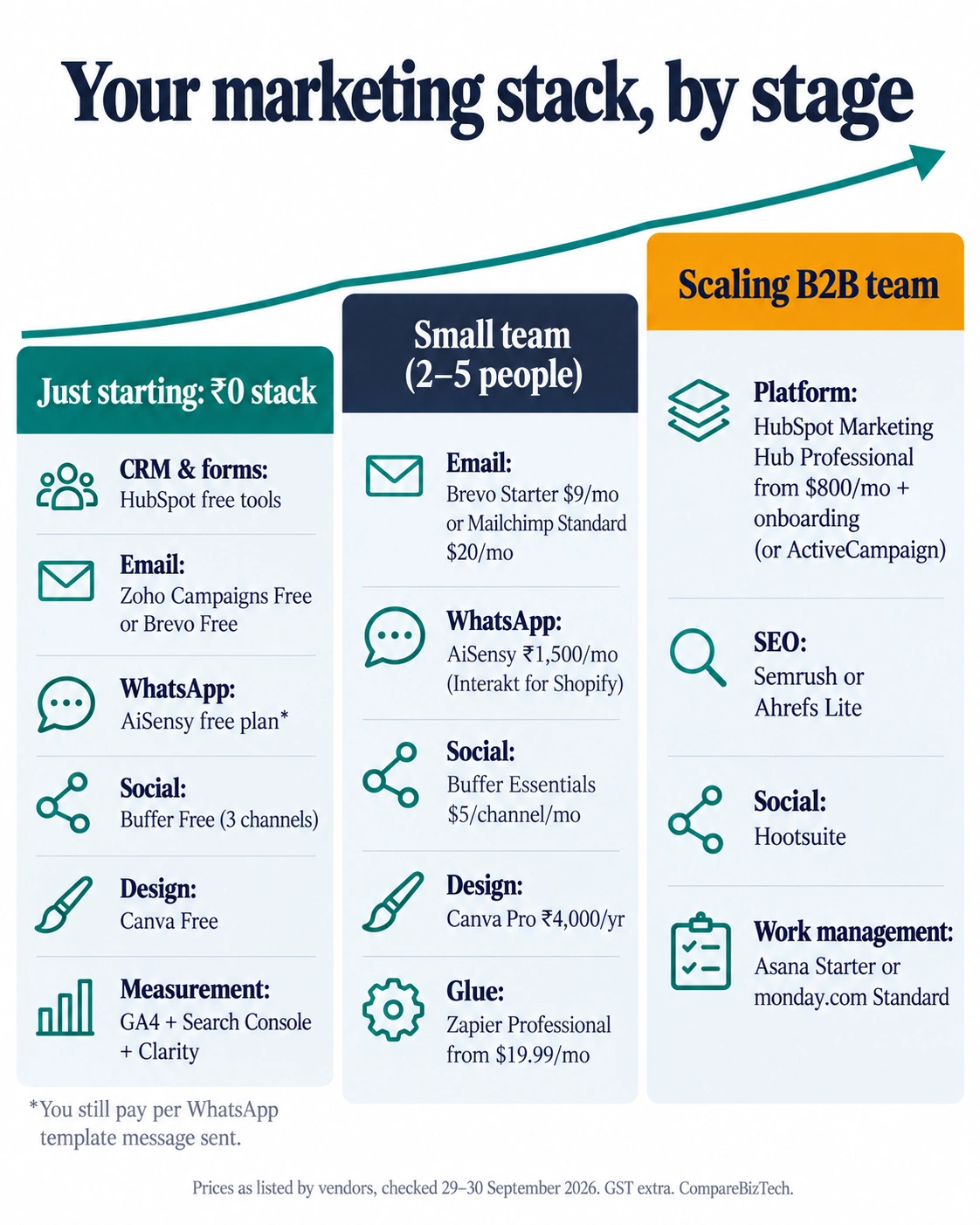
Just starting: a ₹0 stack
- CRM and forms: HubSpot free tools
- Email: Zoho Campaigns Free (up to 2,000 contacts) or Brevo Free
- WhatsApp: AiSensy free plan (you still pay per template message sent)
- Social: Buffer Free (3 channels)
- Design: Canva Free
- Measurement: GA4, Search Console and Microsoft Clarity
Small team (2–5 people), first real budget
- Email: Brevo Starter ($9/mo) or Mailchimp Standard ($20/mo)
- WhatsApp: AiSensy (₹1,500/mo), or Interakt if you run on Shopify
- Social: Buffer Essentials ($5 per channel per month, annual)
- Design: Canva Pro (₹4,000/yr)
- Glue: Zapier Professional (from $19.99/mo) if tools need to talk to each other
Scaling B2B team with a sales function
- Platform: HubSpot Marketing Hub Professional (from $800/mo annual, plus onboarding), or ActiveCampaign if email automation is the core need
- SEO: Semrush or Ahrefs Lite
- Social: Hootsuite if you need a shared inbox and monitoring
- Work management: Asana Starter or monday.com Standard
How to choose marketing software (India checklist)
- Start with the channel that already brings customers. If orders come through WhatsApp, a WhatsApp platform will earn its cost faster than an enterprise automation suite.
- Check the billing model, not just the price. Email tools charge by contacts or by sends; WhatsApp tools add per-message fees; social tools charge per user or per channel. Model your real volumes.
- Confirm currency and invoicing. Some vendors, including Canva and Zoho, show INR pricing; many bill in USD. Check whether you'll get an invoice that works for GST input credit before committing.
- Plan for Indian compliance. Promotional SMS needs DLT registration, and consent and data handling fall under the Digital Personal Data Protection Act. See our DPDP compliance guide.
- Make sure it connects to your CRM. Marketing data that never reaches sales is wasted. If you haven't picked a CRM yet, read how to choose CRM software and our AI CRM software for Indian businesses.
- Test on a free plan or trial with real work. Send an actual campaign, schedule a real week of posts, then decide.
- Price the next tier up. The plan you need in a year matters more than today's entry price.
All-in-one platform or separate tools?
An all-in-one platform like HubSpot keeps data in one place and reduces integration work, but you pay for features you may not use and upgrades can be expensive. Separate best-of-breed tools are often cheaper and stronger in each category, but you'll spend time connecting them, usually with Zapier. As a rule of thumb, small teams with one marketer usually do better with a few focused tools; teams with sales and marketing working the same leads tend to benefit from a shared platform.
How much does marketing software cost?
Most categories have a usable free tier, and entry paid plans for small businesses typically cost between a few hundred and a few thousand rupees a month per tool. Based on the vendor pricing checked for this guide:
- Email: free plans from Brevo, Mailchimp and Zoho Campaigns; paid plans from $9–$20 a month for small lists.
- WhatsApp: subscriptions from about ₹1,500–₹2,500 a month, plus per-message charges (AiSensy lists ₹1.09 per marketing message to Indian users).
- Social: Buffer from $5 per channel a month; Hootsuite from $99 per user a month.
- SEO: Ahrefs Starter at $29 a month; full SEO suites from about $129–$139 a month.
- All-in-one and enterprise: HubSpot Professional from $800 a month; enterprise B2B automation from roughly $1,250 a month.
Hidden costs to budget for: onboarding fees, extra users or seats, contact-tier jumps, add-ons (chatbots, SMS credits, AI credits) and GST.
What changed since the previous version
The original 2020 list included several tools that have since been renamed, changed focus, or were never really marketing software. Here's what we changed and why:
- Renamed and updated: Pardot is now Salesforce Marketing Cloud Account Engagement; SharpSpring is now Constant Contact Lead Gen & CRM; Dynamics 365 Marketing is now Dynamics 365 Customer Insights – Journeys; SEMrush is now styled Semrush and is owned by Adobe; Net-Results is being renamed Paminga.
- Removed because they aren't marketing software: Notifii (package management), Groove (a help desk; the old link pointed to a different company) and Adapt (a B2B contact database, better suited to our lead generation tools guide).
- Removed as too niche or low relevance for SMBs: Bounceless (email verification), Net-Results/Paminga and Marketing 360.
- Moved to more specific guides: Wix (see best website builders), SpyFu and BuzzSumo (SEO and content research), Trello and Wrike (project management).
- Kept and updated: HubSpot, Mailchimp, Semrush, Canva, Zapier, Asana, monday.com, MeetEdgar and Textedly, with current pricing and corrected details.
- Added: Brevo, ActiveCampaign, Zoho Campaigns, AiSensy, Interakt, Wati, Buffer, Hootsuite, Ahrefs, GA4 + Search Console and Microsoft Clarity.
Frequently asked questions
What is the best marketing software for small businesses?
For most small businesses, HubSpot Marketing Hub is the best all-in-one option because it combines email, forms, automation and a free CRM. If budget matters more than having everything in one place, Brevo for email and messaging plus Canva, Buffer and Google Analytics 4 covers the essentials at low cost.
What is the best marketing software for businesses in India?
Indian businesses should prioritise WhatsApp, because it's where many customers already talk to brands. AiSensy is a strong value choice, Interakt suits Shopify stores, and Wati suits agencies. For email, Zoho Campaigns offers INR pricing and a generous free plan, and Canva publishes INR prices for design.
Is there free marketing software?
Yes. Google Analytics 4, Google Search Console and Microsoft Clarity are free. HubSpot, Zoho Campaigns, Brevo, Mailchimp, Buffer, Canva, Zapier, Asana, monday.com and Semrush all have free plans with limits. A small business can run a basic marketing operation on free plans alone.
How much does marketing software cost per month?
Entry paid plans usually cost $5–$30 a month per tool for small teams, WhatsApp platforms start around ₹1,500–₹2,500 a month plus message charges, and all-in-one or enterprise automation platforms range from hundreds to thousands of dollars a month. Taxes such as GST are extra.
Should I choose an all-in-one platform or separate tools?
Choose an all-in-one platform if sales and marketing share leads and you want one source of truth. Choose separate tools if you have a small team, a tight budget, or one dominant channel such as WhatsApp or email. Many businesses start with separate tools and consolidate later.
What’s the difference between email marketing software and marketing automation software?
Email marketing software sends campaigns and simple sequences to a list. Marketing automation software goes further: it tracks behaviour across channels, scores leads, branches journeys based on actions, and syncs with a CRM so sales can follow up at the right time.
Do I need a CRM as well as marketing software?
If you have a sales process, yes. Marketing software brings in and nurtures leads; a CRM tracks deals and conversations. Some platforms, such as HubSpot and Zoho, include both, which avoids syncing problems.
What happened to Pardot and SharpSpring?
Pardot was renamed Salesforce Marketing Cloud Account Engagement in 2022. SharpSpring was acquired by Constant Contact in 2021 and rebranded as Constant Contact Lead Gen & CRM. Both products still exist under their new names.
Final verdict
There isn't a single best marketing software, but there is a best starting point for most businesses: set up the free Google measurement stack, pick one platform for your main channel (HubSpot for an all-in-one approach, Brevo or Zoho Campaigns for email, AiSensy or Interakt for WhatsApp), and add Canva and a social scheduler. Upgrade only when a tool's limits are genuinely holding back results, and check the next pricing tier before you commit.
Browse more tools by category in our business software directory, or read AI marketing tools for AI-specific options.
Sources and pricing references
- Vendor pricing pages linked in each tool entry, checked 29–30 September 2026.
- Pardot rename: Forvis, June 2022; Agentforce Marketing: Salesforce.
- SharpSpring rebrand: Constant Contact Knowledge Base.
- Dynamics 365 Marketing rename: Microsoft documentation.
- Adobe's acquisition of Semrush: MarketScreener.
- Groove acquisition by Clari: Business Wire.
- Net-Results renaming to Paminga: Net-Results.
- Account Engagement list pricing: Redress Compliance 2026 guide (third-party; confirm with Salesforce).
- Interakt and Wati plan details: CompareBizTech hands-on comparison, updated July 2026.
Disclosure: CompareBizTech may earn a commission from some links on this page at no extra cost to you. It doesn't affect which tools we include or how we describe them. Read our affiliate disclaimer.

Praveen Kumar Panjiar is the founder of CompareBizTech.com, where he cuts through the noise in B2B tools with sharp, no-fluff comparisons. His work focuses on breaking down features, pricing, and real-world use cases, built specifically for high-intent buyers evaluating tools and looking to choose the right solution, fast.