

Someone typed a question about your industry into ChatGPT last week. Maybe they were comparing software, or looking for a local service, or just trying to understand something before they spent money on it. Did your business show up in the answer? Honestly, most owners have no clue. Nobody checked. Until pretty recently, there wasn’t much to check.
Not anymore. ChatGPT handles somewhere between 250 and 500 million searches a week on its own, and it’s passed a billion monthly users. Add Gemini, Perplexity, Claude, and Copilot into the mix, and you’ve got a real second channel now, one where people expect a straight answer instead of ten blue links to sort through. Quick reality check though: Google still sends the vast majority of search traffic on the internet, north of 85% by most measures, and every AI platform combined still sends a sliver of that. So no, don’t torch your SEO budget over this. But the AI slice is growing in multiples, not single-digit percentage points, and whoever figures out how to appear in ChatGPT search early gets a head start before the space fills up.
So, what actually moves the needle for getting cited, mentioned, or recommended by ChatGPT and the other big AI engines? And what’s mostly noise you can skip? That’s what this guide covers.
Can You Actually Optimize for ChatGPT?
Sort of. And the honest answer here matters more than the confident one you’ll find on most agency landing pages.
Here’s what nobody selling “GEO optimization” packages wants to say first: Google has stated, plainly, that there’s no separate index and no special markup for AI Overviews or AI Mode. Pages that already rank well in regular search are the ones that get pulled into AI answers, because AI Overviews draw from Google’s existing index and run the same quality checks it’s always run. No secret backstage ranking system waiting behind a curtain somewhere.
ChatGPT’s a different animal, because it isn’t just reading Google’s index. When it goes out and searches the live web, it’s largely pulling from Bing’s results, and it leans hard on a handful of sources it already trusts. Wikipedia especially. Perplexity does its own thing entirely, pulling a surprising amount from Reddit threads and forum chatter. ChatGPT SEO, if you want to call it that, isn’t really one discipline. It’s three or four overlapping ones, all sitting on top of decent SEO and genuinely useful writing, with a different accent depending on which engine you’re dealing with.
What can you actually influence? Whether your content ranks well enough to be seen at all. Whether it’s written so a model can lift a clean answer out of it without much effort. Whether your brand has enough of a footprint elsewhere that an AI system recognizes you as a real, credible thing rather than a random page. What you can’t do, no matter what a sales deck promises, is pay your way into a citation, guarantee a mention, or flip some switch that makes a language model pick you over a competitor with a better page.
How AI Engines Actually Pick Their Sources
Worth sitting with this one for a minute, because where each platform pulls from tells you exactly where to put your effort.
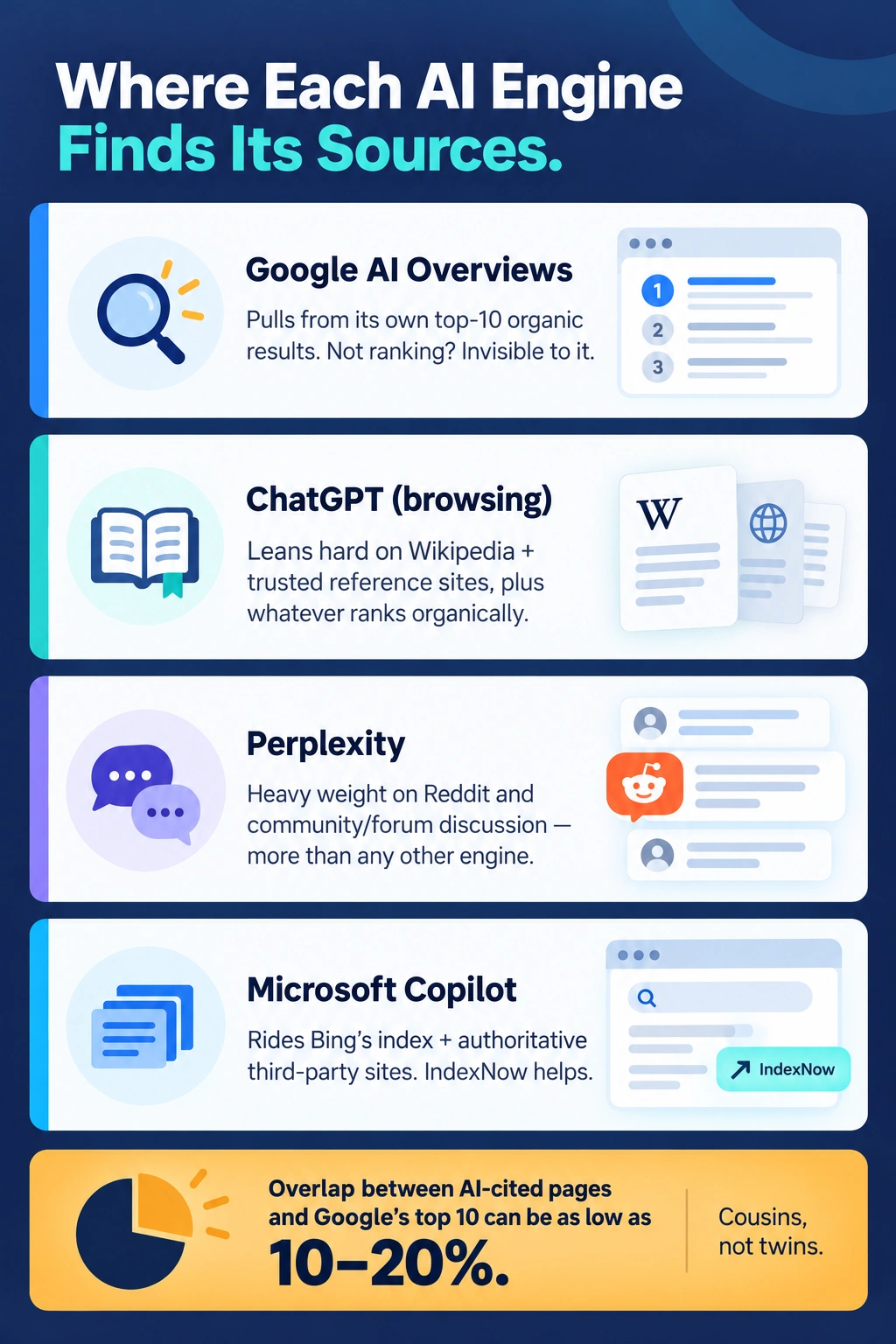 Google AI Overviews leans on pages already sitting in the top 10 organic results for most of what it cites. Not ranking? You’re basically invisible to it. Old-fashioned SEO, no way around that.
ChatGPT, when it’s browsing, leans hard on Wikipedia and other well-established reference sources, along with whatever’s ranking organically. If your industry has a decent Wikipedia presence and you’re not part of that conversation, you’re probably missing one of ChatGPT’s favorite hangouts. (Don’t go edit your own Wikipedia page though. It gets reverted within hours, and it looks exactly as bad as it sounds.)
Perplexity’s the odd one out here. It pulls a lot of weight from Reddit and community discussion, more than any other major AI search tool does. A polished product page on your own site can matter less to Perplexity than what actual people say about you in some subreddit you’ve never even visited.
Copilot mostly rides Bing’s index plus authoritative third-party sites, so old-school Bing SEO and fast indexing through tools like IndexNow genuinely help there.
One more wrinkle. Research comparing AI-cited pages against Google’s top 10 keeps finding the overlap is a lot smaller than you’d guess, sometimes as low as 10 to 20%. Ranking first on Google is a solid start toward better AI search visibility, sure. But it’s not a guarantee of a citation. The two systems are cousins, not twins.
Building Topical Authority, Not Just One Good Page
AI models trust businesses that clearly know their subject, same as a smart shopper would. A single brilliant article about, say, invoicing software, sitting next to a pile of thin two-paragraph posts on unrelated stuff, carries less weight than that same article would inside a site that’s actually built out the whole topic.
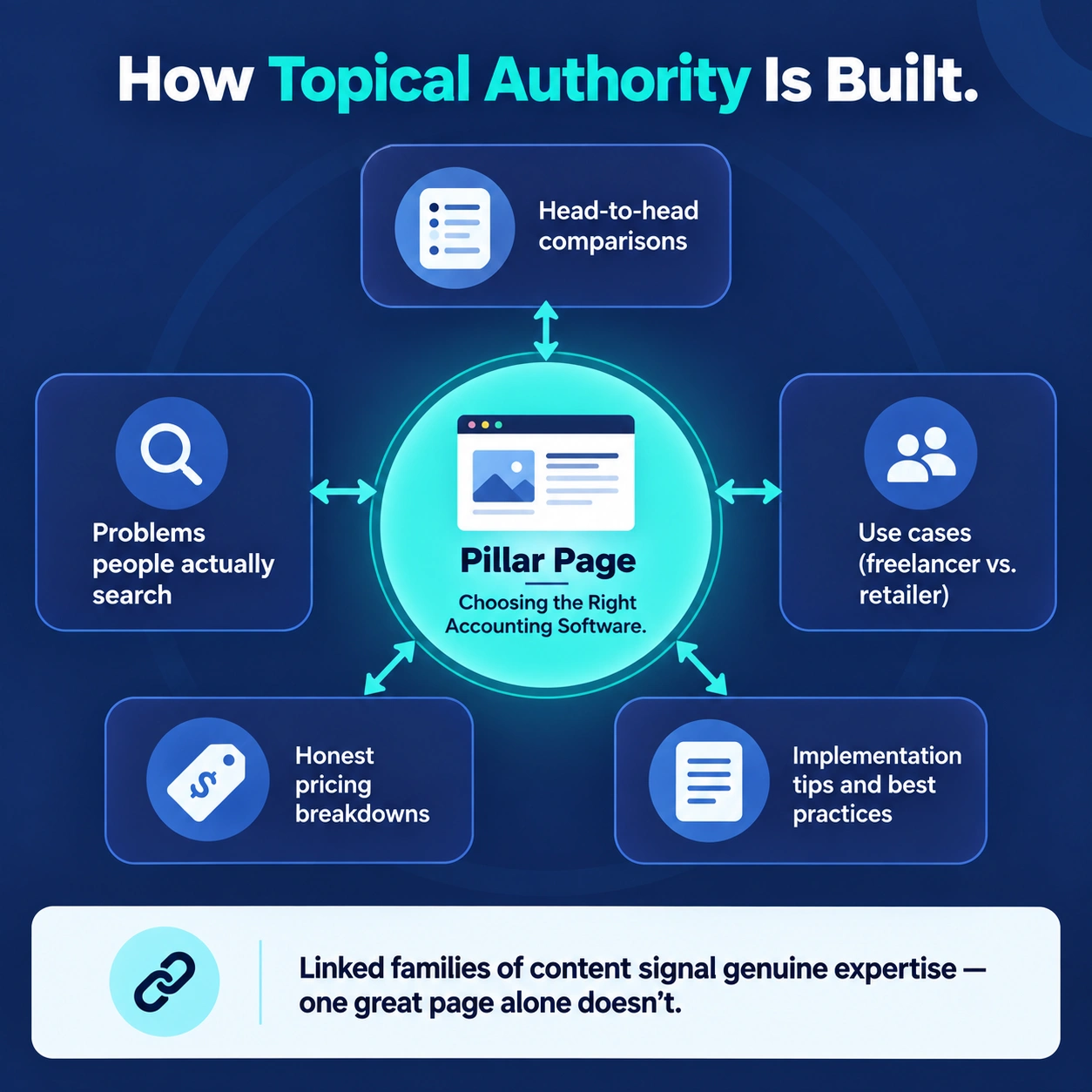
So, what does that look like day to day? Group your content into families instead of firing off random posts whenever an idea hits. Say you sell accounting software. You’d want a pillar page on choosing the right one, then supporting pieces on specific comparisons, different use cases (a freelancer’s needs aren’t a retailer’s needs, not even close), the problems people are actually searching for, and honest pricing breakdowns. Link them to each other. That’s how both search engines and AI crawlers figure out this is a subject you genuinely understand, rather than one you dipped into chasing a keyword for a week.
 It’s slower than throwing up a single viral post and hoping something sticks. But it’s the difference between being a source an AI model treats as dependable background knowledge and one it’s barely run into.
E-E-A-T Still Matters. Maybe More Than Before
E-E-A-T (Experience, Expertise, Authoritativeness, Trustworthiness) has been part of Google’s playbook for years, and it carried straight over into how AI systems decide what’s worth citing. If anything it counts for more now, because a chatbot summarizing an answer for a stranger is putting its own credibility on the line too. Whatever it pulls from needs to look trustworthy, fast.
What does that mean in practice? Start with the byline. A real name, an actual job title, a short bio explaining why this person knows what they’re talking about, not a placeholder. Then an author page or LinkedIn profile that exists and actually matches what the article claims about them. Original thinking helps too, not a rehash of whatever five other blogs already said last week, because a twelve-year-old could spot recycled content, and so, more or less, can a retrieval system. And whenever you drop a stat, source it. A number floating in a paragraph with nothing behind it reads as suspicious to readers and machines alike.
None of this is groundbreaking, and it never was. It’s just gotten more consequential, because generic, unattributed, interchangeable content is exactly what AI systems are getting better at quietly skipping past, in favor of something with an actual point of view behind it.
What Makes Content Worth Citing
One pattern shows up across nearly every study on this: specificity beats fluff, pretty much every time.
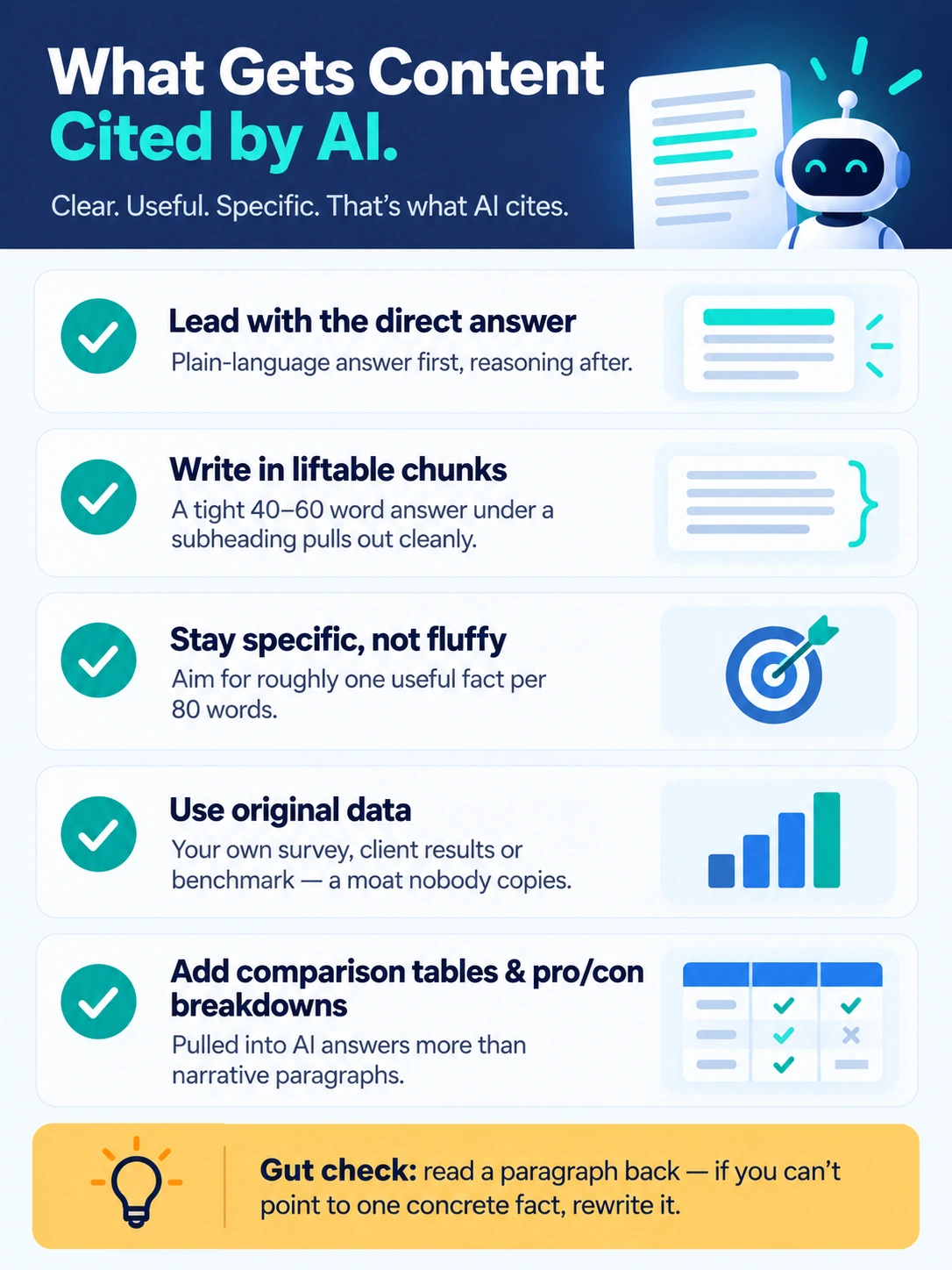
Content that gets cited tends to be dense with real facts rather than padded with filler. Concrete numbers, named examples, dated data, direct comparisons, instead of vague lines like “many businesses find this useful.” One study floated a rough benchmark, something like one distinct, useful fact per 80 words, for content that performs well in citations. You don’t need to hit that ratio exactly. It’s more of a gut check: read your own paragraph back, and if you can’t point to a specific fact anywhere in it, that paragraph probably needs work.
A handful of things consistently help with AI search optimization. Lead with the direct answer, plain language, before you get into your reasoning, because AI systems (like impatient readers) grab whatever clear answer shows up first. Write in short chunks a model can actually lift, a tight 40-to-60-word answer under a subheading pulls out cleanly, while the answer buried in the middle of a dense 300-word paragraph doesn’t. Original data beats borrowed data too, and it isn’t close, run a small survey, pull real numbers from your own client work, test something yourself, because that’s a moat nobody copies overnight and exactly the kind of thing that gets picked up since no one else has it. And comparison tables or honest pro/con breakdowns tend to get pulled into AI answers more than long narrative paragraphs, especially for anything shaped like “best X” or “X versus Y.”
Where Structured Data Actually Fits
This one gets oversold constantly, so let’s be blunt. Google has said, in plain English, that structured data isn’t required for its generative AI features, and there’s no special AI-only schema you need to bolt on. Anyone telling you a pile of schema markup will unlock AI citations is stretching the truth a bit.
Doesn’t make it useless though. It still earns you rich results in regular search, it helps engines correctly figure out who you are and what a page’s actually about, and a few independent audits found sites with clean Article, FAQPage, and Organization schema showing modestly better AI visibility than sites without it. Fair read: it’s a supporting signal, not a growth lever on its own. Add it because it’s good technical hygiene, not because it’s some magic switch.
Want a priority order? Cover Organization schema first, logo, social links, description. Then Article schema with a real author attached. Then FAQ Page schema, but only on pages that genuinely answer distinct questions rather than ones you’re stretching to fit the format. That covers most of the value here without turning into a six-month project.
Entity Signals: Making Sure AI Knows Who You Are
An “entity,” in search-nerd language, just means: does the system recognize your business as a real, distinct, trustworthy thing, separate from some random page with your name typed on it somewhere? This matters more now than it used to, since a model is effectively deciding whether to put your name behind an answer it’s giving a total stranger.
The building blocks aren’t glamorous, but they work. A consistent business name, address and description across your site, your Google Business Profile, and any directory you’re listed in. A Wikidata entry, if you happen to qualify for one. Social profiles that are actually active, not abandoned, and that link back to your site. Author bios with credentials that check out, ideally tied to real published work somewhere else.
None of it happens overnight. But it’s the difference between an AI model treating you as a known, citable source versus just another unverified page floating around in its retrieval pool.
Third-Party Mentions Do More Work Than Your Own Site
Here’s something that catches a lot of business owners off guard: what other people say about you, on sites you don’t own, often carries more weight toward an AI citation than what you say about yourself.
Getting reviewed, mentioned, or featured somewhere an AI model already trusts moves the needle more than yet another blog post on your own domain. A trade publication in your field. A legitimate “best of” roundup. A podcast appearance that gets transcribed and indexed somewhere. A real, organic mention in a relevant Reddit thread, which matters especially if you’re chasing visibility on Perplexity.
This is where old-school digital PR earns its keep again, honestly. One solid mention in a publication AI system already trust can outweigh weeks of publishing on your own blog. If you wrote off PR as a vanity metric a few years back, this is the argument for dusting it off.
Technical SEO Still Sets the Floor
None of the content or authority work matters if the crawlers can’t get in the door in the first place. A few things worth checking today, not next quarter:
Confirm your robots.txt explicitly allows the major AI crawlers, GPTBot from OpenAI, ClaudeBot from Anthropic, PerplexityBot, and Google-Extended (which governs whether Google can use your content for its generative features, separate from regular Googlebot). Surprisingly common mistake to have one of these accidentally blocked, usually left over from some aggressive “block all bots” plugin someone installed years ago and never touched again.
Page speed still counts. Slow pages get skipped by real-time retrieval the same way they get penalized in ordinary search. Server-side rendering matters more than people assume, too. If your key facts only show up after JavaScript finishes running, some AI crawlers may never see them at all, since they’re reading raw HTML the moment it arrives, not executing scripts the way a browser does.
And what about `llms.txt`, the file that’s supposed to hand AI systems a curated map of your site? Honest state of play in 2026: adoption’s climbed fast in raw numbers, while actual usage by AI crawlers sits at basically nothing. One widely cited analysis of over 130,000 domains found 97% of published llms.txt files got zero requests, and among the small share that did get hit, AI bots made up roughly 1% of the traffic. Google’s said flat out it doesn’t use it and has no plans to. OpenAI doesn’t document support for it either. Anthropic has at least engaged with the idea and publishes its own, but hasn’t confirmed Claude’s retrieval actually reads anyone else’s. Worth doing anyway? It takes one afternoon, it can’t hurt, and writing it forces you to take real stock of everything you’ve published. Just don’t let anyone bill you real money for it, and don’t expect it to move a single number.
Measuring Whether Any of This Is Working
You can’t improve what you never measure, and “I asked ChatGPT once and we showed up” doesn’t count as tracking.
The realistic starting point for a small business is a dedicated tool that runs a batch of prompts against several AI engines on a schedule and tells you when your brand shows up and how. Otterly.ai is the budget-friendly entry, starting around $29 a month, covering ChatGPT, Google AI Overviews, Perplexity, and Copilot in the core plan, with Claude and others available as add-ons. Outgrow that, and Profound or Semrush’s AI toolkit sit at the enterprise end, generally starting near $99 a month and climbing well past that.
Outside a paid tool, keep it simple. Check your analytics for referral traffic tagged as coming from chatgpt.com, perplexity.ai, and the like. Set a recurring reminder to manually ask each major platform a handful of questions a real customer would ask, and jot down whether you show up, how you’re described, and who you’re mentioned next to. Do it every month. Tedious, sure, but it’s the only honest way to know if any of this work is actually landing.
GEO Mistakes That Waste Time and Money
A few habits worth dropping, because they show up in nearly every agency pitch and DIY checklist out there.
Treating llms.txt like a growth hack, for one. As covered above, the evidence just isn’t there yet.
Assuming one platform’s playbook covers everyone else. Optimize purely for ChatGPT and assume Perplexity or Claude will fall in line, and you’ve got a real blind spot, since they pull from different places and reward different things entirely.
Chasing schema markup as the whole plan while the content underneath stays thin. Google’s been clear on this: no special AI schema exists, and structured data can’t rescue a page that has nothing to say.
Publishing generic, keyword-stuffed listicles that read like every other listicle out there. This is precisely the kind of content AI systems are getting sharper at recognizing and quietly skipping past, because it adds nothing that a hundred other pages haven’t already said.
Skipping third-party mentions entirely, too. If every signal about your business lives only on your own domain, you’re missing the outside trust signals these systems increasingly weigh.
And forgetting the basics. No amount of clever tactics fixes a slow site, blocked bots, or a page that isn’t ranking in regular search to begin with. GEO optimization sits on top of SEO. It doesn’t replace it, no matter how the acronym gets marketed.
A 30-Day Starter Plan
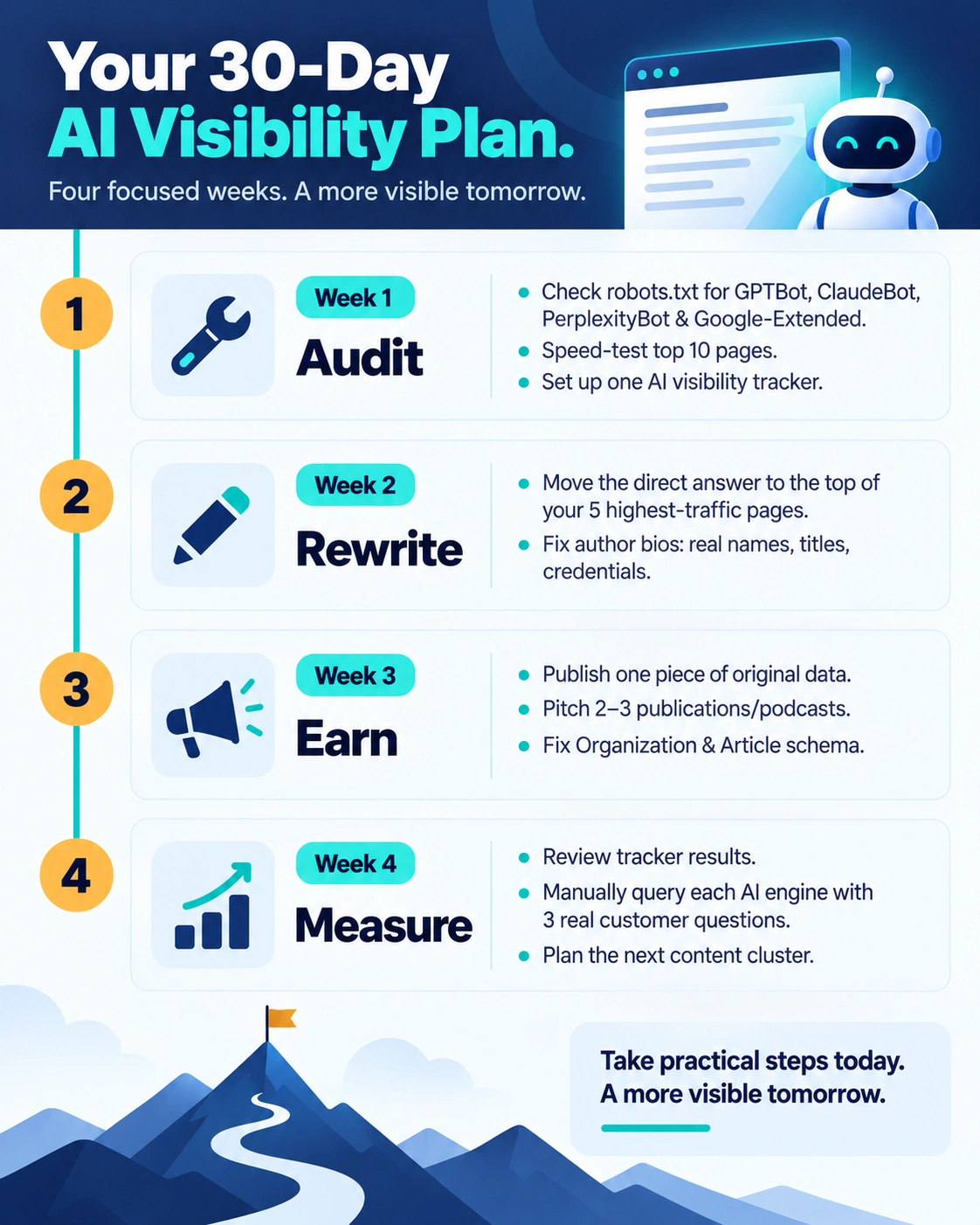 Week 1: Check robots.txt for GPTBot, ClaudeBot, PerplexityBot, and Google-Extended access. Run your top 10 pages through a speed check. Pick one AI visibility tool, Otterly.ai is a sensible starting point for most small businesses, and load in your first batch of prompts.
Week 2: Rewrite the opening 100 words on your five highest-traffic pages so the direct answer sits right up top, plain language, before you get into the reasoning behind it. Clean up author bios while you’re at it: real names, real titles, a sentence on why this person actually knows the topic.
Week 3: Find one piece of original data you can turn into a short post, a survey, a client result, an internal benchmark, whatever you’ve actually got lying around. Pitch two or three relevant publications or podcasts for a mention. Check your Organization and Article schema and fix whatever’s missing or broken.
Week 4: Look at what your visibility tool picked up over the past couple weeks. Manually ask each major AI platform three questions a real customer might ask, and write down what comes back. Based on where you’re weakest, pick your next content cluster and start planning it out.
None of this guarantees a citation by next month. Nothing does, and anyone promising otherwise is selling you something. This is just the actual, evidence-backed groundwork, and it’s the same groundwork that keeps paying off as these platforms keep shifting under everyone’s feet. Getting cited by ChatGPT isn’t a trick you pull once. It’s a habit you build.

Prashant Srivastava is a digital marketing leader and AI-powered growth strategist with nearly two decades of experience across SaaS, healthcare, real estate, D2C, and B2B. His expertise spans SEO, paid media, marketing automation, analytics, and Generative Engine Optimization, helping businesses achieve measurable, sustainable growth.