
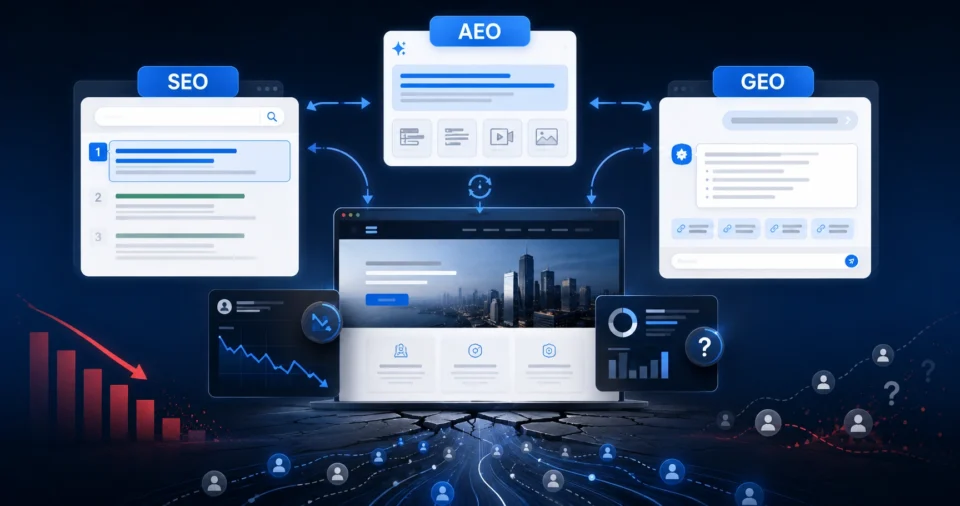
If you have spoken to a marketing agency in the year you have probably been handed three new acronyms and a bill. SEO, AEO, GEO. Everyone has a framework, a certification, a “2026 playbook.” Underneath all of it sits one question nobody wants to answer does any of this work and can you prove it?
That is the problem this August. Not that AI search exists that ship sailed two years ago. The problem is that the measurement, the traffic and the whole business model underneath search marketing is cracking at the time and a lot of what is being sold to small business owners right now is either recycled SEO with new letters stapled on or untested guesswork dressed up as a “framework.” Here is what is really going on piece by piece.
The terms overlap more than anyone wants to admit
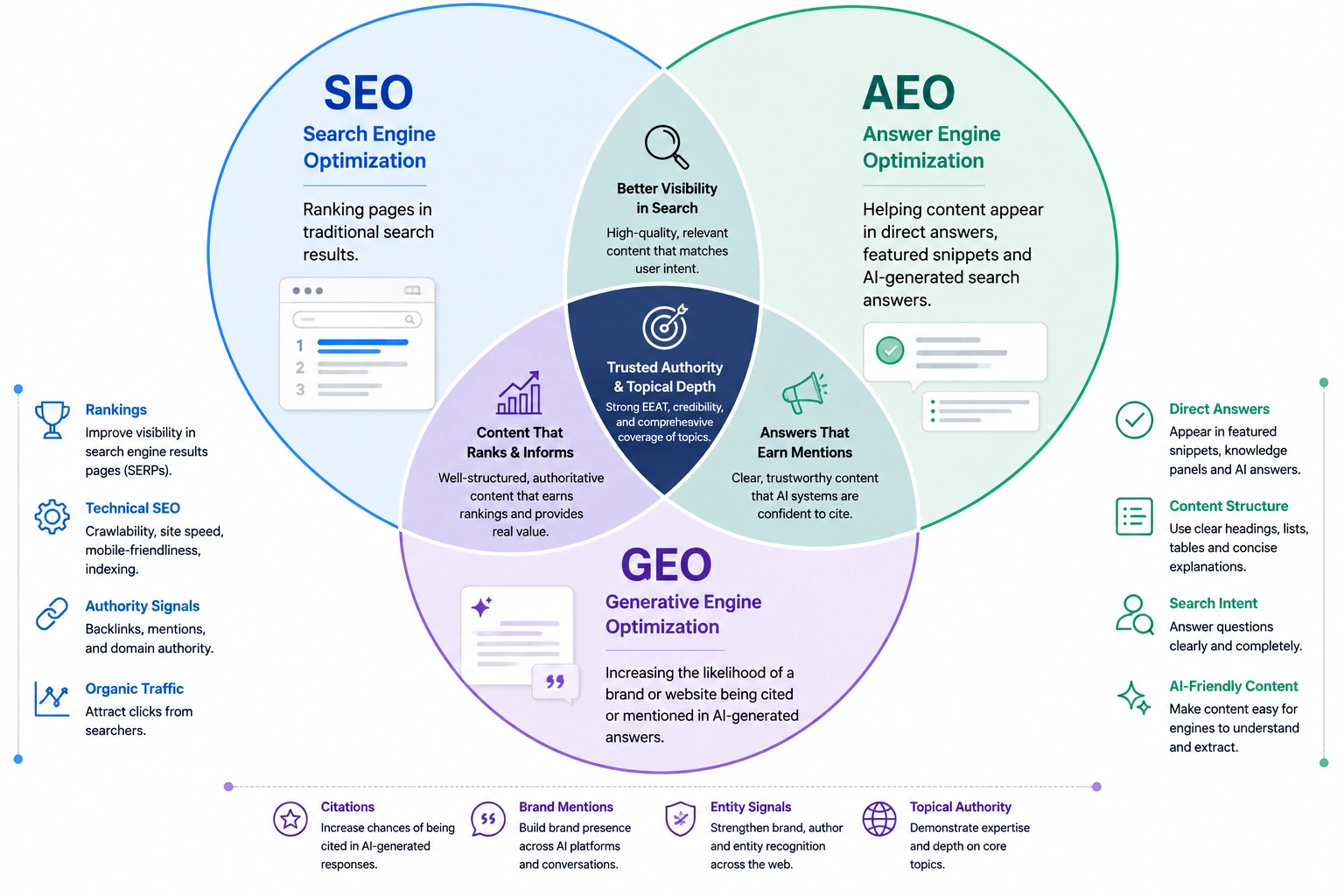 SEO is optimizing so Google (and other search engines) rank your page well in a list of links. AEO, Answer Engine Optimization means shaping your content so it gets pulled into an answer: a featured snippet, an AI Overview, a voice assistant reading it out loud. GEO, Generative Engine Optimization is narrower: getting cited or mentioned by name inside a chatbots generated answer whether that is ChatGPT, Gemini, Perplexity or Google’s AI Mode.
Nobody agrees where one ends and the next begins and agencies rarely say that part loud. Google published a guide in May 2026 arguing AEO is basically SEO with better formatting: same E-E-A-T principles, same crawlability requirements just packaged so AI systems can lift and summarize the content instead of only linking to it. Some practitioners said that matched what they were already doing. Others pushed back hard arguing that ranking and getting cited by a model are now two games with different rules. Both sides have a point. That disagreement is a part of why this space feels so messy right now.
Traffic is. Not evenly
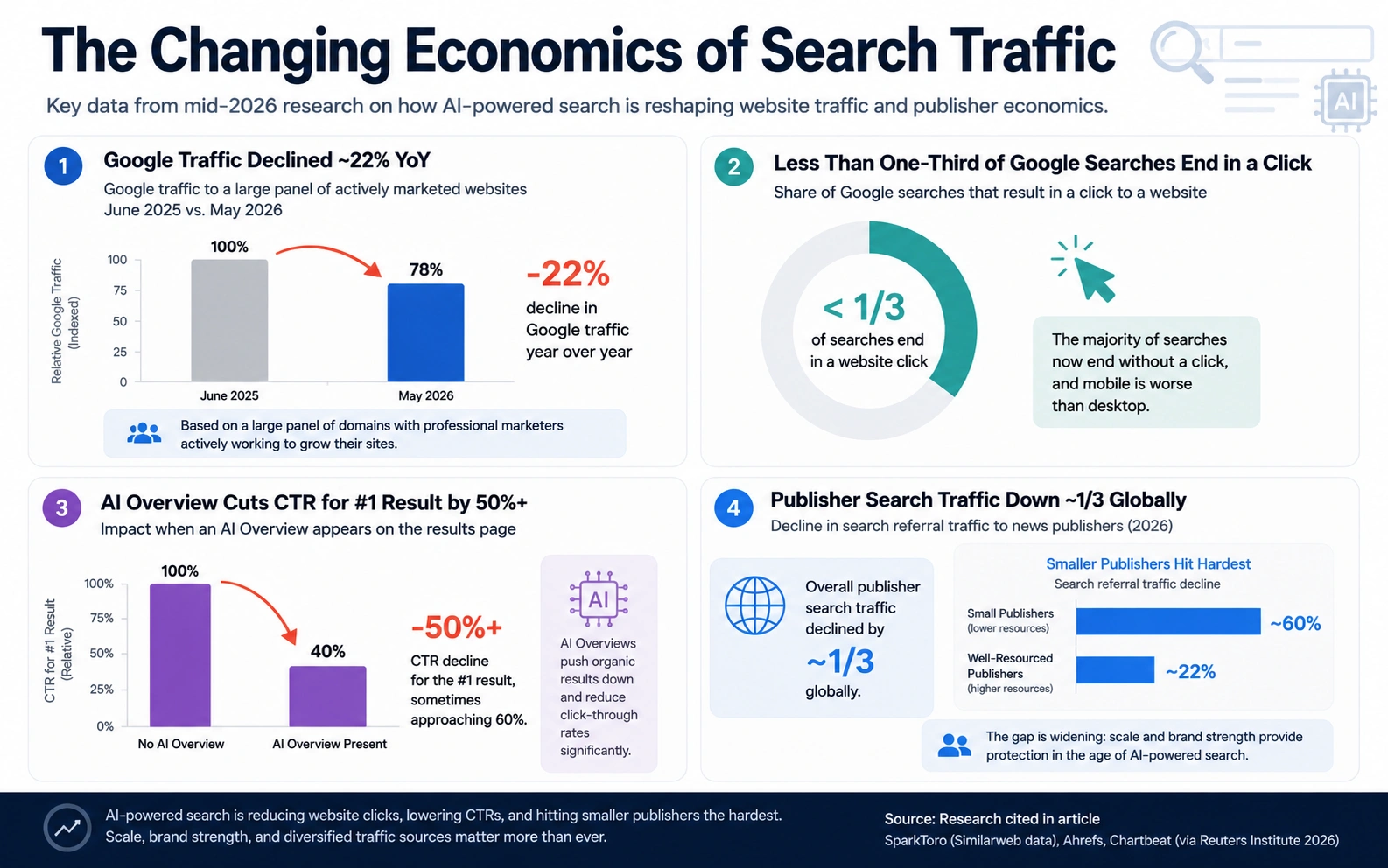 Start with the numbers because they are stark. SparkToros mid-2026 research, built on Similarweb panel data found Google traffic to a large group of actively marketed websites dropped about 22% in a single year, June 2025 to May 2026. These were not neglected sites. This is a panel of domains with professional marketers working to grow them. Less than a third of Google searches now end in a click to a website and mobile is worse than desktop.
Other firms measuring the collapse from different angles land in similar territory. Ahrefs looked at 300,000 keywords. Found that once an AI Overview shows up on a results page the click-through rate for the page ranking in position one drops by more than half, sometimes closer to 60%. Chartbeat data, cited in the Reuters Institutes 2026 media trends report showed publisher search traffic falling by a third globally and small publishers got hit hardest. They lost around 60% of search referral traffic compared to about 22% for well-resourced sites.
That gap matters if you run a business. Scale is protection now. A large publisher with a deep content library and existing brand recognition can absorb an AI Overview eating into its click-through rate because it still has volume, direct traffic and brand search to lean on. A ten-person SaaS company that built its lead pipeline on ranking for “best invoicing software” doesn’t have that cushion. If your model has always been “get traffic convert some percentage of it ” that model is under real pressure especially for the informational “how to” and “what is” content that used to be the front door of most funnels.
And it is not evenly distributed by query type. Informational searches (the “what is,” “how does X work” kind) are getting swallowed by AI Overviews at close to rates in some categories. Transactional queries, “buy X” or “price of Y ” are holding up better since people still generally want to click through before they hand over a credit card. If your content strategy leans heavily on top-of-funnel posts that is the category taking the biggest hit.
Nobody can actually prove what is working
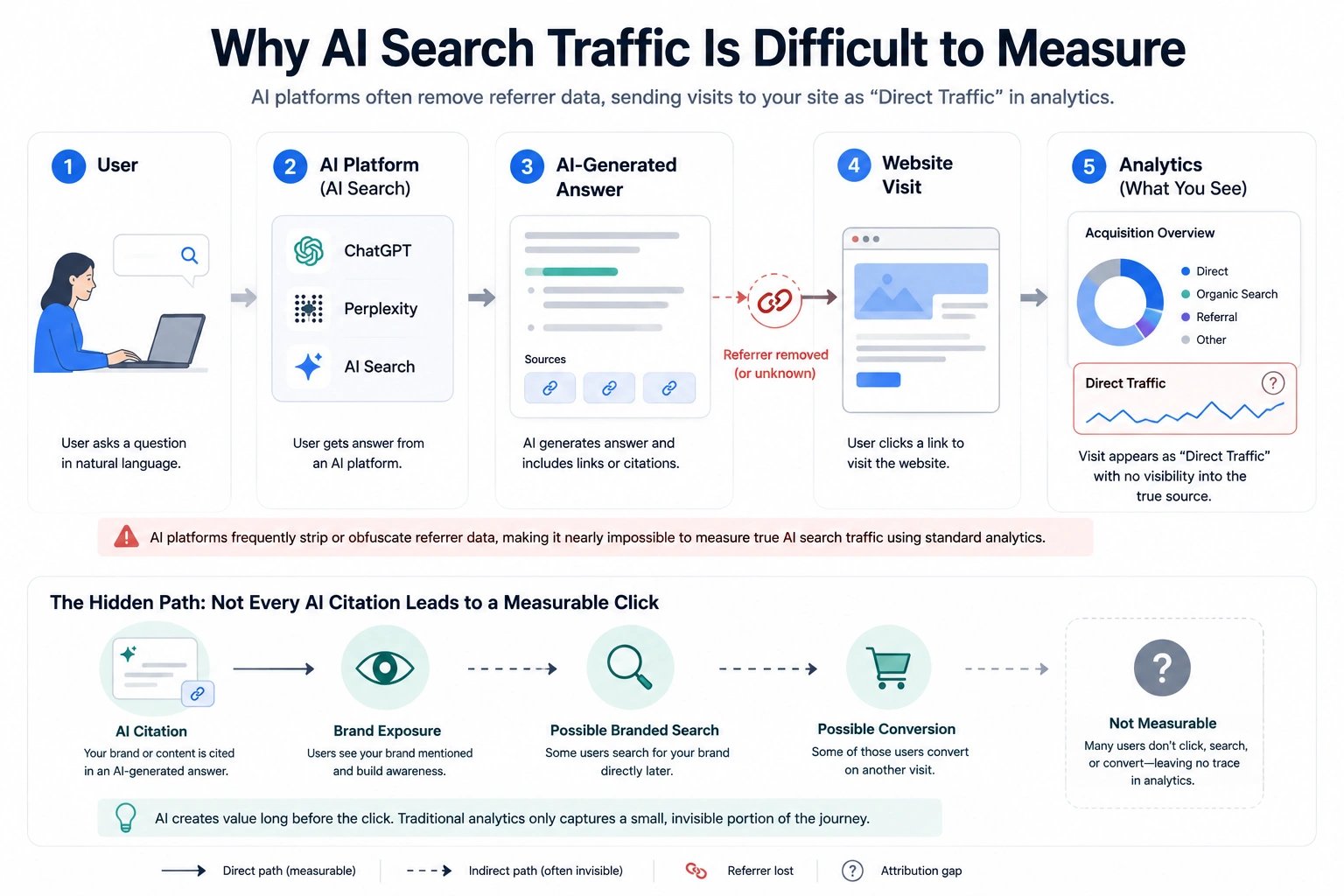 This might be the problem and it is the one most agencies gloss over because admitting it makes their retainer harder to justify. When someone lands on your site after chatting with ChatGPT or Perplexity most AI platforms strip the referrer before the click reaches your analytics. Google Analytics has nothing to attach the visit to. It gets dumped into “Direct traffic.” Industry estimates put somewhere between half and two-thirds of AI-driven traffic sitting invisibly in that bucket unless someone goes and builds a custom tracking setup to dig it out.
So when a business owner asks their marketing team whether the AI search push is working the honest answer now is: we are not fully sure because the tools were not built to see it. A 2025 Conductor survey found well over half of marketing leaders admit they can’t measure the return on their AI search optimization spend. That is not a niche complaint. That is most of the industry saying the thing.
It gets murkier still. Even when you can track a citation your brand getting mentioned by name inside an AI answer most of those mentions never produce a click. Research on Perplexity found around 12% to 18% of citations there ever generate a visit to the cited site. The rest is exposure with no measurable trail, a bit like someone mentioning your business at a dinner party you were not at. Maybe it helps. Maybe it plants a seed that shows up as a branded search two weeks later.. If you are trying to hand leadership a dollar figure you are mostly working with educated guesses and “assisted conversion” models, not hard numbers.
If a vendor promises you a provable GEO ROI figure this quarter push back and ask how. The honest ones are building dashboards, tracking citation frequency and share of voice as leading indicators and admitting up front that a clean revenue number is still mostly out of reach across the industry.
Ranking well and getting cited are turning into two jobs
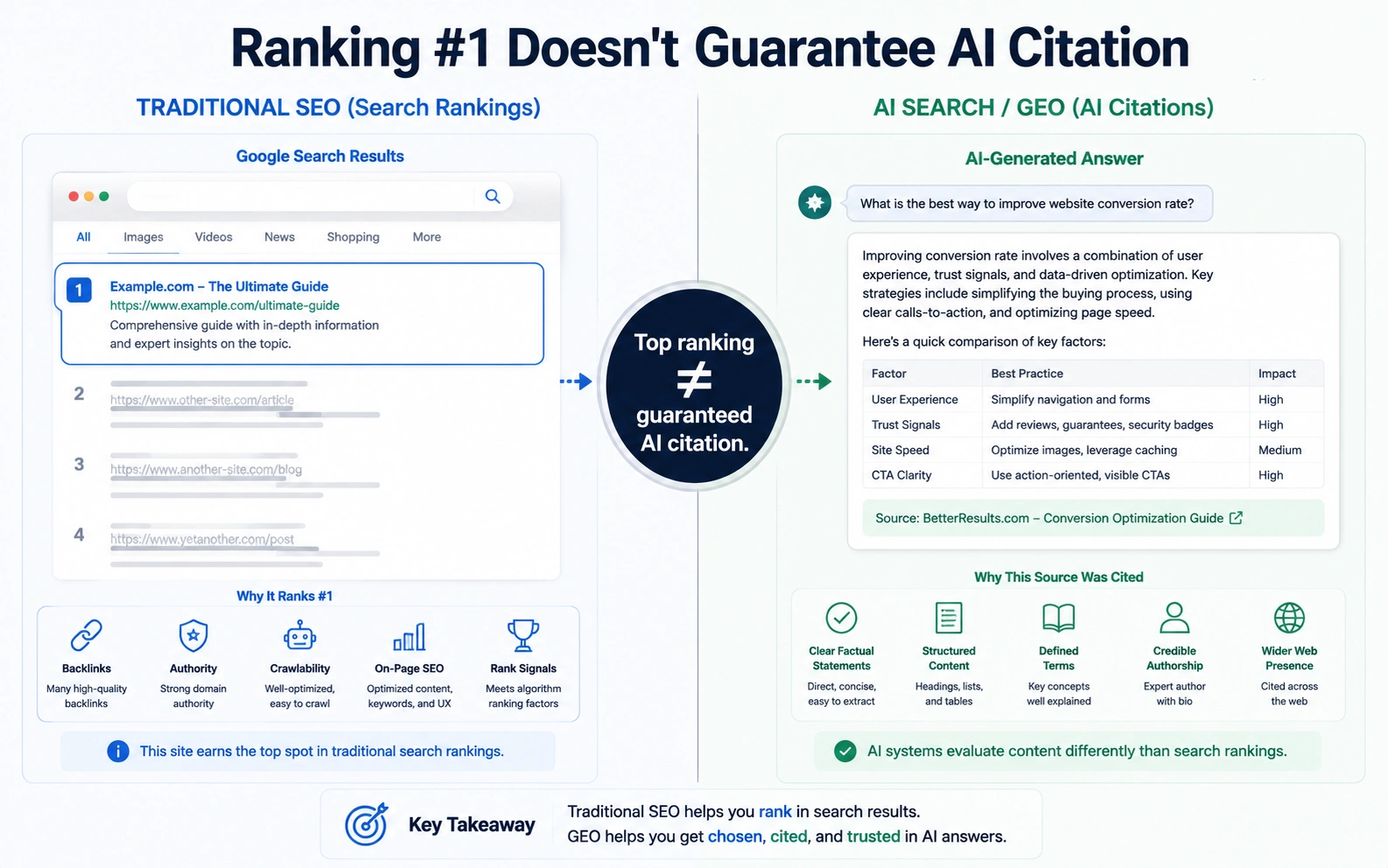 For years the assumption was simple: land in Googles top ten and you are basically set for everything downstream including AI visibility. That assumption is breaking. Ahrefs data from 2026 found the overlap between ten Google rankings and pages actually getting cited inside Googles own AI Overview has fallen under 40%. Your page can rank first on the results page and still get skipped entirely when the AI writes its summary in favor of some other source the model decided fit better for that particular question.
That is a headache for anyone trying to run one unified content strategy. Solid backlinks and a decade of domain authority the things SEO rewards no longer guarantee you will show up where a growing share of people are getting their answers. AI models seem to weigh how clearly a page states facts, how well it is structured for extraction ( headers, direct answers near the top defined terms, comparison tables) and how consistently a person or brand shows up as a credible source across the wider web, not just on their own site. Reddit threads YouTube videos and third-party comparison pages get pulled into AI answers constantly ahead of the brands own website.
In practice a chunk of your SEO budget and your GEO/AEO budget now buy things. You can’t assume one automatically covers the other anymore. As search evolves, these AI SEO tools can help businesses improve online visibility and adapt their optimization strategies.
Publishers and AI crawlers are heading toward a standoff
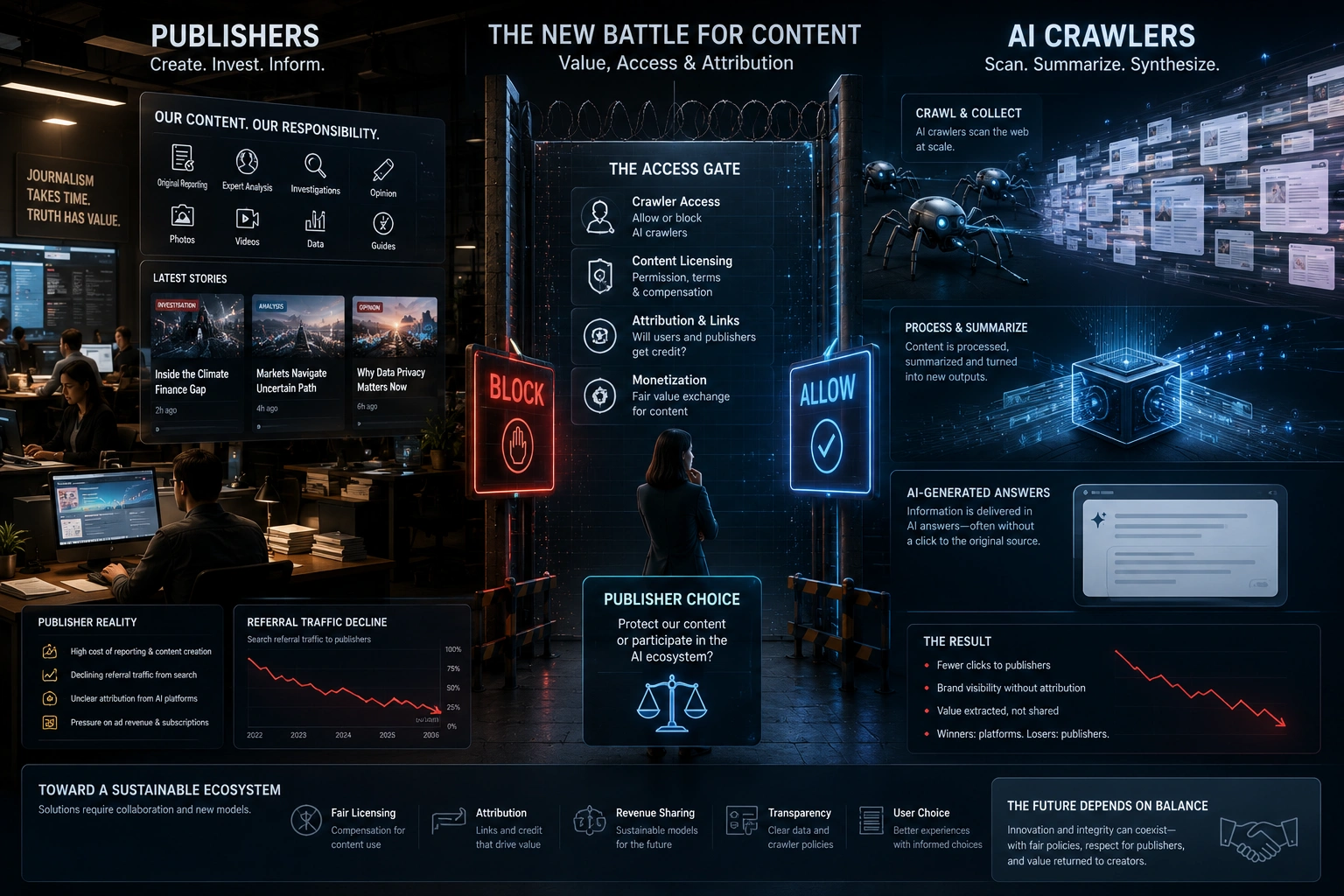 There is a fight happening in the background worth knowing about even if you don’t run a media company. Big publishers, outlets like Condé Nast and Time have spent 2026 openly modeling what their business looks like with a lot Google referral traffic because the numbers keep getting worse. Some sites are seriously considering blocking Googles AI crawlers betting that if their content is going to get scraped and summarized without sending a click back they would rather withhold it than give it away free. Cloudflares leadership has been pushing publicly for a paid licensing setup, a ” solution” that keeps sites discoverable by AI systems without handing over content for nothing.
Why should a small business owner care? Because this fight is going to shape what “visibility” even means next. If enough high-quality content locks AI crawlers out. The AI answers get worse pulled from thinner sources or licensing deals become normal and a new toll system forms between content creators and AI platforms. Nobody, including Google has landed on a long-term setup yet. Betting your content strategy on todays rules holding through 2027 would be a mistake.
Content has to work and it goes stale faster
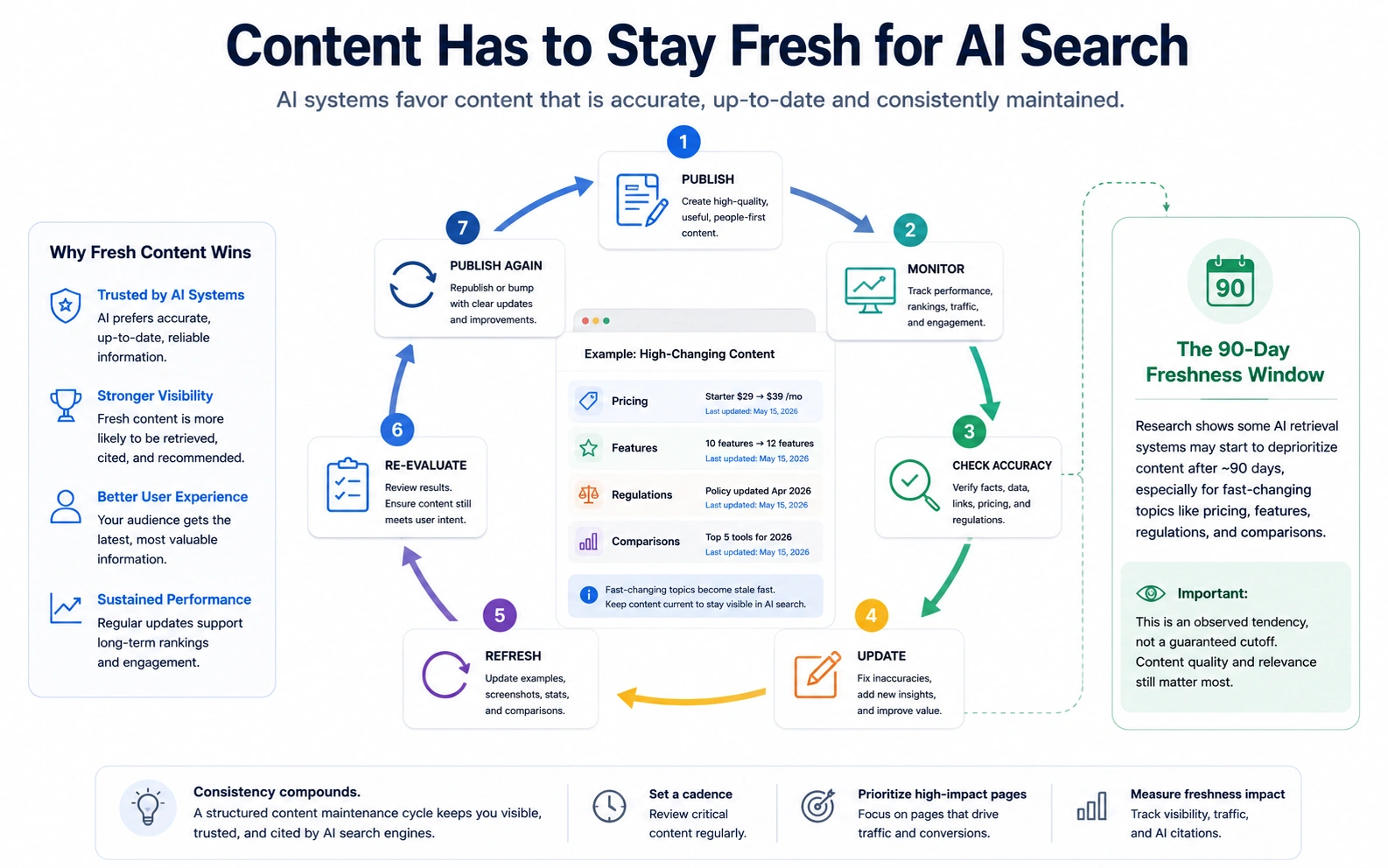 There is also a practical day-to-day headache: some AI platforms lean hard toward freshness. Perplexity in particular seems to deprioritize content fast. Analysis of its citation behavior suggests pages start losing retrieval priority to ones once they pass roughly the 90-day mark especially for anything that moves quickly like pricing, features or regulation. That is a shift, from classic SEO, where a strong well-linked page could coast on authority for years with only the occasional touch-up.
For a business content that used to be a one-and-done asset (a comparison page, a pricing breakdown, a “best tools for X” roundup) now needs a maintenance schedule. Not a full rewrite every quarter a real check: are the prices still right is the feature list current does the page still describe the market as it actually looks today. Skip that upkeep. You’re not just going stale for readers. You’re losing ground with the systems that are increasingly deciding who gets cited.
The advice itself is a mess. Some of it isn’t proven
Type “GEO strategy 2026” into any search bar and you’ll get dozens of confident frameworks most from agencies or vendors with something to sell. Some of it holds up: content, clear entity signals, consistent author credentials tied to real LinkedIn and organizational profiles schema markup that helps machines parse a page. Some of it is repackaged SEO wearing a badge.. Some of it is speculative built on small sample sizes or a handful of client case studies, presented with more confidence than the underlying research actually supports.
Here’s the honest part: AI platforms don’t publish how citation decisions get made. Search Engine Land has pointed out that prompt volume, the reasoning behind why one source gets picked over another and how much weight any single source carries in a blended answer are all currently invisible from the outside. For businesses looking to streamline AI-assisted optimization, these AI SEO tools can help maximize online visibility and rankings. They’re useful for spotting trends but the whole category is young. Anyone promising a guaranteed formula for getting cited by ChatGPT is selling certainty that doesn’t exist yet.
What a small or mid-sized business should do
Businesses on a limited budget can also use these free SEO tools to improve search visibility and strengthen their rankings.
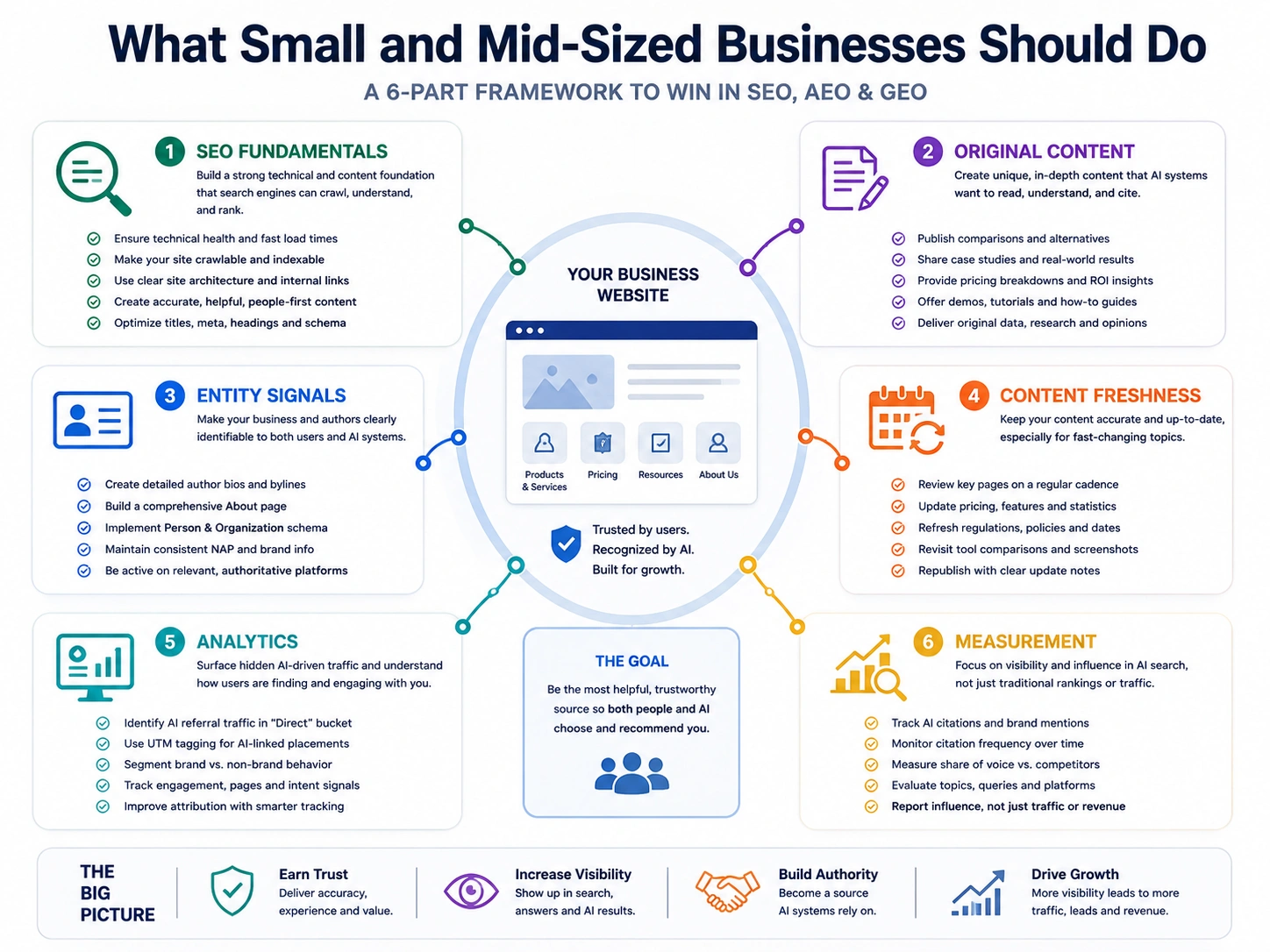
Don’t abandon SEO fundamentals. Every credible source in this space including Googles guide keeps landing on the same point: solid well-structured factually accurate content with real expertise behind it is still the foundation both traditional search and AI systems draw from. To strengthen your SEO foundation, explore these best SEO tools for improving website traffic, conversions, and search rankings.
Shift the content mix from pure top-of-funnel “what is” posts and toward things AI has a harder time replacing: original comparisons, real case studies with actual numbers, pricing breakdowns, demos, hands-on reviews. These are also the query types where AI Overviews show up least and where a real click still matters to the person searching.
Get entity signals in order. Consistent author bios, an About page, Person and Organization schema profiles on LinkedIn and Crunchbase that match what’s on your site. AI models increasingly weigh whos saying something, not whats being said, when they decide what to trust and cite.
Set up a freshness routine for anything time-sensitive: pricing pages, feature comparisons, ” tools” roundups. Even a light quarterly review beats letting a page sit untouched for two years.
Fix your analytics before you evaluate any GEO spend. Build a custom channel grouping in GA4 (or whatever you use) that tries to pull the AI referral traffic out of your bucket and add a simple “how did you hear about us” question to intake or demo forms. It won’t be perfect. It beats flying
And be skeptical of anyone selling a guaranteed GEO ROI number this year. Track citation frequency and share of voice as leading indicators treat the revenue connection as directional, than exact and revisit the whole approach every few months since the platforms themselves are still rewriting their own rules.
None of this is. I’d be suspicious of anyone who tells you it is. My guess: the businesses that do best over the year won’t be the ones chasing some secret GEO hack. They’ll be the ones that kept their content useful kept their technical house in order and stayed loose enough to adjust as the rules keep changing.

Prashant Srivastava is a digital marketing leader and AI-powered growth strategist with nearly two decades of experience across SaaS, healthcare, real estate, D2C, and B2B. His expertise spans SEO, paid media, marketing automation, analytics, and Generative Engine Optimization, helping businesses achieve measurable, sustainable growth.