
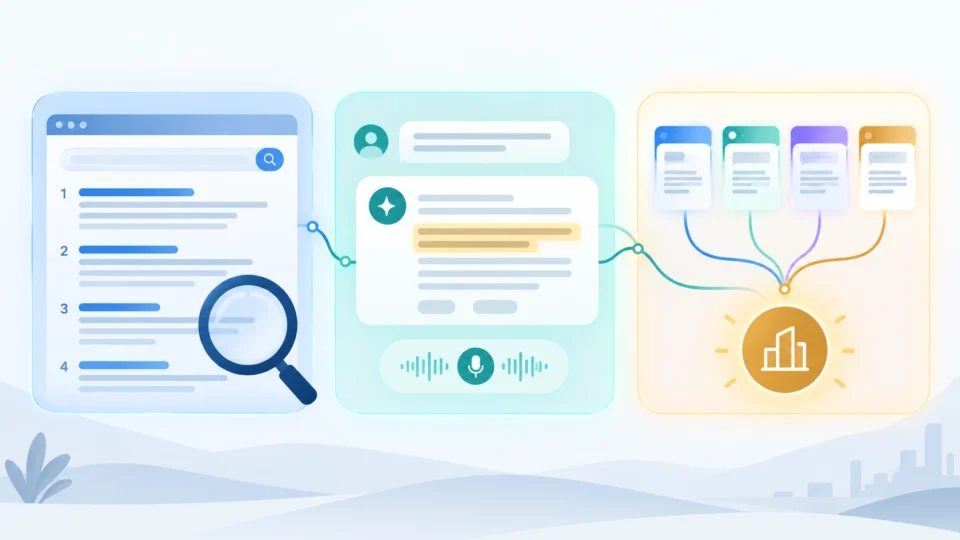
Somebody on your team said “GEO” in a meeting this year and you nodded like you knew what they meant. You didn’t. Honestly, neither did they, not really. The terminology around AI search has gotten messy fast, and three acronyms now get tossed around like they’re interchangeable: SEO, AEO, and GEO. They overlap. But they’re not the same thing, and mixing them up is exactly how a business ends up buying the wrong tool or panicking about a strategy it doesn’t need yet.
So, let’s actually sort this out. What each term means, where they overlap, where they genuinely split apart, and how much of your budget should go where, whether you’re running a five-person shop or a marketing department with a real headcount.
SEO, AEO, and GEO: The Quick Definitions
SEO (Search Engine Optimization) is the one you already know, so I won’t insult you by over explaining it. Getting your pages to rank in Google, people click through, you’re in business. Rankings, backlinks, keywords, page speed. The usual suspects.
AEO (Answer Engine Optimization) is a bit different, and it’s worth slowing down on. This is about getting your content pulled out and handed over as the answer itself, whether that shows up as a featured snippet on Google, something a voice assistant reads out loud, or a box at the top of an AI Overview. Put plainly, answer engine optimization means structuring what you write so tools like Google AI Overviews, ChatGPT, Perplexity, and voice assistants can lift it out and present it as the answer. Here’s the part that trips people up: you’re not even trying to get a click anymore. You’re trying to win the answer, full stop, even if nobody ever lands on your site.
GEO is the newest of the three, and also the fuzziest. Think of it this way: generative engine optimization is about shaping your content and your brand’s reputation across the whole internet, not just your own website, so that ChatGPT, Perplexity, and Claude actually mention you by name when someone asks a relevant question. That’s a bigger job than tweaking a page. It’s brand level, not page level.
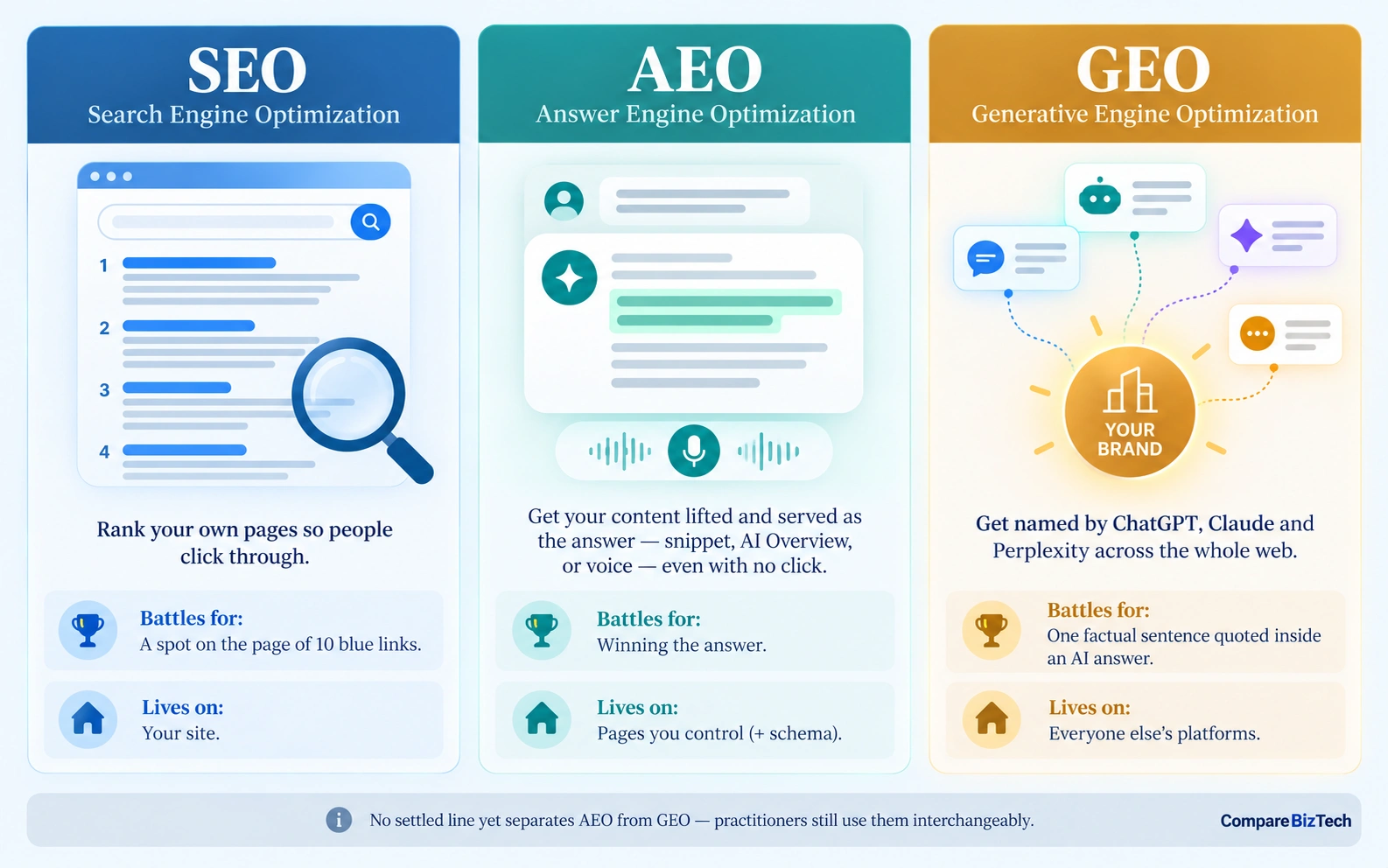 Now, a confession worth having upfront: nobody in this industry fully agrees where AEO stops and GEO starts. Ask five people and you’ll get five slightly different answers, sometimes from the same conference stage. There’s no settled definition separating these terms yet, and practitioners use them almost interchangeably half the time. So don’t feel behind if this all still feels a little blurry. It is blurry. Even the people selling the tools argue about it.
Where They Overlap
Strip away the acronyms and all three rest on the same floor: fast pages, clear writing, and actual expertise on whatever you’re writing about. Nobody skips that part, no matter which letter combination you’re chasing this quarter. Crawlable pages on a server that doesn’t crawl at a snail’s pace, that’s the shared foundation, and everything else builds up from there.
Even Google has weighed in here, and their take is worth knowing. Their own 2026 documentation basically argues that optimizing for AI search is just optimizing for search, full stop, still SEO under a new hat. Fair enough, if you’re only thinking about Google’s AI Overviews. But that framing quietly ignores what’s happening over on ChatGPT, Claude, and Perplexity, none of which crawl or rank pages the way Google does. So, take Google’s version with a grain of salt. It’s true for their own product. It’s not the whole story.
Where They Actually Diverge
This is the part that should actually shape your budget, so stick with me here.
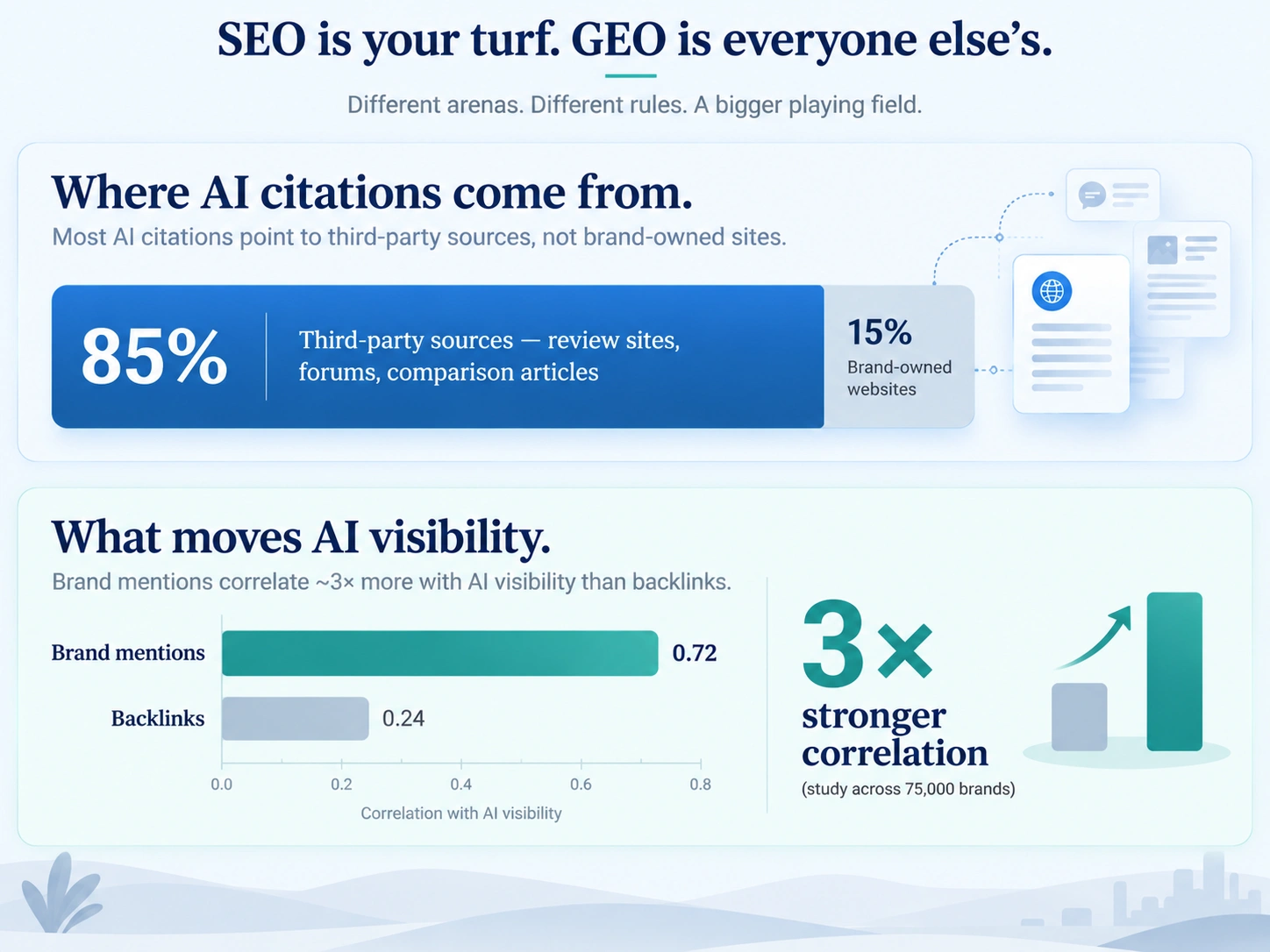
Old school SEO is mostly a game you play on your own turf. You own the site, you optimize it, you rank it. GEO flips that completely. It’s a third-party game now, your reputation scattered across everyone else’s platforms, not just what sits on your own domain. Something like 85% of what AI models cite comes from third party sources, not brand owned websites. Translation: review sites, forums, and comparison articles (yes, like this one) matter more to your AI visibility than your own blog does. That’s a hard pill for a lot of marketing teams who’ve spent a decade optimizing their own turf.
The unit of competition has changed too, and this one’s subtle but important. Old SEO fights for a spot on a page of ten blue links. GEO fights for something smaller: one specific, factual sentence getting lifted and quoted inside somebody’s AI answer. You’re not battling for position three anymore. You’re hoping a model picks your one paragraph out of a hundred that say basically the same thing.
And backlinks, long the golden ticket of SEO, just don’t carry the same weight here. A study across 75,000 brands found something that should reshuffle a few marketing budgets: brand mentions correlate with AI visibility roughly three times more strongly than backlinks do. If your comms team keeps landing your brand in industry write ups, even without a single link back, that’s doing more heavy lifting for your AI visibility than another guest post ever will.
 AEO sits somewhere in the middle of all this. It still lives mostly on pages you control, but it wants a different shape than a normal SEO article. Schema markup, the structured data tucked into your site’s code, helps AI crawlers actually understand what’s on the page instead of guessing. And the payoff is measurable: pages using FAQ Page schema show up in Google AI Overviews about 3.2 times more often than pages without it. That’s a real lever you can pull this week, which is more than most of GEO can promise you right now.
Google vs ChatGPT vs Perplexity: Who’s Actually Sending You Anything?
Here’s where things get uncomfortable if you’ve assumed AI search is quietly replacing Google traffic. It isn’t, not yet anyway, and the actual numbers tell a stranger story than a simple handoff.
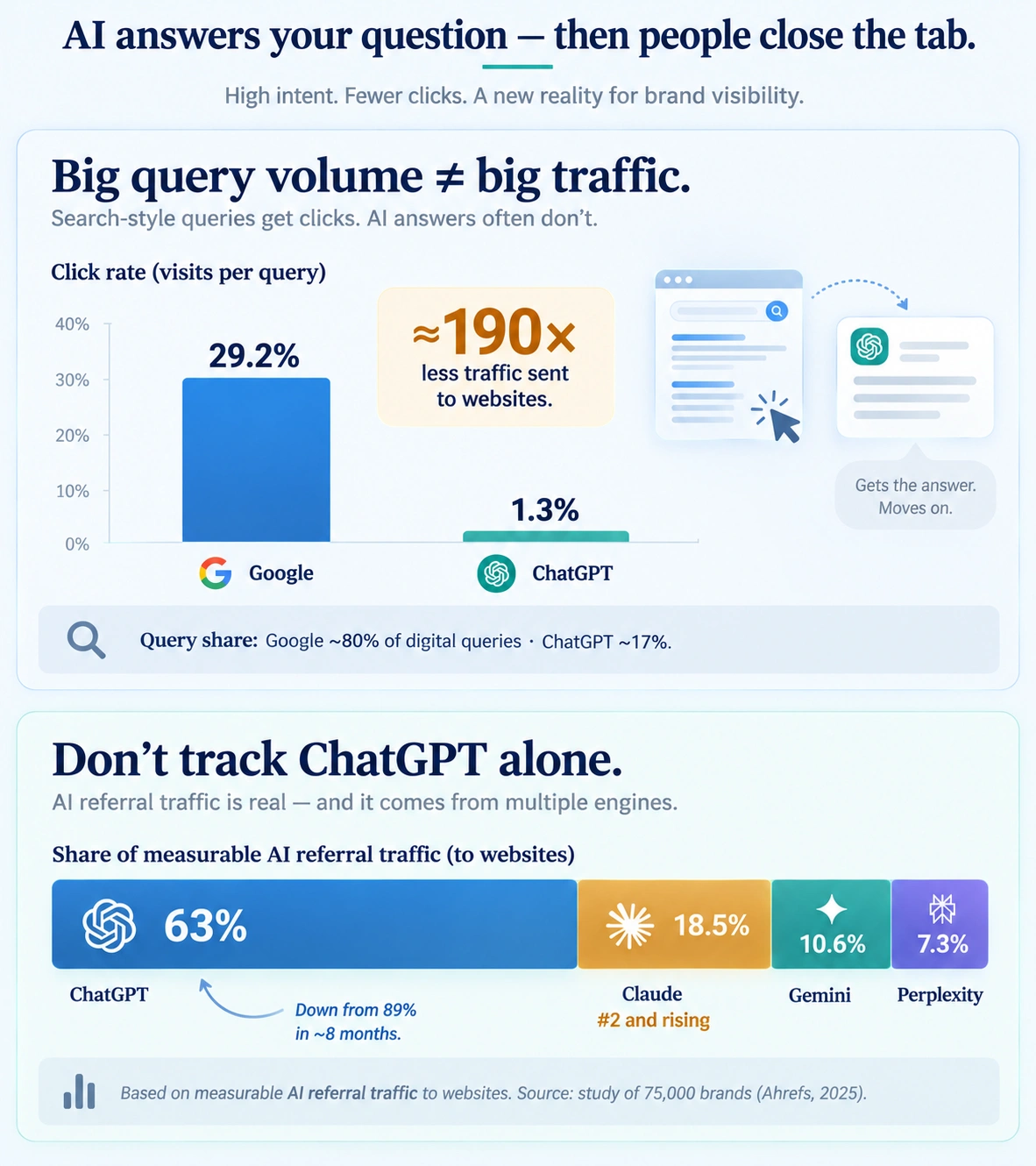
Google still handles somewhere around 80% of all digital queries. ChatGPT sits closer to 17%, with everything else splitting the last few crumbs. Sure, ChatGPT’s growth is wild on paper, 900 million weekly users now, processing something like 2.5 billion prompts a day. But query volume and referral traffic are two completely different animals, and confusing them is an easy mistake to make.
Here’s the number that should actually reshape your budget conversation. ChatGPT handles roughly 12% of Google’s daily query volume, yet it sends about 190 times less traffic to actual websites for a comparable search. The click through gap is brutal when you line it up: ChatGPT’s estimated click rate on search style queries sits around 1.3%, next to Google’s roughly 29.2%. People ask their question, get their answer, and just close the tab. Why wouldn’t they? They already got what they came for.
It’s not even just a ChatGPT story anymore either, and this matters if your whole plan is “get quoted by ChatGPT and call it done.” ChatGPT’s share of measurable AI referral traffic dropped from 89% down to 63% in about eight months. Meanwhile Claude climbed to 18.5% and became the number two source, Gemini’s sitting at 10.6%, Perplexity at 7.3%. Track only ChatGPT and you’d have completely missed a third of the AI referral landscape quietly moving elsewhere.
 Zero click behavior is spreading everywhere too, not just inside chatbots. Regular Google searches now end without a click somewhere between 60 and 69% of the time, up from 56% back in mid-2024. Inside Google’s AI Mode specifically, that number jumps to 93%. So even ranking well on Google doesn’t guarantee you a visitor the way it used to. Kind of unsettling, honestly, if your whole business model leans on organic clicks.
What This Means for Traffic, Visibility, Leads, and Cost
Let’s turn all that into numbers you can actually plan around, because “zero click rate” won’t pay your rent.
Traffic: expect a gradual softening, not a cliff. Gartner’s forecasting a 25% drop in traditional search volume by the end of 2026, and the longer view has unprepared brands losing anywhere from 20 to 50% of search traffic by 2028. Worth planning for now, not panicking about.
Visibility: this is where GEO earns its keep even when zero people click through. Getting named inside an AI answer, even with no traffic attached, still puts your brand in front of a buyer at the exact moment they’re deciding. It’s brand awareness, just wearing a different outfit. Harder to put a number on, still worth something real.
Leads: here’s a genuinely good stat buried in all this doom scrolling. One Ahrefs case study found AI search visitors were only 0.5% of total site traffic but drove 12.1% of signups, roughly a 24 to 1 conversion advantage over regular visitors. People who arrive via an AI citation have usually already been sold. They’re not browsing around, they’ve decided. Fewer people showing up, but a much better crowd.
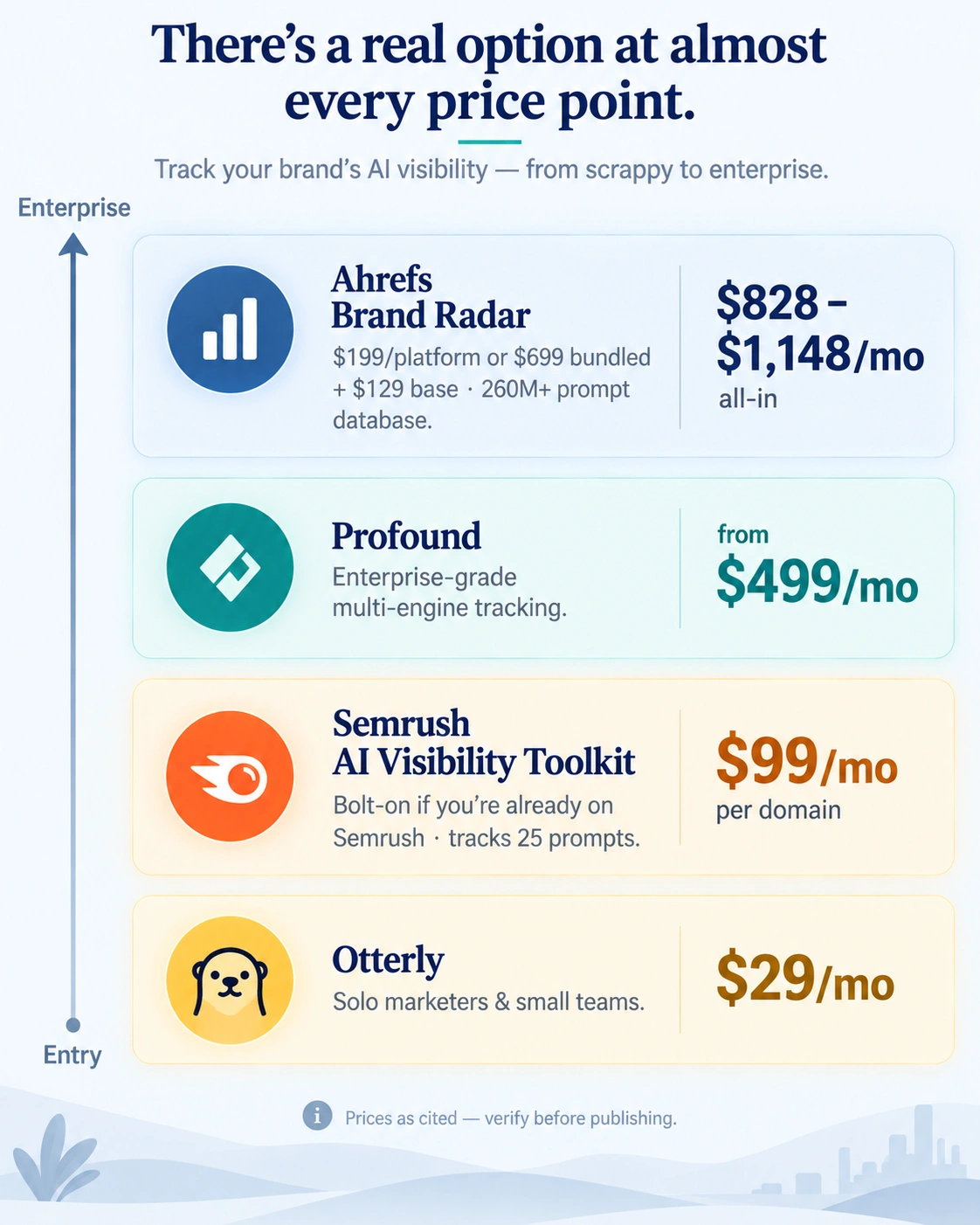
Costs: and this is where it gets genuinely relevant if you’re watching a small business budget, because the tool landscape splits hard by price. Already on Semrush? Bolt on their AI Visibility Toolkit for $99 a month per domain, tracking 25 prompts. Ahrefs users have something similar but pricier, Brand Radar runs $199 a month per platform or $699 bundled, stacked on top of a $129 base plan, so realistically $828 to $1,148 a month all in, though you do get a 260 million plus real prompt database that nobody else really matches. On the cheap end, Otterly starts at $29 a month, built for small teams and solo marketers. On the expensive end, Profound starts around $499 a month for enterprise level tracking. There’s a real option at almost every price point, which is genuinely good news. You don’t need the thousand-dollar platform to get started.
 The SMB Strategy: Don’t Panic, Get the Basics Right First
Running a small or mid-sized business? Here’s the honest version: don’t torch your budget chasing a GEO consultant who’s promising you AI citations by next quarter. Spend that money on fundamentals instead, the stuff that quietly serves all three disciplines at once.
Start with whatever technical SEO you’ve been putting off. Fast pages, clean structure, something that actually works on a phone. Still the floor everything else stands on, for Google and for AI models alike.
Then add the cheap AEO wins, because they’re genuinely low effort for a small team. Drop FAQ Page and How To schema onto your key pages, one afternoon of developer time, not a six-month project. And write your answer at the top of the page, in plain words, before you wander into the supporting detail. AI models like a direct answer up front. So do actual humans, if we’re being honest.
For GEO specifically, resist buying the expensive monitoring platform first. Just ask ChatGPT, Claude, and Perplexity the questions your customers would ask, and see if your business even shows up. If it doesn’t, the fix usually isn’t some technical hack on your homepage. It’s getting mentioned more in the places AI models actually pull from, review sites, industry roundups, local directories, comparison articles like this one. That’s PR and reputation work more than it’s SEO work, and it’s often cheaper than people assume it’ll be.
Once you’ve got a rough sense of where you stand, a budget tool like Otterly at $29 a month is enough to track whether you’re improving. You don’t need the enterprise dashboard to know you’re heading the right direction.
The Enterprise Strategy: Bigger Budget, Bigger Blind Spots
Running marketing at a bigger company? The math shifts. You’ve probably got SEO and AEO reasonably locked down already, so the real opportunity, and the real risk, sits inside GEO.
The risk: treating GEO like a single platform problem. A lot of enterprise teams built their whole AI monitoring plan around ChatGPT alone, and that plan is already out of date given how much share has shifted over to Claude, Gemini, and Perplexity in the last year. Budget for multi-platform monitoring from the start. Something like Ahrefs Brand Radar or Profound, covering six or more engines, is worth the extra spends at this scale.
The opportunity: coordinating GEO with your PR and brand teams, something most companies still haven’t gotten around to. Since third party citations now matter more than owned content for AI visibility, your comms team’s media relations work is functionally part of your search strategy whether anyone’s labeled it that way or not. That’s a new conversation for a lot of organizations, and it’s worth putting one specific person in charge of it, rather than letting it fall into the gap between marketing and comms and quietly getting ignored by both.
A Simple 2026 Framework
If you only remember one line from all this: SEO is the foundation, AEO is the format, GEO is the reputation.
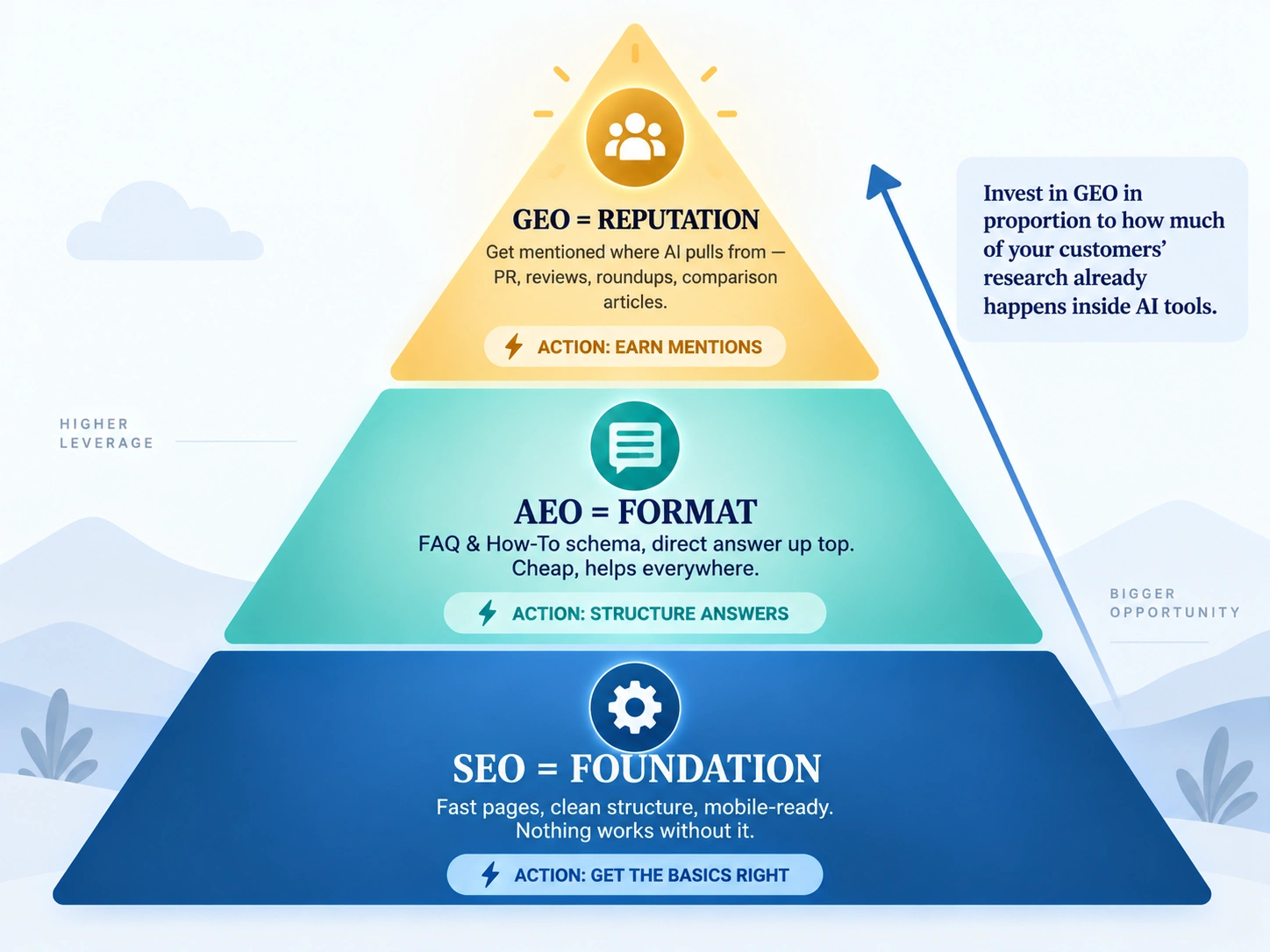 Fix technical SEO first, nothing else works without it. Layer in AEO structure, schema, direct answers up top, clear headers, because it’s cheap and it helps everywhere, even plain old Google. Then invest in GEO in proportion to how much of your customer’s research actually happens inside AI chat tools right now, which you’ll only know once you go check. For most small businesses in 2026, that’s still a modest slice of the budget. For enterprise brands in high consideration categories like software or finance, it’s turning into a much bigger one, and getting bigger by the month.
FAQs
Q. Do I have to pick just one of these three?
A. No, and please don’t. Think of them as layers stacked on top of each other, not three competing strategies. SEO gets your pages ranking in traditional search, which matters more than people assume, since answer engines pull most of their candidates from pages that already rank well anyway.
Q. Is GEO about to replace SEO?
A. Not based on where the numbers sit today. Google’s still handling around 80% of digital queries against ChatGPT’s 17%, so traditional search isn’t vanishing anytime soon. It’s shrinking at the edges. It’s not disappearing.
Q. What’s the cheapest way to actually start with GEO?
A. Open ChatGPT, Claude, and Perplexity and just ask the questions your customers would ask. Costs nothing but ten minutes. Once you’re ready to track it properly, Otterly starts at $29 a month and is a sensible first paid step.
Q. Should I stop building backlinks altogether?
A. No, just rebalance where the effort goes. Brand mentions now correlate with AI visibility roughly three times more strongly than backlinks do, so a mentions and PR strategy deserve at least as much attention as your link building one does, maybe more.
Related reading: AI Agents vs AI Assistants and Agentic AI in 2026

Prashant Srivastava is a digital marketing leader and AI-powered growth strategist with nearly two decades of experience across SaaS, healthcare, real estate, D2C, and B2B. His expertise spans SEO, paid media, marketing automation, analytics, and Generative Engine Optimization, helping businesses achieve measurable, sustainable growth.