
Your website used to answer to one boss: Google’s crawler, plus whatever human eventually clicked through from a results page. That’s not the whole story anymore. Now there’s a small crowd showing up in your server logs: GPTBot, ClaudeBot, PerplexityBot, Google-Extended, Applebot-Extended, and somewhere in the mix, a real person who might read an AI’s answer about your business and never visit your site at all. Building an AI-ready website in 2026 basically means designing for all of them at once, not just the one you’re used to.
The good news? This isn’t a total teardown of everything you already know about technical SEO. Most of it still applies. But there’s a genuinely new layer sitting on top, and if you skip it, your content just quietly stops showing up in places your competitors have already claimed. Let’s actually walk through it.
What “AI-Ready” Even Means
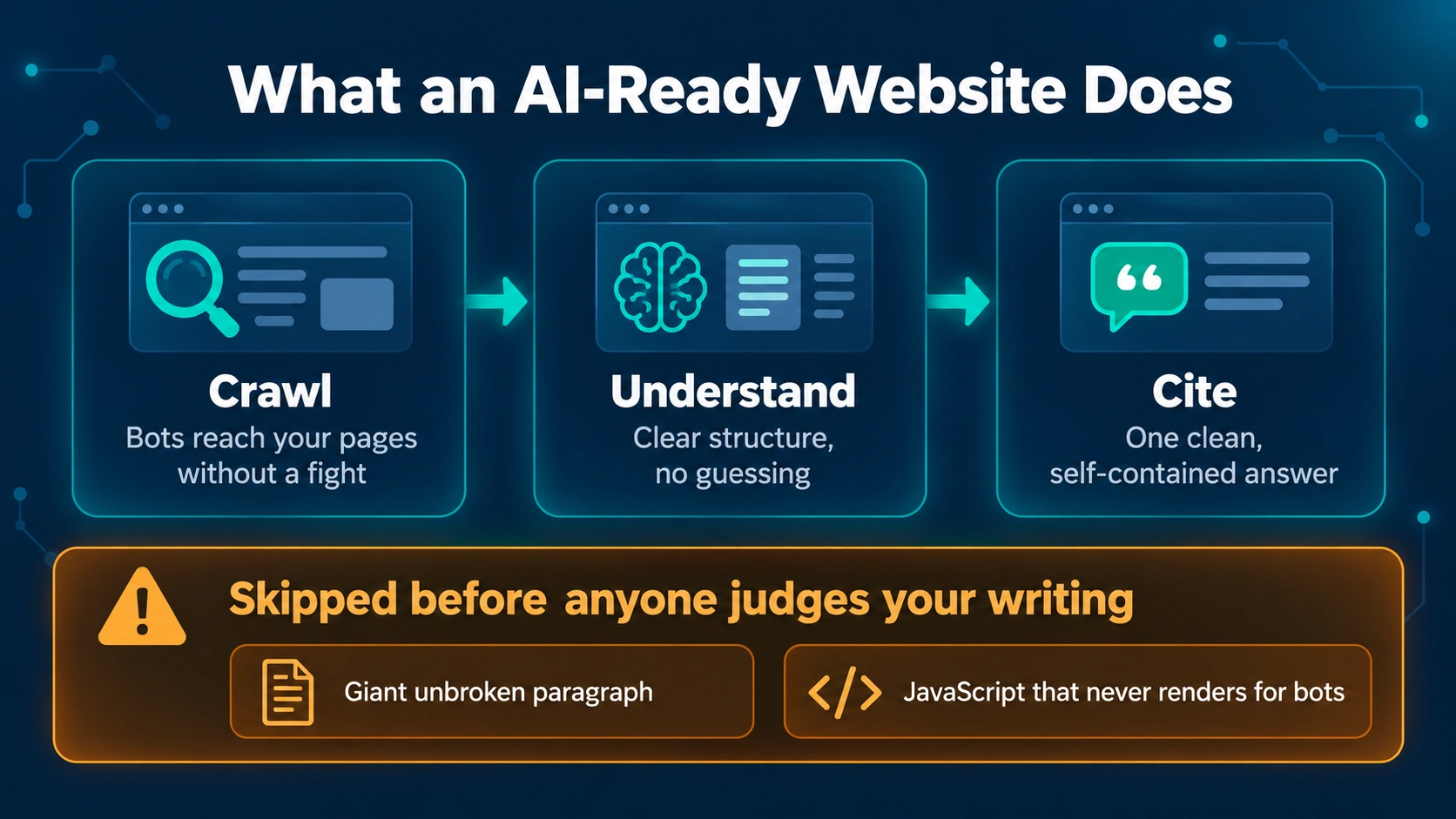
Boil it down and an AI-ready site does three things well: it lets AI systems crawl it without a fight, understand it without guessing, and pull a clean answer out of it without stitching together scraps from three different pages.
Google Search still works roughly the way it always has. But ChatGPT, Perplexity, Gemini, and Claude behave a little differently under the hood. They’re not ranking ten blue links for someone to scroll through. They’re reading a chunk of your page, deciding on the spot whether that chunk answers the question well enough to trust, and either citing you or moving on without a second thought. If your best content is buried inside a giant unbroken paragraph, or trapped behind JavaScript that never actually renders for a bot, none of that gets evaluated at all. You’re invisible before anyone judges whether your writing is even good.
Crawlability: Let the Right Bots in First
Start here. Nothing else on this list matters if the bots can’t reach your pages in the first place.
There’s a whole new cast of characters crawling the web now, and they don’t all do the same job, which is exactly where most site owners get their robots.txt file wrong. Some bots train future models. Others power live citations inside an actual chat conversation happening right now. Mixing those two up is an easy mistake and a costly one.
GPTBot, from OpenAI, is the training crawler. It’s not the one fetching pages while someone’s actively chatting with ChatGPT. OAI-SearchBot and ChatGPT-User handle that part, and those are the two that actually decide whether you show up inside a live ChatGPT answer. ClaudeBot works the same split for Anthropic, training on one side, while Claude-SearchBot and Claude-User handle search and live browsing on the other. PerplexityBot and Perplexity-User cover indexing and live fetches for Perplexity. Google-Extended is its own separate thing entirely, a simple opt-out token controlling Gemini training that has zero effect on your regular Google Search rankings either way. Applebot-Extended plays the same role for Apple Intelligence, kept apart from the regular Applebot that’s already been powering Siri and Spotlight for years.
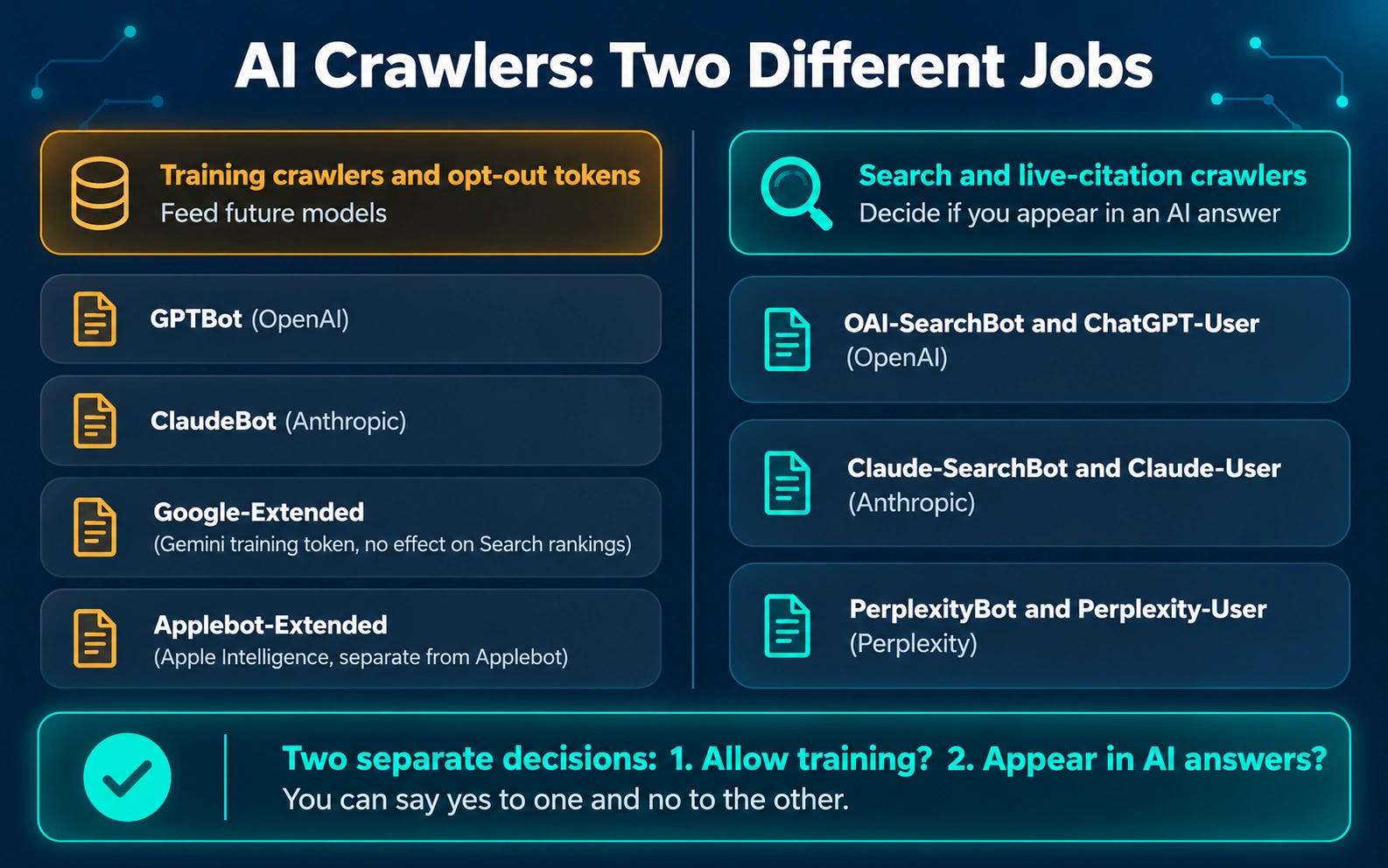
Here’s the actual decision you need to make, and it’s simpler than it looks once you separate the two questions. Are you okay with your content training future AI models? That’s one call. Do you want to show up when someone asks an AI assistant a question your page could answer? That’s a completely different call. You can say yes to the second and no to the first. Plenty of sites already do exactly that, allowing the search bots while blocking the pure training crawlers.
A reasonable starting robots.txt for most small business sites:
| User-agent: OAI-SearchBot
Allow: /
User-agent: ChatGPT-User Allow: /
User-agent: ClaudeBot Allow: /
User-agent: Claude-SearchBot Allow: /
User-agent: PerplexityBot Allow: /
User-agent: Google-Extended Allow: / |
One thing worth knowing before you trust that file completely: not every crawler out there actually respects it. Bytespider, ByteDance’s crawler, has a documented history of ignoring robots.txt rules outright, so a fair number of site owners just rate-limit or block it at the server level instead, since the polite ask doesn’t always work.
Site Architecture: Make the Path Obvious
Once the bots can get in, they need a map that actually makes sense. Flat, logical structure matters more now than it used to, partly because AI systems often follow your internal links to build context around a topic before deciding whether a page’s chunk is worth citing, not just to stumble on new URLs the way old-school crawlers did.
Nothing exotic here. Keep your important pages within three clicks of the homepage. Use URLs that reflect real topic structure instead of some database ID string nobody could ever guess. And actually, check your XML sitemap once in a while, because a surprising number of sites are still running one from a redesign two years back, listing pages that don’t exist anymore.
Semantic HTML: Speak the Language Bots Actually Read
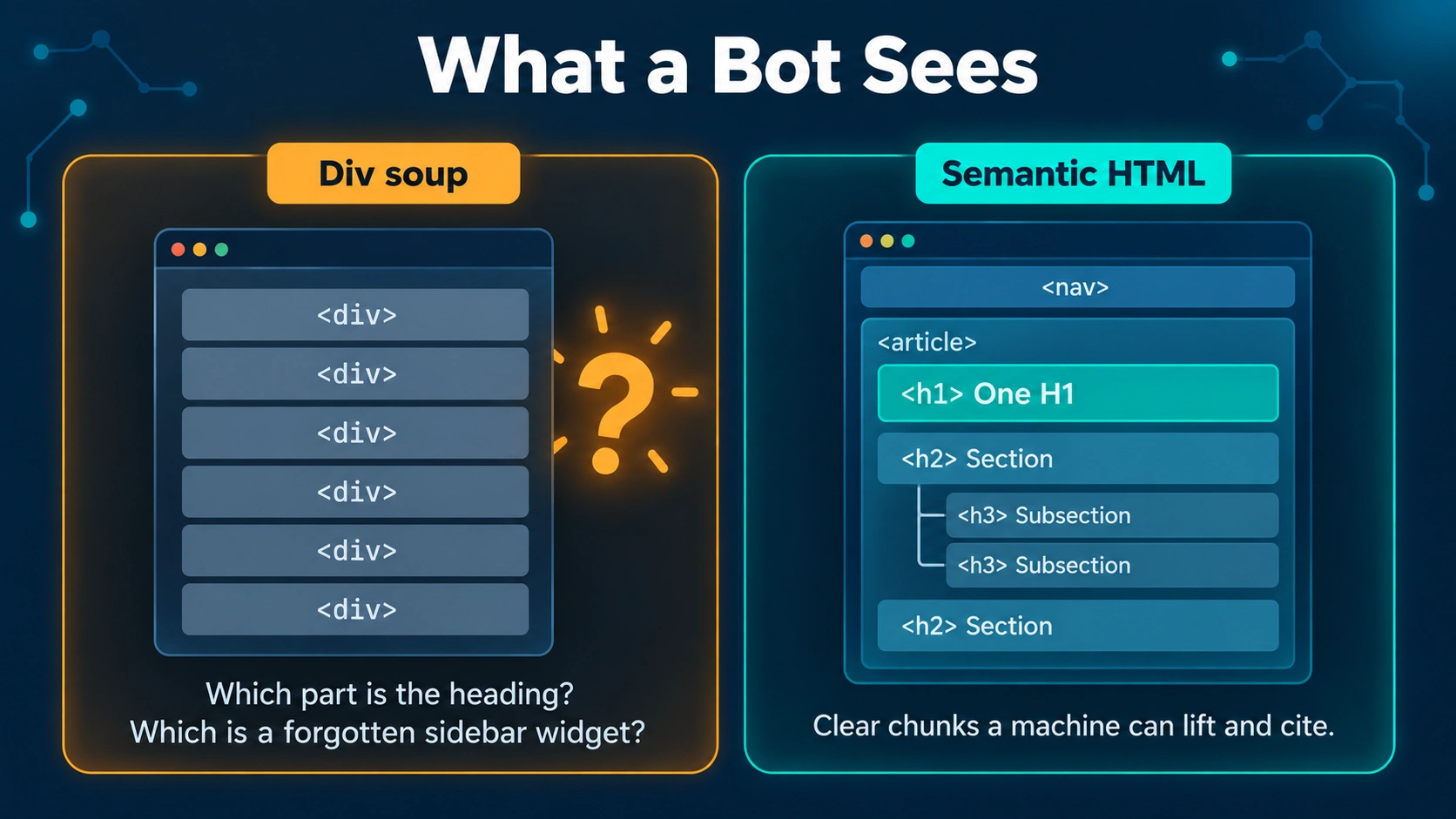
This is the part most “AI SEO” checklists conveniently skip, probably because it sounds too boring to write about. It shouldn’t be skipped. Semantic HTML, meaning real `<article>`, `<section>`, `<nav>`, and proper heading tags used the way they’re meant to be used instead of a pile of generic, meaningless `<div>` soup, hands crawlers an actual skeleton to hang meaning onto.
A page built entirely out of unstyled divs looks totally fine to a human. To a machine trying to figure out which part’s the heading and which part’s just a sidebar widget somebody forgot to remove, it’s a genuine mess. A clear heading hierarchy, one H1, logically nested H2s and H3s underneath, does double duty here. It helps a person scan the page quickly. And it helps an AI system break your content into the kind of self-contained, answerable chunk it’s actually hunting for.
Structured Data and Schema: Not Optional Anymore
Schema markup used to be a nice little bonus, the kind of thing that got you a star rating or a recipe card in Google’s results and not much else. That’s changed. In 2026 it’s closer to a primary signal for AI engines specifically. ChatGPT, Perplexity, Google AI Overviews, and Claude all parse JSON-LD schema when it’s sitting there on a page, and they lean on it hard, because structured data cuts down the risk of pulling something wrong or ripping a quote out of context.
Four schema types cover most of the real work here, and honestly, they cover the vast majority of what a small business site actually publishes:
Article schema goes on blog posts and guides, telling AI systems what they’re looking at and who’s behind it. FAQPage schema goes on question-and-answer content, and this one’s worth prioritizing above almost everything else on this list, since one analysis found FAQ content with entity-linked answers getting cited roughly 340% more often than the exact same information presented as plain, unmarked text. HowTo schema fits anything with numbered steps, which lines up naturally with how AI systems already like to format procedural answers anyway. And Speakable schema flags a short summary section, a clean TL;DR, as suitable for being read aloud or lifted more or less word for word.
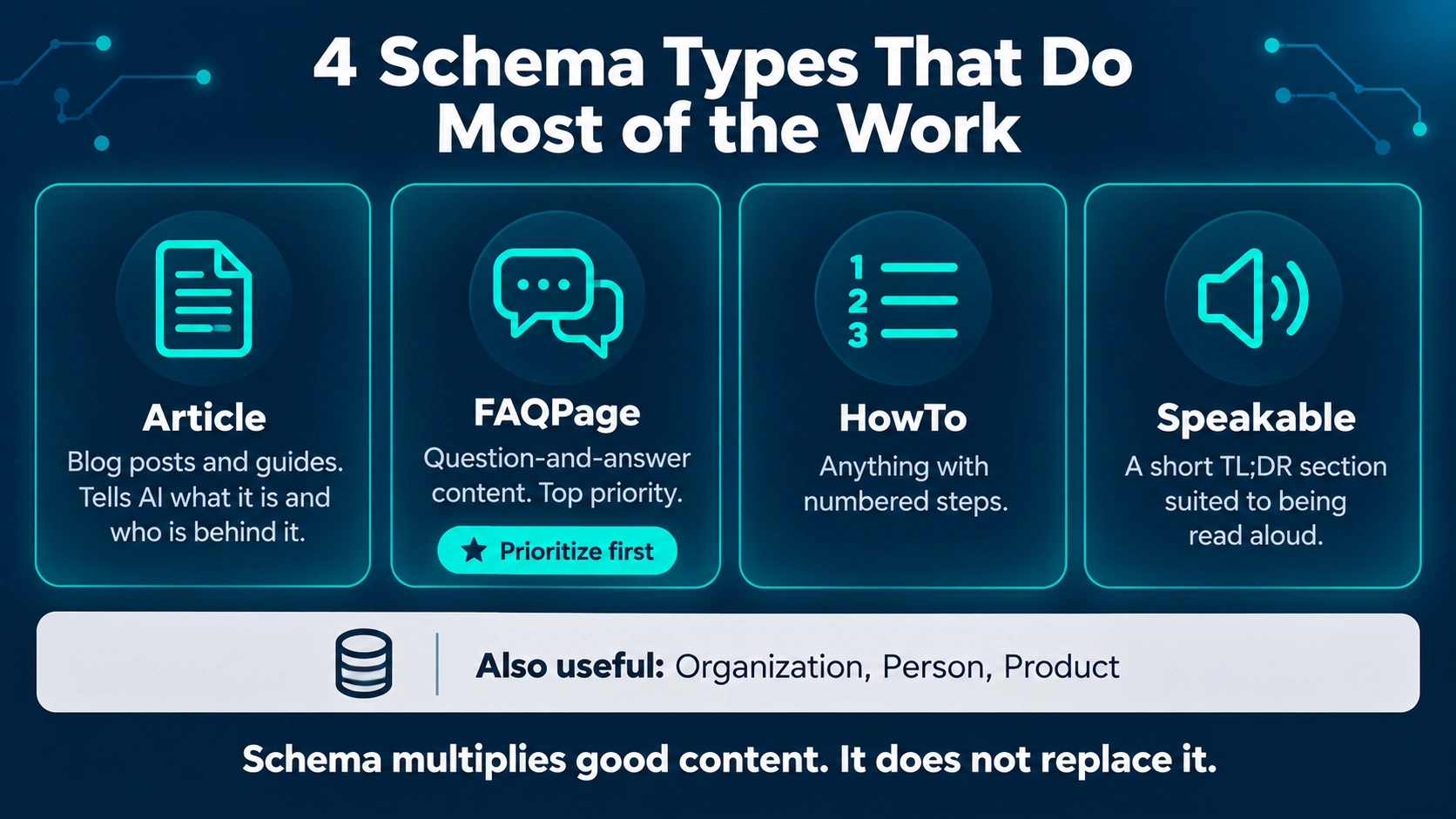
Past those four, Organization, Person, and Product schema round things out if you’re selling something specific or want a stronger entity presence online. None of these guarantees you a citation by themselves, to be totally clear about that. What they do is make your content dramatically easier to trust and pull cleanly, which meaningfully raises your odds of getting picked when it actually counts.
If you’re running WordPress, RankMath and Yoast both handle Article, FAQPage, and HowTo reasonably well through their block editors. Neither one handles Speakable natively yet, so that usually still needs a small manual code snippet. And the free tier of either plugin is genuinely enough to get all the core schema types live. You don’t need to pay for the premium version just for this part.
Entity Signals: Tell AI Systems Who You Actually Are
Entities, meaning your business, your named writers, your brand existing as a distinct “thing” a knowledge graph can actually recognize, matter more here than most site owners realize. There’s a real reason branded mentions have become such a big deal. One analysis found branded web mentions correlating with AI Overview appearances at a strength of 0.664, compared to just 0.218 for traditional backlinks. That’s a genuinely wide gap, and it says something worth sitting with: being talked about by name, consistently, across the open web now often matters more for AI visibility than the old backlink chase ever did.
So, what does that actually look like in practice? Keep your business name, address, and description identical everywhere it shows up, your site, your Google Business Profile, LinkedIn, review sites. Use sameAs properties inside your organization schema to point at your verified social profiles and Wikipedia entry, if you’ve got one. And don’t sleep on third-party review platforms either. Sites with an active G2, Capterra, or Trustpilot profile are roughly 3 times more likely to get cited by AI systems than similar sites without one, which makes claiming and actually filling out those profiles a genuinely high-leverage move, not just some box-ticking exercise.
Authors and About Pages: Prove a Real Person’s Behind This
E-E-A-T didn’t quietly disappear when AI search showed up. If anything it matters more now, because AI systems weigh trust signals heavily when they’re deciding whether to lean on a source at all. A named author with real, checkable credentials, a bio that isn’t three generic sentences copy-pasted from a template, and an actual photo, does more for your visibility than most people assume it would.
Your About page deserves the same attention. A thin “we’re passionate about excellence” paragraph tells a crawler nothing at all. A real About page, one with actual founding history, named team members, and specific details about what you actually do day to day, gives both a human reader and an AI system something solid to anchor trust to.
Original Content: The One Thing AI Genuinely Can’t Fake
This part connects straight back to the technical side, even though it doesn’t sound technical at all. AI systems increasingly favor content that shows actual first-hand experience: real data, a genuine case study, an opinion grounded in something that actually happened to you, over generic explainer content that could’ve been written about literally anyone’s business. And here’s the uncomfortable part. If your site reads like the same paraphrased advice every competitor’s site already has, there’s just no real reason for an AI system to pick you over the next nearly-identical result sitting right next to you.
Tables: Underrated and Quietly Powerful
Tables deserve their own callout, because they perform noticeably well with AI systems specifically. One analysis found comparison pages using three or more tables earning roughly 25.7% more ChatGPT citations than the same comparison written out as prose paragraphs. Makes sense once you think about it for a second. A table’s already pre-chunked, pre-labeled data sitting there in neat cells. An AI system doesn’t have to guess which number belongs to which product line. It’s just right there.
Got pricing tiers or feature comparisons to show off? Put them in an actual HTML table. Not a screenshot of a spreadsheet somebody exported once and forgot about. Not three paragraphs of prose describing the same numbers in a roundabout way. It’s a small change, and the payoff’s bigger than it has any right to be.
FAQs: A Format AI Systems Are Basically Built to Love
FAQ sections line up almost perfectly with how AI systems retrieve answers, because a decent FAQ is already structured as a clean question paired with a self-contained answer sitting right underneath it. Pair genuinely useful FAQ content, the actual questions real people ask you, not filler invented purely to hit a word count, with FAQPage schema, and you’ve covered both the content angle and the technical signal at the same time.
Keep every answer short and complete on its own. If your answer to “how much does this cost” only makes sense after someone’s already read three paragraphs above it, an AI system pulling just that one chunk is going to produce a confusing, half-finished answer, and it’ll probably skip you entirely in favor of a source whose FAQ stands on its own two feet.
Internal Links: Context, Not Just Navigation
Internal linking still does what it always did, spreading authority around your site and helping crawlers stumble onto new pages. But there’s an extra layer now worth knowing about. Internal links help AI systems build a fuller picture of a topic as they move across your site, connecting one specific answer back to the wider context it actually sits inside. Link generously between genuinely related pages, and use anchor text that actually describes what’s on the other end, not some lazy “click here.” It helps both the human reader and whatever’s crawling behind them.
Speed: Quietly Become a Bigger Deal Than It Used To Be
Here’s a piece of technical SEO that’s gotten more important, not less, since AI search entered the picture. AI engines tend to pull sources in something close to real time rather than working purely from a pre-built index the way classic search still does, and a slow page risks getting skipped entirely in favor of a faster one, sometimes even a faster one with noticeably thinner content behind it. Speed has genuinely turned into a form of eligibility now. It’s not just a nice-to-have anymore.
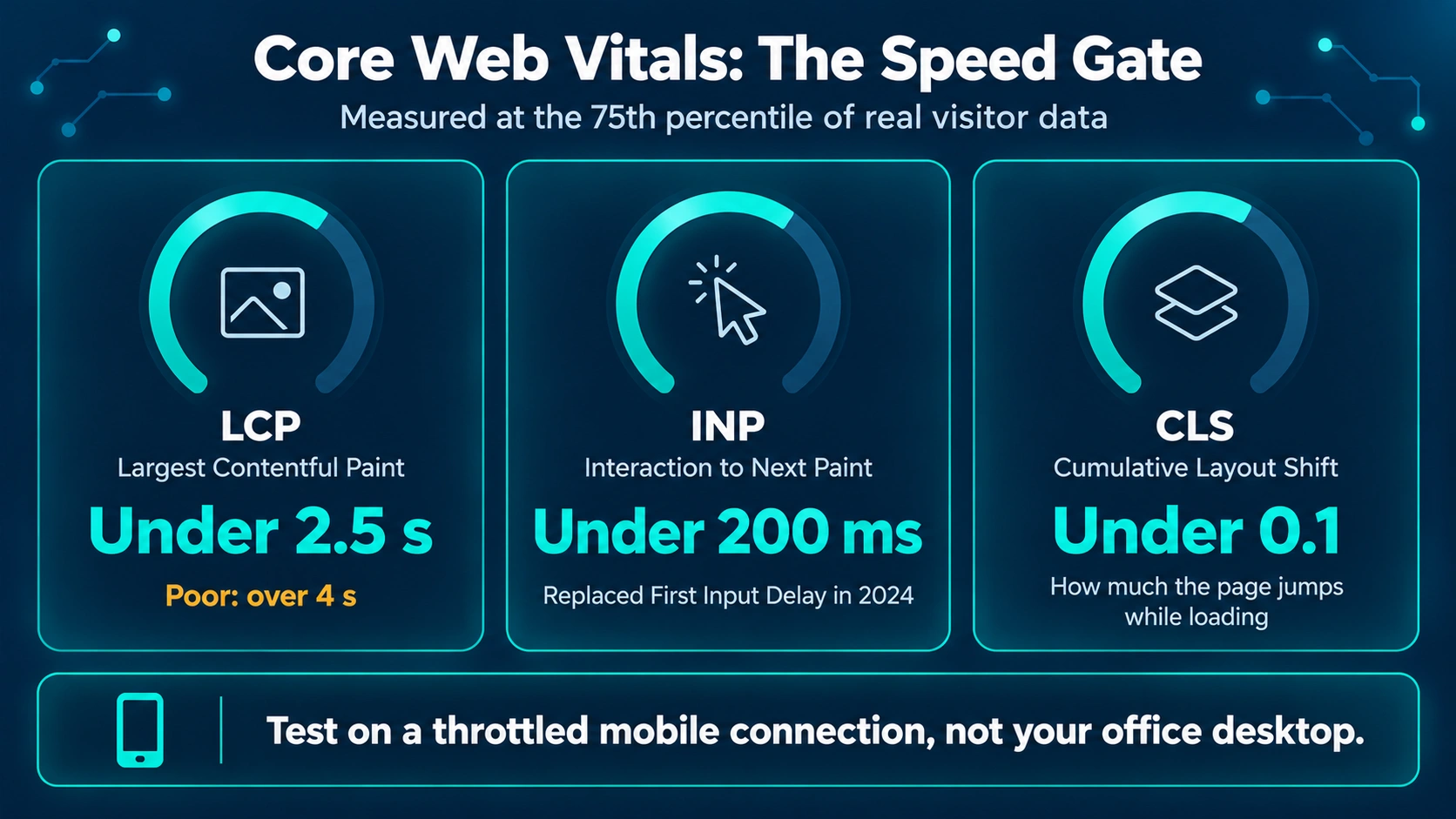
Three Core Web Vitals metrics matter here, all measured at the 75th percentile of real visitor data, not some lab test on a fast office connection:
- Largest Contentful Paint, or LCP, needs to land under 2.5 seconds to count as good, with anything past 4 seconds landing in “poor” territory.
- Interaction to Next Paint, INP, needs to stay under 200 milliseconds, and it replaced the older First Input Delay metric back in 2024.
- Cumulative Layout Shift, CLS, needs to sit under 0.1, measuring how much stuff jumps around while a page is still loading.
Where the industry actually stands right now: roughly 55.7% of web origins globally pass all three thresholds as of early 2026 data, up from around 50% just two years back. But there’s still a real, stubborn gap between desktop and mobile, with about 57% of sites passing on desktop compared to only around 50% on mobile. If your site’s failing on mobile specifically, and honestly there’s a decent chance it is, that’s probably worth fixing before you touch anything else on this whole list, since it drags down both classic rankings and AI citation eligibility at the same time.
Mobile UX: Where Most of Your Actual Traffic Already Lives
Mobile performance isn’t some side category separate from Core Web Vitals. It’s basically the primary lens those metrics get judged through now. A site that loads beautifully on a fiber desktop connection but drags its feet on a mid-range Android phone over 4G is, functionally speaking, just a slow site as far as both Google and most AI crawlers are concerned. Go test your key pages on a throttled mobile connection, not your desktop browser sitting on a fast office network, because that’s genuinely closer to the experience most real visitors, and most AI retrieval systems, are actually running into.
The llms.txt File: New, Optional, Still Worth Doing
A newer addition worth knowing about is llms.txt, a plain markdown file sitting at your site’s root, at yoursite.com/llms.txt, that gives AI systems a quick plain-language summary of your site along with links to your most important pages. It’s not an official web standard the way robots.txt is, and no AI providers committed to fully honoring it yet, so don’t treat it like a magic switch. But it costs almost nothing to set up, and it’s a low-effort way to point AI crawlers toward the content you’d actually want them citing, instead of just leaving them to guess on their own.
A basic one looks something like this:
| # Your Business Name
> One-line description of what you do
## Main sections – [Pricing](https://yoursite.com/pricing): What we charge and what’s included – [About](https://yoursite.com/about): Who we are and our background – [Guides](https://yoursite.com/guides): Our core how-to content |
Also worth knowing about, even if it’s early days: RSL 1.0, short for Really Simple Licensing, a newer standard for machine-readable AI licensing terms, already backed by companies like Reddit, Yahoo, and Cloudflare. Adoption’s still thin right now, but it’s the direction things seem to be heading if you eventually want finer control over how AI systems can use what you publish.
Where Different AI Engines Actually Pull Their Answers From
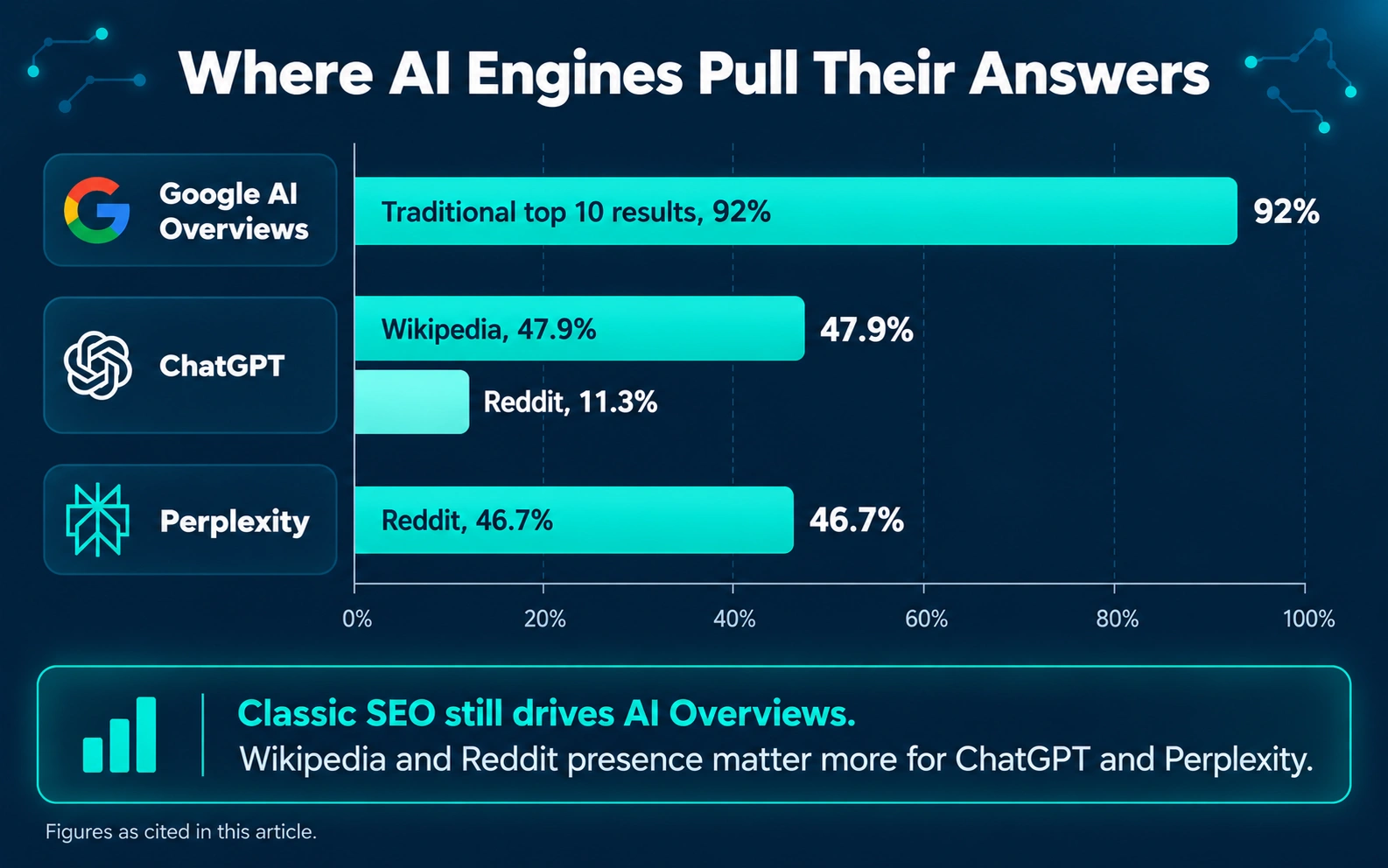
Worth knowing before you spread your effort too thin: not every AI system sources content the same way, not even close. Google AI Overviews leans hard on pages already ranking well, pulling from the traditional top 10 results roughly 92% of the time, which means classic SEO still does most of the heavy lifting there, no surprise. ChatGPT tells a different story though. It cites Wikipedia around 47.9% of the time and Reddit around 11.3% of the time, showing a real, consistent preference for established, community-vetted sources over random brand websites. Perplexity leans on Reddit even harder, around 46.7% of its citations. Which tells you something useful if your budget’s tight: showing up authentically in relevant Reddit conversations and having a solid Wikipedia presence might genuinely do more for your AI visibility right now than one more blog post buried on page four of your site.
One more thing worth flagging: AI Overviews trigger overwhelmingly on informational queries, something like 99.2% of the keywords that produce one are informational rather than transactional, and longer, more specific searches, eight words or more, are meaningfully more likely to trigger one than a short two-word query ever would. That’s a decent hint about which pages on your own site are actually AI-Overview bait. It’s your detailed explainer content doing that work, not your checkout page.
The AI-Ready Website Checklist
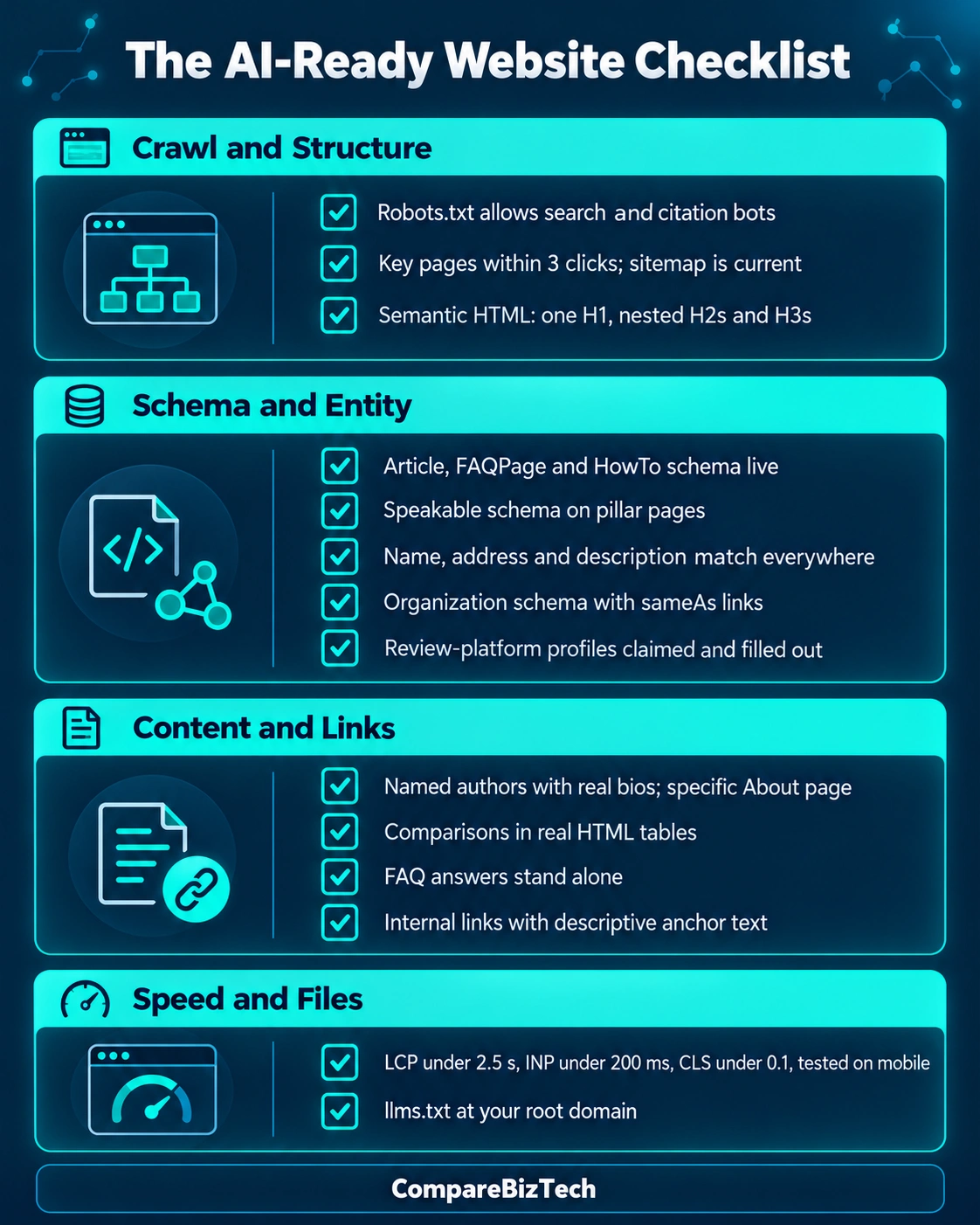
Pull all of this into something you can actually work through this week, not just admire in theory:
– Robots.txt allows the search and citation bots (OAI-SearchBot, Claude-SearchBot, PerplexityBot) even if you’re blocking pure training crawlers elsewhere
– Site architecture keeps key pages within three clicks of the homepage, and your XML sitemap actually reflects what’s live today
– Pages use real semantic HTML, not div soup, with one H1 and logically nested H2s and H3s underneath it
– Article, FAQPage, and HowTo schema are live on the content types that need them
– Speakable schema sits on your top pillar pages, attached to a clean summary section
– Your business name, address, and description match exactly across your site, Google Business Profile, and social platforms
– Organization schema includes sameAs links pointing to your verified profiles
– You’ve actually claimed and filled out profiles on relevant review platforms like G2, Capterra, or Trustpilot
– Named authors have real bios, and your About page has actual specifics instead of filler
– Comparison content lives in real HTML tables instead of prose paragraphs or screenshots
– FAQ answers stand alone and don’t require reading three paragraphs above them to make sense
– Internal links use anchor text that describes what’s actually on the other end
– LCP sits under 2.5 seconds, INP under 200 milliseconds, CLS under 0.1, and you’ve tested this specifically on mobile
– An llms.txt file exists at your root domain, pointing toward your priority pages
FAQs
Q. Do I need to block AI crawlers to protect my content?
A. Not necessarily, and doing that has a real cost attached. Blocking the search-focused bots, OAI-SearchBot, Claude-SearchBot, PerplexityBot, cuts you out of a fast-growing discovery channel entirely. You can block just the training-only crawlers like GPTBot and Google-Extended if you’re specifically uncomfortable with your content training future models, while still leaving the search agents open that actually make you eligible for citations.
Q. Does schema markup guarantee I’ll get cited by ChatGPT or Google AI Overviews?
A. No, and nobody credible claims otherwise. What schema actually does is make your content much easier to parse cleanly and trust, which raises your odds of being picked as a source when your content genuinely fits the question. Think of it as a multiplier sitting on top of good content, not a replacement for having good content in the first place.
Q. Is llms.txt something I need to set up right now?
A. It’s optional, and it’s not an official standard yet, since no major AI providers committed to fully honoring it. But it takes maybe twenty minutes to build and costs nothing at all, so there’s not much reason to skip it, especially if you’ve got a content-heavy site where pointing crawlers toward your strongest material could genuinely help.
Q. How much does Core Web Vitals performance actually affect AI citations?
A. Speed doesn’t work as a ranking factor the way schema does. It’s closer to a gate. An AI system pulling live sources in something close to real time will just skip a source that loads too slowly, no matter how good the writing underneath actually is. Passing the thresholds doesn’t win you anything on its own, but failing them badly enough can quietly knock you out of the running before your content’s even evaluated at all.
Q. What should a small business with limited time and money prioritize first?
A. Roughly in order of effort versus payoff: fix any glaring Core Web Vitals failures on mobile first, since that’s a pure eligibility problem sitting in your way. Then add FAQPage and Article schema to whatever content you’ve already got, since that’s fast and genuinely cheap to do. After that, build out real author bios and an About page that isn’t just filler. Tables and llms.txt come next on the list. And ongoing entity-building through review platforms and consistent brand mentions is the slow, boring long game that just keeps paying off well past the initial setup.

The Team Compare BizTech is made up of people from marketing backgrounds, digital marketing & content marketing backgrounds, each with unique experiences and nuggets of wisdom to share with you. The team is passionate about creating unique, accurate, and engaging content.