
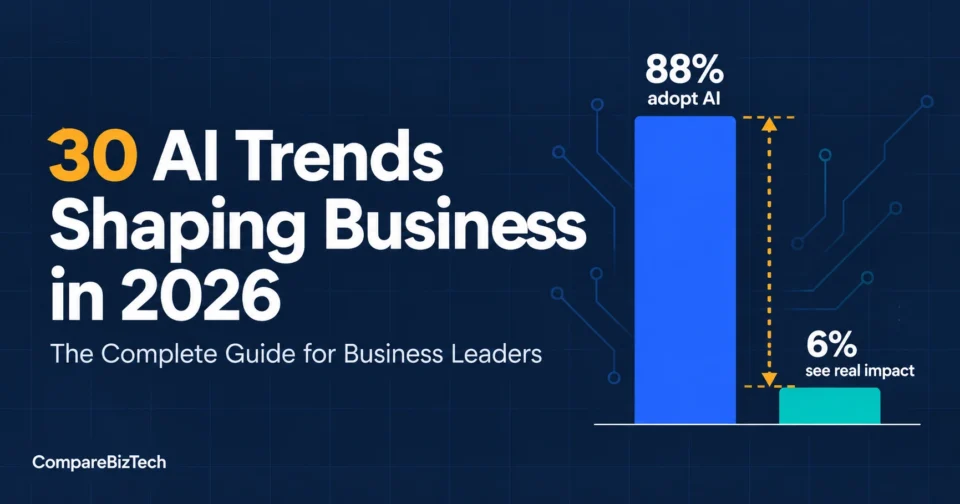
About 85 percent of business organizations now use artificial intelligence (AI) in at least one business function. Only about 6% of them qualify as genuine AI “high performers,” the kind where it actually shows up in the bottom line. That gap, adoption everywhere, real payoff almost nowhere, is the single most important thing to understand about AI business trends 2026. It’s the thread running through basically everything below.
This isn’t a hype piece, and it isn’t a doom piece either. Think of it as a practical rundown of where AI actually stands in business right now, organized so you can jump straight to whatever’s relevant to you. How customers find your company. How your sales team spends its day. Whether your security team should be losing sleep. This blog discusses thirty trends, grouped by theme, a number attached to each claim so you can check it yourself.
The Big Picture: Where AI Adoption Actually Stands
1. Adoption is nearly universal. Real value capture isn’t.
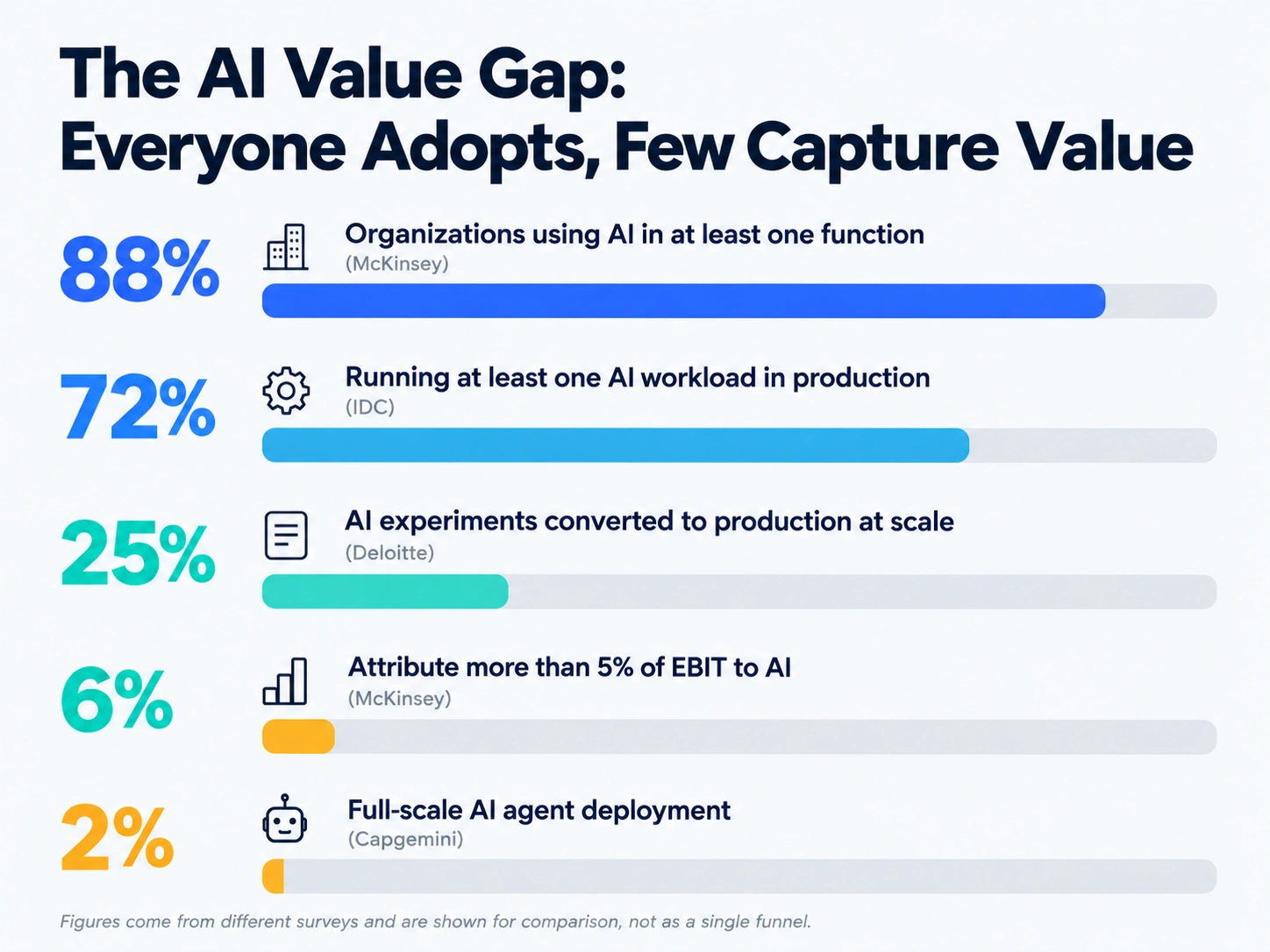
Two numbers tell the whole story here. McKinsey’s 2026 Global Survey puts AI use at 88% of organizations in at least one function, up from 78% a year earlier. But only around 6% attribute more than 5% of their EBIT to it. Most companies have AI running somewhere. Very few have restructured a process enough for it to actually move the financial needle.
2. Why do so many pilots never graduate to production?
Different firms measure this differently. Deloitte found 25% of AI experiments converting to production at meaningful scale. Capgemini put full-scale agent deployment at just 2%. Everyone agrees on the shape of it though, lots of pilots, few graduations. IDC’s number, 72% of enterprises now running at least one AI workload in production, up sharply from 55% in 2024, shows the industry is moving. Just slower from pilot to actual payoff than the marketing likes to suggest.
3. Spending keeps climbing regardless.
Gartner pegs worldwide AI spending at $2.59 trillion for 2026. Enterprise generative AI spend alone hit roughly $37 billion in 2025, more than triple the 2024 figure. That kind of money doesn’t dry up just because ROI stays uneven. It raises the pressure on every business leader to have an actual plan, not a tool subscription sitting there unused.
Agentic AI and AI Agents Take Center Stage
4. “Agentic AI” became the industry’s word of the year.
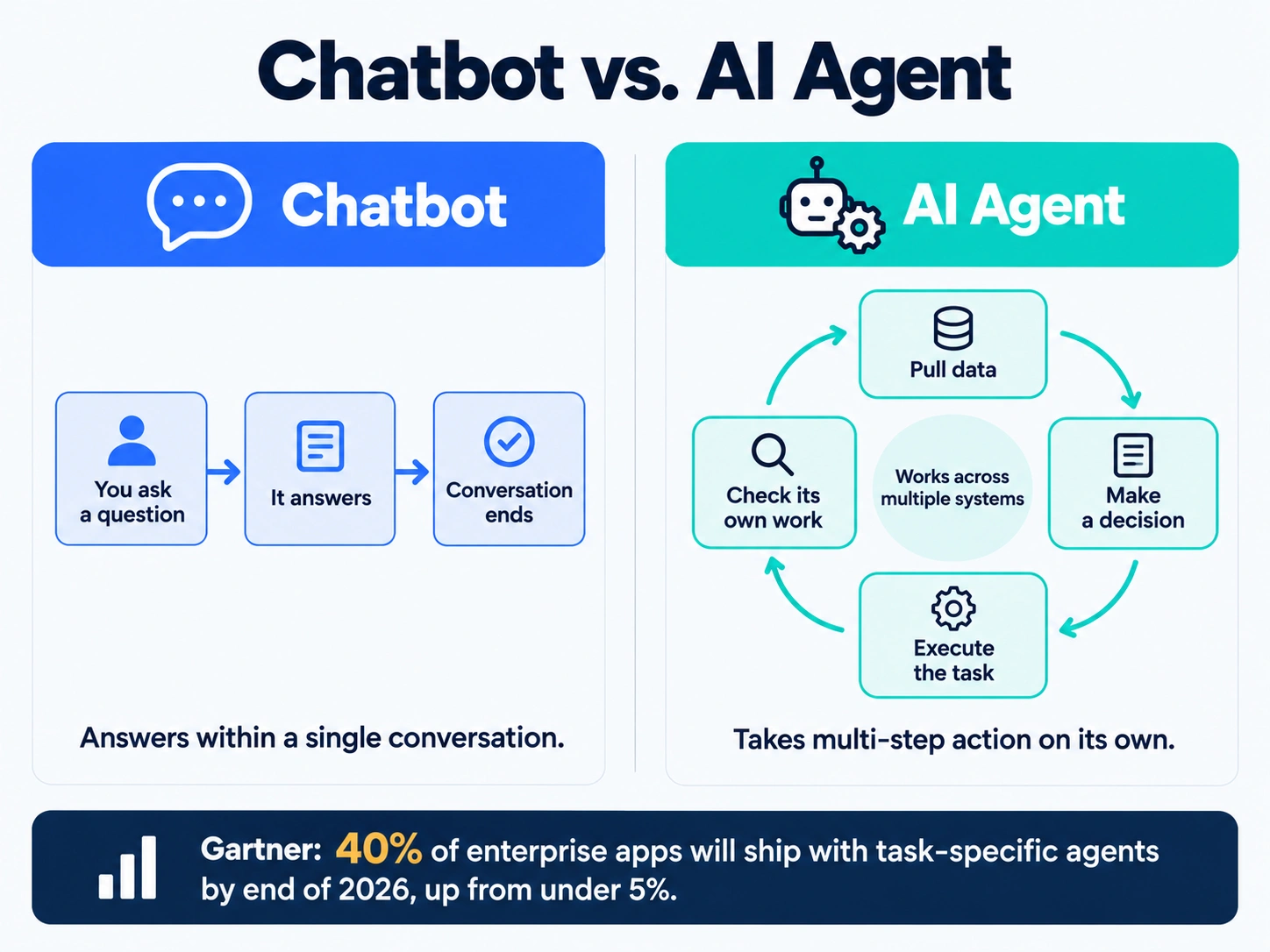
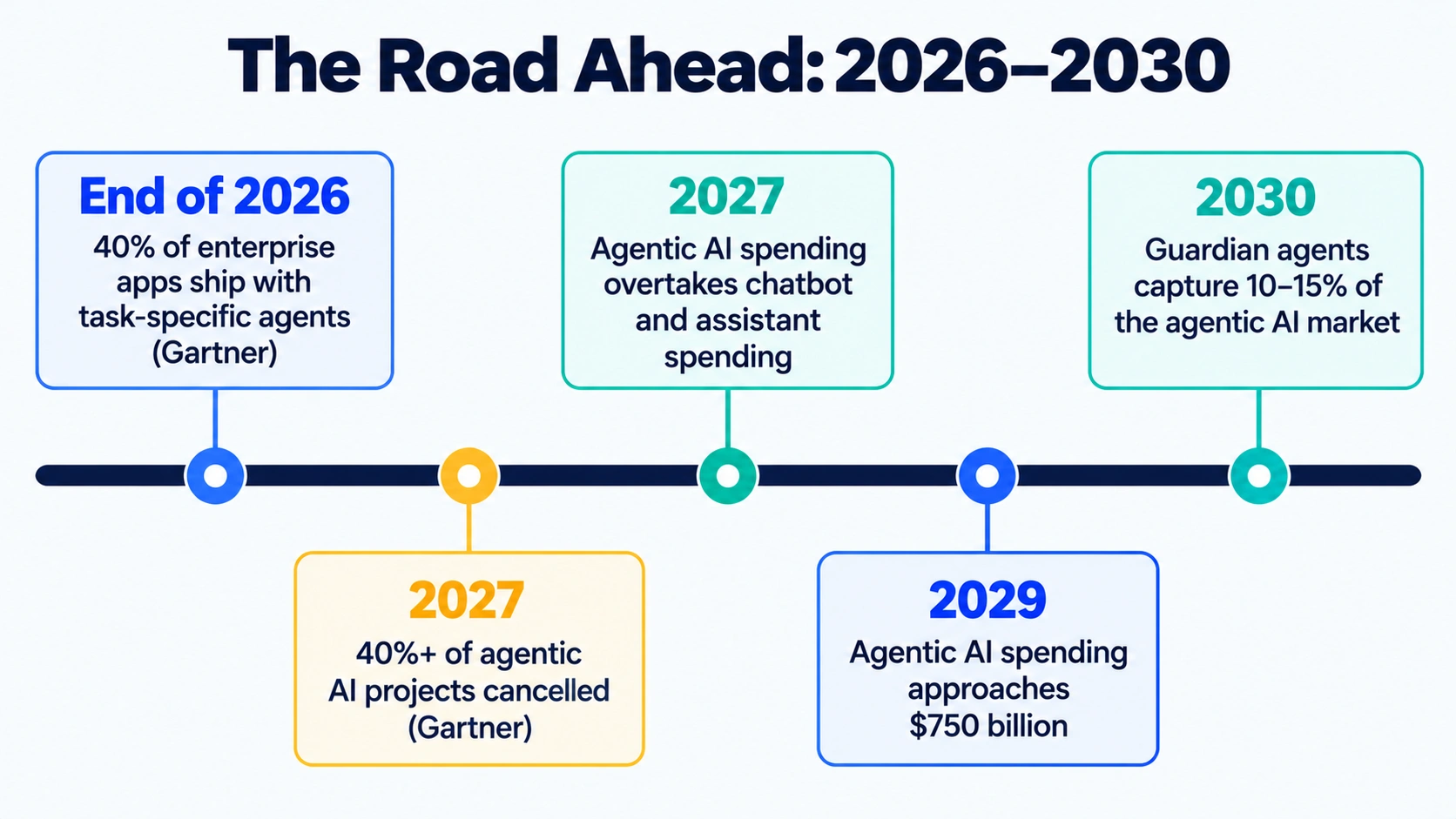
With good reason, too. Unlike a chatbot that just answers a question, an agent can take multi-step action on its own, pull data, make a decision, execute a task, check its own work afterward. Gartner projects 40% of enterprise applications will ship with task-specific agents by the end of 2026, up from under 5% at the start of it. One of the fastest adoption curves tracked in enterprise software, full stop.
5. Picture where agents actually get deployed first, and a pattern shows up fast.
Tech companies lead every sector here, per McKinsey, 24% scaling agents in software engineering, 22% in IT operations, mostly incident triage and log analysis. Banking and insurance follow at roughly 47% running at least one agent in production, according to S&P Global, mostly back-office and fraud-screening work where a human still checks the output before anything final happens. The common thread: agents show up first wherever a mistake is cheap and quick to catch.
6. Most agent projects are still failing.
Worth saying plainly rather than glossing over it. Gartner expects more than 40% of agentic AI projects to get cancelled by 2027, citing unclear ROI and weak risk controls as the usual culprits. MIT’s Project NANDA went further, finding 95% of generative AI deployments showed no measurable profit-and-loss impact at all. So if your team’s agent pilot stalled somewhere along the way, you’re in the majority, not doing something uniquely wrong.
7. Some companies never had to unlearn the old playbook in the first place.
AWS’s 2026 “Engines of Growth” study found AI-native startups, ones built around AI from day one instead of bolting it onto existing workflows, reaching billion-dollar valuations in half the time it took pre-AI startups. 55% generate over $400,000 in revenue per employee, against $150,000 to $300,000 for traditional SaaS. Less something to copy overnight, more a signal of where the competitive bar is actually heading.
How Customers Find You Now: AI Search, GEO, and Zero-Click
8. When was the last time you actually clicked past the first Google result?
ChatGPT passed roughly 900 million weekly active users by early 2026, up from 400 million a year prior. Google’s AI Overviews reach around 2 billion monthly users. More strikingly, 37% of users now say they start searches inside an AI tool instead of a traditional search engine, and 51% of B2B decision-makers begin product research in a chatbot rather than Google, per G2’s Answer Economy report.
9. Zero-click search is the default now, not some edge case anymore.
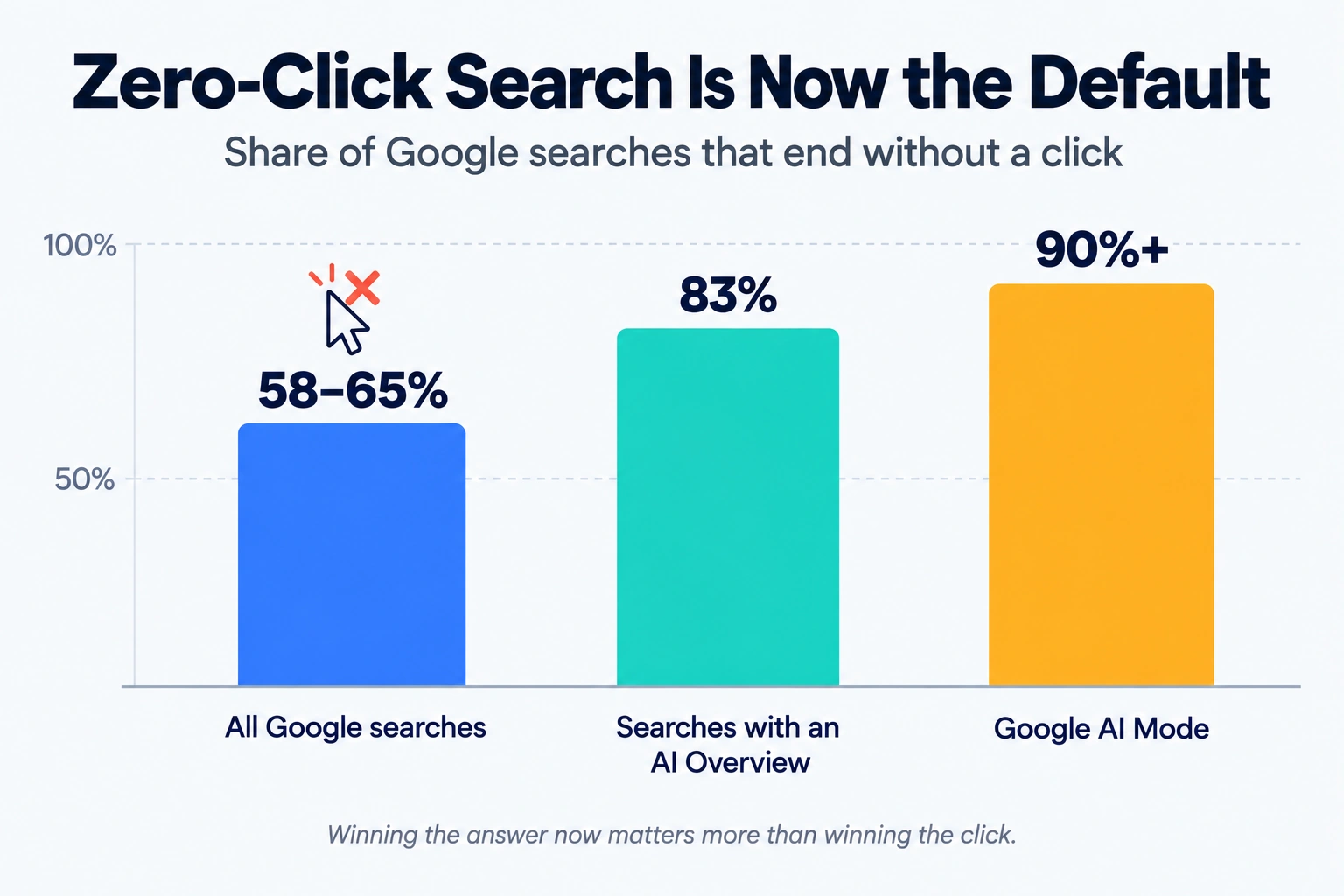
Roughly 58% to 65% of all Google searches end without anyone clicking a link at all. Add an AI Overview to the page, and that jumps to 83%. Google’s own AI Mode pushes it past 90%. This is the single biggest shift in how **AI search** changes marketing: showing up inside the answer matters more now than winning the click ever did.
10. GEO is turning into a real discipline with an actual budget line.
Only about a third of companies have trained teams on Generative Engine Optimization so far, but the early movers are seeing meaningfully better results. Brands cited inside AI Overviews get roughly 35% more organic clicks and 91% more paid clicks than uncited competitors, one large-scale analysis found. GEO isn’t replacing SEO, think of it as a layer sitting on top, structured, quotable, entity-clear content an AI model can lift cleanly into an answer.
11. Fewer visits, but the ones that land actually convert.
Ahrefs clocked AI-referred visitors converting at roughly 23 times the rate of standard organic visitors in some of its analyses. Adobe tracked a 693% year-over-year surge in AI-driven referral traffic to US retail sites over the 2025 holiday season. The people who click through from an AI answer tend to already be close to a decision by that point, not just browsing.
The Customer-Facing Stack: CRM, Sales, Support, and Ecommerce
12. AI is quietly becoming a default feature of CRM, not an optional add-on.
Salesforce’s Agentforce, HubSpot’s Breeze, Microsoft Dynamics, they all ship with built-in agents now that draft follow-up emails, summarize call notes, flag deals at risk automatically. For a small business, the real question isn’t whether to use AI in your CRM anymore, most major platforms already bundle it into mid-tier plans, it’s whether you’re actually configuring it or letting it sit there unused.
13. Sales floors are shrinking at the top of the funnel.
SaaStr’s 2026 data found B2B sales teams running noticeably smaller than a year prior while holding revenue steady. One cited example, Vercel, runs nearly all of outbound through a single human paired with AI agents. ICONIQ’s 2025 benchmarking study found AI-native sales orgs closing at rates roughly 50% higher than traditional peers. Prospecting grunt work’s getting automated. Closing complex deals still needs an actual person in the room.
14. Klarna is basically the case study everyone in this space cites, for good reason.
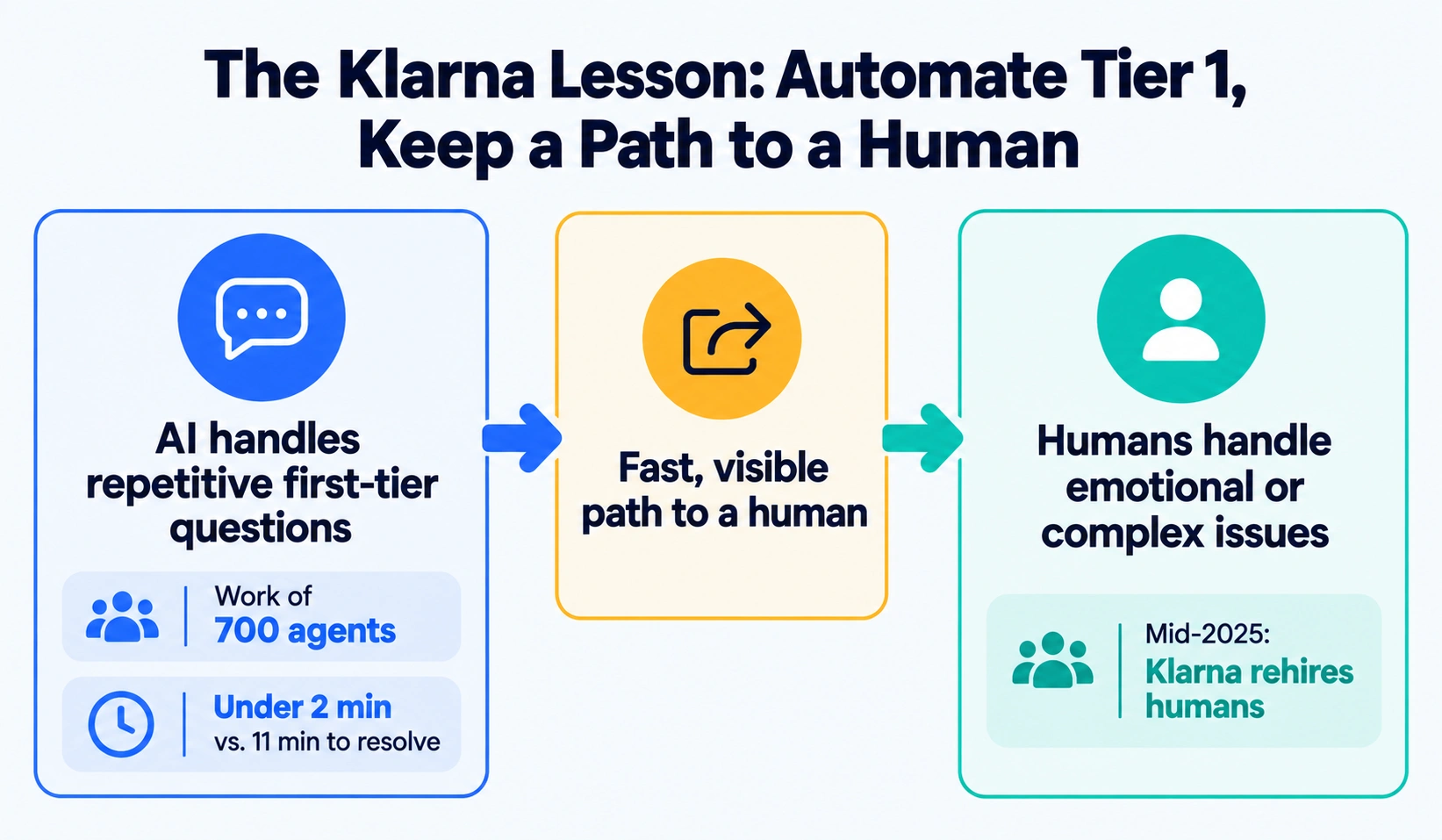
Its AI assistant handled the equivalent workload of 700 agents at one point, resolving issues in under 2 minutes versus 11 for a human. By mid-2025 the company was rehiring humans, admitting the push had gone too far and hurt service quality along the way. The lesson holding up across the industry: automate the repetitive first-tier stuff, keep a fast, visible path to a human for anything emotionally charged or genuinely complex.
15. Ecommerce personalization has moved past simple if-then rules.
Instead of manually built segments, customers who bought X also see Y, AI now builds dynamic recommendations and pricing per shopper in real time, predicting churn and lifetime value well before a human analyst would even catch the pattern forming. Shopify’s ecosystem of AI-powered apps, alongside Amazon’s and Meta’s advertising AI, has made this table stakes for any mid-sized online retailer now, not just enterprise players who could afford custom builds before.
16. Dashboards used to be where the thinking stopped. Now they’re where it starts.
Tools like Power BI’s Copilot and Tableau’s Pulse now write plain-language summaries of what changed and why, instead of leaving a person to interpret a chart cold. Genuine time-saver. But it comes with a caveat worth repeating every time: AI on top of messy, disconnected data just produces a confident wrong answer faster than a person would’ve reached a slow, uncertain one.
Under the Hood: Coding, Infrastructure, Cloud, and New Interfaces
17. “Learn to code” advice is colliding head-on with the actual data.
Stack Overflow found 84% of developers already using or planning to use AI coding tools. Cursor, the standout example, hit roughly $4 billion in annualized revenue by June 2026 with under 1,000 employees, and Stanford’s AI Index tracked model performance on real coding benchmarks jump from 60% to near 100% success in a single year. Also reshaping who gets hired into junior developer roles, a trend with real consequences for the broader AI workforce conversation.
18. Infrastructure spending is shifting from training toward inference.
As more companies actually run AI in production instead of just experimenting with it, the cost center moves from “train one giant model” to “serve millions of real-time requests cheaply, every day, forever.” That’s driving continued heavy investment in specialized chips and data center capacity, and it’s part of why AI spending keeps climbing even as ROI stays uneven, the infrastructure bill doesn’t wait around for the value to show up first.
19. Notice how hard it’s gotten to buy cloud software without AI attached.
Microsoft’s Copilot is woven through Office, GitHub, and Azure now. Google’s Gemini sits inside Workspace and Vertex AI. AWS pushes Bedrock as the neutral layer for picking among multiple foundation models. For a business already locked into one of these ecosystems, the AI features are hard to avoid whether you asked for them or not, so an actual audit of what’s already included in your current plan is worth doing before buying a separate point solution.
20. Automation used to mean following a script. Now it means making a call.
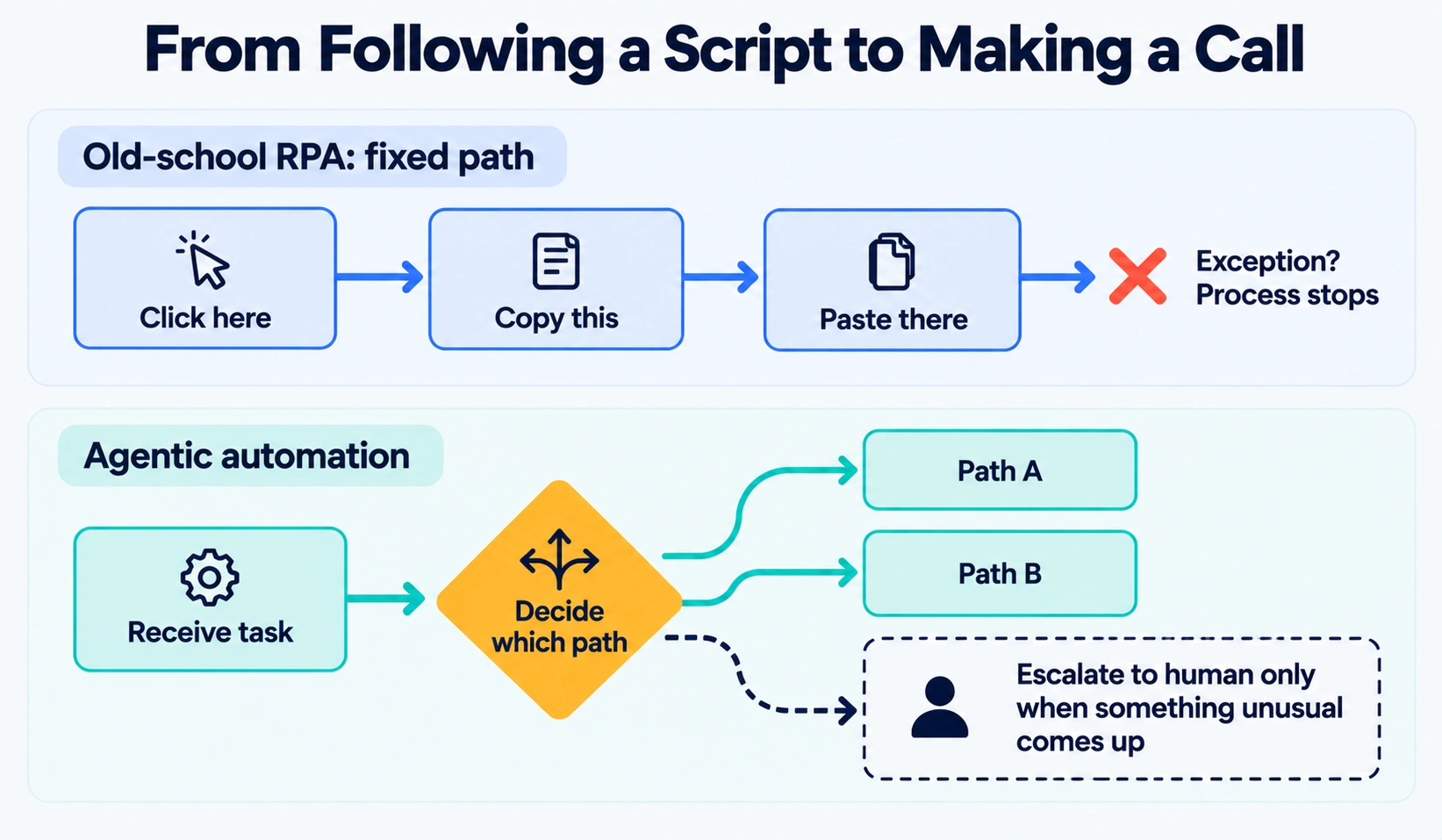
Old-school robotic process automation followed a fixed path, click here, copy this, paste there, nothing else. The newer wave can handle exceptions, decide which of several paths to take, escalate to a human only when something genuinely unusual comes up. Real capability jump, and it’s why vendors like UiPath have spent the last two years rebuilding around agents instead of fixed scripts.
21. One tool now does what three used to.
Multimodal AI, models handling text, images, audio, and video all at once, is becoming the norm rather than the exception. Practically, this means a single tool can read a scanned invoice, listen to a customer call, and analyze a product photo without needing three separate specialized systems bolted together. For businesses this mostly shows up as fewer point tools to juggle, more capability packed into whatever platform they’re already paying for anyway.
22. Remember calling customer service and immediately knowing it was a robot?
Voice agents finally cleared the quality bar that made them basically unusable a couple of years back. Latency dropped enough that a phone call no longer has that awkward lag giving it away, and tools built on newer voice models handle interruptions and natural back-and-forth far better than the robotic IVR systems everyone learned to hate. Restaurants, medical offices, and service businesses are the fastest adopters, mostly for appointment scheduling and after-hours calls.
The Risk Side: Cybersecurity, Shadow AI, and Governance
23. Ask a security professional what scares them most right now, and the answer’s shifted.
A Dark Reading poll found 48% of cybersecurity professionals naming agentic AI and autonomous systems as the single most dangerous attack vector for 2026, ranking above deepfakes and passwordless authentication concerns entirely. The reasoning’s simple enough: an AI agent operating with elevated permissions across multiple systems is a much bigger attack surface than a human clicking through one dashboard at a time.
24. It’s already happening inside your company, whether IT approved it or not.
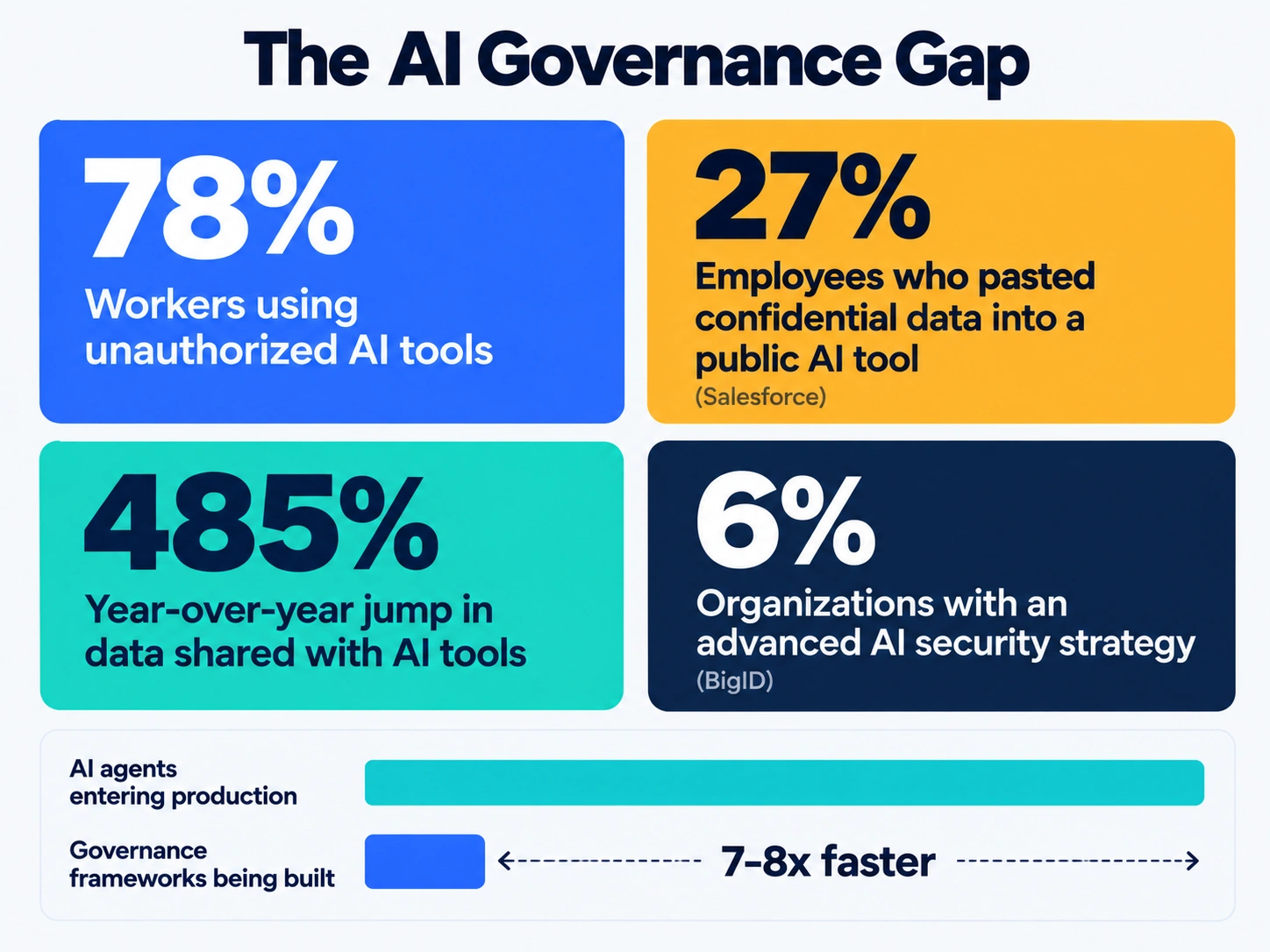
Roughly 78% of AI users at work admit to bringing their own unauthorized tools in, and 27% of employees have pasted confidential company data into a public AI tool at some point, per Salesforce’s research. Data shared with AI tools jumped 485% year over year in one analysis alone. Not a future risk to plan around eventually. A current gap most companies haven’t even measured yet, let alone closed.
25. Deployment is outrunning oversight, and the gap is widening.
Only around 6% of organizations report having an advanced AI security strategy actually in place, per BigID’s research, while agents are entering production roughly seven to eight times faster than governance frameworks are getting built around them. Forrester’s 2026 predictions go as far as forecasting a publicly disclosed data breach caused by an agentic AI deployment before the year’s out, framed as a cascade of overlooked failures rather than one single mistake.
26. Regulators are still catching their breath.
The EU’s AI Act keeps rolling out risk-tiered obligations. US regulation remains a patchwork of state-level rules rather than one federal standard anyone can point to cleanly. For a business handling customer data through any AI tool, the practical move stays the same regardless of jurisdiction: know exactly where customer data goes once it touches an AI system, and get that answer in writing from every vendor, not just the big-name ones.
27. Who watches the AI that’s watching everything else?
“Guardian agents,” AI systems built specifically to monitor and govern other AI agents, are emerging as their own category now. Sounds almost recursive, using AI to watch AI, but it’s a direct response to the governance gap just described. Analysts project this segment could capture 10% to 15% of the broader agentic AI market by 2030. If your organization’s deploying multiple agents without any real oversight layer, this is the category worth watching closest.
Where This Shows Up by Industry and Function
28. Not every industry is moving at the same speed, and that’s by design.
Banking and insurance lead agent deployment at roughly 47%, mostly fraud detection and back-office processing where outputs get reviewed before anything customer-facing happens. Healthcare’s been slower given the stakes involved in a wrong output, but administrative use cases, prior authorization drafting, clinical note summarization, appointment scheduling, are seeing real adoption precisely because a human still signs off on anything touching patient care directly.
29. Marketing looks almost unrecognizable compared to two years ago.
Beyond writing ad copy and email sequences, AI now handles campaign optimization, audience targeting, and increasingly the GEO work described earlier around how a brand gets cited inside AI search answers. The strategic layer, deciding what story a brand actually tells and to whom, stays stubbornly human. The execution layer wrapped around it just keeps shrinking.
30. Here’s the uncomfortable connection nobody quite says out loud.
Harvard research tracking 66 million workers found entry-level hiring fell roughly 80% per quarter at firms adopting generative AI, even as senior hiring kept growing at those same companies, concentrating the disruption right where most businesses’ future talent pipeline actually gets built. McKinsey’s finding that only 6% of companies see meaningful EBIT impact from AI is really the flip side of that same coin. Businesses are cutting cost centers faster than they’re building the judgment and oversight roles that make AI investments actually pay off. Getting the ROI story right and getting the workforce transition right aren’t two separate problems. One problem, viewed from two different desks.

What Businesses Should Actually Do Next
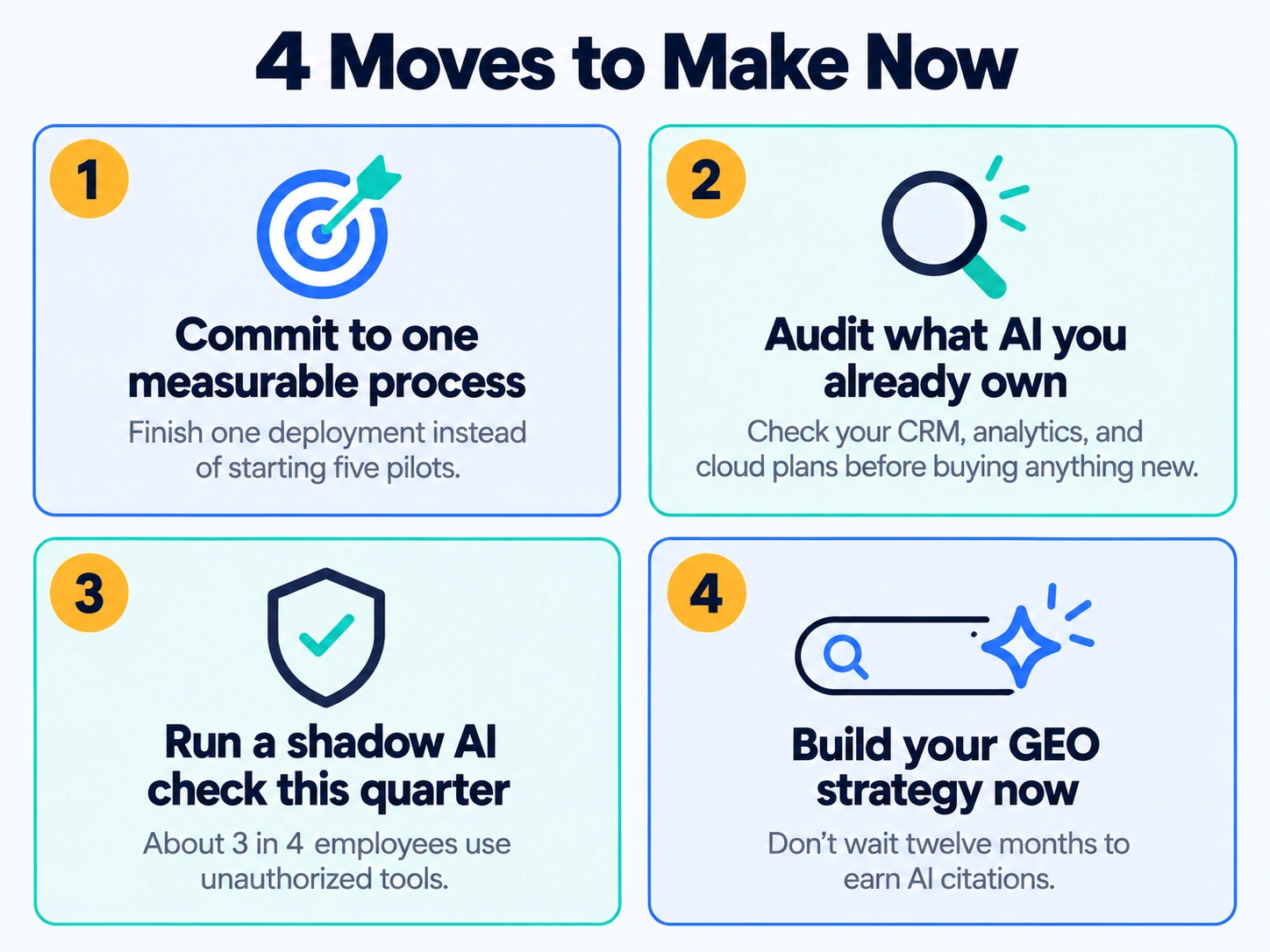
Pick one specific, measurable process and commit to it fully, rather than running five shallow pilots at once. McKinsey’s data suggests scaled value shows up when a company actually finishes a deployment, not when it merely starts several.
Audit what AI is already sitting inside your current software subscriptions before buying anything new, a lot of the CRM, analytics, and cloud tools covered above already include features plenty of companies pay for and never turn on.
Run an honest shadow AI check across your team this quarter too. With roughly three in four employees admitting to using unauthorized tools already, you likely have more exposure than you think and zero visibility into it right now.
And build your GEO strategy now rather than in twelve months, since the businesses investing early are already seeing meaningfully higher AI referral traffic than the ones still waiting to see how it all shakes out.
The 2027 Outlook
The gap between AI adoption and AI value capture is the trend worth watching closest over the coming year. Gartner’s agentic AI spending forecast shows the category overtaking chatbot and assistant spending by 2027, climbing toward $750 billion by 2029, so the investment case only gets more urgent from here, not less.
Expect governance and guardian-agent tooling to mature quickly in response to the security incidents Forrester and others are already forecasting. Expect zero-click search to keep climbing and GEO to move from “emerging discipline” into “standard marketing line item” within the year.
And expect the entry-level hiring squeeze to force a genuine rethink of how companies train future senior talent once the traditional junior-role ladder keeps shrinking underneath them. None of that adds up to AI replacing business as we currently know it. It adds up to a widening gap between companies that treated AI transformation as a real structural decision, and the ones still treating it as just another subscription to renew each year.
FAQs
Q. Is AI adoption actually as widespread as the headlines suggest?
A. Yes and no, honestly. Nearly 9 in 10 organizations use AI somewhere in the business, but fewer than 1 in 10 have scaled it in any single function, and only about 6% see a measurable financial impact from it. Adoption’s broad. Depth is still shallow almost everywhere you look.
Q. Is it too late to start with GEO?
A. Not even close. Fewer than a third of companies have trained teams on generative engine optimization yet, which means there’s still a real first-mover advantage sitting there for businesses willing to treat AI search visibility as seriously as they’ve treated traditional SEO for the last decade.
Q. Should a small business worry about AI cybersecurity risks right now?
A. Yes, and the biggest risk usually isn’t some sophisticated outside attack. It’s an employee pasting confidential data into an unapproved AI tool during a normal workday. That’s already happening at most companies whether leadership knows about it or not, and it’s worth addressing before investing in flashier AI capabilities on top.
Q. What’s the real difference between a chatbot and an AI agent?
A. A chatbot answers questions within a single conversation. An agent takes multi-step action on its own, pulling data, making decisions, executing tasks, checking its own work, often across multiple systems without a human approving every step.

The Team Compare BizTech is made up of people from marketing backgrounds, digital marketing & content marketing backgrounds, each with unique experiences and nuggets of wisdom to share with you. The team is passionate about creating unique, accurate, and engaging content.