
Ask ten people what “shopping online in India” actually looks like and you’ll get ten completely different answers, depending on their city, their age, whether they’ve ever had to wait more than ten minutes for a delivery. That’s kind of the whole point here. The future of ecommerce in India isn’t one tidy story with a beginning and an end. It’s groceries showing up before you’ve finished writing the list. It’s a WhatsApp chat that quietly turns into a UPI payment. It’s an AI reordering your detergent before you’ve even clocked that you’re running low.
None of this is speculation dressed up to sound smart. The market’s genuinely one of the fastest-growing anywhere on earth right now, and it’s taking a shape that looks pretty different from how ecommerce grew up in the US or China. Here’s what’s actually happening, and where it seems to be headed next.
So How Big Is This Market, Really?
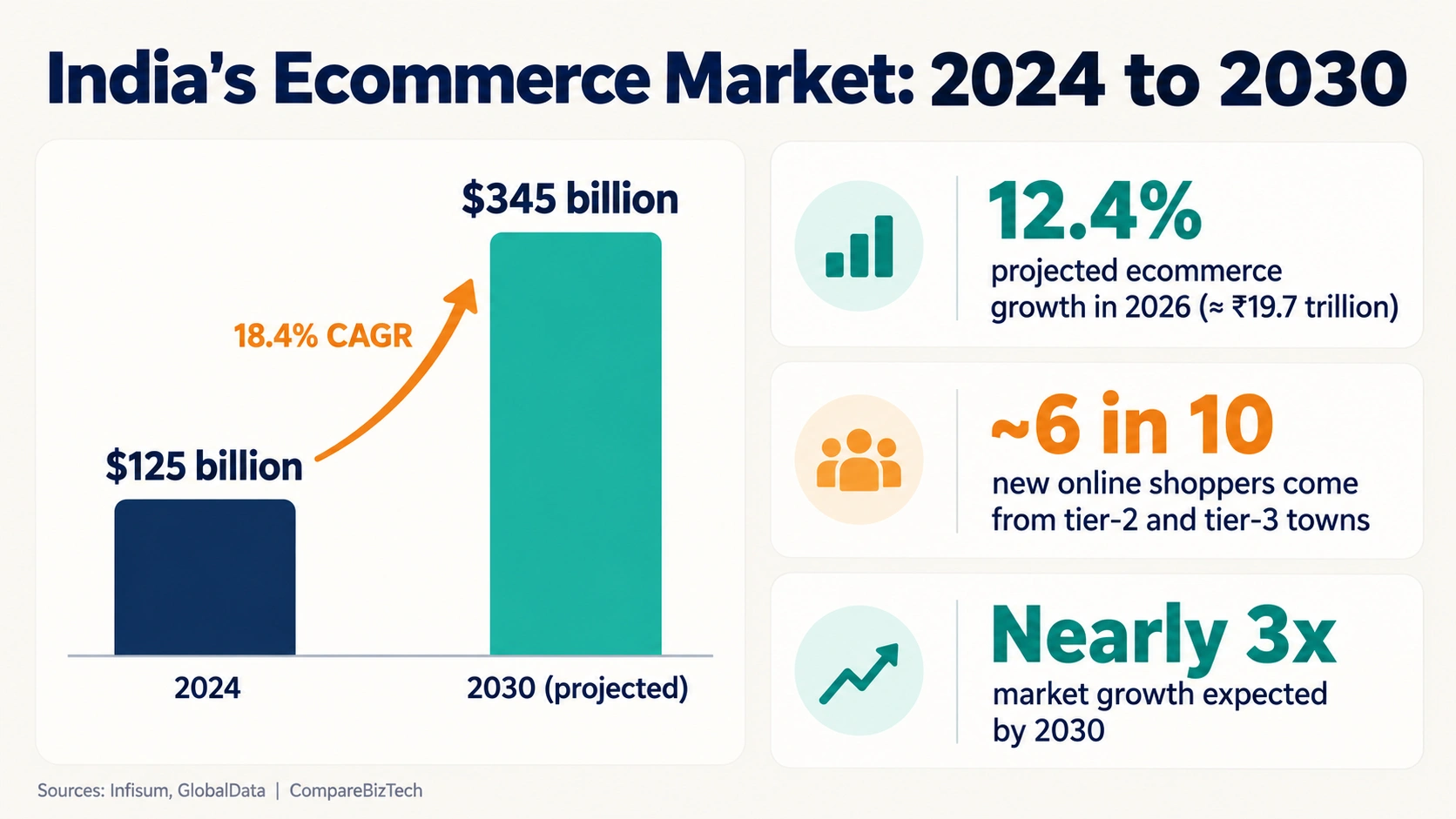
Depends who you ask, honestly. India’s ecommerce market sits somewhere between $120 billion and $147 billion today, and every major forecaster more or less agrees on the direction even where the exact number wobbles: somewhere around $300 to $350 billion by 2030. GlobalData puts 2026 growth at 12.4%, landing close to ₹19.7 trillion. A separate report from research firm Infisum expects the market to nearly triple, from $125 billion in 2024 to $345 billion by 2030, growing at an 18.4% compound annual rate.
What’s interesting isn’t really the growth number itself. It’s where that growth is coming from. Roughly six in ten new online shoppers today are showing up from tier-2 and tier-3 towns, not the metros everyone assumes. That single fact explains a lot of what follows on this list, cheap logistics, local language support, and trust matter more here than a slick checkout screen ever will.
Trend 1: AI Stops Being a Feature and Starts Being the Shopping Assistant
For years, “AI in ecommerce” basically meant a recommendation carousel sitting at the bottom of a product page. That’s shifting fast now. Meta announced in early 2026 that it’s rolling out AI shopping agents across Instagram, Facebook, and WhatsApp, agents that can put together a shopping list from your saved merchants, check what’s in stock, and complete the purchase without you ever touching a browser. And globally, platforms like ChatGPT, Google’s AI Mode, and Microsoft Copilot are already testing what people are calling agentic commerce, where the AI doesn’t just suggest something, it actually goes and researches and buys it with barely any input from you.
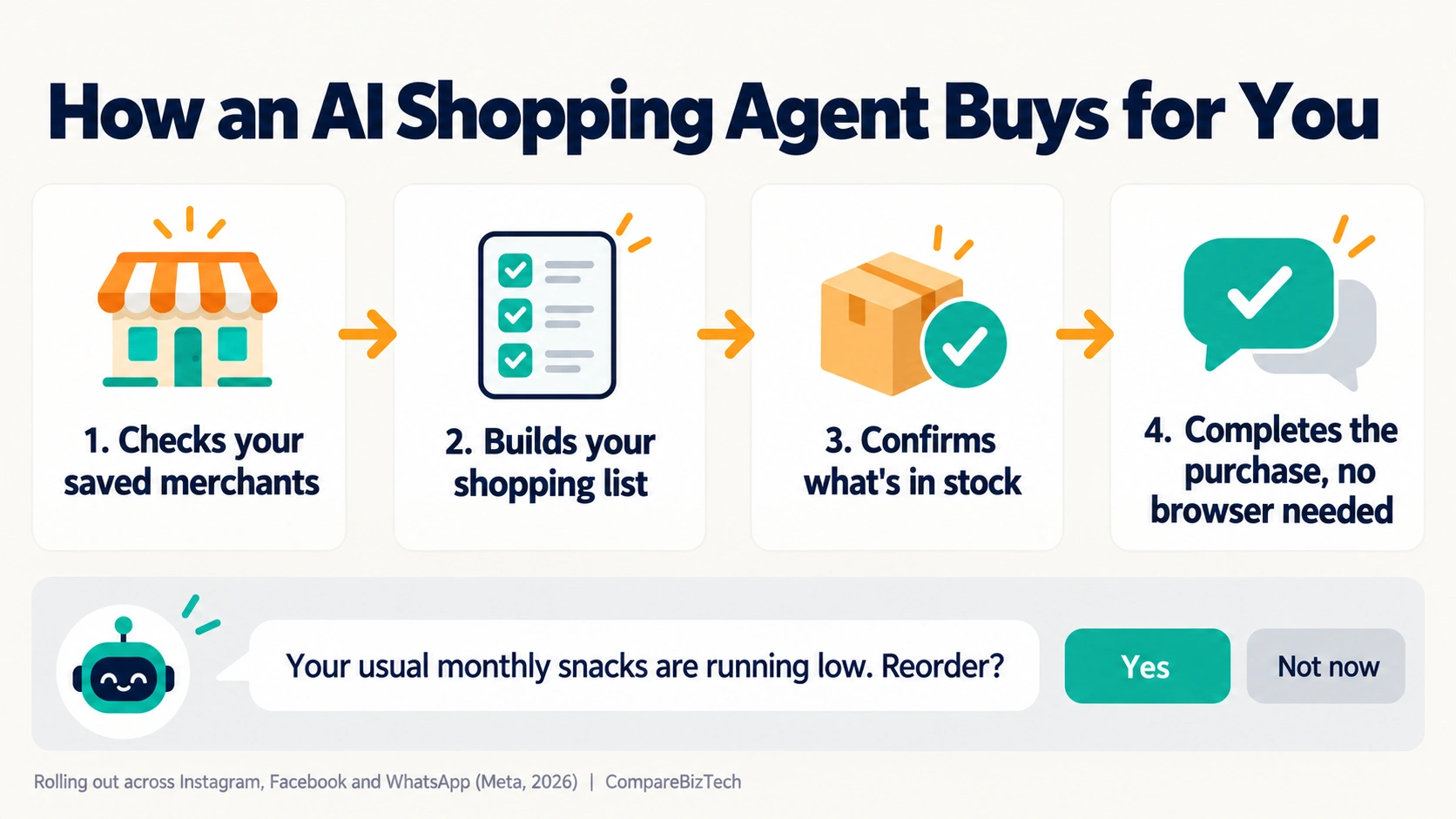
For most Indian shoppers, this won’t feel like “talking to a robot.” It’ll feel quieter than that. An assistant sitting inside a chat you already use, one that remembers you buy the same snacks every month and just asks if you want them again. The brands showing up inside these AI recommendations get the sale. The ones that don’t? They basically stop existing at the exact moment someone’s ready to buy.
This is also why “SEO” is quietly turning into something people are now calling AI visibility, or answer-engine visibility, depending who’s writing the LinkedIn post. When an AI agent is deciding which three products to show a shopper, ranking well on Google stops being enough on its own. Product data needs to be clean enough for a machine to actually parse it properly, honest specs, real reviews, pricing that matches across every channel, because the agent’s reading and comparing all of that on the shopper’s behalf now. Nobody’s scrolling through ten browser tabs to compare anymore.
Trend 2: Quick Commerce Keeps Eating Into “Normal” Ecommerce
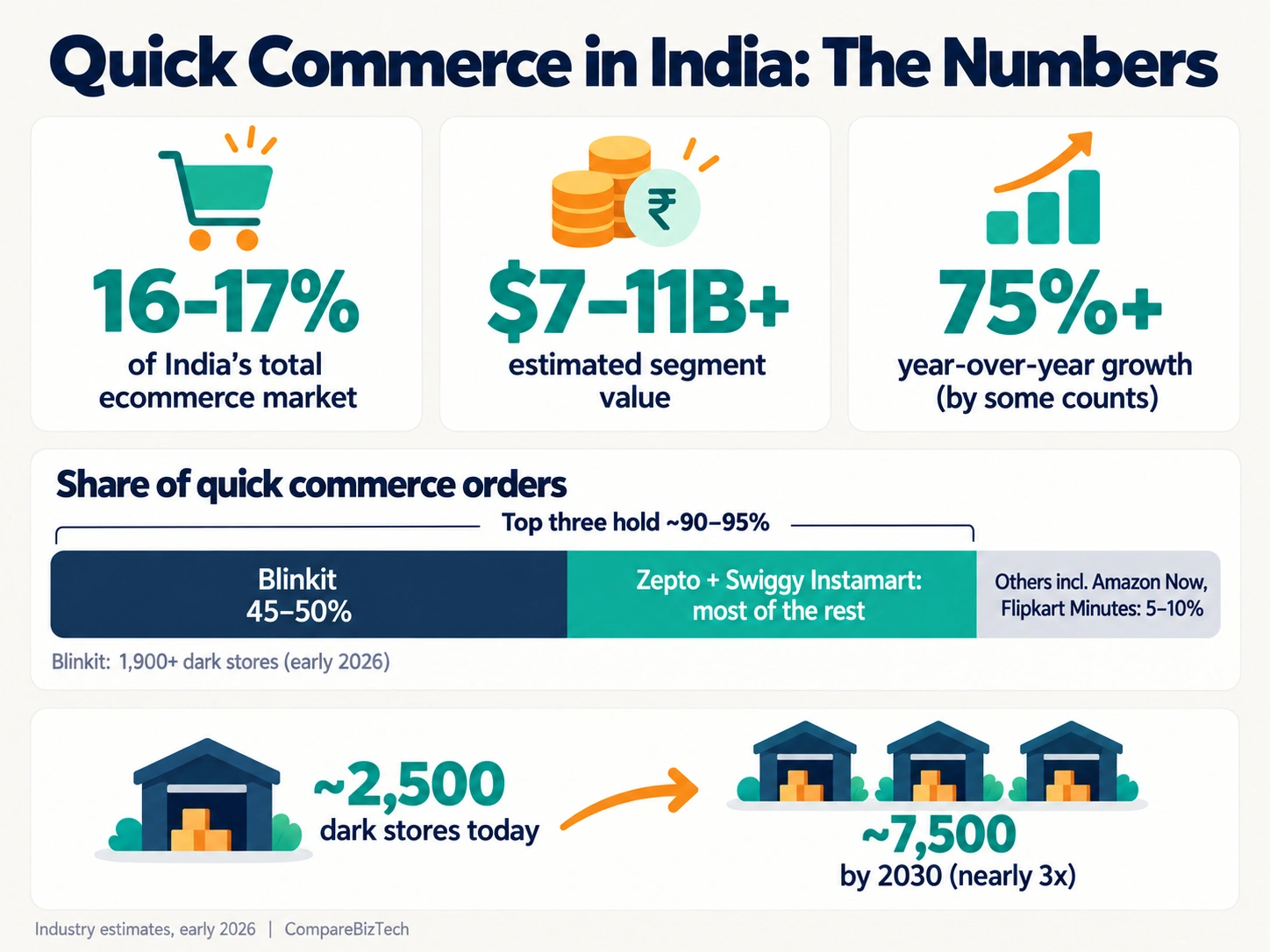
Ten-minute delivery stopped being a novelty a while back. It’s just how a growing chunk of India shops for everyday stuff now. Quick commerce already makes up somewhere between 16% and 17% of the country’s total ecommerce market, and depending which estimate you trusts the segment’s worth anywhere from $7 billion to north of $11 billion right now, growing at more than 75% year over year by some counts. That’s a wild growth rate for something this young.
Three names dominate here: Blinkit, Zepto, and Swiggy Instamart, together holding somewhere around 90 to 95% of all quick commerce orders between them. Blinkit leads with roughly 45 to 50% market share and over 1,900 dark stores as of early 2026, with Zepto and Instamart splitting most of what’s left. What’s genuinely interesting, though, is that Amazon Now and Flipkart Minutes are scaling up fast too, so this fight for who owns “fastest delivery in India” is nowhere near settled. By 2030, the country’s dark store network is expected to nearly triple, from around 2,500 stores today to something like 7,500, as the category pushes past milk and biscuits into pricier stuff like beauty products and ready meals.
There’s a real question mark hanging over all of it, though. Profitability. Bernstein’s research suggests most dark stores across India’s eight biggest cities are turning a profit now, but stores in smaller tier-2 towns are still burning through cash trying to build the same density that actually makes the model work in a place like Mumbai. Whether quick commerce becomes a genuinely durable, profitable business everywhere, or just stays concentrated in the twenty biggest cities, might be the single biggest open question in Indian retail right now. Either way, if you sell anything that fits inside a ten-minute delivery window, groceries, personal care, small electronics accessories, quick commerce isn’t a side category anymore. It’s a direct competitor for that sale.
Trend 3: Social Commerce Isn’t Instagram’s Buy Button, It’s WhatsApp
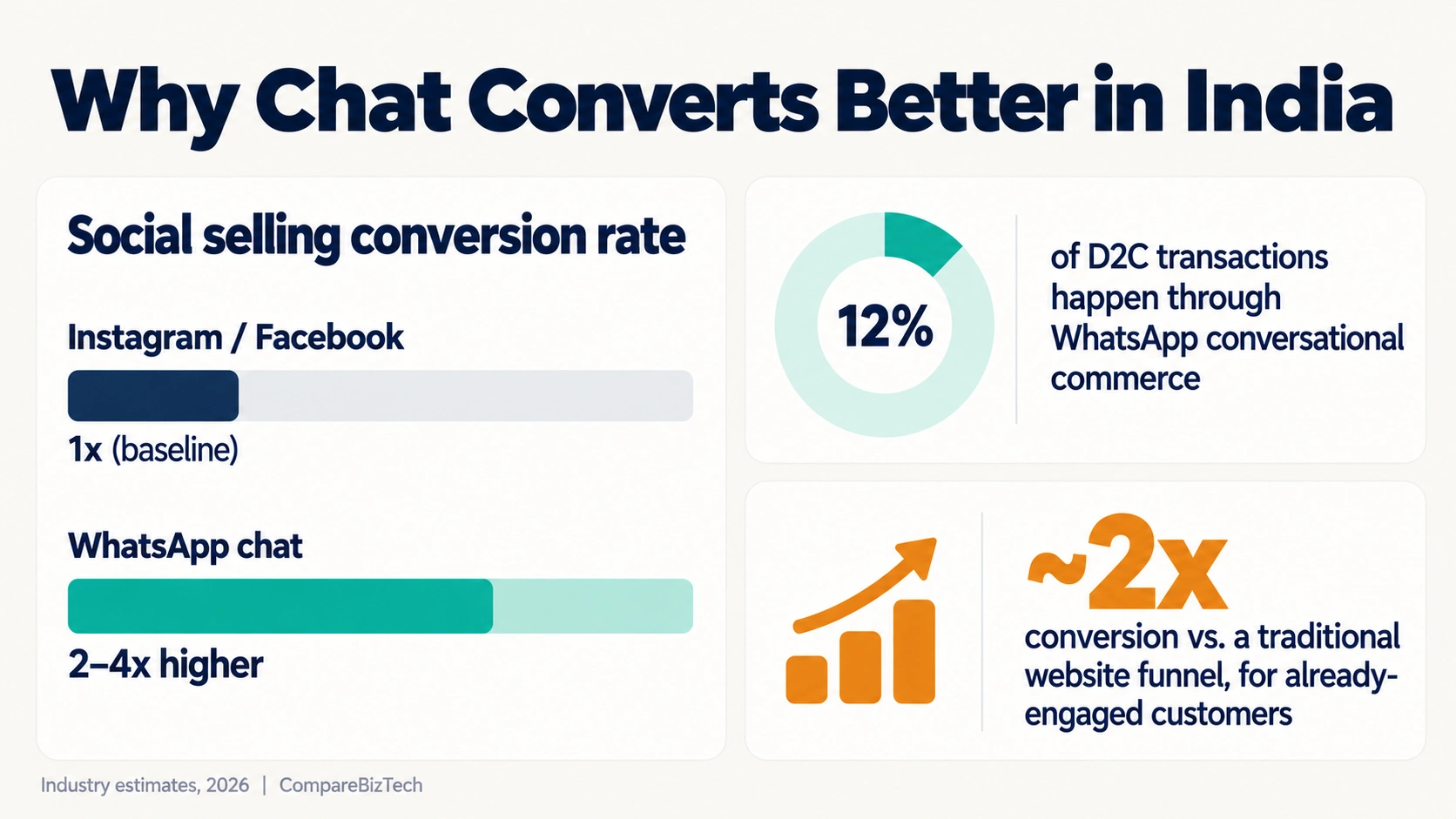
In most Western markets, social commerce India would mean scrolling Instagram and tapping “buy” on something a creator showed you five seconds ago. Here, the bigger story is happening somewhere else entirely, inside chat threads. WhatsApp’s conversion rate for social selling runs anywhere from 2 to 4 times higher than Instagram or Facebook, mostly because it feels like talking to an actual person, not clicking on an ad that followed you around the internet.
Meesho basically pioneered this whole model years back, letting resellers, mostly women running side businesses from home, sell straight to their own communities through WhatsApp and Facebook without ever needing a storefront. That relationship-first style of selling, a brand’s WhatsApp group, a local creator’s word-of-mouth, a YouTube review that ends with someone DMing to buy, is really the actual shape social commerce takes here. And it looks quite different from the copy-paste playbook that works fine in the US.
Trend 4: Conversational Commerce Becomes the Default, Not the Novelty
Chat-based buying, where someone messages a brand, gets sent a catalog, asks a question or two, and pays right there in the same thread, has already crossed a real threshold in India. Industry estimates put conversational commerce through WhatsApp at capturing somewhere around 12% of D2C transactions, with conversion rates roughly double a traditional website funnel for anyone already engaged. This channel especially shines for repeat purchases, where the customer already trusts the brand and just wants the fastest possible route back to buying again, no fifteen-step checkout required.
Meta’s own 2026 roadmap leans hard into exactly this, generative AI ad creation, shoppable Instagram Reels, native WhatsApp checkout, all rolling out with the Indian market specifically in mind. The bet here is pretty simple. Indian commerce is becoming scroll-driven and chat-driven, not search-driven the way it was five years ago.
Trend 5: WhatsApp Commerce Grows From “Nice to Have” Into Core Infrastructure
Worth pulling this apart from general social commerce, because WhatsApp is doing something structurally different in India than anywhere else on earth. Native catalogs, in-chat payments, and agentic shopping tools now rolling out, WhatsApp is quietly becoming a full storefront for businesses that could never have afforded to build one on their own. A local boutique, a home baker, a small D2C brand testing one new product, all of them can run a genuine sales operation entirely inside a chat app their customers already trust with their family gossip.
The businesses actually winning here aren’t the ones with the flashiest chatbot. They’re the ones using WhatsApp exactly how Indian shoppers already want to buy, personally, with real replies from a real person, minus the hassle of downloading yet another app just to place one order.
Trend 6: Voice Shopping Finally Finds Its Real Use Case
Voice commerce never quite took off the way people predicted a few years ago, at least not as “hey, order me some toothpaste” through a smart speaker sitting in the corner. What’s actually gaining ground is voice search and voice-assisted product discovery baked into regional-language apps, genuinely useful for first-time internet users in smaller towns who feel more comfortable speaking than typing, especially in a language that isn’t English. As internet access keeps deepening into tier-2 and tier-3 India, expect voice to matter more as an accessibility feature than as some standalone shopping channel on its own.
Trend 7: Payments Get Faster, and UPI Just Keeps Winning
Nothing has done more to make Indian ecommerce frictionless than UPI, full stop, and there’s no sign of it slowing down. UPI now handles roughly 60 to 65% of all ecommerce payments countrywide, processing over 18 billion transactions a month as of early 2026. Cash on delivery, once the safe default for a wary shopper who didn’t trust putting card details online, has shrunk to somewhere around 25 to 30% of orders, still meaningful, sure, but nowhere near dominant anymore.
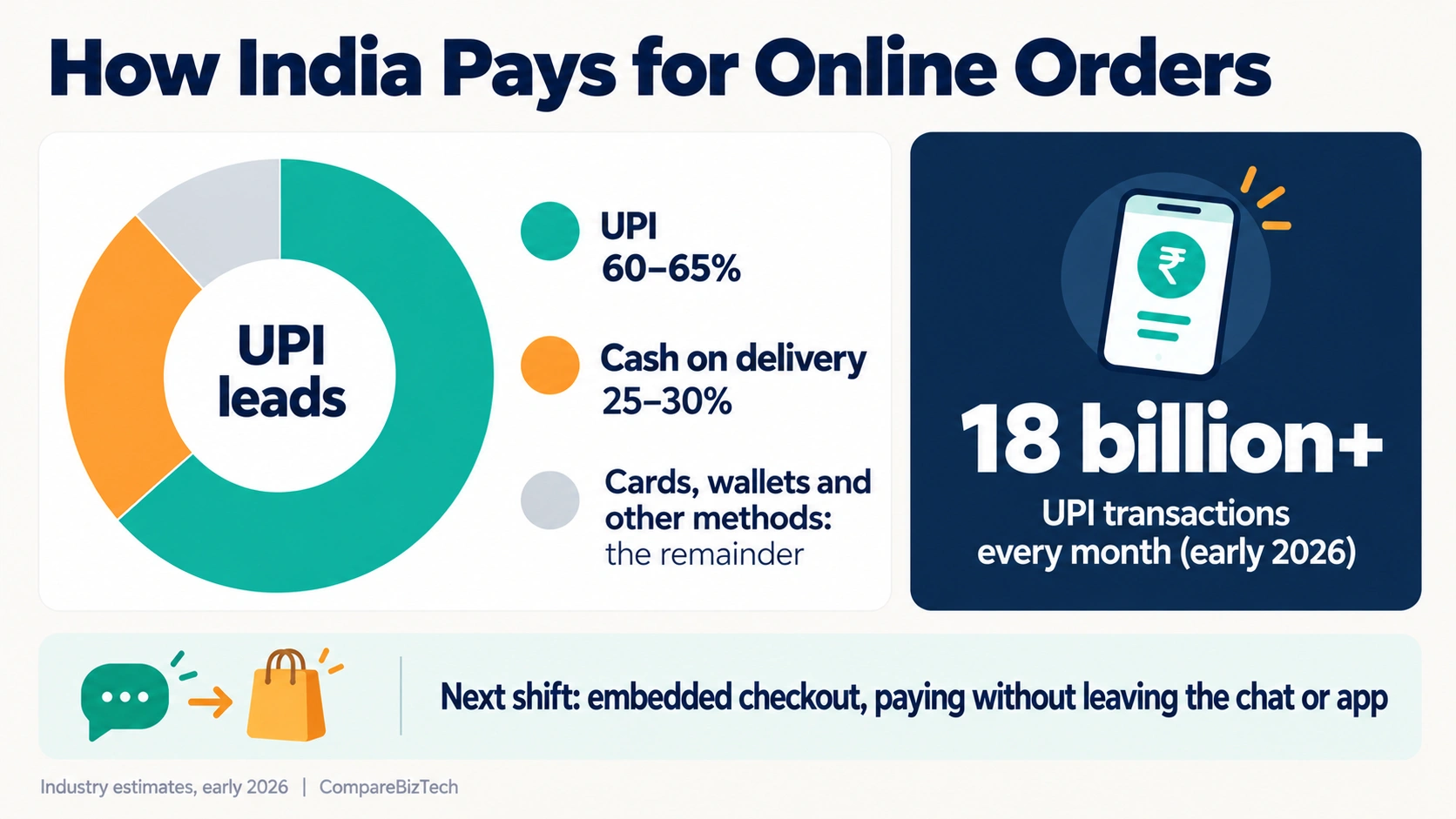
The next payments shift worth watching closely is embedded checkout, paying without ever leaving the chat or app you’re already sitting inside. WhatsApp Pay integrations and in-app UPI checkout inside Instagram Shops are both part of this exact same push: remove every last tap standing between “I want this” and “I already bought it.”
Trend 8: Customer Data Gets Smarter, and Also a Lot More Regulated
Ecommerce personalization is genuinely delivering real results now, industry benchmarks point to conversion improvements of 18 to 25% on platforms that’ve properly built out AI-driven personalization, whether that’s product recommendations, dynamic pricing, or push notifications timed for when someone’s actually likely to buy something.
But all this is happening right alongside a tightening data protection environment. India’s Digital Personal Data Protection Act is moving through its rollout phases, with stricter consent and data-handling rules landing progressively through 2027. Any ecommerce business building a personalization engine on customer data right now needs to bake in real consent tracking and data minimization from day one. Not bolt it on later once regulators come knocking with questions nobody wants to answer under pressure.
Trend 9: Automation Quietly Runs the Boring Stuff So Humans Don’t Have To
Order confirmations, delivery updates, return processing, basic support questions, none of it needs a human anymore, and increasingly, none of it gets one. What’s actually changing is how invisible this automation is becoming. The best setups don’t feel like “talking to a bot” at all, they just feel like the order showed up on time and the return got processed without three separate phone calls and a lot of hold music. The businesses getting this right are freeing up their actual people for conversations that genuinely need judgment, a complaint, a custom order, a high-value client, while the repetitive 80% just runs itself in the background.
Trend 10: ONDC Quietly Tries to Do for Ecommerce What UPI Did for Payments
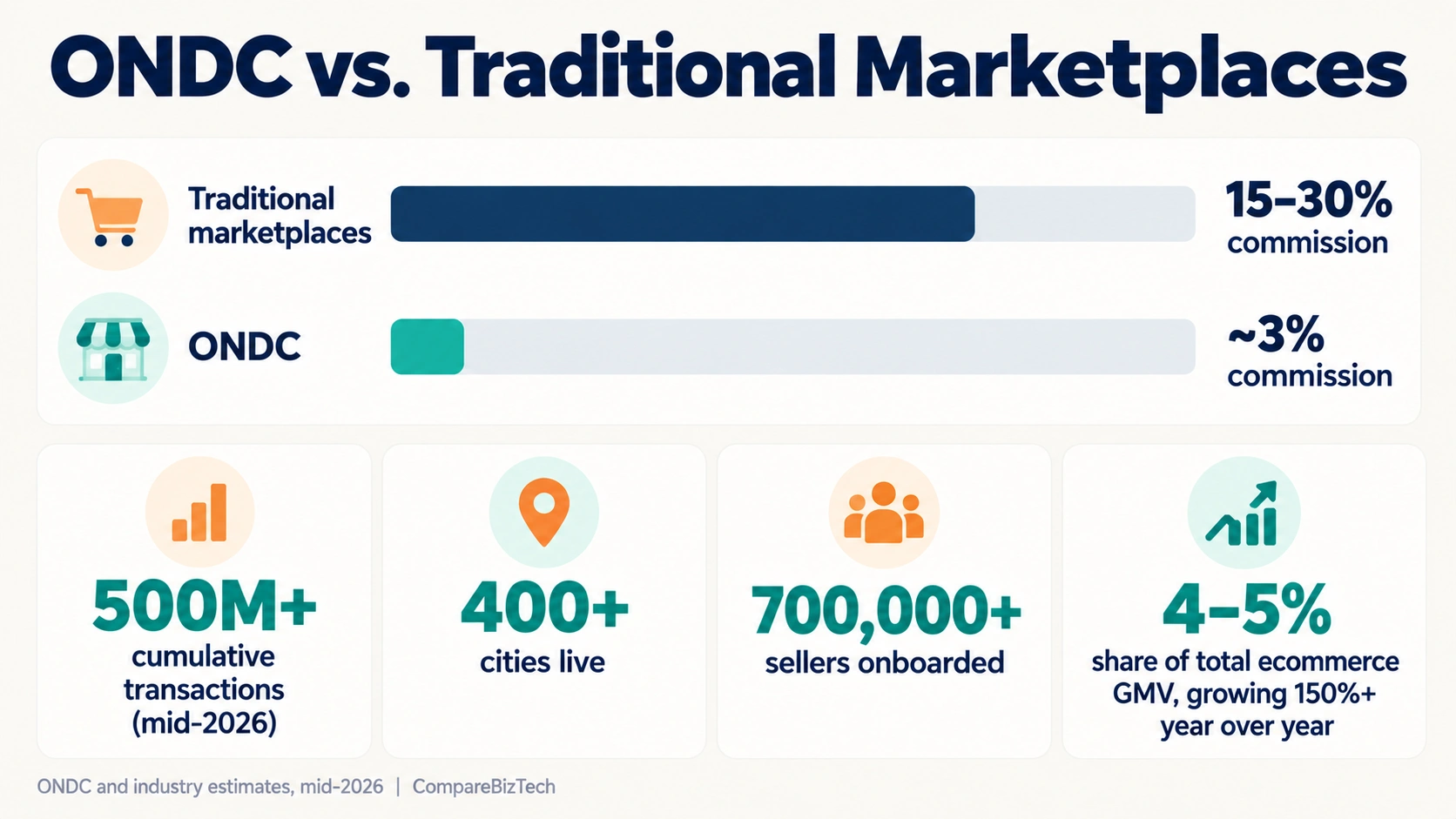
This is probably the trend most likely to matter enormously five years from now, and the one getting talked about the least today. The Open Network for Digital Commerce, a government-backed protocol letting any buyer app connect to any seller instead of locking both sides into one platform forever, crossed 500 million cumulative transactions by mid-2026, up from basically nothing a few years back. It’s live across 400-plus cities with over 700,000 sellers onboarded, and the whole pitch is refreshingly simple: commission rates around 3%, against the 15 to 30% traditional marketplaces charge sellers just for the privilege of showing up.
ONDC’s still a small slice of total ecommerce GMV, current estimates put it around 4 to 5%, so no, it’s not toppling Amazon or Flipkart anytime soon. But the growth rate is genuinely startling, some reports cite year-over-year growth above 150%, and people keep comparing it to UPI’s early years for good reason. UPI also looked like some niche government experiment right up until, suddenly, it wasn’t. If ONDC follows even a slice of that same curve, it could meaningfully lower the cost of getting started for small sellers and quietly reshape who even gets to compete in Indian ecommerce going forward.
What makes ONDC worth watching specifically if you run a small business is the B2B layer that’s grown up alongside the consumer side, manufacturers and wholesalers connecting straight to local kirana stores without the usual chain of distributors taking a cut along the way. If you’ve been priced out of Amazon or Flipkart’s ad costs, or you just can’t stomach commission rates eating 15 to 30% of every single sale, a 3% network is genuinely worth a look, even while it’s still finding its footing.
What This Actually Means If You’re Running a Business, Not Just Reading About One
If there’s one thread tying all ten of these together, it’s this. The businesses winning in Indian ecommerce over the next few years won’t necessarily be the ones with the biggest ad budgets. They’ll be the ones showing up wherever their customer already is, a WhatsApp chat, a ten-minute delivery slot, an ONDC-connected buyer app, an AI agent quietly reordering on their behalf without being asked twice. Trying to force customers onto your own standalone website, away from channels they already trust, is looking more and more like a losing bet.
A Few Honest Caveats
Worth holding a couple of things loosely here. Market size projections swing wildly between analysts, anywhere from $250 billion to $350 billion by 2030 depending on who you’re reading, so treat any single number as a rough direction, not something carved in stone. Quick commerce’s unit economics are still shaky outside the biggest cities, genuinely profitable in the top eight metros, still burning cash in smaller towns trying to catch up. And regulatory shifts, on data protection, on platform competition, on how ONDC governs itself, could still change how a few of these trends actually play out.
Nobody’s got a perfect view five years out. Not even the analysts writing these reports with such confidence. What does seem fairly certain, though, is the direction of travel: faster, more conversational, increasingly automated, and built around channels Indians already trust rather than the ones ecommerce companies wish they’d adopt instead. If you’re building anything in this space right now, that’s really the bet worth making.

The Team Compare BizTech is made up of people from marketing backgrounds, digital marketing & content marketing backgrounds, each with unique experiences and nuggets of wisdom to share with you. The team is passionate about creating unique, accurate, and engaging content.