
Everyone selling software to online stores right now says the same thing: bolt on AI, watch revenue climb. It’s a nice pitch. It’s also almost useless, because “AI-powered personalization” doesn’t tell you what changes on your site tomorrow morning, what it costs, or whether it’s worth ditching the tool you already pay for.
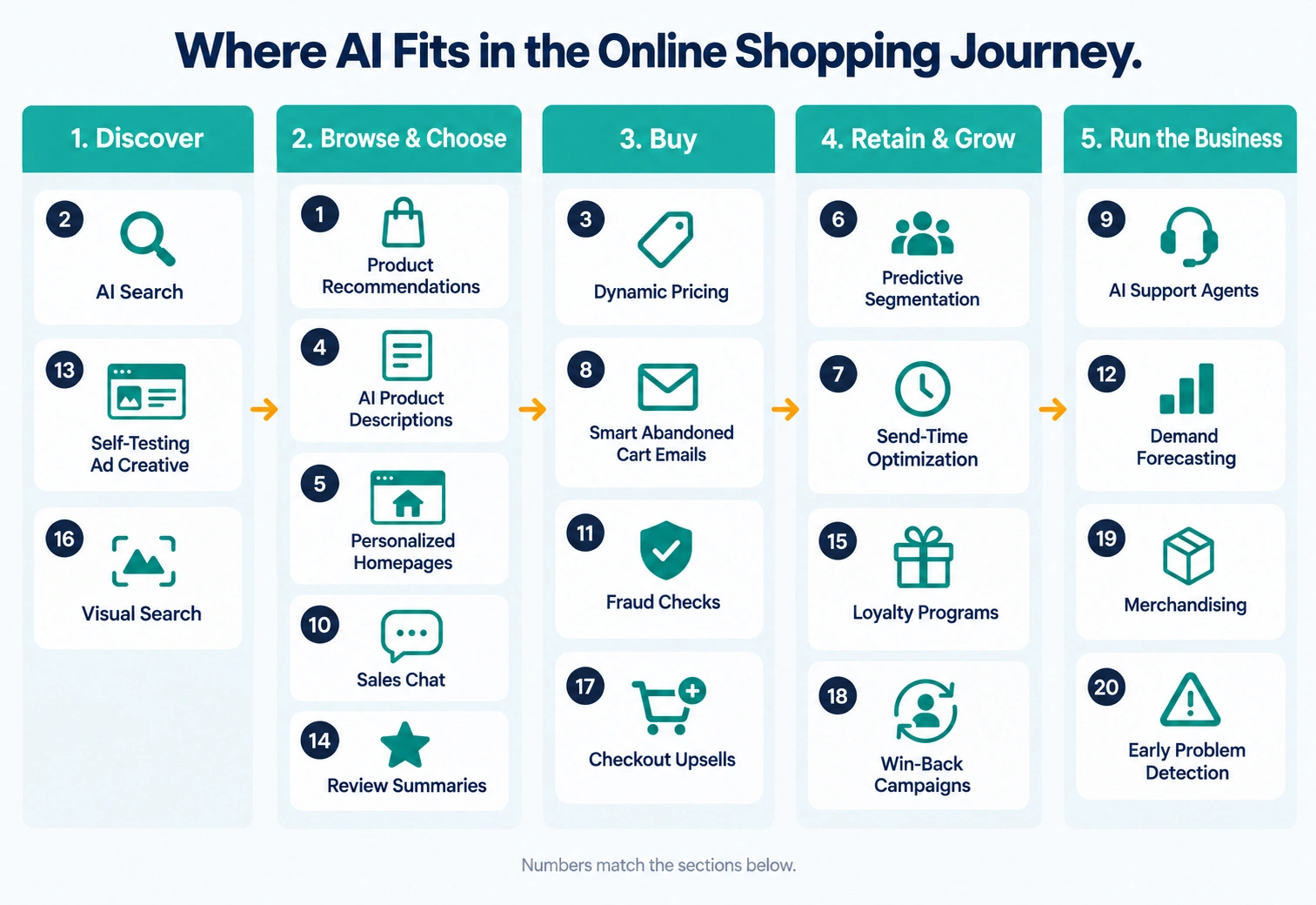
So, let’s skip the pitch and get into what’s actually happening. Below are 20 real, working ways stores are using AI in ecommerce right now, complete with tool names, real pricing, and an honest opinion on who benefits and who’s just burning cash. A few of these you could switch on this afternoon. Others need six months of clean sales data before they’re worth a dime. I’ll tell you which is which as we go.
1. Product recommendations that actually match intent
Remember the old “customers also bought” box? It just looked at purchase history and called it a day. The newer ecommerce AI tools doing this job, Nosto and Rebuy among them, watch what someone’s actually doing right now: what’s in their cart, how long they’ve lingered on a page, even the time of day they’re shopping.
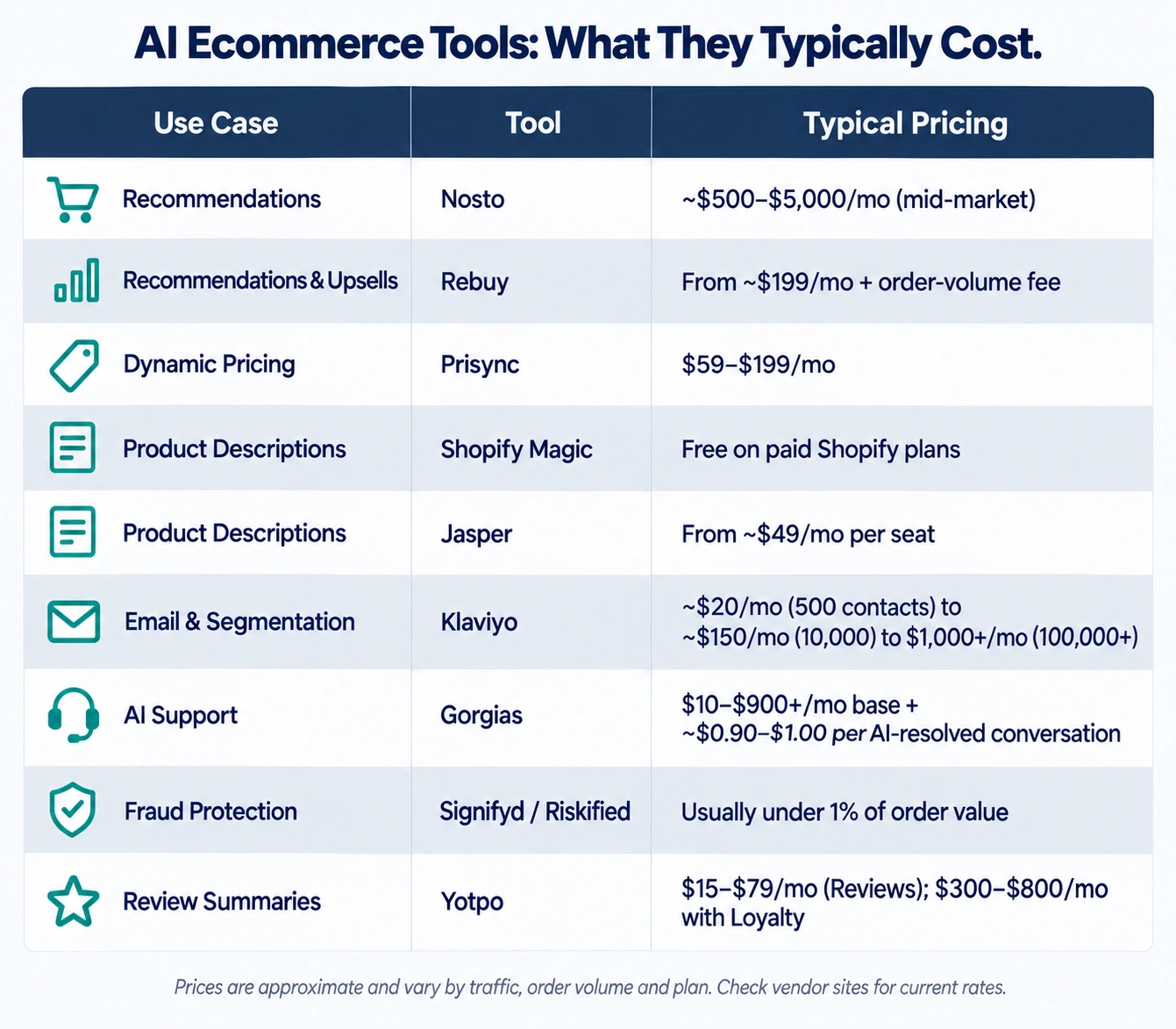
Nosto keeps its pricing deliberately vague, quoting based on your traffic and revenue, and mid-market bills tend to land somewhere between $500 and $5,000 a month. Rebuy is more upfront about it, starting around $199 a month plus a fee tied to your order volume. Both will tell you their engine lifts average order value. Treat those numbers as a starting hypothesis, not gospel, until you’ve run it on your own traffic for a month.
Worth it if you’ve got a catalog big enough that “what pairs with what” isn’t obvious off the top of your head, and you’re doing at least a few hundred orders a month. Skip it if you sell ten products. Nobody needs a machine learning model to tell them the phone case buyer probably wants a screen protector too.
2. Search that understands what people actually mean
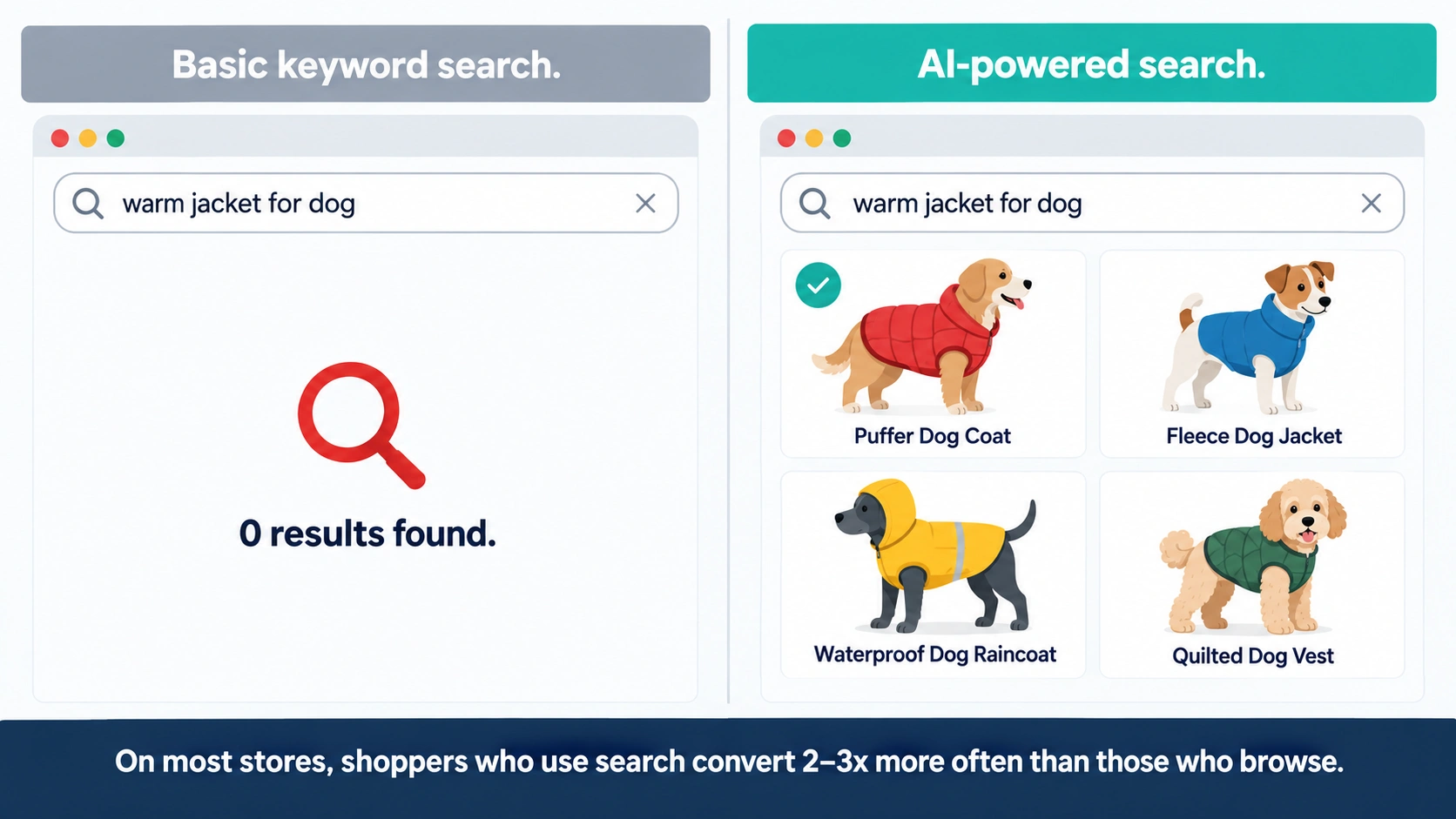
Plain ecommerce search breaks the second someone misspells a brand name or types “warm jacket for dog” instead of your exact product title. Tools like Algolia and Klevu use AI personalization logic on the results page itself, reading intent instead of just matching keywords, and pushing whatever’s actually converting to the top.
Here’s why this one deserves more attention than it gets: on most stores, people who use the search bar convert two to three times more often than people who just browse. If your search returns zero results for a common typo, you’re not losing a sale to a competitor. You’re losing it to a broken text box.
3. Prices that shift with the competition, automatically
Software like Prisync (running $59 to $199 a month depending on the plan) and Omnia watches competitor prices across the web all day and nudges yours within rules you set yourself: never dip below cost, always beat this one rival by a couple percent, match Amazon on this category. This isn’t the surge pricing airlines run. Think of it more like a very fast, very patient assistant checking ten competitor sites an hour so you don’t have to.
Where does this actually pay off? Commodity categories, phone accessories, household basics, anything where price is the whole game. Where does it flop? Brands built on trust and price consistency. If your customers would feel a little burned finding out the price moved since yesterday, leave this one alone.
4. Product descriptions written by AI, edited by a human
Writing 500 unique product descriptions by hand is nobody’s idea of a fun week. Tools like Jasper, Copy.ai, and Shopify’s own Shopify Magic can spit out a decent first draft from a spec sheet in seconds. Shopify Magic comes free on paid Shopify plans, while Jasper starts around $49 a month for one seat.
Here’s the part most people skip past: AI-written descriptions read fine one at a time, but line up ten of them and you’ll notice they all sound the same. Same rhythm, same three adjectives. Use the AI for the rough draft, then have an actual person punch up the top 20% of your catalog, the products that actually drive revenue. Don’t skip that step. It shows.
5. Homepages that change depending on who’s looking
Instead of every visitor landing on the same homepage, tools like Nosto, Dynamic Yield, and Bloomreach swap out banners, featured products, and even the order of your categories based on who’s on the page. A repeat customer might see new arrivals in their usual size. Someone who just clicked a Google ad might land on your bestsellers instead.
One catch: this needs real traffic to learn from. If you’re under a few thousand sessions a month, the algorithm doesn’t have enough to work with yet, and you’d get more mileage running a couple of manual A/B tests by hand.
6. Segmentation based on what customers will probably do next
Basic segmentation sorts people by simple rules: “bought once,” “hasn’t ordered in 90 days.” Predictive tools baked into platforms like Klaviyo go further, estimating lifetime value, churn risk, and even when someone’s likely to buy again. Klaviyo’s Email plan starts around $20 a month at 500 contacts, climbs to roughly $150 a month at 10,000, and gets well past $1,000 a month once your list crosses 100,000. Good news is that predictive segmentation ships inside the standard plan rather than as some pricey bolt-on, which is a big reason so many direct-to-consumer brands never look elsewhere.
A real-world use: flagging your top 10% of customers by predicted lifetime value so you can get them into a VIP flow before a competitor lures them away with a coupon code.
7. Emails that go out at the moment each person actually opens them
Beyond who gets an email, AI now decides when. Klaviyo and Omnisend both use send-time optimization, learning when each individual person historically opens their inbox and timing the send around that. Sounds minor on paper. Multiply it across a list of 50,000 people and shifting even a slice of sends into each person’s actual “reading” window adds up to a real bump in opens.
8. Abandoned cart emails that only discount when they need to
The old abandoned cart playbook was one flow: wait an hour, send a reminder, maybe toss in 10% off. AI versions look at that specific shopper’s history first. Someone who always pays full price doesn’t get a coupon. Someone who’s bailed on a cart twice before might get one, because the data says they need the nudge.
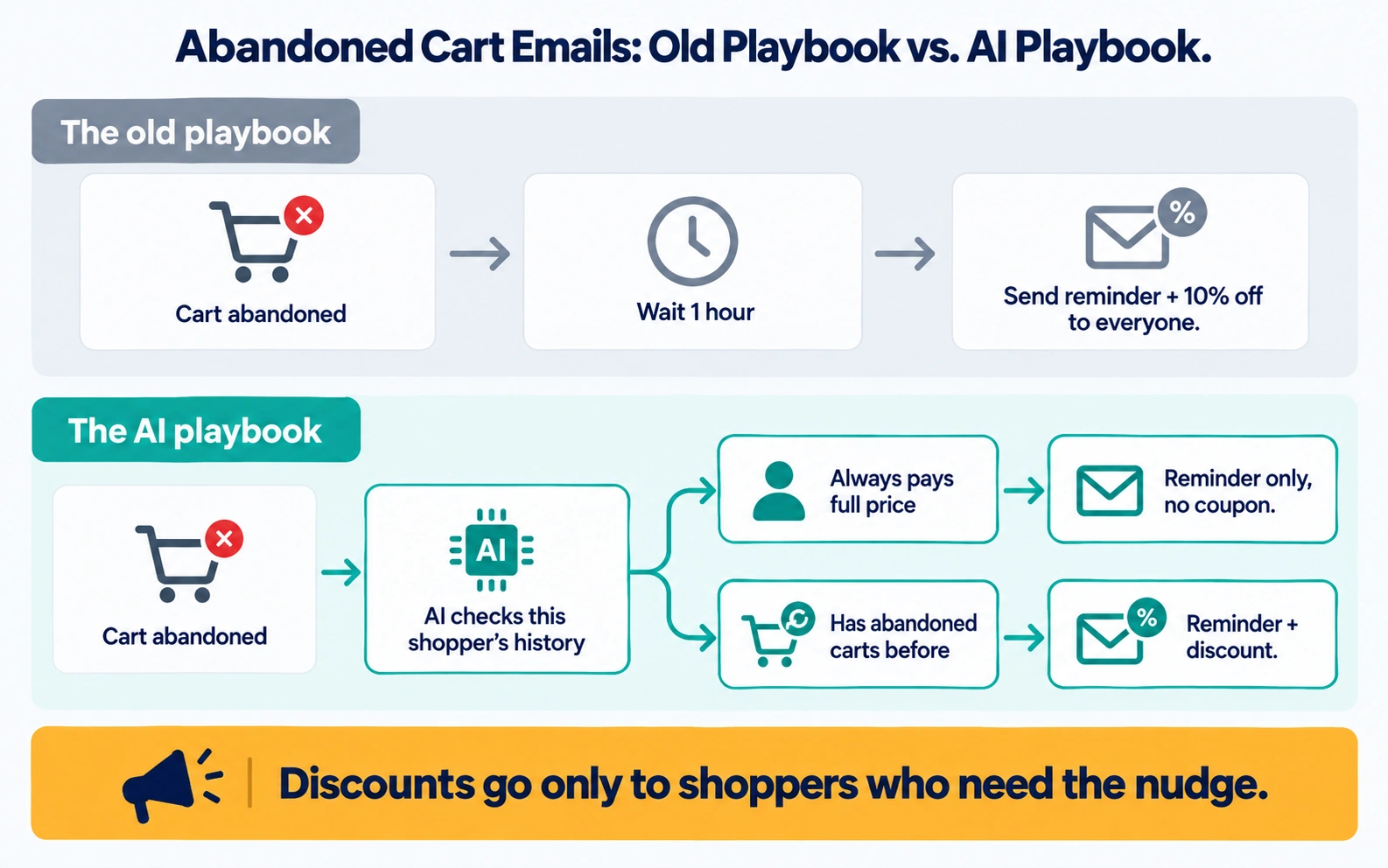
This is probably the highest ROI item on this whole list, honestly, because abandoned cart flows were already profitable long before AI touched them. All the AI does here is stop you from handing out discounts to people who were going to buy anyway.
9. AI support agents that close tickets without a human touching them
This category is moving fastest right now. Gorgias, the biggest name in ecommerce helpdesk software, charges roughly $0.90 to $1.00 per AI-resolved conversation, stacked on top of a base plan that runs anywhere from $10 a month for a tiny store to $900-plus for high-volume operations. Do the math before you sign anything: a store closing 1,000 tickets a month through the AI agent is looking at close to $900 to $1,000 in resolution fees alone, on top of the base plan. It piles up fast, and more than a few buyers have pointed out that Gorgias effectively bills the same conversation twice, once as a regular ticket, once as an AI resolution. Read the invoice line by line.
Good fit: brands fielding a wall of repetitive “where’s my order” and “what’s your return policy” messages, where the AI genuinely takes work off a human’s plate.
Bad fit: low-volume stores where the resolution fees end up costing more than a part-time support hire would.
10. Chat that sells instead of just answering FAQs
Different animal from support tickets. Some AI chat widgets are built to help someone actually pick a product, asking a couple of quick questions (“gift for a coworker?” “what’s your budget?”) and narrowing things down like a good salesperson would. This works especially well in categories where people genuinely don’t know what to buy and quietly leave instead of asking, think skincare, supplements, anything with dozens of near-identical options.
11. Fraud checks that stop rejecting good customers by mistake
Tools like Signifyd and Riskified score every order’s fraud risk in real time using models trained on billions of past transactions, and many will actually guarantee the order against chargebacks once approved. Pricing usually runs as a small percentage of order value, generally under 1%, so it scales as you grow rather than sitting there as a flat fee.
Here’s the underrated part: most stores manually reviewing “suspicious” orders end up rejecting a chunk of perfectly legitimate customers just to be safe. An AI model is usually sharper at this than a tired ops person eyeballing an order list at 11pm, so approval rates tend to go up, not down, once the AI takes over.
12. Forecasting so you don’t run out (or sit on dead stock)
Running out of your bestseller mid-launch costs your sales. Sitting on last season’s leftovers costs you cash flow. AI forecasting tools attached to your inventory system look at seasonality, your marketing calendar, sometimes even weather patterns, to predict what you’ll need and when. Matters most if you hold physical inventory with real lead times. Less relevant if you’re dropshipping.
Honest caveat here: forecasting tools want at least a full year of clean sales history before they’re worth much. Brand new store? This one can wait. Let the data build up first.
13. Ad creative that generates and tests itself
Ad platforms tied to Meta and Google now churn out dozens of copy and image variations on their own, then let the platform’s own AI decide winners through automated testing. This isn’t a separate purchase so much as a feature already living inside Meta Advantage+ and Google Performance Max, tools most stores running paid ads are already using, whether they’ve noticed or not.
he tradeoff: you give up granular control over exactly which ad a given audience sees. Brands who like tight creative control find this uncomfortable. Brands drowning in ad management find it a relief.
14. Reviews that get summarized instead of scrolled through
Tools like Yotpo now use AI to boil down hundreds of reviews into a couple of scannable sentences, plus surface patterns automatically (“runs small,” “great for sensitive skin”) instead of a human reading through comments one by one. Yotpo’s pricing is genuinely confusing to look at: Reviews starts around $15 to $79 a month depending on order volume, but the second you add Loyalty on top, real mid-market bills land between $300 and $800 a month. One thing worth knowing before you get a quote, Yotpo shut down its email and SMS products in December 2025, so you’ll need Klaviyo or Attentive running alongside it either way.
Review summaries genuinely cut down on hesitation for considered purchases, furniture, electronics, anything where shoppers actually read the reviews instead of just glancing at the star count.
15. Loyalty programs that give more to people who need convincing
Points-based loyalty used to treat every customer identically. AI versions adjust the reward based on predicted churn risk, offering a bigger incentive to someone likely to drift away and nothing extra to someone who was going to reorder regardless. Subtler use of AI than most on this list, and easy to overpay for. If a loyalty platform’s “AI features” cost hundreds more a month than the basic version and you can’t name a single decision it’s actually making smarter, you’re paying for a label, not a feature.
16. Snap a photo, find the product
Shoppers can now photograph something they saw in the wild, a dress, a lamp, a specific chair, and AI matches it against your catalog. Pinterest and Google Lens have already pulled this into everyday shopping habits, and search tools like Klevu build visual matching straight into their ecommerce search.
Reality check: only pays off for visually distinctive categories, fashion, home decor, furniture. Sell industrial fasteners? Nobody’s uploading a photo of a bolt.
17. Checkout upsells based on what’s actually in the cart
Instead of a generic “add a warranty?” checkbox everyone ignores, AI-driven checkout upsells look at what’s really in the cart and suggest the one add-on most likely to get accepted, learned from what similar carts converted on before. Rebuy in particular has built its whole product around this, adjusting in-cart and post-purchase upsells per customer instead of showing everyone the same offer.
18. Win-back campaigns that only chase customers worth chasing
AI models flag which lapsed customers are actually worth pursuing, based on past order value and how likely they are to respond, versus which ones are a lost cause. So, your win-back budget goes toward people who’ll realistically come back, instead of blasting a blanket 20%-off code to everyone who hasn’t ordered since March.
19. Merchandising decisions made behind the scenes
Some platforms now quietly suggest which products to feature, discount, or pull from a category page based on margin, current inventory, and predicted demand, basically doing the job a merchandising team used to do manually in a spreadsheet, except continuously and without anyone remembering to update it. This usually shows up as a feature buried inside bigger personalization suites like Bloomreach or Nosto rather than something you’d buy on its own.
20. Catching problems before they blow up into refunds
AI tools scan support conversations and reviews for spikes in negative sentiment tied to one specific product, batch, or shipping delay, flagging a quality issue days before it would otherwise show up as a wave of refund requests or a bad viral post. This one’s defensive rather than directly revenue-generating, but a manufacturing defect caught early, before it snowballs, is real money saved. And saved money spends exactly the same as money made.
So where should you actually start?
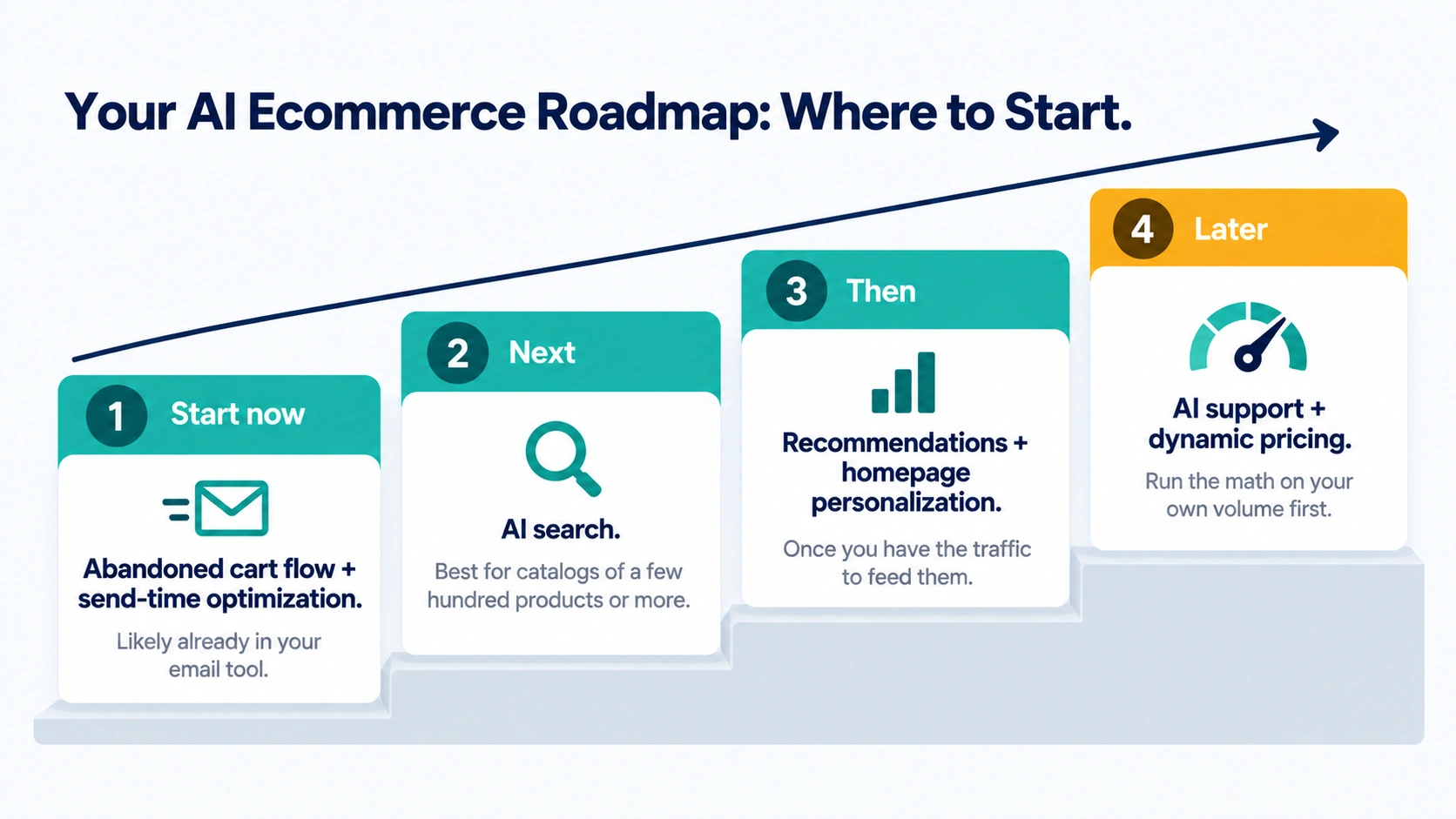
Twenty use cases is a lot to look at, and trying all of them at once is a good way to burn a budget without learning anything. If you want my honest ranking for a typical small or mid-sized store: fix your abandoned cart flow and turn on send-time optimization first, because that’s probably sitting inside the email tool you already pay for and you’re leaving money on the table by not flipping it on. From there, look at search if your catalog runs more than a couple hundred products. Recommendations and homepage personalization come next, once you’ve actually got the traffic to feed them. Save AI customer service and dynamic pricing for later, run the math on your own volume first, because both can quietly cost more than they save if nobody’s watching the meter.
The pattern running through basically everything on this list is the same one. AI doesn’t hand you a new strategy. It just runs the strategy you already had faster, with more data than someone checking a spreadsheet once a week could ever keep up with. The stores actually winning with this stuff aren’t the ones with every AI feature switched on. They’re the ones who picked two or three that genuinely fit how their customers shop, and just did those really well. That’s AI ecommerce automation working the way it’s supposed to, quietly, in the background, instead of being the headline. And honestly, that’s the whole point of AI sales tools doing their job right: you shouldn’t have to think about them once they’re running.

The Team Compare BizTech is made up of people from marketing backgrounds, digital marketing & content marketing backgrounds, each with unique experiences and nuggets of wisdom to share with you. The team is passionate about creating unique, accurate, and engaging content.