

Your sales team is thrashing customer emails into ChatGPT to draft follow ups. Your HR manager just asked an AI tool to summarize twenty resumes, PAN numbers and all. Someone in finance is running a vendor contract through Claude to clean up the language, bank details still sitting right there in the text. None of this feels risky in the moment. It’s just work getting done a little faster.
But here’s the catch: every one of those small actions is now a data protection decision, whether anyone in the room realizes it or not. India’s privacy law finally has real teeth, generative AI has silently become part of daily software, and most businesses simply haven’t linked the two dots yet.
Why Privacy Matters More Than It Did Two Years Ago
For years, Indian businesses got by with a fairly loose privacy regime. The IT Act and its 2011 security rules covered the basics on paper, but enforcement was rare and the fines were small enough that nobody lost sleep over them.
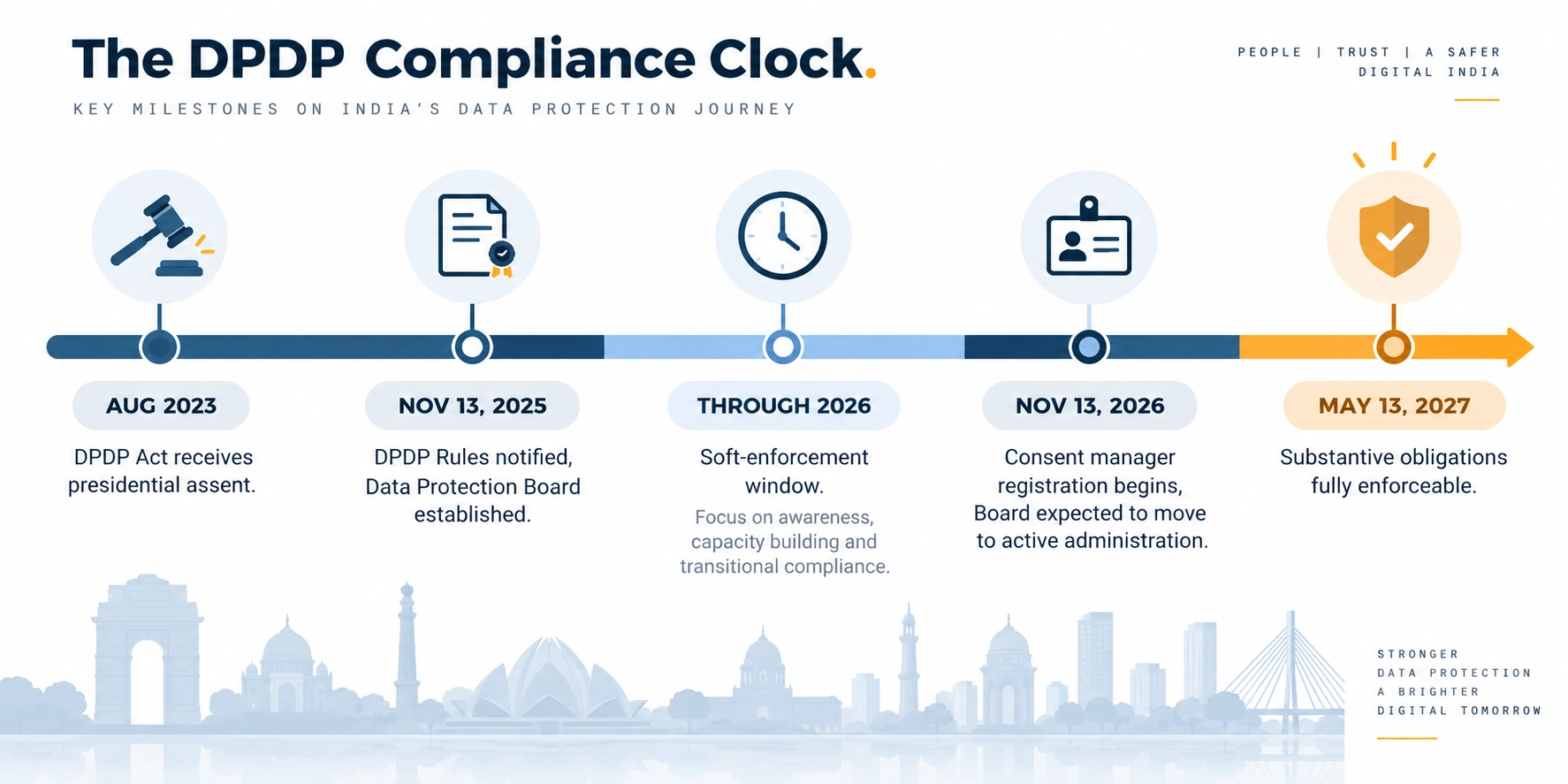
That’s over now. The Digital Personal Data Protection Act, 2023 (the DPDP Act) got presidential assent back in August 2023, then sat low for two years until the government finally notified the DPDP Rules on November 13, 2025. That notification set a clock running. A few provisions, like setting up the Data Protection Board of India, took effect right away. Consent manager registration kicks in on November 13, 2026. And the parts that actually reshape how you collect, store and process personal data become fully enforceable on May 13, 2027.
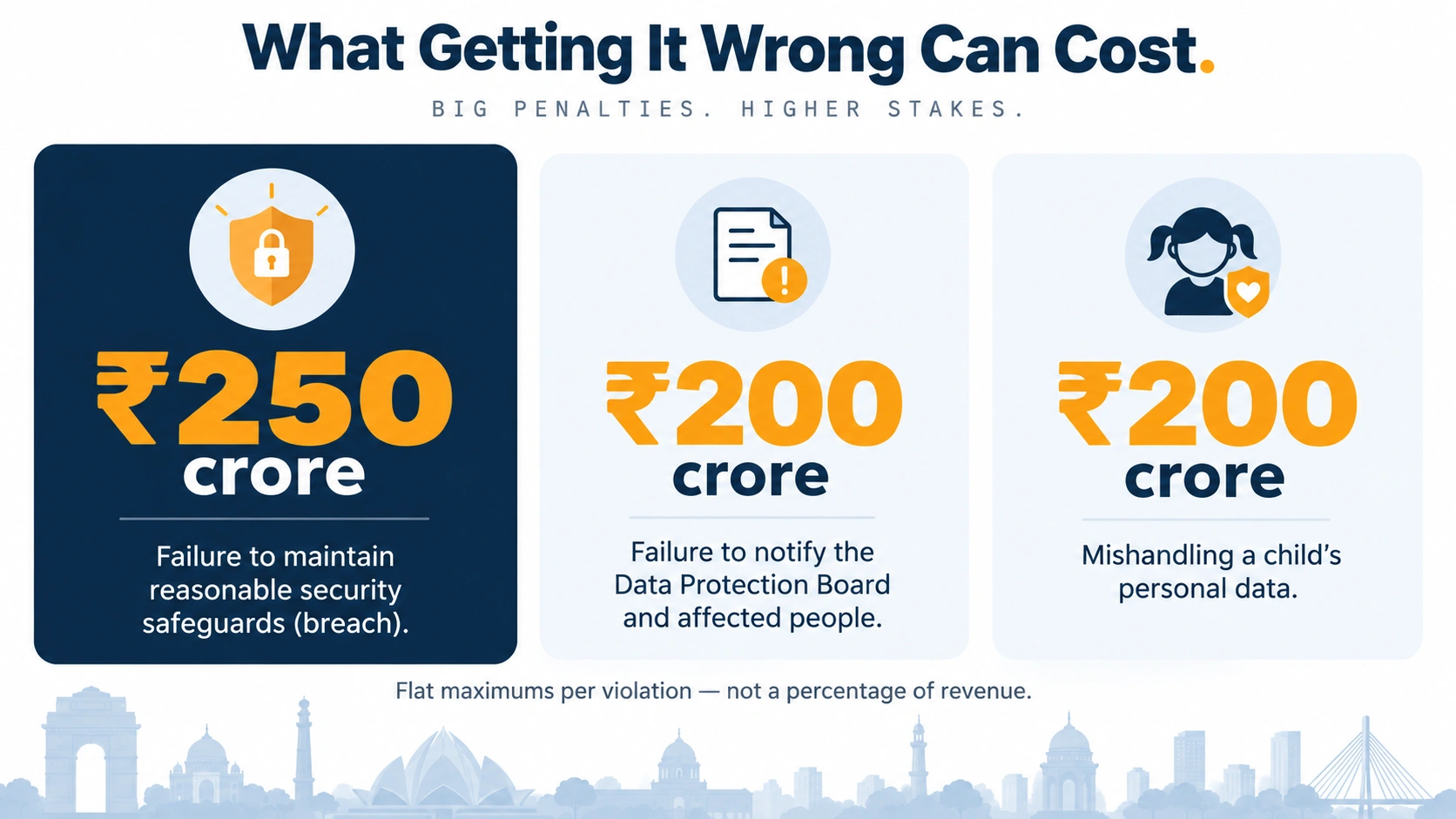
Getting serious about generative AI data protection isn’t optional homework anymore either. Here’s what should really get your attention: the penalties aren’t symbolic. Skip reasonable security safeguards and end up with a breach, and you’re looking at a fine of up to ₹250 crore. Miss the window to notify the Data Protection Board and the people affected, and that’s up to ₹200 crore. Mishandle a child’s data and the cap is also ₹200 crore. Unlike GDPR’s percentage-of-revenue model, these are flat maximums per violation, large enough to sink a small or mid-sized company outright.
So why single out generative AI, rather than talking about data handling in general? Because these tools have a strange talent for pulling sensitive information out of its original context and dropping it somewhere you never intended. Paste a spreadsheet into a chatbot just to reformat it, and that data has already left your controlled environment for a system you don’t run and may not even have a signed agreement with. Most employees don’t think of that as a data transfer at all. Legally, it often is one, and that’s exactly the gap where AI data privacy India compliance tends to fall apart.
The window to get ahead of this is open right now. Soft enforcement runs through most of 2026, and the Data Protection Board is anticipated to shift toward active administration around November 2026. Wait until the fines are actually live, and you’ll be scrambling to build a compliance program under pressure. Start now, and you get to do it at a reasonable pace, without anyone breathing down your neck.
Customer Data: The Riskiest Category by Far
Customer data does the most damage when things go wrong, mostly because it’s the category employees run through AI tools the most. Think about how often someone on your support or sales team drops a customer’s name, phone number, order history or complaint into a chatbot just to get a faster reply written.
Under DPDP, none of that is a grey area. Names, phone numbers, emails, purchase records, location data, anything that can identify a person, all of it counts as personal data. Run it through a third-party AI tool and that tool can become a data processor in the eyes of the law, which means you now need a proper legal basis and real safeguards for that handoff.
The actual risk rarely looks like a dramatic breach. It’s usually smaller and far more ordinary than that. A support rep pastes a customer’s full complaint, address and account number involved, into a public AI tool just to get help phrasing an apology. That text now sits on a server you don’t control, possibly logged for a month or longer, and the customer never approved of any of it happening that way.
What’s the actual fix? Keep customer data workflows separate from casual, general purpose AI use. If your CRM or helpdesk already has AI built in, lean on that instead, since the data never leaves a system, you’re already contractually tied to. And if your team is using standalone tools like ChatGPT or Gemini for customer-facing work anyway, put a real written policy in place that bans identifiable customer details from being typed in, then actually enforce it. A policy nobody reads isn’t a policy, it’s a PDF.
Employee Data: The Blind Spot Most Companies Miss
Everyone worries about customer data. Almost nobody thinks twice about employee data, which is odd, because employee records are frequently more sensitive. Salary figures, performance reviews, medical certificates, disciplinary notes, bank details for payroll. All of it qualifies as personal data under DPDP, no exceptions.
HR teams, meanwhile, have quietly become some of the heaviest AI users in the company, often with zero oversight. Drafting termination letters. Summarizing a whole review cycle in minutes. Screening resumes. Even pulling interview questions together off a candidate’s LinkedIn profile. Every one of these can mean feeding a real person’s data into a tool that was never designed with business AI privacy obligations under Indian law in mind.
The fix isn’t banning AI from HR entirely. It’s drawing a sharper line. Using AI to knock out a generic template letter? Fine, go ahead. Feeding it an actual employee’s performance data, especially anything touching health or a protected characteristic? That needs tighter controls, meaning an enterprise tier tool with a proper data processing agreement rather than a free account, and ideally the data stripped of identifying details before it ever goes in.
Confidential Information: Beyond Personal Data
Not everything worth protecting fits the legal definition of personal data. Your pricing strategy, an unreleased roadmap, a client contract still in draft, internal revenue numbers. None of it counts as “personal data” under DPDP, yet leaking any of it through an AI tool can hurt your business just as badly. And no law forces that AI vendor to guard it the way DPDP forces them to guard personal information.
This is exactly where businesses get a false sense of security. “We’re fine,” they think, “we don’t really handle much personal data.” Meanwhile, someone in finance just asked a free chatbot to build a model using actual revenue figures, or a lawyer pasted a client’s unsigned NDA in just to sanity check the wording.
The rule worth drilling into your team is simple enough: if you’d wince at a competitor seeing this information, don’t paste it into a tool you don’t fully control. Free tiers of most AI products, ChatGPT Free and Plus, the free version of Gemini, can use your inputs to improve their models unless you specifically switch that off. And even with the opt-out flipped on, data typically still hangs around for about 30 days for safety review. That’s a real gap for anything you’d call confidential.
Third-Party AI: Understanding Who Actually Holds Your Data
Sit with this for a second. When your team uses Gemini, ChatGPT, Claude, or Copilot, your data is touching infrastructure owned by OpenAI, Anthropic, Google or Microsoft, often on servers sitting outside India completely. You’ve brought on a new vendor without anyone signing a contract or going through procurement. That’s what it amounts to.
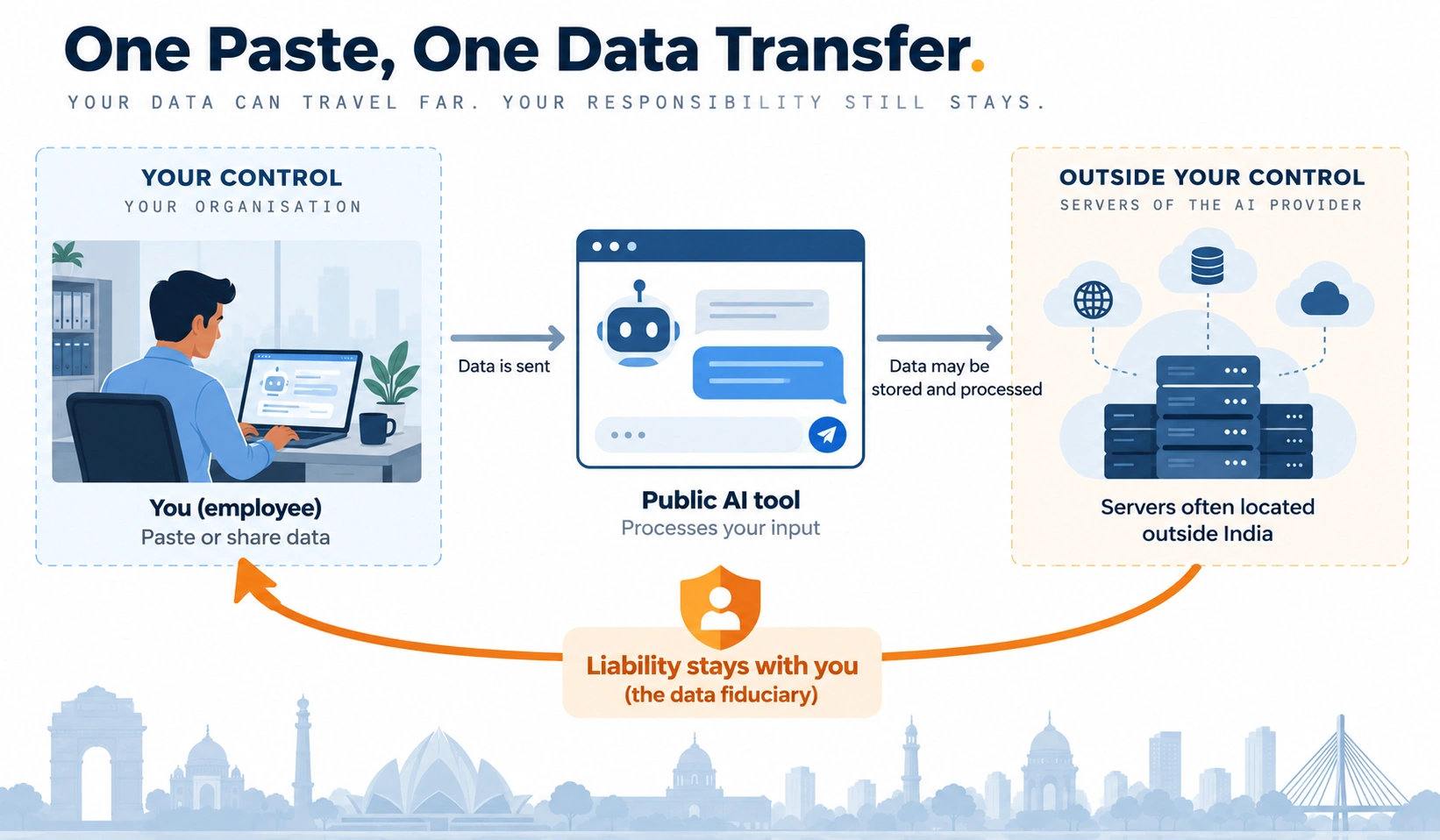
Why does that matter? Two reasons. First, under DPDP, if that tool is processing personal data on your behalf, you, the data fiduciary, stay on the hook for how it’s handled, even though you don’t control the tool itself. You can’t wave the liability away just because the vendor’s servers had an off day. Second, cross-border transfer under DPDP is actually fairly loose right now. India skipped the EU’s strict “adequacy” model, but the government still holds the power to restrict transfers to specific countries later on, and that list hasn’t been finalized in any way businesses can plan confidently around.
So before letting a team lose on a third-party AI tool with real business data, what do you actually check? Does the vendor offer a business tier with a genuine data processing agreement? Do they commit in writing to not training on your inputs? Where do their servers actually sit? And how long is your data kept by default? Ask those four questions and you’ll filter out most of the risky, casual usage quietly happening across offices in India right now.
Retention: How Long Is Your Data Actually Sitting There?
Retention is the query almost nobody bothers to ask, and it’s usually the most revealing one once you do. Most AI vendors hold onto your inputs for a default stretch even after you’re done with the task entirely. OpenAI, for instance, keeps API and Enterprise data for 30 days by default even when it’s excluded from training, purely to monitor for abuse. Some tools hang onto chat history indefinitely unless someone manually deletes it.
Under DPDP, data fiduciaries are supposed to remove personal data once it’s done its job, unless there’s a genuine legal reason to hold onto it longer. If your business is feeding customer or employee data into a tool that softly sits on it for months, you may already be out of step with that principle, even if nobody meant for that to happen.
So, check retention settings across every AI tool your business touches, and not just once at signup either, since vendors update these policies far more often than most IT teams ever revisit them. If a tool offers Zero Data Retention, and a growing number of enterprise tiers do now, it’s worth the extra cost for anything touching real customer or employee information.
Training Concerns: Is Your Data Teaching Someone Else’s Model?
Here’s the question that tends to make business owners genuinely uneasy once it clicks: is the confidential stuff my team typed into an AI tool now baked into that company’s next model release?
Honestly, it depends a lot on the vendor and the tier you’re on. OpenAI’s enterprise privacy commitments say data from ChatGPT Business, Enterprise and the API platform isn’t used to train their models by default. Free and Plus tiers work differently though, training stays on unless someone manually switches it off, and that opt-out doesn’t reach back to anything already submitted. Anthropic changed its consumer policy in 2025 too, so Claude’s free and Pro chats can now be used for training unless you opt out, while API and enterprise setups stay excluded. Google’s Gemini buries its own activity controls somewhere in account settings that most people never think to open.
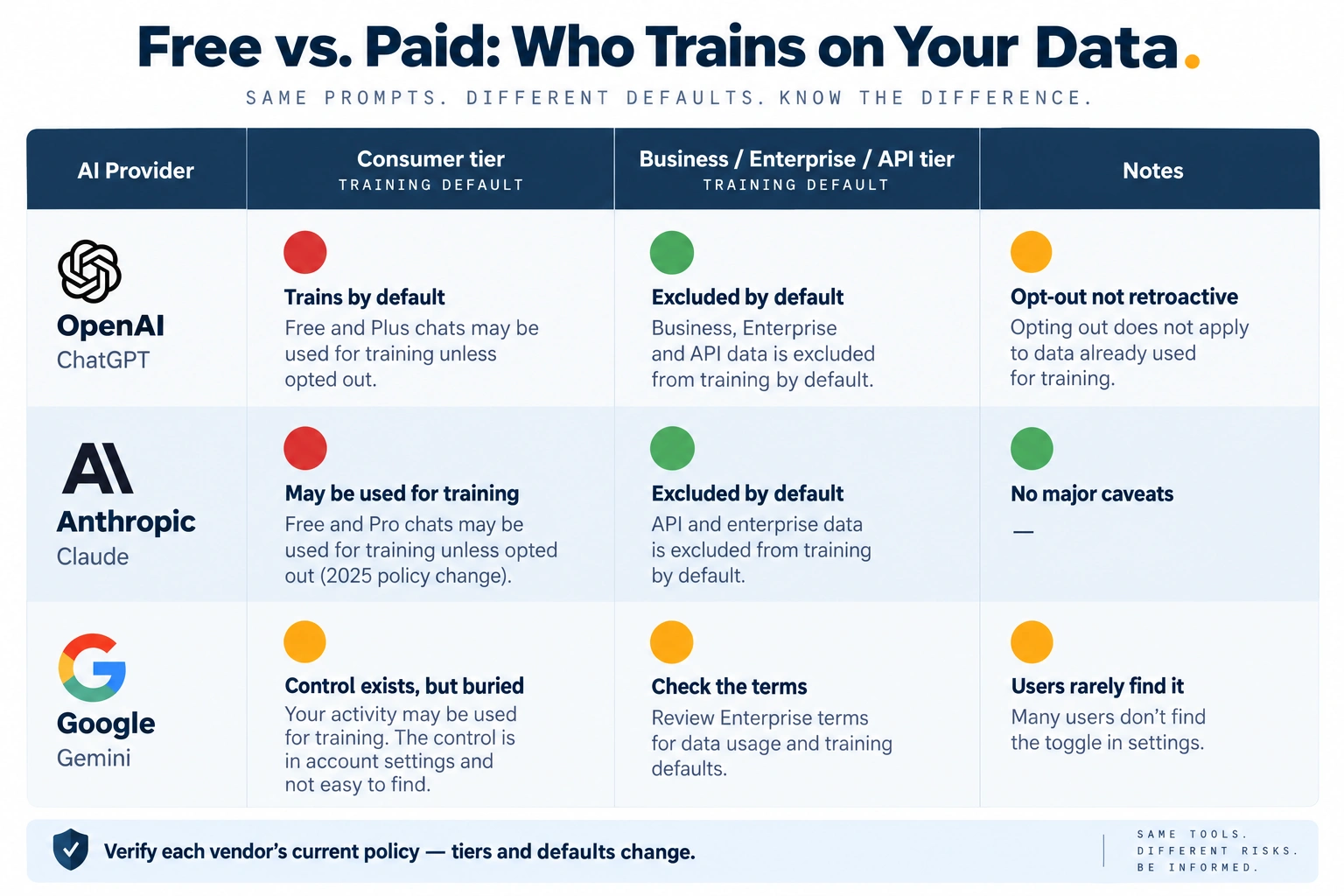
Notice the pattern across all three? Paid business tiers are generally safer, consumer tiers carry more risk, and “safer” still means checking the actual policy rather than assuming things are fine just because a card is on file. None of this is something employees will reliably configure on their own, which is exactly why it needs to be a company-wide decision instead of something left to individual judgment.
Consent: What DPDP Actually Requires
Consent sits at the center of everything DPDP does. Before collecting or processing someone’s personal data, you generally need clear, specific, informed consent for that exact purpose, not a vague catch-all buried on page four of your terms of service. And withdrawing that consent has to be just as easy as giving it in the first place.
This is where AI muddies the water a bit. If a customer agreed to let you process their data to “provide customer support,” did they also agree to that same data getting run through a third-party AI tool to draft the reply? Probably not, unless you told them. Most privacy notices written before 2024 never mention AI processing at all, which means plenty of businesses are technically operating outside the consent they originally collected, without even realizing it.
The fix here doesn’t require reinventing anything, just updating documents most companies haven’t touched in years. Your privacy notice and consent language should spell out whether AI tools process the data, for what purpose, and whether any of it leaves India. This doesn’t need to read like a warning label either, a plain one- or two-line disclosure does the job. It just needs to exist, and it needs to actually match what’s happening inside your business day to day.
Access Controls: Who Can Actually Use These Tools
A lot of privacy incidents aren’t malicious at all. They’re just about too many people having accesses to too much, with nobody checking. If every employee can freely paste anything into any AI tool with zero restrictions, that’s not really a policy gap yet, it’s an access control problem hiding in plain sight.
Enterprise AI tools usually let admins set proper permissions: who gets to use the tool, which data sources it can reach, whether it touches shared drives or the CRM at all. Microsoft 365 Copilot, for one, inherits your existing permission structure automatically, so someone without HR file access in SharePoint won’t suddenly get AI-summarized visibility into those files either. Free consumer tools offer none of that. Everyone who signs up gets the exact same access to type in whatever they want.
If your business handles genuinely sensitive data, financial records, health information, anything falling under DPDP’s more protected categories, the AI tools touching that data need to sit behind the same access controls as the systems underneath them. Don’t let AI quietly become the side door around permissions you spent real effort building everywhere else.
Vendor Due Diligence: Questions to Ask Before You Sign Up
Before accepting any AI tool for work that touches customer or employee data, go through a short list of questions with the vendor directly, not just their marketing page.
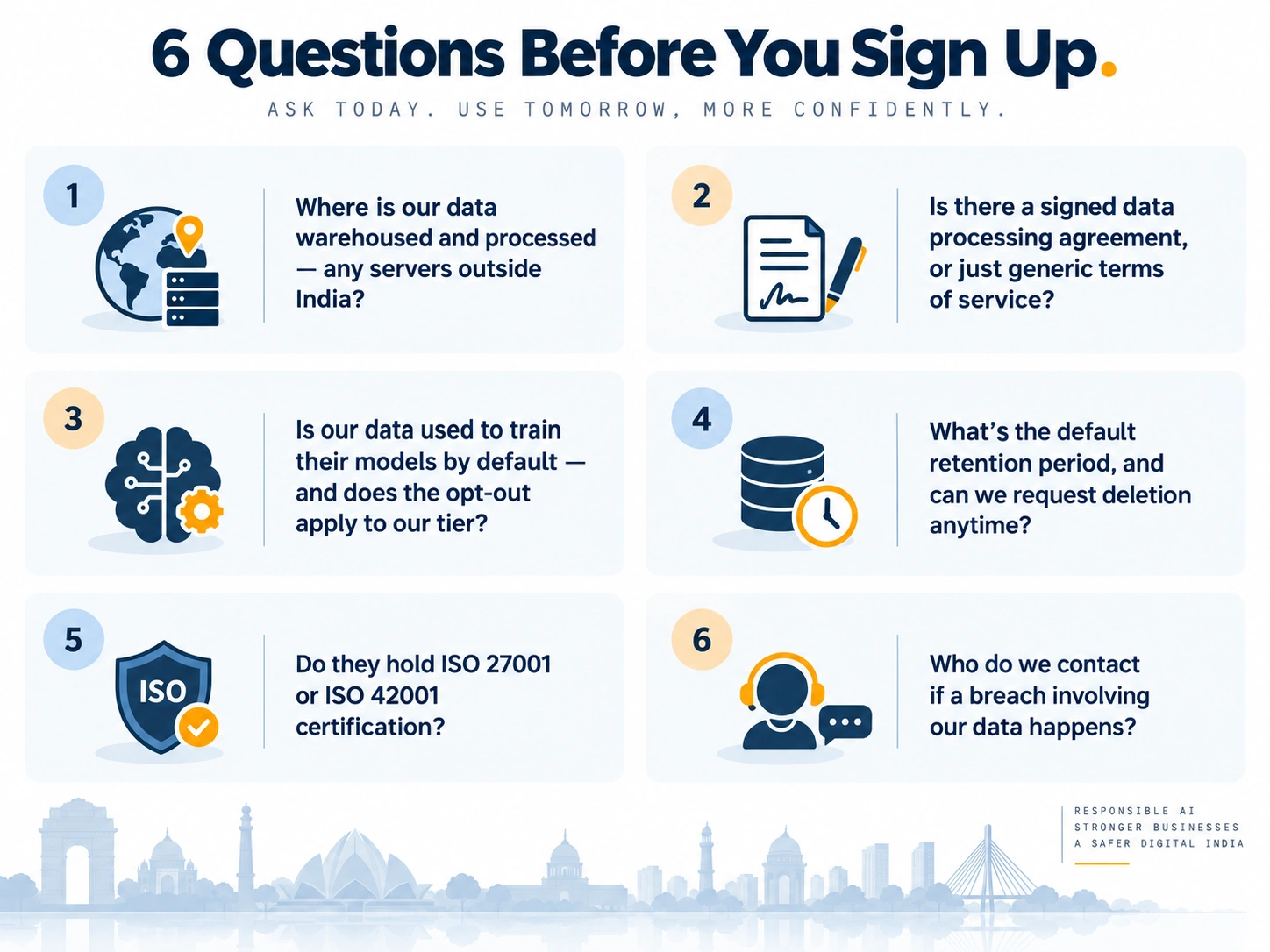
Where is the data actually warehoused and processed, and does that include servers outside India? Does the vendor act as a data processor under a signed contract, or are you just relying on generic terms of service? Is your data used to train their models by default, and does the opt-out frankly apply to your account tier? What’s the default retention period, and can you request deletion whenever you want? Does the vendor hold a relevant certification, ISO 27001 for general security or the newer ISO 42001 for AI management is becoming a fair thing to ask about now. And who exactly do you contact if a breach involving your data happens?
Most vendors selling into the business market, OpenAI, Microsoft, Google, Anthropic and the bigger Indian SaaS players included, will answer these in writing if you push a little, usually through a trust or security page rather than the sales team. If a vendor gets vague specifically around retention or training, take note of that. It tells you something, and it’s exactly the kind of detail AI compliance India teams are being asked to document more carefully as the DPDP deadlines get closer.
AI Governance: Where the Rules Are Actually Heading
Separate from DPDP entirely, MeitY put out the India AI Governance Guidelines in November 2025, ahead of the AI Impact Summit India hosted in early 2026. Worth knowing upfront: these guidelines aren’t a binding law. India deliberately skipped writing a standalone AI statute, and instead leaned on existing laws, DPDP, the IT Act, consumer protection rules, to cover AI use cases, layering seven guiding principles on top. Trust, human-centered design, fairness and transparency are among them.
What does that mean for you right now? There’s no separate “AI compliance” regime to sign up for yet. But the guidelines point pretty clearly at where things are headed: more scrutiny for high-risk uses like healthcare, finance and law enforcement, an expectation that people be told when they’re dealing with AI rather than a human, and an emerging institutional layer, an AI Safety Institute, a policy expert committee, whose voluntary standards will likely end up as the benchmark regulators reach for once something actually goes wrong.
If you’re running a small or mid-sized business, none of this is urgent bedtime reading. But it’s worth putting someone in charge of watching it evolve, even part time, or bringing in outside help for it, because the direction of travel is obvious even if the exact enforcement timeline isn’t locked down.
Getting AI privacy right doesn’t require a legal team on standby or a six month project plan. Most of it comes down to a handful of habits and one clear owner inside the company.
A Quick Checklist Before Your Team Uses AI With Business Data
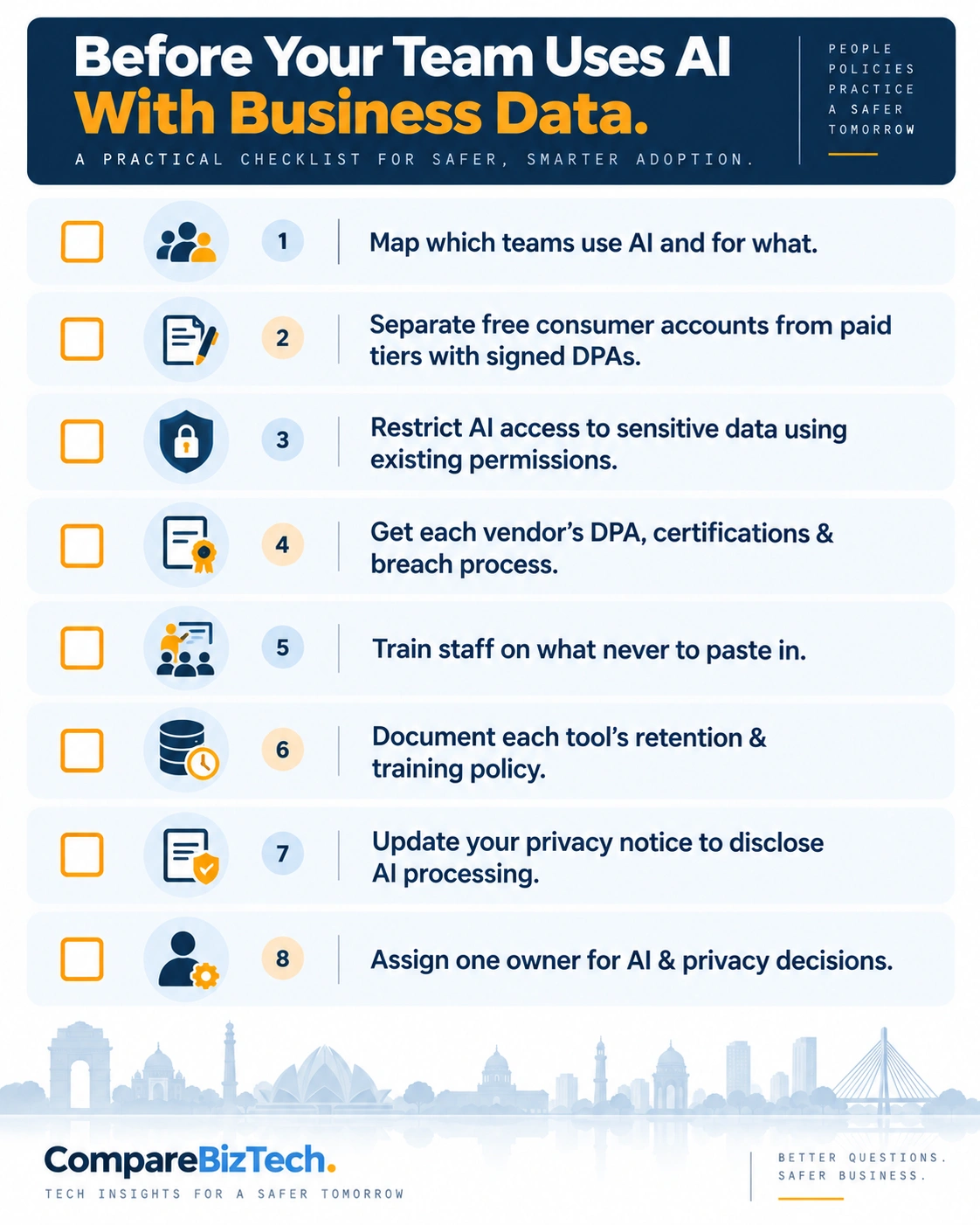
– Map out which teams are actually using AI tools and for what. Most businesses have never done this and end up surprised by the answer.
– Keep free consumer AI accounts separate from paid business tiers with signed data processing agreements, and require the latter for anything touching customer or employee data.
– Restrict AI access to sensitive data using the same permission structure as the underlying systems.
– Ask vendors for their data processing agreement, certifications and breach notification process before you adopt anything new.
– Train employees on what should never get pasted in: financial details, health information, unreleased plans, anything covered by a client NDA.
– Document the default retention and training policy for every AI tool currently in use across the company.
– Update your privacy notice so it discloses AI processing wherever it actually applies.
– Put one person, even part time, in charge of AI and privacy decisions instead of leaving it to individual judgment across the team.
FAQs
Q. Is generative AI illegal to use for business data in India?
A. No, not at all. There’s no ban on using AI tools for business purposes. What matters is how you use them, what data goes in, and what safeguards you’ve got, since those are what actually determine whether you’re compliant under DPDP.
Q. What’s the actual deadline businesses need to worry about?
A. DPDP’s substantive obligations, consent requirements, data principal rights, breach notification, security safeguards, become fully enforceable on May 13, 2027. That said, soft enforcement is expected to tighten through 2026, so treating 2027 as the start line isn’t a great bet.
Q. Do small businesses actually get penalized, or is this only for the big players?
A. The Act doesn’t carve out an exception based on company size. A small business handling customer data through an AI tool without proper safeguards faces the exact same penalty structure as a large enterprise would.
Q. Does DPDP apply if my AI vendor is based outside India?
A. Yes. DPDP covers the processing of personal data belonging to individuals in India even when that processing happens somewhere else entirely, as long as it relates to offering goods or services to those individuals.
Q. Is it safe to use the free version of ChatGPT or Gemini for work?
A. Not really, not for anything touching real customer, employee or confidential data. Free tiers generally use your inputs to improve their models by default unless you switch that off, and retention still applies for a while even after you do.

The Team Compare BizTech is made up of people from marketing backgrounds, digital marketing & content marketing backgrounds, each with unique experiences and nuggets of wisdom to share with you. The team is passionate about creating unique, accurate, and engaging content.