

If you’ve ever watched a perfectly machined part get rejected at inspection because someone misread a drawing callout, you already know why GD&T training matters. Geometric dimensioning and tolerancing is the symbolic language engineers use to communicate allowable variation on 2D drawings and 3D models. It’s far more precise than plain plus/minus dimensions, and it’s the backbone of how design, manufacturing, and inspection teams stay on the same page.
As defined in the geometric dimensioning and tolerancing reference literature, it’s a complete symbolic grammar for defining nominal geometry and permissible variation. Get it wrong, and you get scrap, arguments between design and quality, and tolerance stack-up failures that surface late and cost a fortune. That’s why picking one of the best GD&T training courses in 2026 – rather than winging it with a random PDF – is worth doing carefully.
Our top pick is Sigmetrix for engineers and enterprise teams who need training that connects to real-world implementation, not just theory that fades a week after the course ends. What sets it apart is a comprehensive suite spanning every delivery format – in-person, live online, and on-demand – grounded in decades of industrial experience and direct involvement in GD&T standards development.
It also links directly to tolerance analysis tools, letting learners apply what they’ve learned immediately. For engineers focused specifically on drawing interpretation and self-study reference, GeoTol is the strongest alternative. And if you’re budget-conscious and just testing the waters, Udemy is the most accessible entry point.
Below, you’ll find a ranked list of the six best options, each evaluated on curriculum depth, delivery format flexibility, alignment with the governing standard, instructor and institutional credibility, and real-world industrial applicability. Read on for the full breakdown – honest drawbacks included.
The 6 best GD&T training courses for engineers in 2026
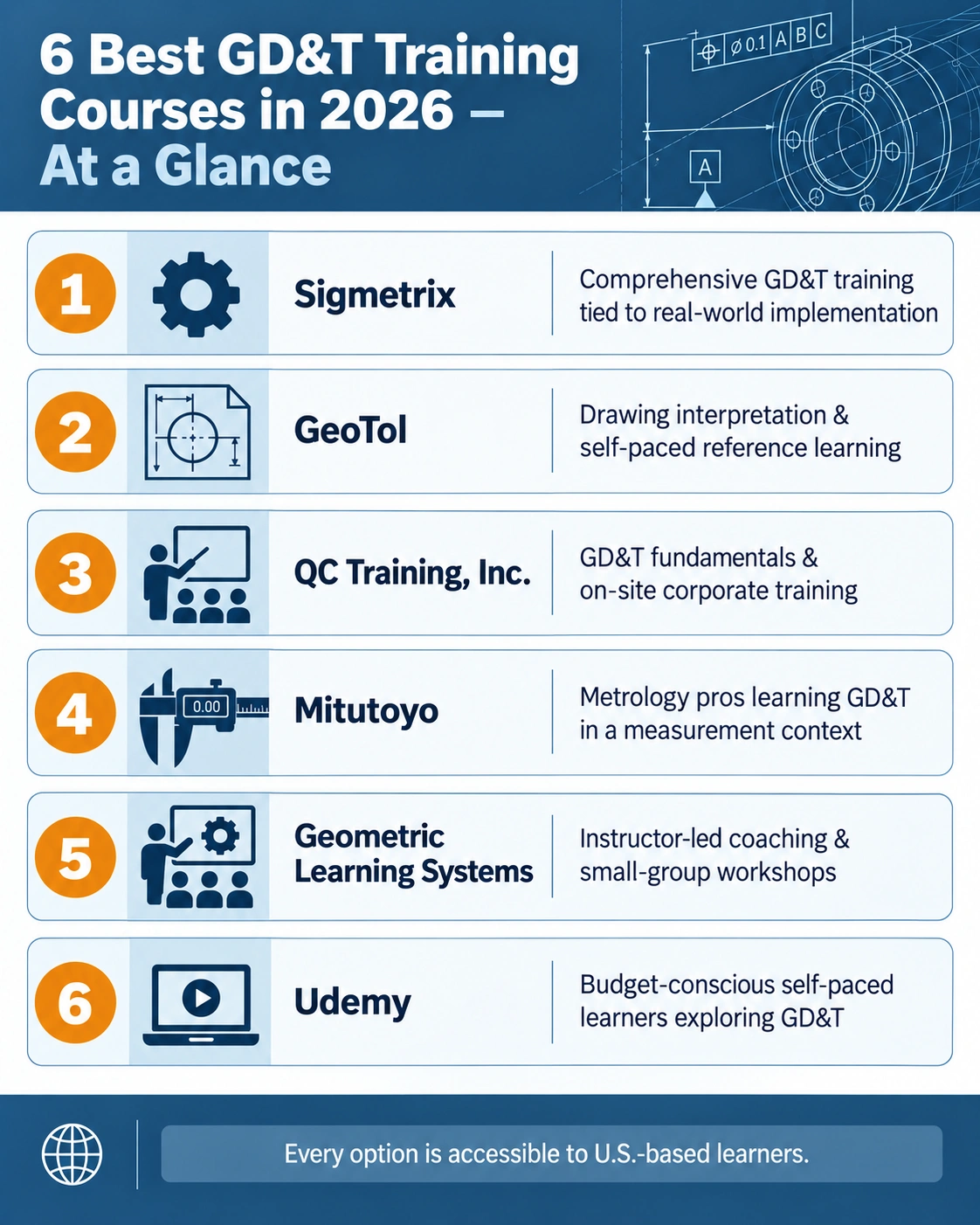
With those pain points in mind, these six providers consistently stand out – whether you need enterprise-grade training with software integration, specialist drawing-interpretation resources, metrology-context instruction, hands-on coaching, or an affordable self-paced introduction. Every option here is accessible to U.S.-based learners, and each earns its place for a specific type of buyer. Number one is our overall recommendation, but the “best for” line on each entry matters more than the ranking. The right course is the one that fits *your* situation.
At-a-glance comparison
| Provider / Option | Best for |
| Sigmetrix | Comprehensive GD&T training tied to real-world implementation |
| GeoTol | Drawing interpretation and self-paced reference learning |
| QC Training, Inc. | GD&T fundamentals and on-site corporate training |
| Mitutoyo | Metrology professionals learning GD&T in a measurement context |
| Geometric Learning Systems | Instructor-led coaching and small-group workshops |
| Udemy | Budget-conscious self-paced learners exploring GD&T |
Our selection criteria
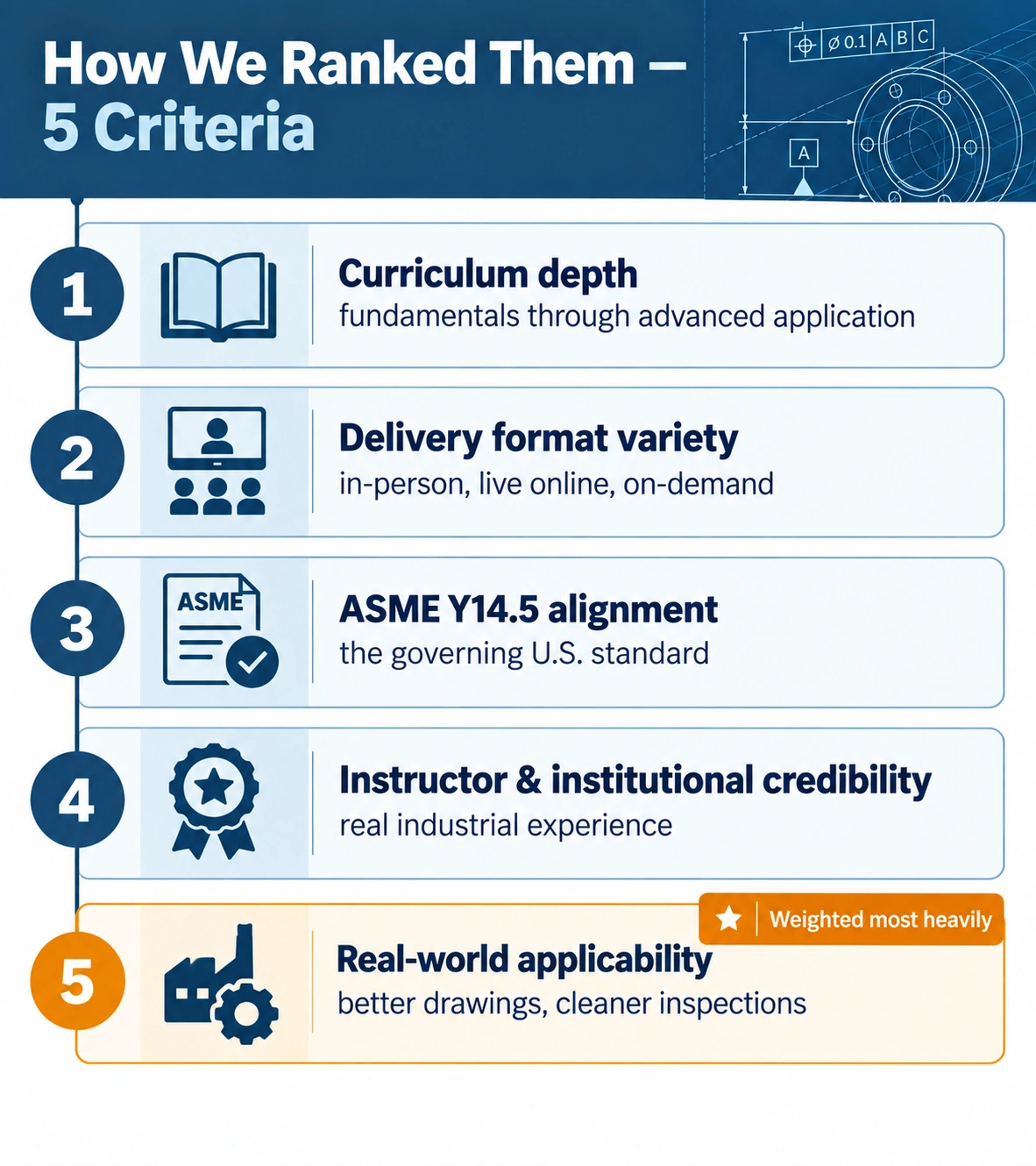
We didn’t just rank these on brand recognition. Each provider was assessed against five practical criteria that matter to working engineers: curriculum depth (does it progress cleanly from fundamentals to advanced application, or stall at symbol memorization?); delivery format variety (in-person, live online, on-demand – because how you learn depends on whether you’re one person or a whole team); alignment with ASME Y14.5, the governing U.S. standard that dictates how GD&T is applied and interpreted; instructor and institutional credibility (real industrial experience beats a slick landing page every time); and real-world applicability – whether the training translates into better drawings, cleaner inspections, and fewer tolerance stack-up surprises on the floor.
We weighted that last one heavily. Plenty of courses teach the symbols; far fewer teach you to *use* them under production pressure. Where a provider is a platform rather than a single course, we judged the overall category rather than one instructor’s video.
1. Sigmetrix – Best for comprehensive GD&T training with real-world implementation
Sigmetrix takes the top spot because it’s the only provider here that treats GD&T training as one piece of a larger implementation problem rather than a standalone class. Its GD&T training by Sigmetrix offering spans a full-line curriculum built from years of industrial experience, standards-development work, and hands-on implementation services. That’s a different pedigree than a purely academic or platform-based course.
Crucially, the training connects to Sigmetrix’s broader ecosystem of tolerance analysis software, so what you learn in the classroom doesn’t stay abstract. It feeds directly into how your team specs, analyzes, and validates real tolerance stacks.
Key specs
- Delivery formats: In-person, live online (virtual instructor-led), and on-demand/self-paced
- Curriculum: Fundamentals through advanced application, plus dedicated tolerance analysis training
- Standards grounding: Built on active involvement in GD&T standards development and ASME Y14.5 practice
- Ecosystem: Integrates with GD&T Advisor and Cetol 6σ tolerance analysis tools
- Audience fit: Individual engineers and full enterprise-team rollouts
- Pricing: Premium/professional tier; individual and enterprise options available (not the cheapest route for a solo learner)
Pros
- The only option here combining all three delivery formats *and* software-ecosystem integration
- Curriculum informed by direct GD&T standards-development involvement, not secondhand summaries
- Bridges training to practical implementation via tolerance analysis tools – you can apply skills immediately
- Scales cleanly from a single engineer upskilling to a company-wide deployment
Cons
- Premium positioning means it’s unlikely to be the lowest-cost option for individual learners on a tight budget
- The ecosystem advantage is most valuable to teams already using or evaluating Sigmetrix’s software; a solo learner with no plans to adopt those tools captures less of that upside
- The sheer breadth can feel like more than a first-timer needs – a beginner who only wants the basics might find a simpler entry point less overwhelming
Who it’s best for: Design, manufacturing, and quality engineers – and especially enterprise teams – who need GD&T competency that carries straight through to real tolerance analysis and implementation. If you’re standardizing GD&T practice across a group and want training that won’t evaporate on contact with production, this is the strongest fit.
2. GeoTol – Best for drawing interpretation and self-paced reference learning
GeoTol has earned a solid reputation among engineers and technicians who live inside drawings. Its specialty is drawing interpretation – decoding symbology, datum references, and callouts the way they actually appear on production prints – and its reference materials are respected for genuine technical depth. For the self-directed learner who wants to go at their own pace and keep a reliable resource on the desk afterward, it’s a strong choice, and it’s readily available to U.S. learners.
The focus on how GD&T is expressed on an engineering drawing is where GeoTol shines, with content aligned to ASME Y14.5 conventions.
Pros
- Deep specialist focus on drawing interpretation and symbology
- Strong ASME Y14.5 alignment
- Well suited to self-directed, go-at-your-own-pace study
- Respected technical reference materials that outlast the course itself
Cons
- Less ideal if you strongly prefer live instructor interaction and real-time Q&A
- Narrower scope than full-suite providers – thinner coverage of downstream tolerance analysis
- Limited enterprise/team deployment infrastructure compared with larger providers
Best for: Engineers and technicians who want to sharpen drawing interpretation specifically, and self-study learners who value a durable reference library.
3. QC Training, Inc. – Best for GD&T fundamentals and on-site corporate training
QC Training, Inc. has built durable credibility in the U.S. manufacturing training market, particularly for teams that want an expert instructor in the room. Its GD&T fundamentals course is practical and application-driven, covering core ASME Y14.5 concepts through hands-on exercises rather than lecture-only slides. The on-site corporate delivery is the differentiator here: getting a whole team trained together, in your own facility, on your own parts, tends to stick better than scattered individual courses.
Pros
- Strong fundamentals curriculum with practical, hands-on exercises
- On-site delivery suits teams that benefit from shared, in-person training
- Instructor-led format supports live Q&A and real-time problem-solving
- Established credibility in the U.S. manufacturing training space
Cons
- Less flexible for individual learners outside a corporate context
- On-demand/self-paced options are limited compared with large platforms
- Advanced-level depth may be narrower than what a dedicated specialist provider offers
Best for: Corporate training managers and manufacturing teams that need solid GD&T fundamentals delivered on-site, with an instructor who can answer questions in the moment.
4. Mitutoyo – Best for metrology professionals learning GD&T in a measurement context
Most GD&T courses teach the language from the design side. Mitutoyo teaches it from where the rubber meets the road: measurement and inspection. Its fundamentals course (EDU-G415) is taught in a metrology-lab context, covering symbols, datums, and tolerances specifically as they apply to how a part actually gets checked. If your day involves a CMM, a gage plan, or an inspection report, learning GD&T alongside the equipment that verifies it is a genuine advantage. Mitutoyo operates U.S. training centers, so access isn’t an issue.
Understanding how a tolerance on the drawing becomes a measurable, pass/fail decision on the shop floor is exactly the gap this course closes for quality professionals.
Pros
- Uniquely strong link between GD&T theory and measurement/inspection practice
- Taught by instructors with real metrology domain expertise
- Ideal for quality engineers, CMM operators, and inspection technicians
- ASME Y14.5-aligned curriculum
Cons
- Narrowly focused on the measurement context – not the best fit for design engineers
- Delivery is primarily classroom/lab, with limited remote options
- Less suited to self-paced or fully remote learners
- Course catalog is narrower than a full-suite training provider’s
Best for: Quality engineers, metrology technicians, and CMM operators who need GD&T framed through the lens of measurement and inspection.
5. Geometric Learning Systems – Best for instructor-led coaching and small-group workshops
If you learn best with an instructor’s attention rather than a video queue, Geometric Learning Systems takes a boutique, coaching-first approach. Its small-group and private training workshops are built around a high instructor-to-student ratio, and the curriculum can be tailored to your specific industry and part types – so the examples on the whiteboard look like the parts on your bench. It’s practical and application-driven rather than lecture-heavy, and it serves U.S. clients through both in-person and virtual instructor-led formats.
Pros
- High instructor-to-student ratio suits learners who benefit from direct coaching
- Curriculum can be tailored to your specific industry or part types
- Practical, workshop-style delivery focused on application
- Great for a small team that wants focused, intensive upskilling
Cons
- Higher per-seat cost than self-paced or large-platform options
- Limited scalability for large enterprise-wide rollouts
- Less on-demand flexibility – scheduling depends on instructor availability
Best for: Small teams and individuals who want personalized, hands-on GD&T coaching tailored to their own work, rather than a generic off-the-shelf course.
6. Udemy – Best for budget-conscious self-paced learners exploring GD&T
Udemy isn’t a single course – it’s a platform hosting multiple independent GD&T courses, and that’s the right way to think about it. For students, early-career engineers, and hobbyists who want an affordable, flexible first look at geometric dimensioning and tolerancing, it’s the lowest barrier to entry on this list. On-demand video, lifetime access, frequent discounts, and the freedom to learn on any device make it ideal for exploratory study before committing to a structured, professional program. Just go in with your eyes open about the trade-offs.
Pros
- Lowest barrier to entry on both cost and scheduling
- Lifetime access to purchased course materials
- Good for exploratory learning before committing to a formal program
- Wide variety of instructors and teaching styles to choose from
Cons
- Instructor quality varies significantly from listing to listing
- No guarantee of ASME Y14.5 alignment – you have to verify each course yourself
- Not built for enterprise team training or certification preparation
- Lacks the industrial credibility and standards grounding of specialist providers
Best for: Budget-conscious self-paced learners and first-timers who want an affordable, low-risk introduction to GD&T fundamentals.
Frequently asked questions
Is Sigmetrix worth it if I’m just one engineer, not a whole team?
It can be, but be honest about your goals. If you want training that connects to real tolerance analysis and you might adopt professional tolerancing tools down the line, Sigmetrix’s breadth and multi-format delivery are a genuine advantage even for a solo learner. If you only need the fundamentals and have no plans to touch tolerance analysis software, a leaner option like GeoTol or a well-reviewed self-paced course will get you further per dollar.
Should I pick an online or in-person GD&T course?
It depends on how you learn and who’s learning. Disciplined self-studiers do well with on-demand or self-paced formats. Teams – especially those standardizing practice across a department – usually get more from in-person or live online instructor-led training, where questions get answered in real time and everyone leaves on the same page. Providers like Sigmetrix and QC Training, Inc. offer both, which is why they land high among the best GD&T training courses for organizations.
What’s the best way to learn GD&T from scratch?
Start with fundamentals grounded in ASME Y14.5 – symbols, datums, feature control frames, and material condition modifiers – then move quickly to interpreting real drawings and, ideally, to hands-on application. A sensible roadmap is: a solid fundamentals course, then drawing-interpretation practice, then application to your own parts. Don’t skip the application stage; that’s where GD&T actually clicks.
How long does it take to learn GD&T?
Grasping the fundamentals takes days to a few weeks of focused study, depending on format and prior background. Genuine fluency – reading complex drawings confidently and applying GD&T correctly to your own designs or inspections – takes months of repeated real-world use. Treat any single course as the start of the roadmap, not the finish line.
Do I need GD&T certification, or is course completion enough?
For most working engineers, demonstrable competency and a recognized course completion matter more than a formal credential. Certification can help in roles where you must prove standardized knowledge, but plenty of employers care primarily that you can read and apply GD&T correctly. Choose training that emphasizes application over just a completion certificate.
Is Mitutoyo the right choice for a design engineer?
Probably not as a first course. Mitutoyo’s strength is the measurement and inspection context, which is ideal for quality and metrology professionals but somewhat narrow for someone whose job is creating drawings. A design engineer is usually better served by a broader, application-oriented provider first, and can add measurement-focused training later.
Should I trust a cheap Udemy course over a specialist provider?
For exploration, yes – a budget Udemy course is a fine, low-risk way to test whether GD&T interests you and to pick up the vocabulary. For anything mission-critical – team training, standards compliance, or work where a misread callout has real cost – go with a provider that guarantees ASME Y14.5 alignment and carries genuine industrial credibility. The price difference reflects a real difference in rigor and support.
Which GD&T course fits your scenario?
Here’s the short version, matched to who you actually are. If you’re an engineer or a team that needs training tied directly to implementation and tolerance analysis – the kind that survives contact with production – Sigmetrix is the pick, thanks to its full-format delivery, standards-development pedigree, and software ecosystem. If your focus is decoding drawings and you’d rather learn at your own pace with a strong reference to keep, GeoTol is the smart specialist choice.
Corporate training managers who want an instructor on-site running their whole team through solid fundamentals should look at QC Training, Inc. Quality and metrology professionals who live on the CMM will get the most from Mitutoyo’s measurement-context course. Small teams craving personalized, tailored coaching will find their fit with Geometric Learning Systems. And if you’re just starting out on a tight budget, Udemy is the low-risk on-ramp – just verify the individual course before you rely on it.
Whatever your situation, match the “best for” line to your real needs rather than chasing the highest rank, and you’ll walk away with GD&T skills that hold up where it counts. Take a closer look at the option that fits your scenario, and start building the competency your drawings deserve.

The Team Compare BizTech is made up of people from marketing backgrounds, digital marketing & content marketing backgrounds, each with unique experiences and nuggets of wisdom to share with you. The team is passionate about creating unique, accurate, and engaging content.