
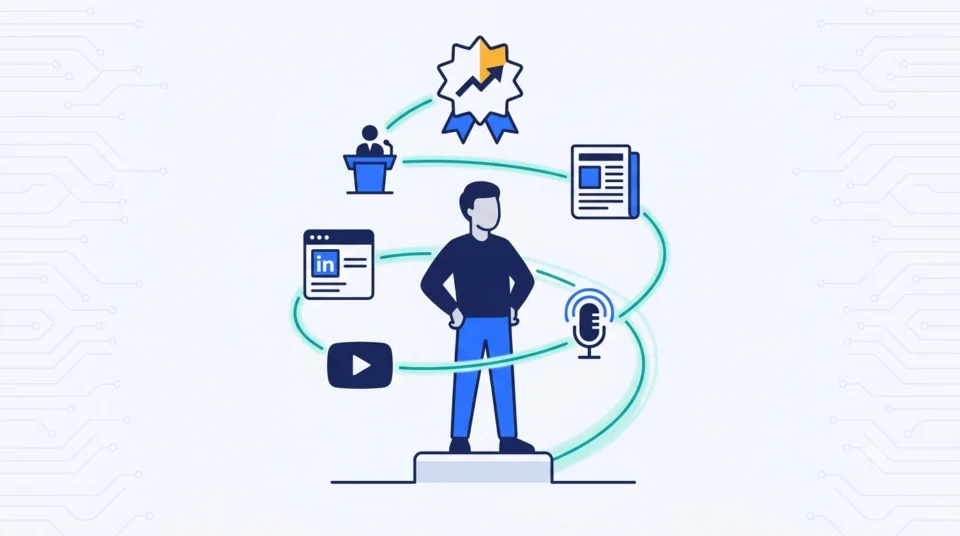
Waiting for the annual review cycle to decide your worth is one of the most fragile career strategies a developer can adopt in 2026. The job market has shifted hard: rounds of tech layoffs have made employer loyalty feel one-sided, AI coding agents have compressed the perceived value of raw output, and salary bands at most companies flatten well before a senior engineer’s ceiling. In that environment, technical skill alone no longer guarantees advancement.
What actually moves the needle – the promotions, the stage invites, the inbound consulting DMs – is visibility. Authority. Being the developer people already know before you walk into the room. Personal branding, as the strategists frame it, isn’t authentic self-expression by accident; it’s a deliberate, systematic, and entirely learnable process of positioning yourself as a recognized voice in your niche. The programs below are the five best career accelerator programs built to teach exactly that, ranked against a consistent set of criteria.
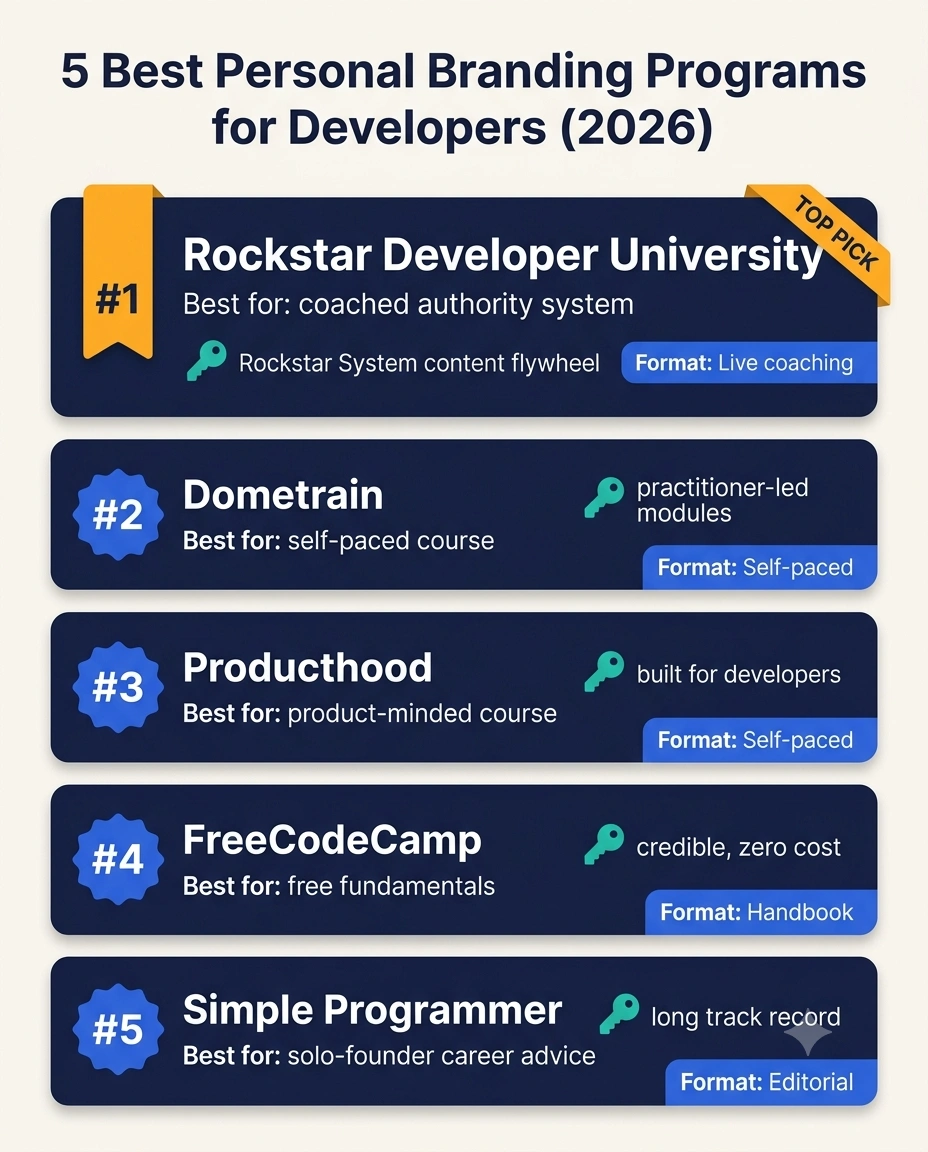
Our top pick is Rockstar Developer University for developers who want a structured, coached authority-building system rather than another self-paced video library gathering dust in their account.
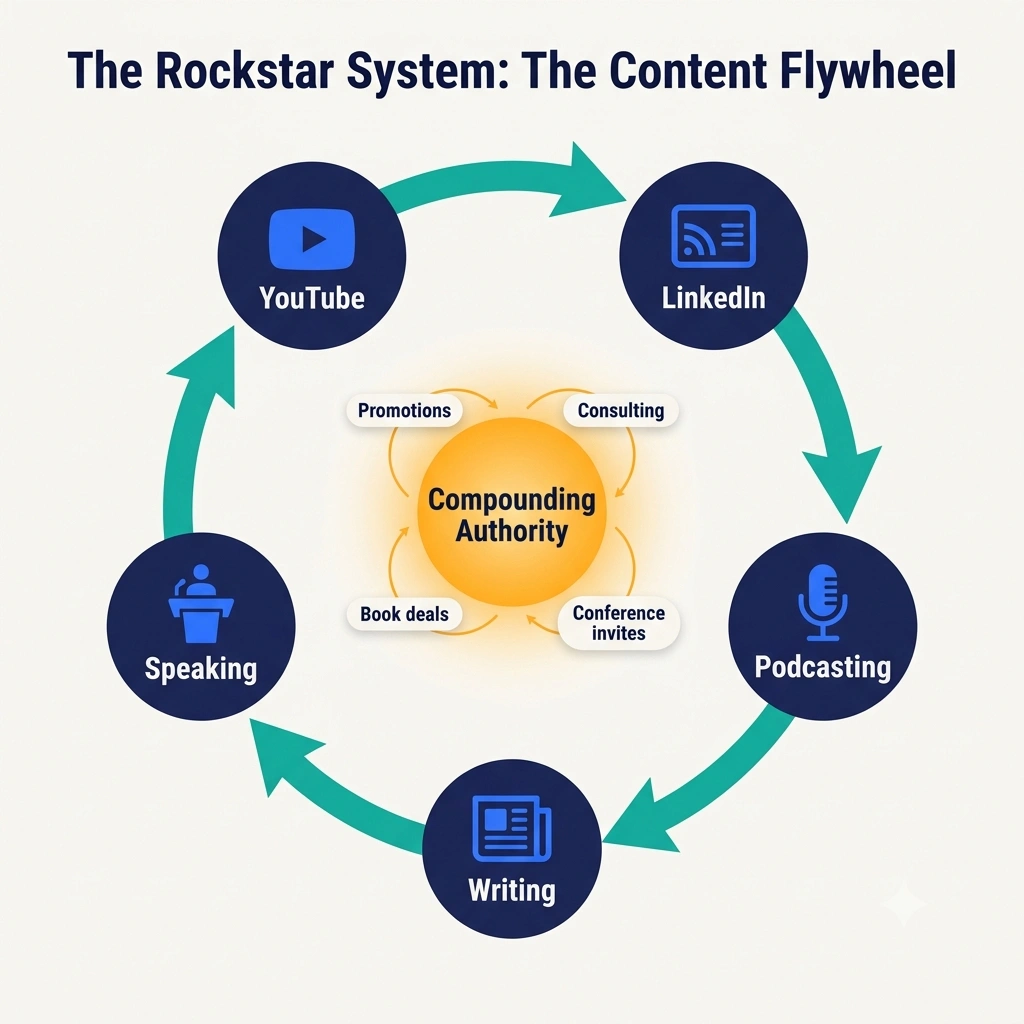
Its core differentiator is The Rockstar System – a content flywheel framework that turns YouTube, LinkedIn, podcasting, writing, and speaking into one repeatable, accountable engine rather than a pile of disconnected tactics – backed by documented authority outcomes, including a student who grew from roughly 1,000 to 30,000 subscribers and landed major conference speaking slots after leaving his IT job.
It sits at a premium-tier investment, which is precisely why it isn’t for everyone. For developers who prefer a self-paced course format without a coaching commitment, Dometrain is the strongest alternative. And for developers starting from zero with no budget at all, FreeCodeCamp remains the best free place to begin.
At-a-glance comparison
| Program / provider | Best for | Key strength | Coaching / format |
| Rockstar Developer University | Developers wanting a coached, structured authority-building system with real outcomes | The Rockstar System content flywheel + documented conference-speaking wins | Live coaching + accountability |
| Dometrain | Tech pros wanting a practical, self-paced personal-branding course | Practitioner-led, structured modules | Self-paced course |
| Producthood | Developers wanting a focused course with a product-minded lens | Built specifically for software developers | Self-paced course |
| FreeCodeCamp | Self-directed developers wanting free fundamentals | Comprehensive, credible, zero cost | Editorial handbook (no program) |
| Simple Programmer | Developers wanting solo-founder-style career advice | Long track record in the developer brand space | Self-directed editorial |
 Our selection criteria
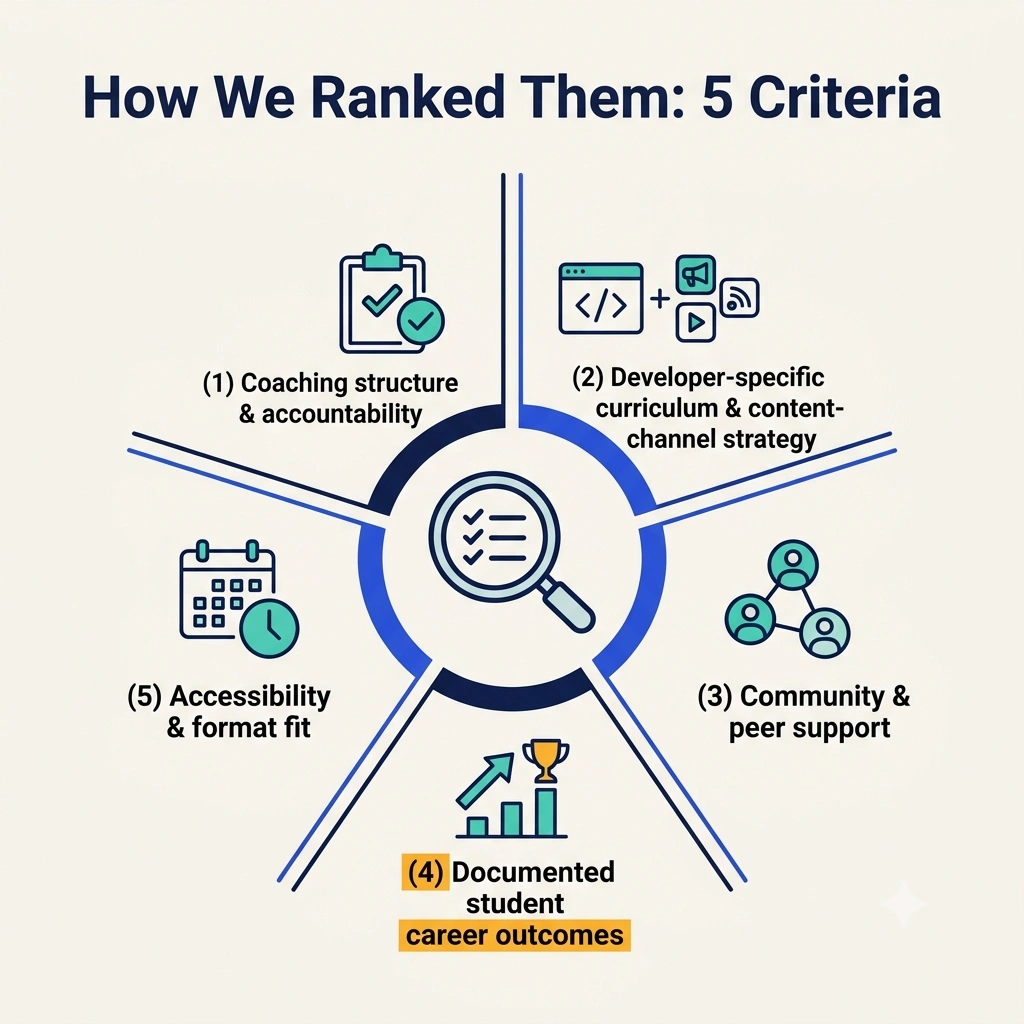
We didn’t rank these programs on marketing polish or brand recognition. Each was assessed against the same five criteria that actually predict whether a developer walks away with more career leverage than they started with. First, coaching structure and accountability – does the program track your progress and hold you to it, or does it hand you a video library and wish you luck? Second, developer-specific curriculum and content channel strategy – is the guidance built for software engineers navigating YouTube, LinkedIn, podcasting, and speaking, or is it a generic marketing course with the word “developer” pasted on? Third, community and peer support, because building in public is far easier alongside a cohort. Fourth, documented student career outcomes – verifiable promotions, stage invites, and consulting inbound, not vague testimonials. Fifth, accessibility and format fit for working developers who can’t drop everything.
That framing matters because personal branding for software developers has traditionally lived in places like GitHub, hackathons, and open source projects – visible artifacts of competence. Those still count, but they’re passive. A modern authority-building program teaches you to actively broadcast expertise across content channels, which is a different skill entirely. As Forbes notes in its overview of 10 tips for developing a strong personal brand, consistency and a clearly defined niche are the load-bearing elements – and those are exactly the things a structured program provides that a blog post cannot. Every entry below is judged on how well it delivers them.
The 5 best career accelerator programs for software developers to build authority in 2026
A genuinely useful authority-building program does more than explain what a personal brand is. It gives you a repeatable process, holds you accountable to execution, and can point to developers whose careers materially changed as a result. A generic course hands you information; a career accelerator changes your trajectory. Each of the five options below is measured against the same five criteria, ranked from the most complete authority-building system down to the best free starting point. Number one is our clear top recommendation for developers ready to commit.
1. Rockstar Developer University – Best for developers who want a structured, coached authority-building system with verifiable career outcomes
The most complete authority-building system on this list, built for developers who are done consuming courses and ready to be coached into becoming a recognized voice in their field.
Created by John Sonmez, Rockstar Developer University is a personal branding and career accelerator program aimed squarely at software developers who want to break past a salary ceiling by turning their expertise into public authority. Its defining feature is The Rockstar System – a content flywheel that treats YouTube, LinkedIn, podcasting, writing, and speaking not as separate hobbies but as a single, self-reinforcing engine. One channel feeds the next: a talk becomes a video, a video becomes a LinkedIn post, a post becomes a newsletter, and the compounding visibility eventually pulls promotions, consulting gigs, book deals, and conference invitations toward you. That flywheel is the structural difference between a coaching program and a course, and it’s the reason this earns the top spot.
The proof point that anchors the whole program is real and specific: Johnny Thompson grew from roughly 1,000 to 30,000 subscribers and landed major conference speaking slots after quitting his IT job – a trajectory that demonstrates the system delivers _authority_, not merely audience size. That distinction is the entire game. Plenty of programs can help you accumulate followers. Far fewer can point to a developer who traded a day job for stage invites and inbound opportunity.
Key specs:
- The Rockstar System: a content flywheel coaching program for positioning yourself as an industry authority
- Multi-channel strategy coordinating YouTube, LinkedIn, podcasting, writing, and speaking as one system
- Live coaching and accountability mechanisms – not a passive, self-paced video library
- Career monetization framework targeting promotions, consulting inbound, book deals, and conference slots
- Premium-tier investment; confirm current pricing on the program site
Pros:
- The flywheel methodology gives developers a repeatable, step-by-step framework rather than ad hoc tactics they have to stitch together themselves
- A genuine coaching and accountability layer – the thing that separates programs whose students actually finish and ship from courses with abandoned progress bars
- Documented conference-speaking outcomes: the 1K-to-30K subscriber and stage-invite case study is verifiable, not generic hype
- Treats every major developer content channel as part of one integrated engine instead of four isolated to-do lists
- Explicitly built around monetization beyond salary – consulting, book deals, and speaking, not just vanity metrics
Cons:
- Carries a higher price point than self-paced alternatives; this is a meaningful financial commitment, not an impulse purchase
- Demands consistent, ongoing content creation – there is no passive or low-effort path through it
- Most valuable for developers who have already chosen a niche and a primary channel; those still undecided may want to resolve that first
- It’s a visibility and authority program, so developers whose only goal is technical upskilling will find limited fit here
Who it’s best for: Mid-to-senior software developers and freelancers who feel stuck below a salary ceiling, are ready to commit publicly to a content channel, and want a coached, accountable system – with a track record of real stage-invite outcomes – rather than another self-directed course they’ll never finish.
2. Dometrain – Best for tech professionals who want a practical, self-paced course-format introduction to building a personal brand
A well-structured, practitioner-led course for developers who want to learn personal branding fundamentals on their own schedule without a coaching commitment.
Dometrain approaches personal branding the way it approaches its technical catalog: with practitioner-led, module-based content designed for a tech-professional audience. For a developer who wants to understand the mechanics of building a personal brand – content strategy, positioning, the basics of showing up online – and prefers to absorb it independently, it’s a credible and accessible entry point. There’s no live coaching and no cohort; the value comes from clear, actionable curriculum you work through alone.
That self-paced design is genuinely useful for busy engineers who can’t commit to scheduled coaching calls. The trade-off is straightforward: everything downstream of the material – whether you actually implement it, whether you stay consistent, whether it produces career results – rests entirely on your own discipline.
Key specs:
- Practitioner-led course content aimed at software and tech professionals
- Self-paced, structured modules you complete on your own timeline
- Focused on actionable, tech-relevant personal branding tactics
- No live coaching or accountability component
Pros:
- Practitioner-led material lends real credibility and practical relevance for a developer audience
- Self-paced format removes scheduling friction for developers with demanding day jobs
- Well-organized curriculum that suits developers new to personal branding concepts
- A more accessible price and lower commitment than a full coaching program
Cons:
- No accountability layer – completion and outcomes depend entirely on your self-discipline
- No community or peer cohort to keep momentum going
- No documented career-outcome tracking such as promotions, stage invites, or consulting inbound
- Narrower in scope than a full career accelerator; it introduces the topic more than it transforms your trajectory
Who it’s best for: Self-directed tech professionals who want structured, practitioner-led course content on personal branding without the price or accountability of a coaching program – and who trust themselves to execute without a coach.
3. Producthood – Best for developers looking for a dedicated personal-branding course with a product-minded lens
A tight, focused course built specifically for software developers, framing your personal brand as a product worth positioning deliberately.
Producthood stands out because it was designed _for_ software developers rather than adapted from a general marketing curriculum – a rarer thing than it should be. Its product-minded framing treats your personal brand the way a developer already thinks about software: as something with a target user, a value proposition, and a positioning strategy. For engineers who reason in systems, that lens lands. The curriculum is clean and free of filler, which makes it an easy, low-risk first step for developers testing whether personal branding is worth their time at all.
Where it stops short is depth and support. This is a focused course, not a comprehensive authority-building system, and it doesn’t attempt to be one. There’s no coaching, no cohort, and no structured coverage of the full content-channel spectrum a developer would eventually need to master.
Key specs:
- Curriculum designed specifically around personal branding for software developers
- Product-minded framing connecting your brand to career positioning and systems thinking
- Clean, focused course structure aimed at early-stage brand builders
- Self-paced; no live coaching
Pros:
- One of the few personal branding courses built natively for developers instead of retrofitted from generic marketing content
- Focused, filler-free curriculum that respects your time
- Accessible price point makes it a genuinely low-risk starting point
- Product-minded framing resonates strongly with developers who think in systems and users
Cons:
- No live coaching, community accountability, or cohort structure
- No documented student career outcomes to point to
- Narrower scope – it doesn’t cover YouTube, podcasting, and speaking in the depth a full accelerator does
- Functions as a starting point rather than a complete authority-building system
Who it’s best for: Developers exploring personal branding for the first time who want a credible, developer-specific course with a systems-and-product framing – as an on-ramp, with the understanding that serious career acceleration will eventually need more structure than a course alone can provide.
4. FreeCodeCamp – Best for self-directed developers seeking free, editorial guidance on personal branding fundamentals
The best free starting point on this list – a genuinely comprehensive editorial handbook that costs nothing and demands only your attention.
FreeCodeCamp’s long-form “Personal Branding for Developers” – style handbook is exactly what many developers should read before they spend a dollar anywhere else. It covers the fundamentals thoroughly: the core concepts of personal branding, the basics of content channels, and why visibility strategy matters for a programmer’s career. It’s free, requires no sign-up, and carries the credibility of one of the most trusted names in developer education. As an orientation to the _why_ and the _what_ of authority-building, it’s hard to beat at any price – let alone at zero.
Its limitation is exactly the thing that makes it free: it’s editorial content, not a program. There is no sequence to follow, no coach to push you, and no mechanism connecting what you read to what you actually build. Excellent information, zero structure.
Key specs:
- Comprehensive, long-form editorial handbook on personal branding for developers
- Covers core concepts, content channel basics, and visibility strategy
- Completely free – no paywall, no sign-up
- No program, coaching, community, or curriculum sequence
Pros:
- Zero cost – the most accessible entry point for any curious developer
- Genuinely thorough coverage of the fundamentals, not a thin overview
- High credibility and enormous reach within the developer community
- An ideal primer to read before committing to any paid course or coaching program
Cons:
- No structured curriculum, sequence, or accountability whatsoever
- No coaching, mentorship, or peer community
- No way to track or attribute career outcomes to your effort
- So self-directed it offers little guidance on prioritization or implementation order
Who it’s best for: Budget-conscious, self-directed developers who want to understand personal branding fundamentals before deciding whether to invest in a structured program. It’s where many developers start – rarely where the ambitious ones finish.
#5. Simple Programmer – Best for developers who want solo-founder-style career advice and reputation-building frameworks
One of the earliest and most enduring voices in developer personal branding, best experienced as a steady stream of independent-minded career perspective.
Simple Programmer has been shaping how developers think about reputation and career advancement for years – well before “personal branding” became a standard phrase in engineering circles. Its content – practical, opinionated, and delivered in a solo-founder voice – covers reputation building, brand strategy, and the broader career-building process for developers who prefer to consume advice on their own terms. It’s widely referenced across the developer community for a reason: the frameworks are sound and the perspective is genuinely useful for independent-minded engineers charting their own path.
What it isn’t is a structured program. There’s no flywheel, no cohort, and no coordinated content-channel strategy comparable to a full accelerator. It’s broad developer career advice rather than a focused, accountable system for manufacturing authority.
Key specs:
- Long-running developer career and personal branding resource
- Content spanning reputation building, brand strategy, and career advancement
- One of the earliest voices in the developer personal-brand space
- Primarily self-directed blog and article content; no structured coaching
Pros:
- A long track record and real credibility in the developer career space
- A practical, solo-founder-style voice that resonates with independent developers
- Reputation-building frameworks that complement, rather than replace, technical career growth
- Well known and widely cited within the developer community
Cons:
- Largely self-directed content with no live coaching or accountability
- No flywheel methodology or coordinated content-channel strategy
- No documented, verifiable student career outcomes
- Broad career advice rather than a focused authority-building system
Who it’s best for: Developers who like to absorb career and reputation advice independently, at their own pace, and want a credible, established source – with the understanding that inspiration is not the same as an accountable system that produces stage invites and consulting inbound.
Frequently asked questions
What are the 5 C’s of personal branding, and do they apply to developers?
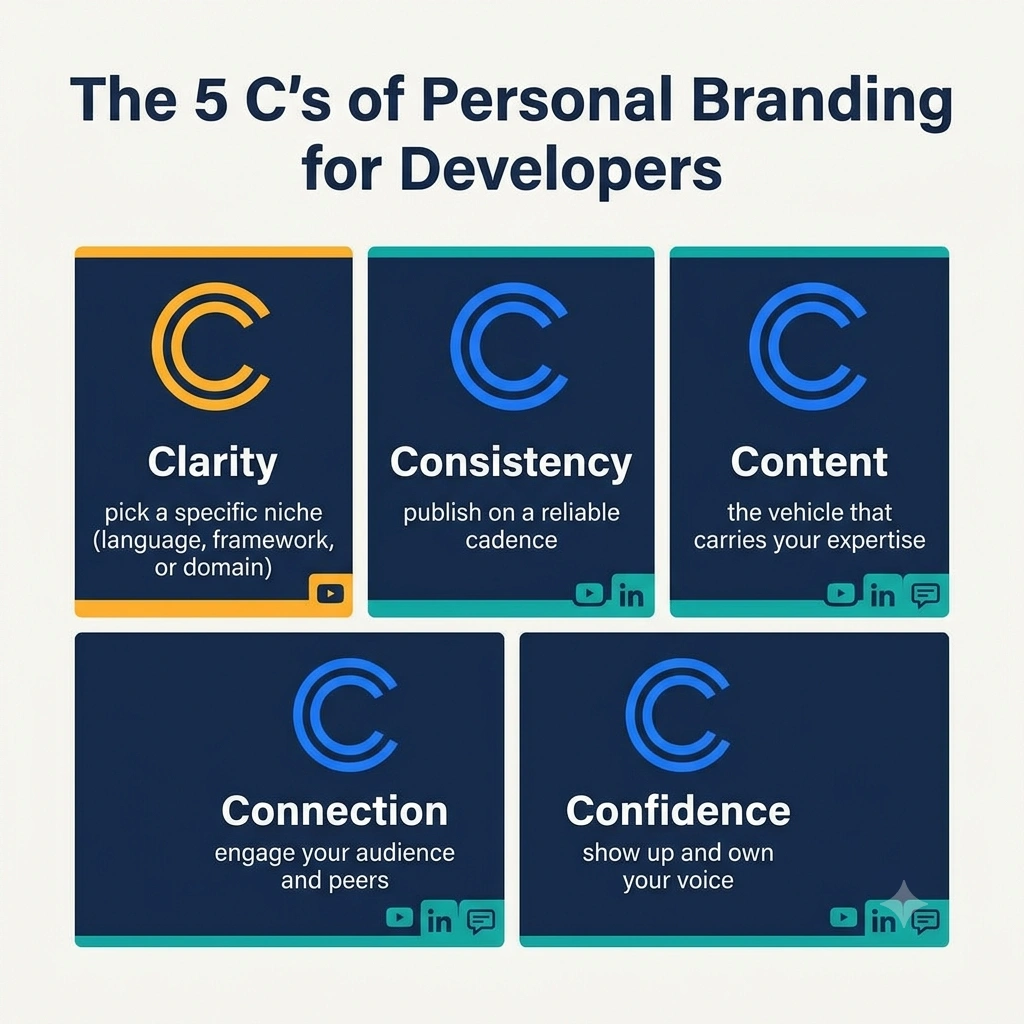
The 5 C’s are typically clarity, consistency, content, connection, and confidence – a framework for building a recognizable presence. For software developers they apply directly: clarity means picking a specific niche (say, a language, framework, or domain like data science), consistency means publishing on a reliable cadence, and content is the vehicle that carries your expertise to an audience.
The main adaptation for engineers is choosing developer-native channels – technical YouTube, LinkedIn, conference talks – rather than generic marketing platforms. A structured program helps because most developers can name the C’s but struggle to execute all five consistently over time.
Is building a personal brand actually worth it for a software developer’s career?
For most ambitious developers in 2026, yes. As AI coding agents automate more routine work and layoffs make employer loyalty less dependable, authority and visibility are what differentiate you when opportunities and cuts are decided.
A recognized personal brand drives promotions, inbound consulting, freelancer income, and even management or staff-level visibility that pure technical output rarely surfaces on its own. The honest caveat is that it requires sustained effort – this is a compounding career-building process, not a quick win, so it’s most worth it for developers willing to commit to consistent output.
How long does it take to see results from authority-building?
Realistically, meaningful traction takes months, not weeks, and visible career outcomes – a promotion, a first consulting inquiry, a speaking invitation – often take six months to a year of consistent publishing. The flywheel effect is the reason: early content compounds slowly, then accelerates as your body of work grows and channels start feeding each other.
Documented cases like the developer who scaled from 1,000 to 30,000 subscribers and landed conference slots illustrate what’s possible, but those are attributed outcomes for committed individuals, not guaranteed timelines. Accountability and a repeatable system are what keep developers publishing long enough to reach the acceleration point.
Does audience size matter more than authority?
Authority matters more. A developer with 5,000 highly engaged followers in a specific niche will attract more consulting gigs, speaking invitations, and hiring interest than someone with a large but generic audience.
The goal of a serious authority-building program isn’t a vanity follower count – it’s being recognized as _the_ voice on a particular topic, which is why outcomes like conference invitations are stronger proof than raw subscriber numbers. Focus on depth of positioning within a niche before you worry about breadth of reach.
Can I build a personal brand while working full-time as a developer?
Absolutely – most developers who build authority do it alongside a full-time job, which is exactly why format fit and accountability matter so much. The traditional visibility channels developers already use, like GitHub, open source projects, and hackathons, can be repurposed as content, lowering the additional effort required.
Personal branding is distinct from interview prep or one-off job hunting; it’s an ongoing investment that gradually reduces your reliance on the traditional interview cycle by making opportunities come to you. A coached program helps working developers most by imposing a realistic, sustainable cadence rather than an all-or-nothing sprint.
Which program wins for your situation
The right choice comes down to your stage and how much you’re ready to commit. If you’re a mid-to-senior developer serious about turning expertise into promotions, consulting inbound, and stage invites – and you want a coached, accountable, repeatable system rather than a shelf of unfinished courses – Rockstar Developer University is the clear pick, with the content flywheel and documented conference-speaking outcomes to back it up.
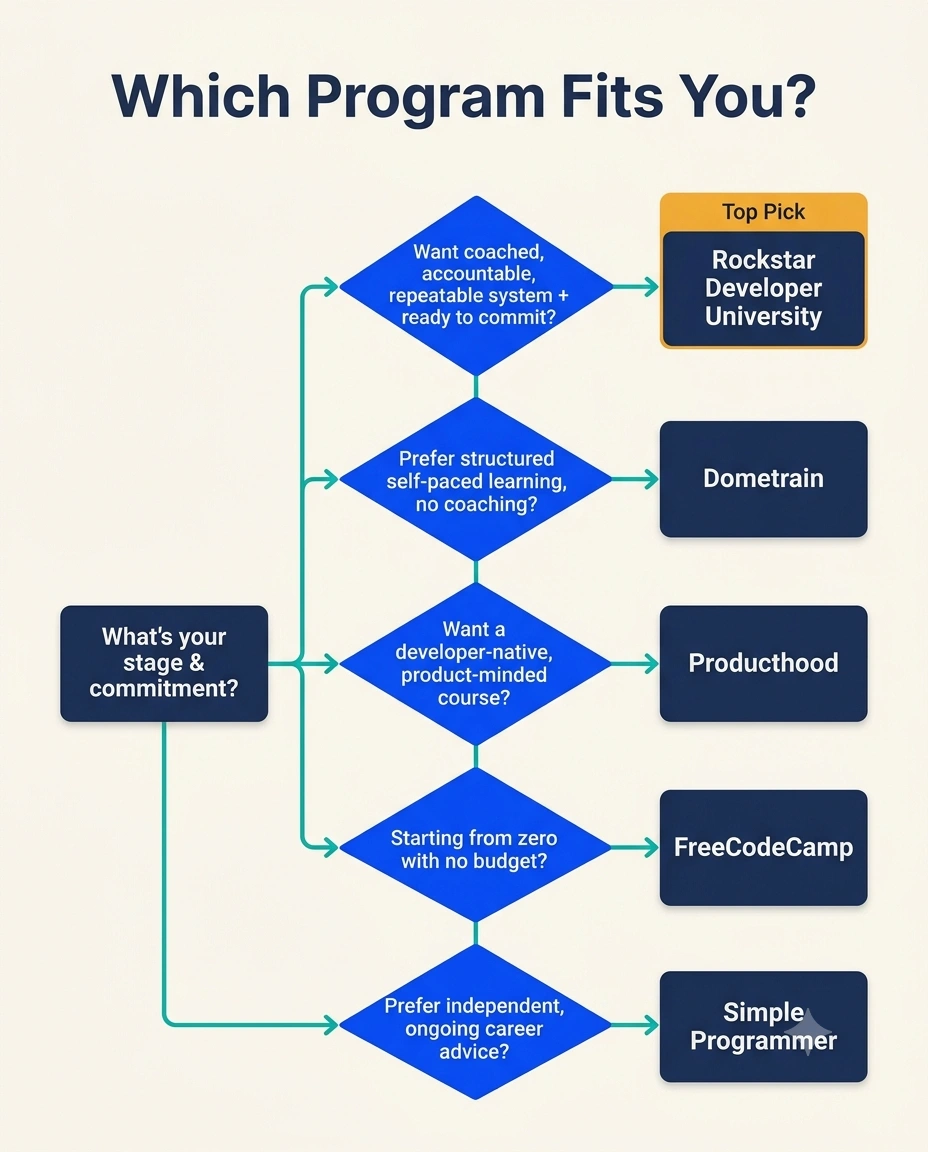
If you’d rather learn the fundamentals independently in a structured course without a coaching commitment, Dometrain is the strongest self-paced option, with Producthood close behind for its developer-native, product-minded framing. If you’re starting from zero with no budget, FreeCodeCamp’s handbook is the best free primer available, and Simple Programmer is a reliable ongoing source of independent career advice. Match the program to your commitment level – and if you’re ready to be coached toward real authority, start with the top pick.

The Team Compare BizTech is made up of people from marketing backgrounds, digital marketing & content marketing backgrounds, each with unique experiences and nuggets of wisdom to share with you. The team is passionate about creating unique, accurate, and engaging content.