

Someone on your digital marketing team has probably asked this out loud: why pay a writer in dollars for a blog post when a chatbot can accomplish the same task in ninety seconds? Fair question, honestly. The ongoing debate over AI content vs human content isn’t really about which one is “banned” or which one “wins” outright. It’s messier than that. And the mess, it turns out, is where the useful answer actually lives.
So, let’s dig into what the data says, not what Twitter threads say, about how each one actually performs once it hits real search results.
What Search Engines Actually Care About
Here’s the part that trips a lot of people up. Google search engine has never said and claimed AI content is against its algorithms and rules. Not once. Google’s own position, published on its Search Central blog, is that ranking systems reward original, high-quality content that shows expertise, experience, authoritativeness, and trustworthiness (E-E-A-T) thing. It also focuses on quality over production method has guided rankings for many years. Google doesn’t check who the typist of the sentence. It checks whether the sentence is worth reading.
What actually gets punished is something Google calls scaled content abuse. That’s the formal term, defined in its spam policies, for churning out a huge pile of pages purely to game rankings rather than help anyone. And this next bit matters a lot: it doesn’t matter who or what made the pile. A human content farm cranking out a thousand cookie-cutter “service plus city name” pages gets treated the same as an AI doing it. The problem was never really the machine. Mass production with zero thought was always the problem. AI just made that a lot cheaper to attempt.
So no, Google AI content doesn’t carry some secret invisible penalty. What tanks is thin, generic, copy-paste stuff, and AI just happens to be really good at generating a lot of that, fast, if nobody’s watching.
Where AI Content Genuinely Wins
Let’s give it credit where it’s due, because pretending AI writing is useless isn’t honest either.
Speed
Obviously. SE Ranking ran a real experiment: they published 2,000 AI-generated articles across 20 brand-new domains. Within 30 days, Google had already indexed around 71% of those pages. The same pages pulled in over 122,000 impressions and 244 clicks almost instantly. No human writing team on earth hits that kind of output in thirty days.
Getting indexed faster, specifically
A separate six-month study tracking 200 matched pairs of AI and human articles across 14 domains found AI content getting into Google’s index 1.8 times quicker, a median of 14 hours compared to 26 for the human pieces. Why? Probably faster publishing cadence and cleaner, more crawl-friendly templates, since automation pipelines tend to spit out tidier code by default.
Consistency
It works when you need fifty of the same things. If you’re writing product pages for fifty SKUs, AI won’t get bored on page thirty and start phoning it in the way a tired freelancer sometimes does.
And here’s a number worth sitting with for a second: 72% of SEO professionals now say AI writing ranks as well as, or better than, fully human-written content. That’s up from 64% just two years back. Opinion in the industry has genuinely shifted.
Where Does AI Content Falls Apart?
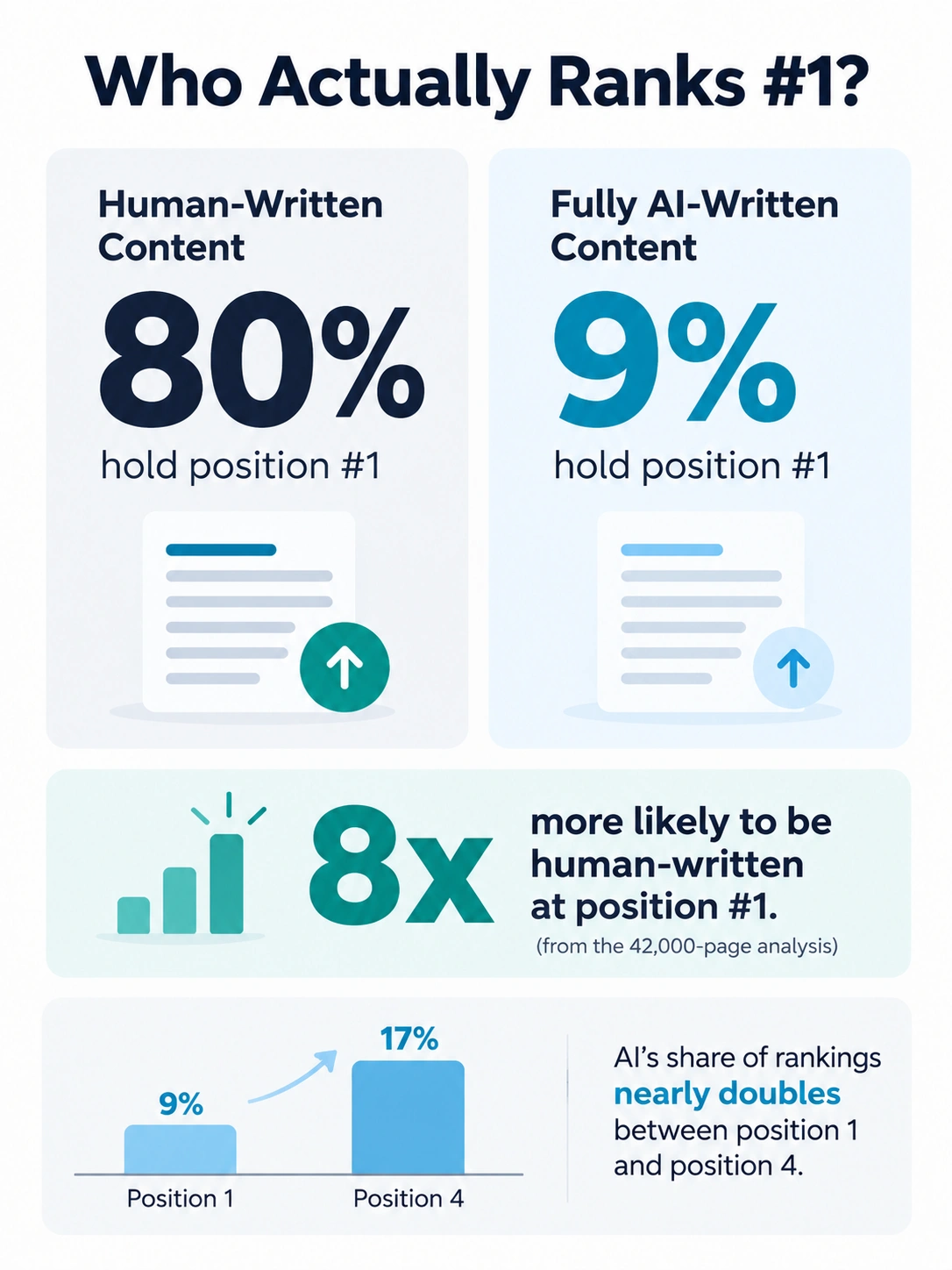
But look at what’s hiding right underneath that 72% number, because it tells a different story. The same research also analyzed 42,000 actual blog pages and found that content sitting in the number one spot was eight times more likely to be human-written. So, the industry believes one thing, and the top of the search results shows another. That gap is worth paying attention to.
Other numbers back this up pretty bluntly. Fully AI-written content lands the top spot only around 9% of the time. On the other hand, human writing holds that number one position roughly 80% of the time. And the gap isn’t evenly spread across the page either. It’s worst right at the very top, with AI’s share nearly doubling between position 1 and position 4. Translation: AI content tends to pile up further down the results, not at the top.
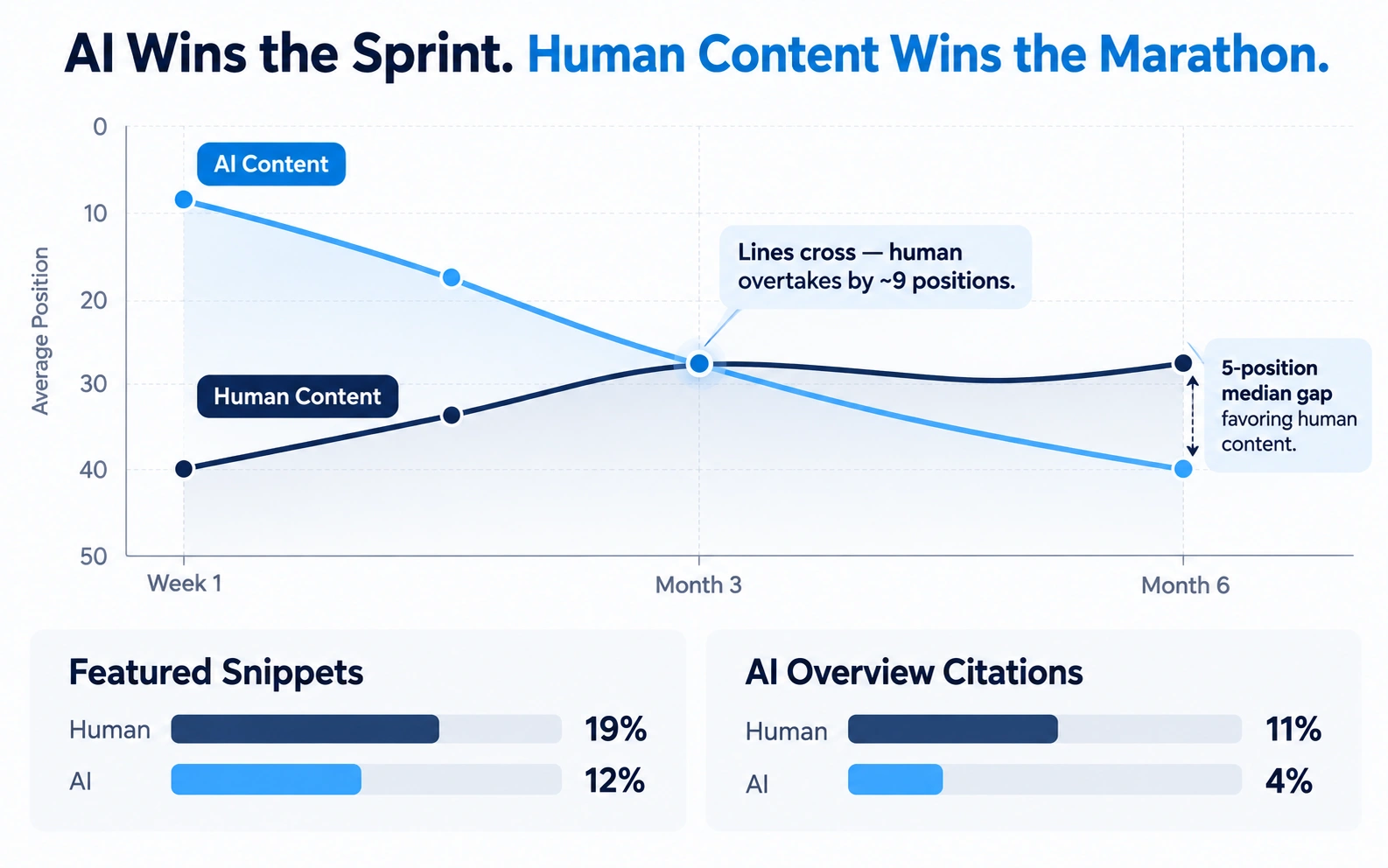
The long game looks even rougher for AI-only work. That six-month, 200-article study found something almost poetic happening. AI wins the sprint, then loses the marathon, badly. AI articles start out ranking higher in week one. By month three, the lines cross completely, and human content pulls ahead by around 9 positions on average. By month six, there’s a five-position median gap, and it favors humans. Featured snippets follow the same pattern: human content grabbed them 19% of the time versus AI’s 12%. The gap widens even more for AI Overview citations, where human writing gets cited 11% of the time against AI’s 4%.
Then there’s the cautionary tale buried in SE Ranking’s own numbers. Those 2,000 unedited AI articles across 20 new domains looked promising at first, with 80% of the sites ranking for at least 100 search queries early on. But with zero editing, backlinks, updates, and real trust behind them, the share of pages sitting in the top 100 fell from 28% down to just 3% within three months. Same starting content. Completely different fate, purely because nobody touched it after publishing.
Notice the pattern showing up in study after study here? Unsupervised AI content gets a short trial run, and then Google quietly loses interest in it.
What Human Content Still Does Better
So, what exactly does a person bring that AI still can’t fake? A few specific things, not just vague “humans are special” hand-waving.
Original experience
Probably the single biggest gap of all. E-E-A-T specifically rewards content built on real, lived experience with a topic, not just accurate facts about it. Someone who actually blew a budget on a failed ad campaign and can explain exactly where it went wrong is offering something no model can invent from scratch, because it was never trained on that specific mistake. AI can describe what a bad ad campaign generally looks like. It can’t tell you what happened in yours last March.
Expertise that shows its receipts.
Bringing in a named expert, a real credential, an actual case study, a direct quote from someone who’s done the work, instantly strengthens the experience and expertise legs of E-E-A-T in a way generic AI phrasing simply cannot fake convincingly, no matter how polished the sentences sound.
Accuracy under pressure.
AI models still confidently invent numbers, dates, and stats that sound completely plausible and are completely wrong. A sharp editor catches this before it publishes. An unsupervised AI pipeline running at scale usually doesn’t, and the moment a reader catches you wrong on something checkable, trust in the rest of the article evaporates too.
Judgment calls that don’t have a formula.
What to leave out, which caveat actually matters here, how to phrase something delicate without sounding tone-deaf. These still lean hard on human judgment. AI approximates it. It doesn’t really understand it.
The Real Story: It Was Never Actually a Fair Fight
Here’s the part most “AI versus human” headlines skip right past, and it’s the most useful bit in this whole piece. In basically every study cited above, the best-performing content wasn’t purely AI, and it wasn’t purely human either. It was an AI draft with a real human editor behind it.
Remember SE Ranking’s own blog test? Those AI-assisted articles, the ones that actually got edited and fact-checked before going live, pulled in over 555,000 impressions. The same articles fetched 2,300+ clicks in a year. Three of six landed in Google’s top 10. Five got cited as sources inside AI Overviews. Compare that to the 2,000 unedited articles that quietly fell apart by month three. Same underlying technology. Wildly different outcome, and editing was the only real difference.
One piece of industry research put it plainly: AI-generated content SEO works when
- AI handles the structured first draft, and
- a human handles the cleanup, the accuracy pass, and the voice.
Such content doesn’t work well when raw AI output goes straight out the door untouched. Roughly 39% of marketers report improved organic traffic after publishing AI-assisted content. About 33% report stronger rankings compared to human-only work, but that’s almost certainly describing edited output, not unreviewed AI dumps.
There’s also a quieter payoff to this hybrid approach that a lot of businesses completely miss: showing up inside AI answers themselves. Pages ranking at the top position in Google are 3.5 times more likely to also get cited by ChatGPT. Pages sitting outside the top 20 rarely gets any citation. Rank well the traditional way, edited, trustworthy, backed by real expertise, and you often end up appearing inside AI-generated answers too, almost as a free side effect.
So Where Does the Line Actually Sit?
If scaled abuse is the real problem and hybrid content is the fix, where exactly is the boundary between “using AI smartly” and “the stuff that gets you buried”?
Simple test: did a real person touch the substance, not just the formatting, before it went live? Did someone verify the facts? Add a genuine opinion or a real example from their own experience? Trim the parts that were obviously filler? If yes, you’re probably fine, no matter how the first draft got written. If a script wrote it, nobody read it, and it went straight to “publish,” that’s the scaled abuse Google’s actually going after, whether or not that was the intent.
And volume by itself still isn’t automatically the crime here. Google says templated pages from a human content mill get treated exactly the same as AI-templated pages. It was always about mass production without added value. AI just made that mistake a whole lot cheaper to make.
A Content Process Worth Actually Copying
Based on what’s genuinely working right now, here’s a workflow worth stealing than reinventing from scratch on your own.
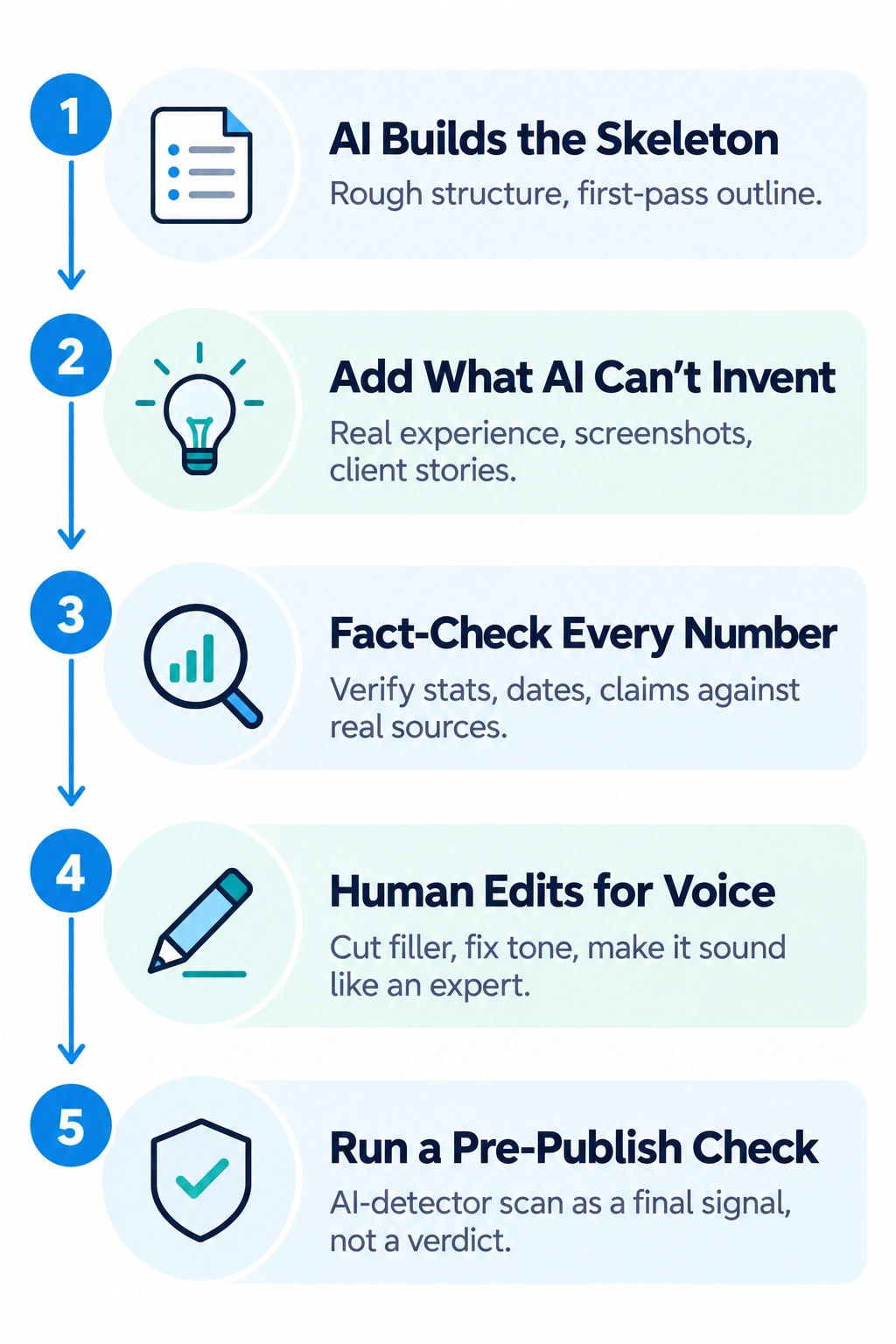
Let AI build the skeleton, not the soul. Use it for a rough structure, a first pass at explaining a concept, an outline you can react to. Don’t let it be the final voice on anything that actually matters to your business.
Add something AI genuinely can’t invent. A real screenshot from your own results. A mistake you made and what it taught you. A client story with actual numbers attached. This is the “experience” half of E-E-A-T, and honestly, it’s usually the single highest-leverage thing you can add to any draft.
Fact-check everything, especially the numbers. AI hallucinates statistics with total, unearned confidence. Before anything goes live, someone needs to verify every figure, date, and claim against a source that actually exists.
Get a real human to edit for voice, not just grammar. Not a rubber stamp. An actual pass where someone cuts the generic filler, fixes anything that sounds hollow, and makes sure it reads like a person who genuinely knows the topic wrote it, because in the best version of this workflow, they basically did.
Run a strict check before it publishes. It is useless to edit after Google’s already indexed it. This is where AI detectors earn their keep, even if you never plan to run every single article through one. Originality.ai runs about $12.95 to $14.95 a month. It tends to be the strongest at catching lightly paraphrased AI text, which matters if your process favors heavily on AI-first drafts. Winston AI starts somewhere between $10 and $18 a month depending on the tier. It bundles in plagiarism scanning plus OCR for scanned documents. Copyleaks starts around $11 to $14 a month and leans more toward enterprise and multilingual needs.
Worth remembering though: every one of these tools gives you a probability, not proof. OpenAI itself has said publicly that no detector can reliably declare text came from a model. Treat a flagged score as a nudge to look closer, not a final verdict.
Don’t confuse “ran spellcheck” with “was edited.” A quick grammar pass isn’t the same as an editor actually engaging with what the piece says. Every study above showing hybrid content winning is describing real editorial involvement, not a five-second glance before hitting publish.
FAQs
Q. Does Google punish AI-generated content just for being AI?
A. Not exactly. Google’s stated policy focuses on quality, not the tool used to produce it. What gets punished is scaled content abuse and mass-produced pages with nothing real behind them. This thumb rule applies whether a person or a model wrote it.
Q. Can pure AI content ever actually rank?
A. Sometimes, especially early on or in a low-competition niche. But every dataset here shows that advantage fading fast without real editing, backlinks, and trust signals behind it. Treat any early AI-only ranking as temporary, not as proof of a working strategy.
Q. Is human writing automatically better for SEO, then?
A. Not automatically either. Plenty of thin, lazy human content underperforms too. What human writers bring is real experience and expertise. This helps if the writing actually shows it in place of just claiming it.
Q. Should I run everything through an AI detector before publishing?
A. It can be a useful signal, especially if you’re managing freelancers or a big content team. It is equally useful if you need a quick first filter. Just don’t treat one score as gospel. Use it to flag content worth a closer human read, not to make the final call on its own.
Q. Will AI Overviews and chat tools change what wins going forward?
A. Probably. It’s already happening. Content that ranks well in traditional search overlaps heavily with content that gets cited inside AI-generated answers. So, the underlying advice barely changes: be genuinely useful, verified, and specific. Good content marketing fundamentals are still functional. They’ve just picked up a new reader that happens to be an algorithm, quietly looking over the human reader’s shoulder.
Q. What’s the right split between AI and human effort?
A. There’s no exact formula that can explain the right split between AI and human effort, but the pattern across every case study points the same direction: AI handles structure and speed, humans handle accuracy, experience, and voice. Think “AI drafts it, a person owns it,” not some fixed 50/50-word count split.

Praveen Kumar Panjiar is the founder of CompareBizTech.com, where he cuts through the noise in B2B tools with sharp, no-fluff comparisons. His work focuses on breaking down features, pricing, and real-world use cases, built specifically for high-intent buyers evaluating tools and looking to choose the right solution, fast.