
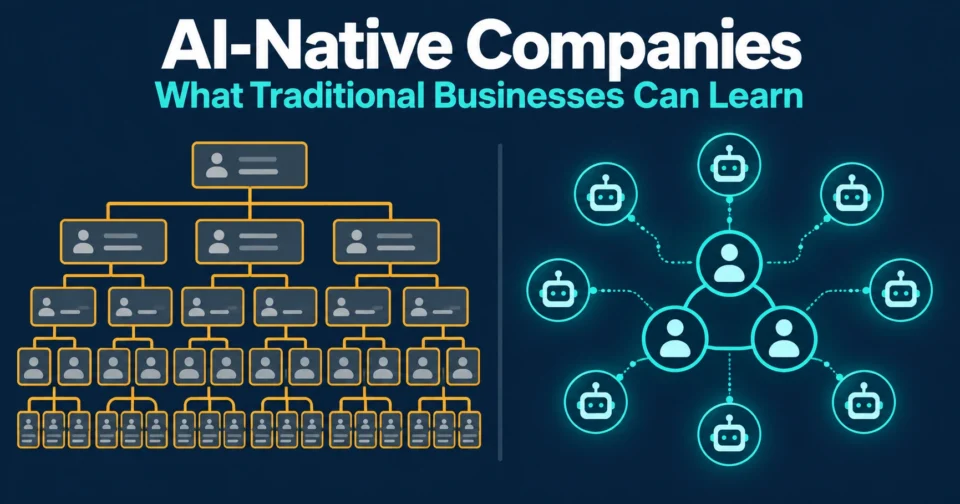
The AI coding tool, Cursor, hit roughly $4 billion in annualized revenue in June 2026. With about 700 people on staff. A traditional enterprise software company pulling in that kind of revenue would typically need five to ten times that headcount just to keep things running. That gap is basically the whole story of AI-native companies, and it’s why traditional business owners should care how these companies are built, not just what they sell.
Forget chatbots and background automation scripts for a second. This is a different way of designing a company from day one, AI sitting at the center of the business instead of getting bolted onto the side of it after the fact. What does that actually look like in practice, though? And what can a regular business, running on QuickBooks and a CRM instead of custom-trained models, actually take from it?
What Is an AI-Native Company, Really?
An AI-native business puts artificial intelligence (AI) at the center of how it runs, not off in a corner helping out occasionally. Imagine a restaurant that anchored a delivery app onto its existing kitchen, versus one built from scratch around what a ghost-kitchen delivery model actually needs. Same industry. Completely different starting point, and it shows in everything downstream.
These companies build their product, team structure, and pricing around the assumption that AI handles a big part of the work that used to require a person. A old-style software company hires a support team, then adds a chatbot later to deflect a few tickets. An AI-native one designs the product so a support agent, human or otherwise, rarely has to get pulled in at all. When one does get involved, AI handles the first response automatically, not as some bonus feature.
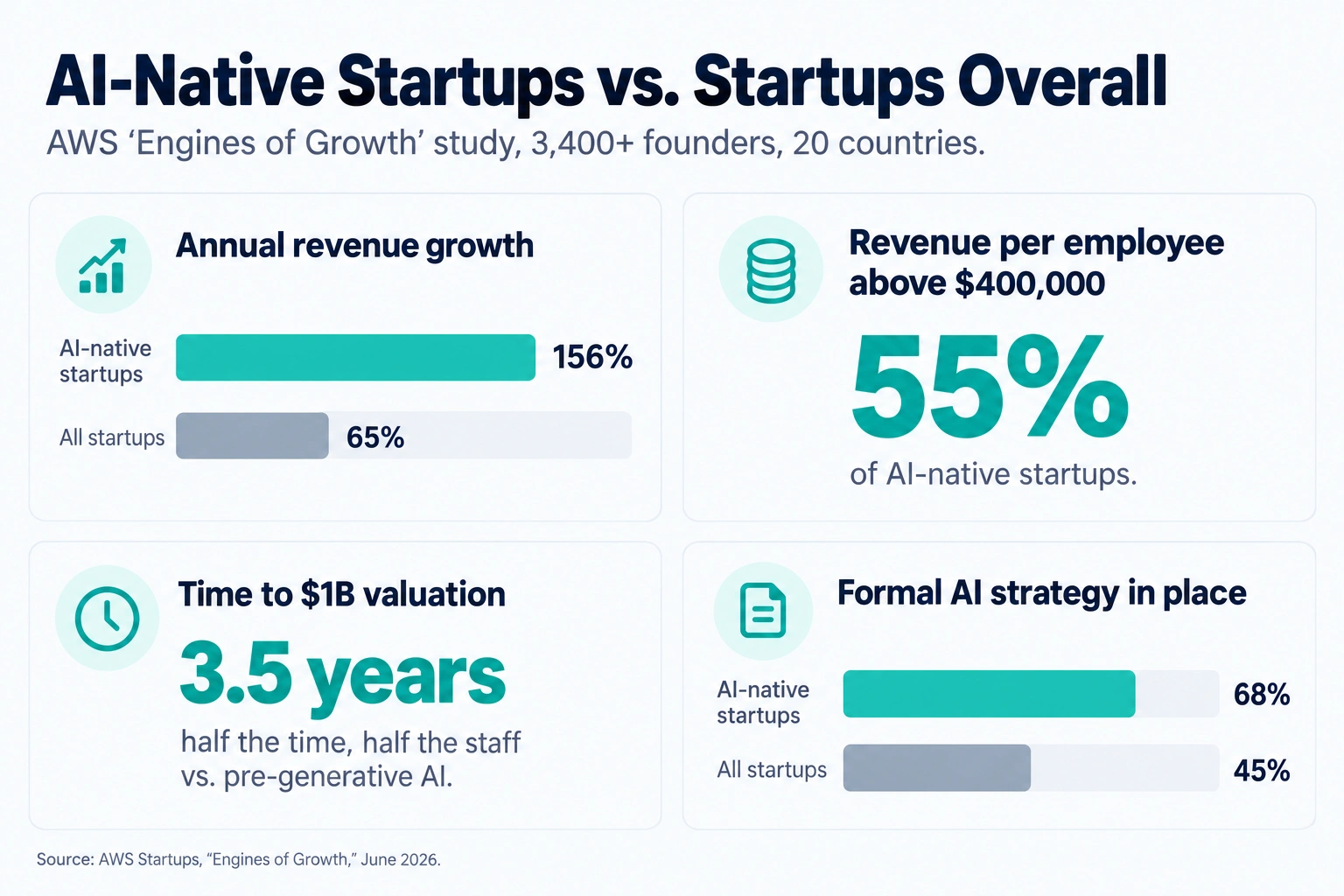
The numbers back this up. AWS ran a 2026 study, “Engines of Growth,” surveying more than 3,400 founders across 20 countries. AI-native startups were reaching billion-dollar valuations in about 3.5 years. It roughly took half the time before generative AI showed up, with half the staff. Average annual revenue growth landed at 156%, against 65% for startups overall. About 55% of them pulled in more than $400,000 in revenue per worker. Traditional SaaS usually sits somewhere around $150,000 to $300,000 per head. Not a small gap. A different category, really.
AI-First vs. AI-Enabled: The Distinction That Actually Matters
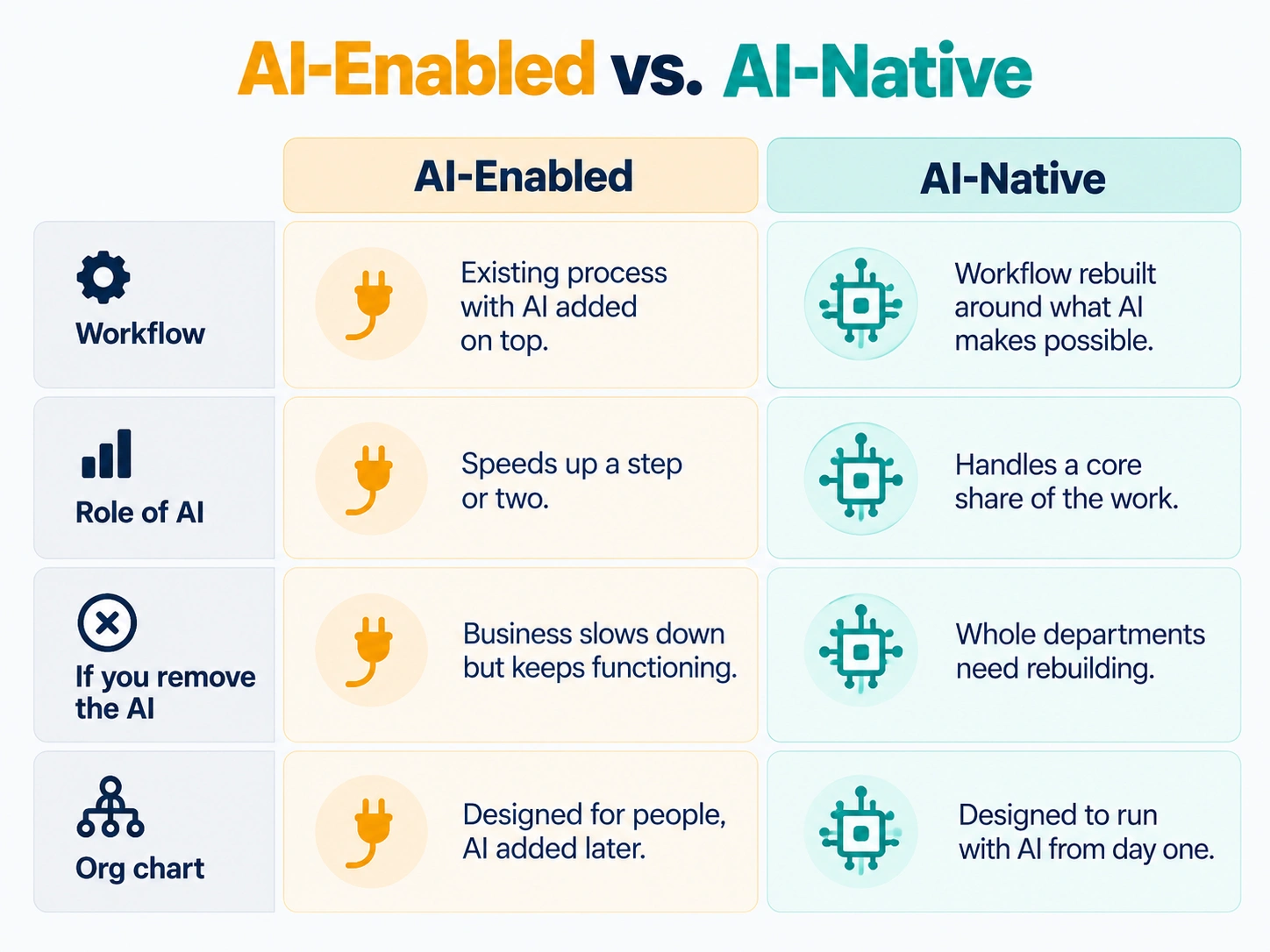
Most companies call themselves “AI-powered” nowadays because they slapped a chat widget on the homepage. Fine, but that’s AI-enabled. Not the same thing as AI-native. Remember the gap between the two matters more than it sounds like it should.
An AI-enabled business takes its existing workflow and employs some AI on top to speed a step or two along. Useful, sure. But the bones of the company haven’t actually moved. An AI-first company rebuilds the workflow around what’s newly possible instead. Structural choice, not a feature you ship on a Tuesday afternoon.
Here’s a decent gut check. Pull the AI tool out of an AI-enabled company, and the business slows down but keeps functioning about how it always did. Pull it out of an AI-native one, and whole departments would need rebuilding from the ground up, because the org chart was never designed to run without it in the first place. Most traditional businesses, honestly, sit a lot closer to the first category than they’d probably like to admit.
New AI Business Models Worth Understanding
t’s not only operational either. Pricing itself is shifting. Traditional software sells seats, one license per human logging in. A lot of newer AI business models sell outcomes instead: priced per task completed, per ticket resolved, per agent-hour of work done, regardless of how many actual humans touch either end of the transaction.
Different pitch entirely. Instead of “pay us $50 a month per employee who uses this,” it’s “pay us $2 per customer conversation we successfully close out.” Worth knowing if you’re a small business owner evaluating vendors, because usage-based pricing can land much cheaper than seat licensing, or blow up on you depending on volume. Read the fine print on rate limits and overage charges before you sign. Not after the first invoice shows up.
Why Smaller Teams Are Doing More
The headcount numbers get repeated continually, and they’re real. But there’s a tradeoff hiding underneath them that doesn’t make it into the celebratory posts. 2-3 people running AI coding assistants can ship a product that used to take a dozen engineers. One marketer with the right stack produces and tests ad creative that would’ve needed a whole agency five years back.
Small AI-native teams often run harder, though, not easier. Five people effectively producing what fifty used to isn’t just an output win, it’s a burnout risk waiting to happen. If you’re eyeing this model with a bit of envy, know that “lean” in AI-native land frequently just means understaffed on purpose. That costs you in turnover and lost institutional knowledge, in ways that never show up on a pitch deck.
Product Development: Building and Testing in Days, Not Quarters
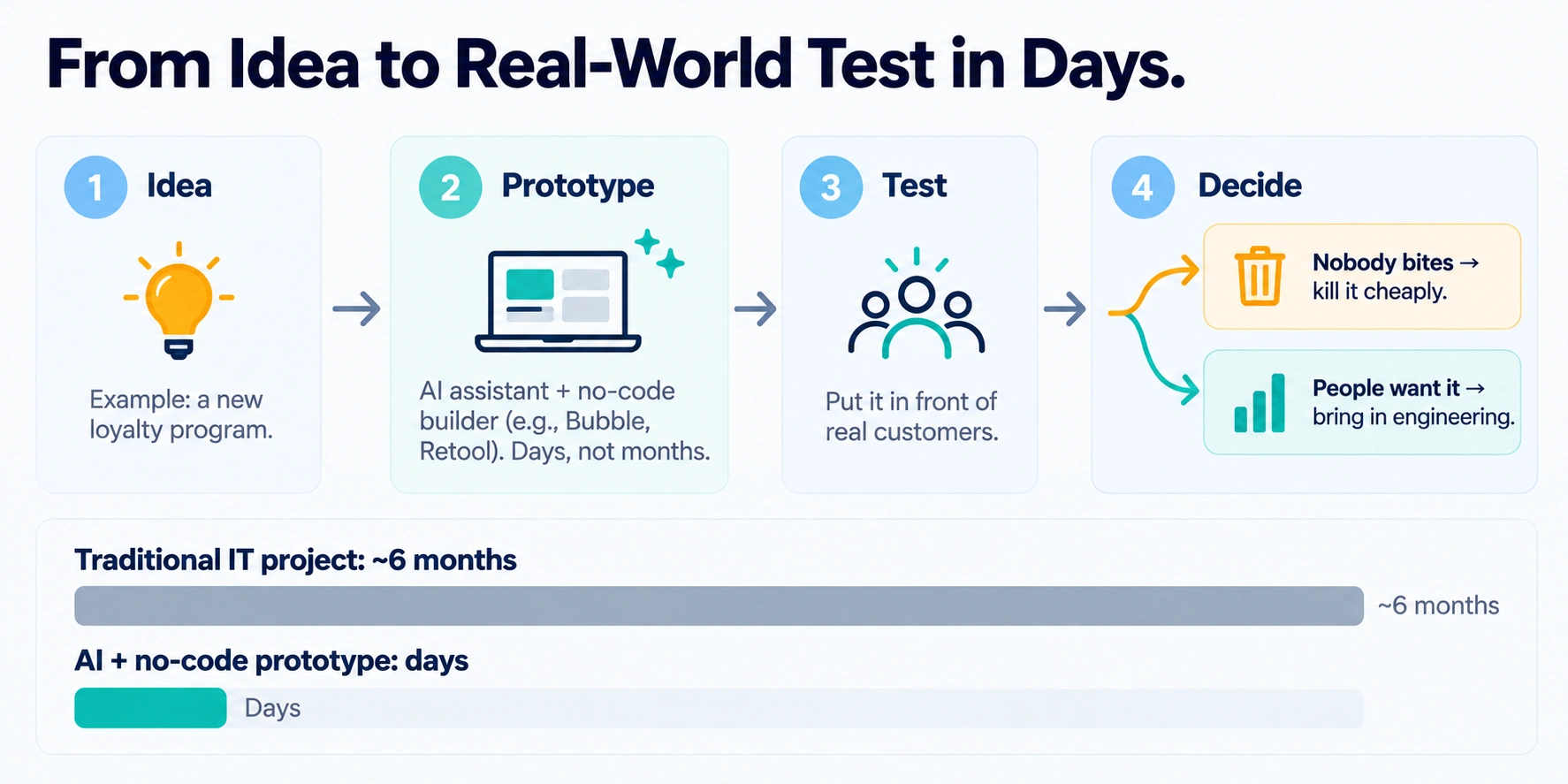
Probably the clearest spot for a traditional company to borrow a page from. AI-native product teams use AI to draft code, mock up interfaces, and write test cases. A dev cycle that used to eat a whole quarter now takes a couple of weeks in plenty of cases.
The practical lesson isn’t “replace your developers.” It’s bridging the gap between having an idea and being able to test it with real people. A local retailer piloting a new loyalty program doesn’t need a six-month IT project anymore. Claude or ChatGPT paired with a no-code builder, Bubble or Retool, gets a working prototype before customers within days. Test it cheap. Kill it fast if nobody bites. Bring in real engineering time only once you know people actually want the thing.
Customer Support: The Klarna Lesson Everyone Should Actually Read
Klarna’s the case study everyone cites, so let’s tell the whole thing, not just the flattering half. Early 2024, Klarna announced its OpenAI-powered assistant was handling the workload of 700 full-time agents, resolving issues in under 2 minutes versus 11 for a human, at satisfaction scores the company claimed matched human agents. Headcount dropped 22% through attrition as the company leaned hard into that bet.
Then, by mid-2025, it completely retracts. CEO Sebastian Siemiatkowski told Bloomberg the company was rehiring human agents. The company admitted the AI-first push had gone too far and hurt service quality. One line of his is worth keeping around: “It’s so critical that you are clear to your customer that there will always be a human if you want.”
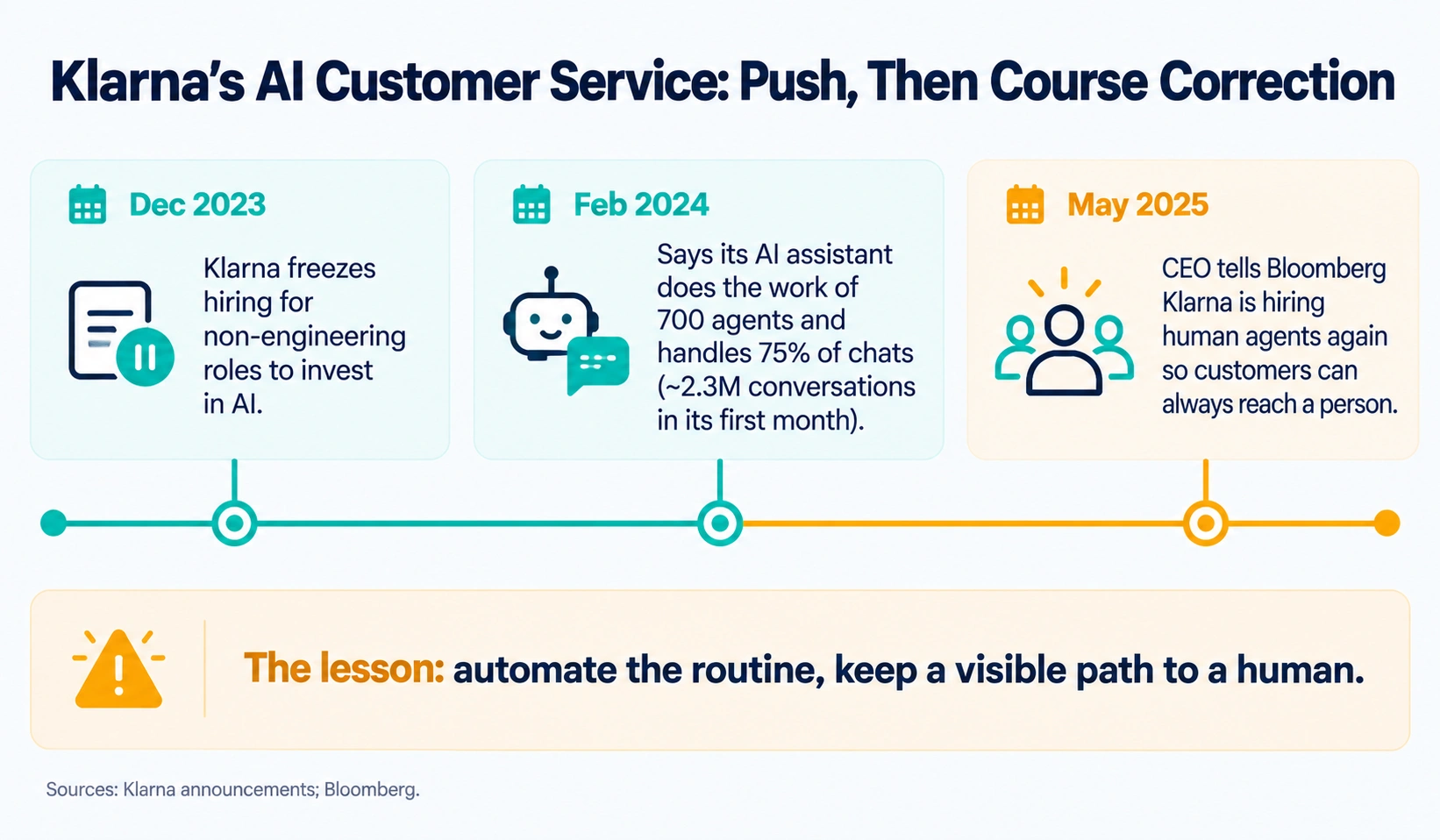
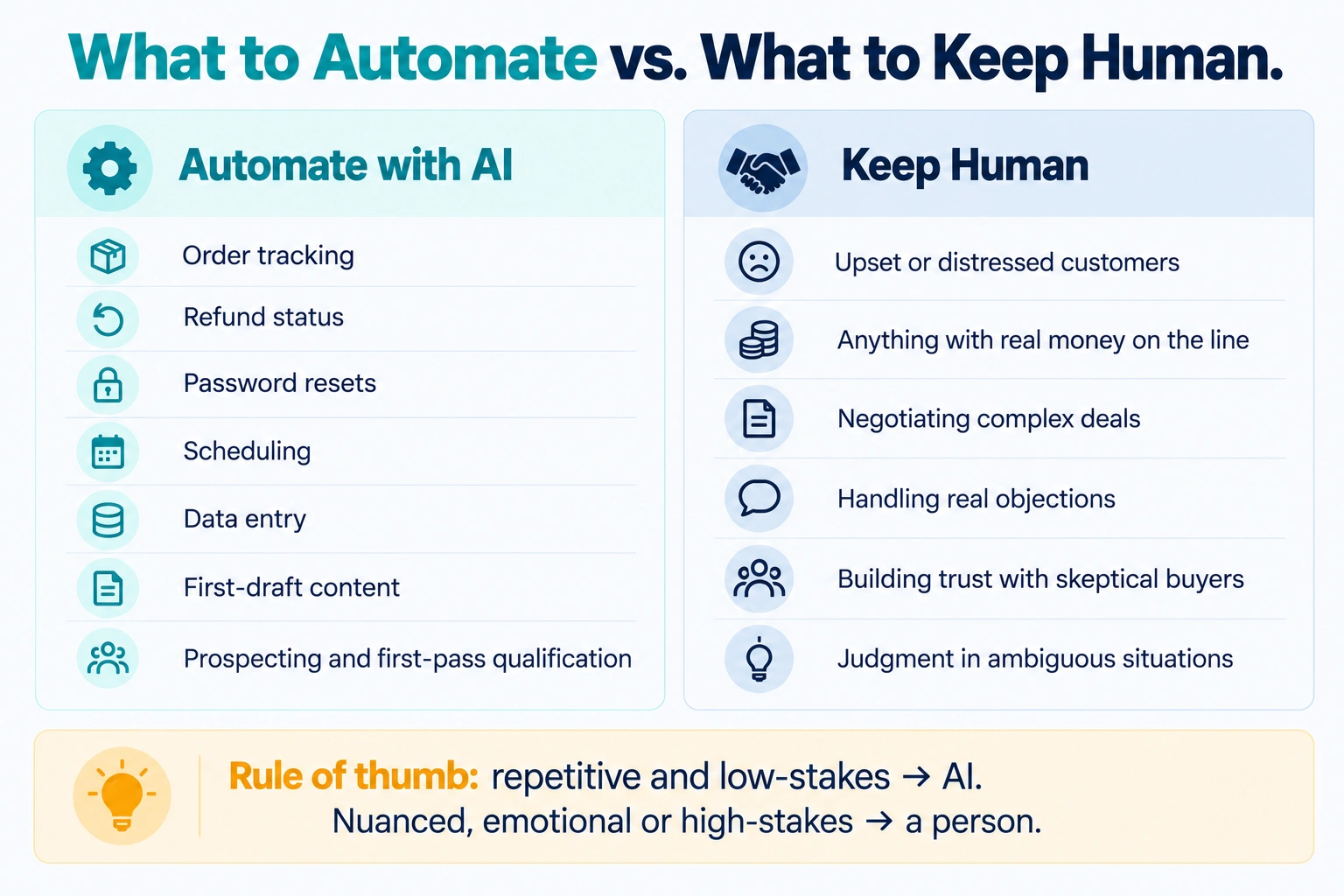
Not really a story about AI failing at its job. More a story about a company swinging too hard toward automation without leaving a real off-ramp to a human when things got complicated, or when a customer was just plain upset. Automate the monotonous, low-stakes stuff first, order tracking, refund status, password resets, and keep a fast, visible path to a real person for anything with actual nuance or money on the line. Don’t let a cost-cutting spreadsheet decide where that line sits for you.
Sales: Fewer Reps, Different Skills
SaaStr’s 2026 predictions, built from data across its own portfolio and partner companies, point to B2B sales teams running noticeably smaller than a year earlier while holding revenue flat or growing it. One example cited: Vercel running nearly all of outbound through a single human working alongside AI agents. ICONIQ’s 2025 GTM benchmarking study found AI-native companies posting close rates roughly 50% higher than traditional peers doing the same job.
AI isn’t replacing the sales team here. It’s handling prospecting, first-pass qualification, scheduling, freeing up the humans left to spend their week on the parts of selling that genuinely still need a person. Negotiating a gnarly enterprise deal. Working through real objections. Building trust with a skeptical buyer who’s heard every pitch before. For a traditional business, that’s not a license to fire half your sales floor. It’s a reason to take an honest look at how much of your reps’ week goes to admin work AI could just absorb.
Operations and Data: The Unglamorous Engine Room
None of the flashy stuff above works without a foundation most companies chronically underinvest in, clean, connected data. AI-native companies build one source of truth from the start. Customer data, product usage, support history, all feeding systems that actually talk to each other, because their AI tools are only ever as good as what they can see.
Traditional businesses usually have the opposite setup. Customer records living in three different systems, each with a slightly different spelling of the same company name. Inventory data updating on a different schedule than sales data does. Before any AI transformation makes real sense, this is the unglamorous work that has to happen first. AI on top of messy, disconnected data just produces confident wrong answers faster than a person would’ve reached a slow, uncertain one.
What Happens to Human Roles
This is the question every business owner actually wants answered, and it genuinely depends on the role. Roles built around repetitive judgment calls with clear patterns, tier-one support, basic bookkeeping, first-draft content, are shrinking or getting folded into AI-assisted workflows. Roles built around relationship-building and navigating real ambiguity? Those are getting more valuable, not less, because they’re the differentiator once the routine work gets automated away.
The AWS study found something telling here too. AI-native startups aren’t running with zero people, they’re running with fewer, more specialized ones. 98% employ dedicated in-house AI talent, versus 70% of large enterprises. Pretty clear signal that the winning move isn’t blind headcount cuts. It’s shifting who you hire and what you’re actually asking them to spend their time on.
Common Mistakes Traditional Businesses Make Chasing This
A few patterns keep showing up when traditional companies try to copy the AI-native playbook without actually becoming AI-native underneath.
Bolting AI onto a broken process and expecting a transformation is the first one. If customer service is slow because your systems don’t talk to each other, an AI chatbot sitting on top of that mess just hands customers a faster, more confident wrong answer.
utting headcount before the AI tooling actually works is the second, basically Klarna’s mistake at a smaller scale. IBM’s 2025 survey of 2,000 CEOs found only 25% of AI projects were delivering the ROI they’d promised, and even fewer scaled successfully across the whole company. Sobering number if you’re tempted to make staffing calls off the strength of a vendor demo.
Treating AI adoption as a tooling purchase instead of an actual strategy rounds out the list. The AWS data found 68% of AI-native startups have a formal, comprehensive AI strategy in place, against 45% of startups overall, and 72% have built some proprietary AI capability rather than duct-taping off-the-shelf tools together. A subscription to a chatbot platform isn’t a strategy on its own. Deciding which parts of your business genuinely benefit from automation, and which need to stay human, is the actual work.
How a Traditional Business Actually Starts Becoming More AI-Native
Nobody’s suggesting a 40-person regional business tear itself down and rebuild overnight. There’s a more realistic path here, and it starts small.
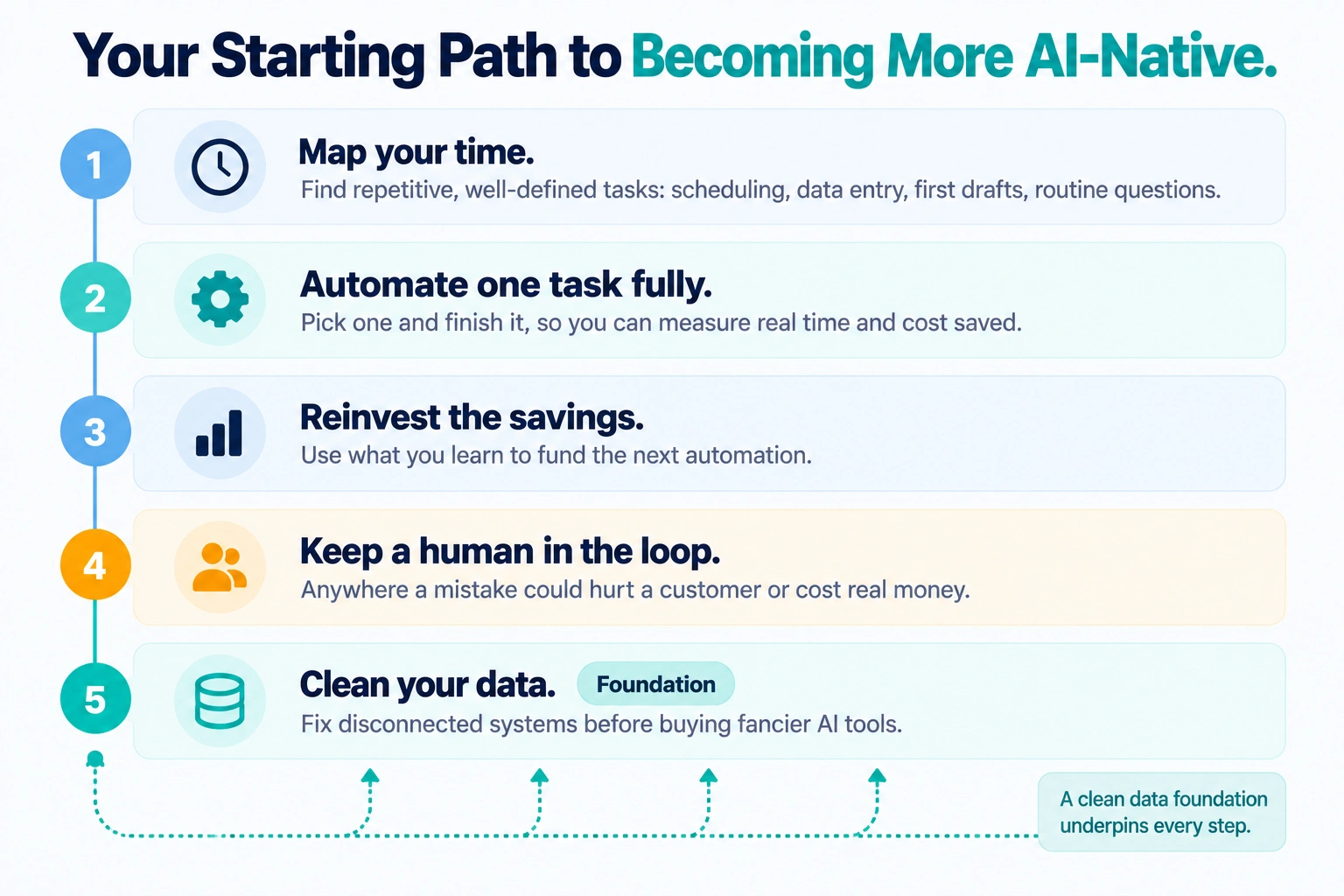
Map where your team’s time actually goes on repetitive, well-defined tasks: scheduling, data entry, first-draft writing, routine customer questions. Pick one and automate it fully, not halfway, so you can measure the real time and cost it saves. Use what you learn there to fund the next one. Keep a human clearly in the loop anywhere a mistake would genuinely hurt a customer relationship or cost real money. And clean up your underlying data before spending on fancier AI tools sitting on top of it. That foundation decides whether any of this actually works, or just looks good in a sales deck.
Five Lessons Worth Taking From AI-Native Companies
- Structure follows strategy, not the other way around. Understand what AI should essentially be responsible for before buying the tool.
- Smaller and faster beats big and slow, sure. Only if your remaining team isn’t running itself into the ground to make that math work, though.
- Keep a visible human option anywhere emotion or real complexity is involved. Klarna learned that one publicly, and expensively.
- Your data is the actual product here. Every AI tool is only as sharp as what it can see, and most traditional businesses have messier data than they’d like to believe.
- Revenue per employee is worth tracking quarter over quarter, even if you never chase it the way an AI-native startup does. It tells you honestly whether new tools are changing how the business runs, or just adding one more subscription to the pile.
Where This Is Headed
The future of business almost certainly isn’t every company turning into a 700-person, $4 billion outlier like Cursor. Most businesses aren’t software companies. A lot of work, healthcare, manufacturing, anything needing physical presence and trust built over years, isn’t going to compress the way developer tools have.
What looks likely instead is the gap widening between companies that treated AI transformation as a real structural decision, and the ones that treated it like a feature purchase. The AWS data already shows AI-native startups increasing AI spending 46% year over year, against 35% for startups overall. That flywheel, more investment, better tooling, more capable teams, compounds over time. Traditional businesses don’t need to become AI-native by next quarter. But the ones treating this as a real strategic question now, instead of a line item to get to later, are going to have a much easier time catching up than the ones waiting until their competitors have already made the leap.

The Team Compare BizTech is made up of people from marketing backgrounds, digital marketing & content marketing backgrounds, each with unique experiences and nuggets of wisdom to share with you. The team is passionate about creating unique, accurate, and engaging content.