
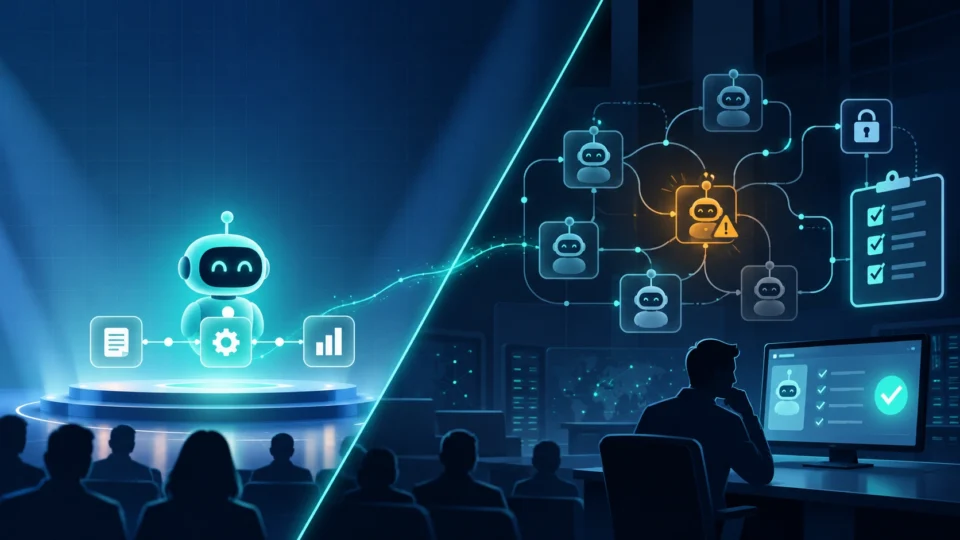
The demo always works. That’s never been the problem with ai agent frameworks for enterprise projects. The problem shows up two weeks later, once production starts asking the questions a demo never has to answer. Who actually approves the agent’s action before it fires? What happens when step six of a ten-step run just dies? And is any of this going to survive a SOC2 review without turning into a six-month standoff with security?
Here’s where the seven frameworks enterprises are actually shipping on in 2026 differ: how they handle state, how agents hand off to each other, how much a human gets to veto before something happens, and what you end up paying once the free tier stops covering it.
What Are AI Agent Frameworks and Why Do Enterprises Need Them?
Strip it down and an AI agent framework is just the layer sitting between a raw model and something you could actually call enterprise ai workflow automation. It breaks a task into steps. It lets one agent pass work to another. It remembers what happened three steps back instead of forgetting the second the context window scrolls past it. And when something’s about to touch a production system, it waits for a person to say yes.
Without that layer, most agent projects fail the same way, over and over. One agent handles the easy 80% fine. Then it hits the messy 20%, the exception nobody wrote a rule for, and the whole thing falls over. Multi agent orchestration frameworks exist specifically to fix that, by splitting the hard task across a handful of narrower agents instead of asking one generalist to do everything.
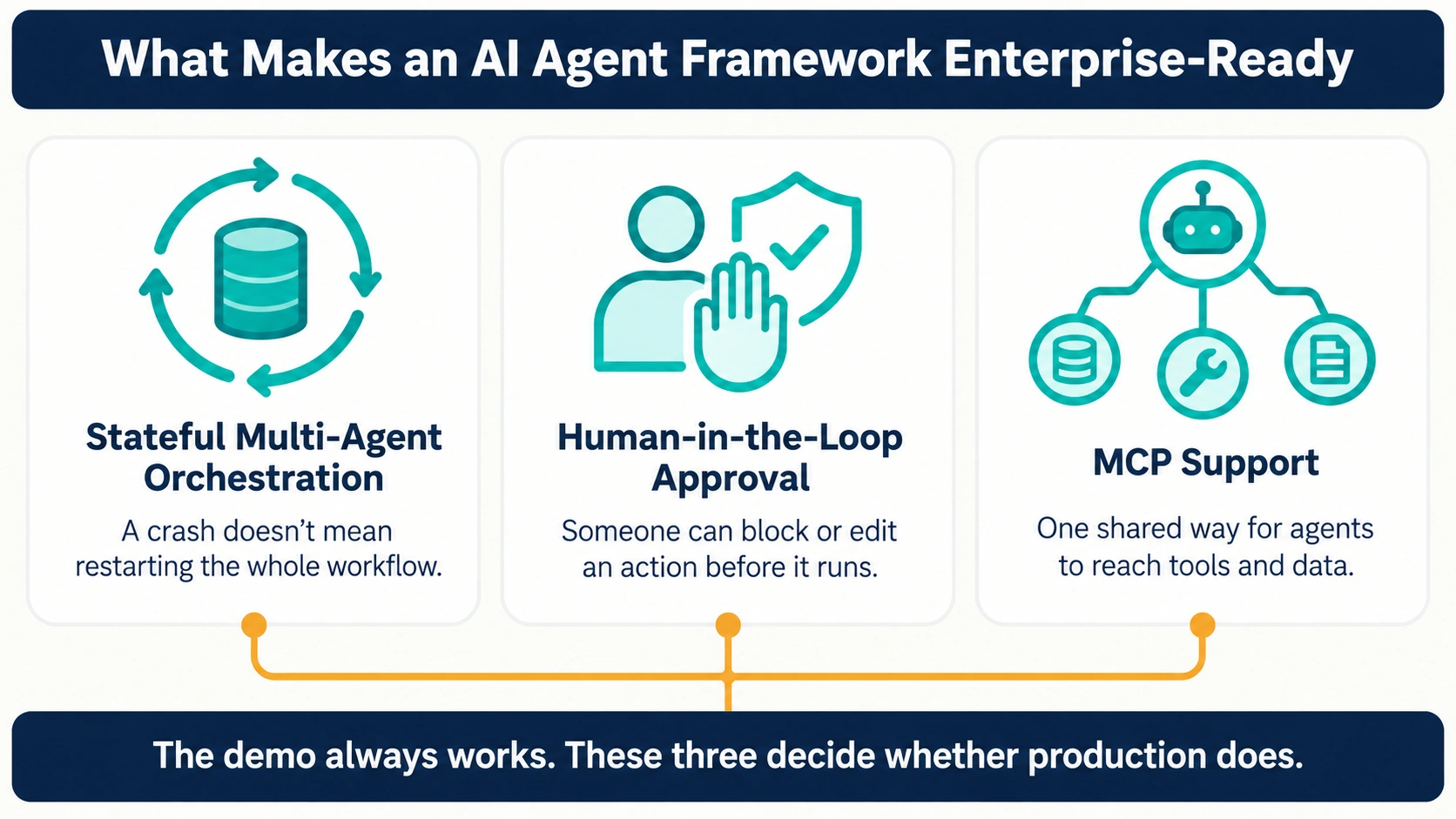
So, what actually separates a weekend side project from something IT signs off on? Three things, mostly.
- Stateful multi agent orchestration, so a crash doesn’t mean starting the whole workflow over from scratch
- Human in the loop ai agent framework support, so someone can step in and block or edit an action before it runs
- Model context protocol MCP agents, a shared way for agents to reach tools and data without a one-off integration built for each one.
Quick Comparison: Best AI Agent Frameworks at a Glance
| Framework | Best For | License | Enterprise Pricing | Language |
| LangGraph | Complex, stateful production workflows | MIT (open source) | Free tier, LangSmith Plus from $39/seat/mo, Enterprise custom | Python, JS |
| CrewAI | Fast multi-agent prototyping | MIT (open source) | Free Basic tier, Enterprise custom-quoted | Python |
| Microsoft Agent Framework | .NET / Azure enterprise shops | MIT (open source) | Free framework; pay for Azure AI Foundry usage | Python, .NET |
| AutoGen / AG2 | Research-style multi-agent conversation | MIT (open source) | Free, framework only | Python |
| Semantic Kernel | Existing .NET plugin ecosystems | MIT (open source) | Free, framework only | C#/.NET, Python |
| Pydantic AI | Type-safe Python agents | MIT (open source) | Free; Logfire observability $0–$249/mo | Python |
| LlamaIndex Workflows | Document-heavy, RAG-centric agents | MIT (open source) | Free tier; LlamaCloud paid tiers scale with usage | Python, TS |
Top 7 AI Agent Frameworks Reviewed (Features, Pros, Cons & Pricing)
1. LangGraph
Picture an agent workflow as an actual graph. Nodes, edges, a shared state object updating as execution moves across it. That’s LangGraph, built by the LangChain team, and the whole pitch is that explicitness. You can point to exactly where a workflow branches. Retry the one node that broke instead of rerunning the entire thing. Pause halfway through for someone to sign off.
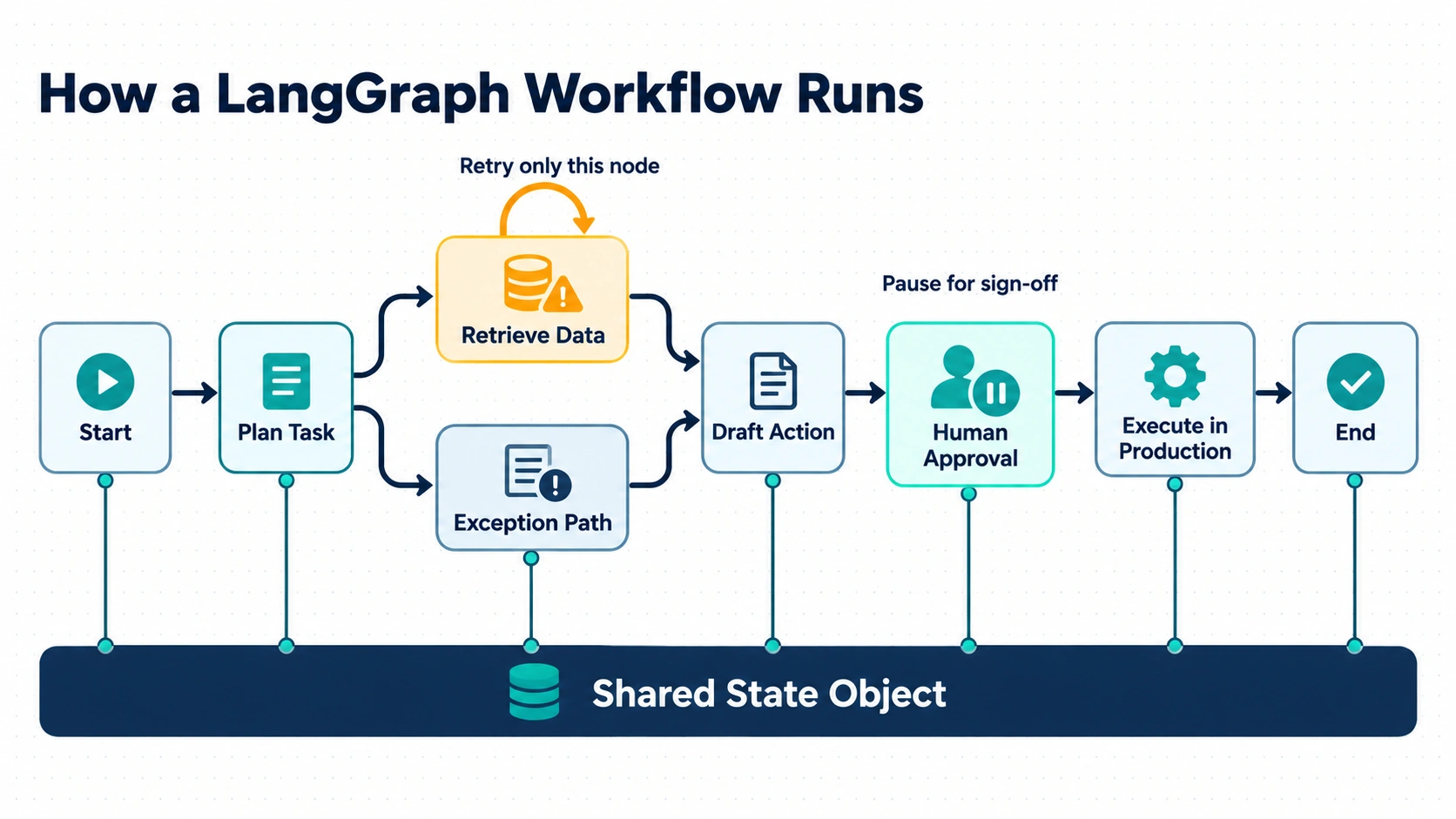
What you get for that: fine-grained control over every state change, a real production track record at companies pushing serious volume, and a lighter token bill per run than conversational frameworks, since routing is just a function call rather than another trip back to the model.
What it costs you is time up front. More setup than a role-based tool like CrewAI, and the graph-first way of thinking needs a sprint or two before it stops feeling foreign.
Framework’s MIT-licensed, so self-hosting is free. The paid side is LangSmith, which handles observability and managed deployment. There’s a free Developer tier with 5,000 base traces a month, a Plus tier at $39 per seat monthly covering 10,000 traces, then usage-based pricing above that and Enterprise if you ask for it directly.
2. CrewAI
No graph here. CrewAI builds around roles instead, a “researcher,” a “writer,” a “reviewer,” each given a goal and left to sort out delegation between themselves. It’s the quickest path most teams have to a working multi-agent demo, period, which is exactly why it dominates “crewai vs langgraph for enterprise” searches from people still at the proof-of-concept stage.
Speed’s the whole draw. Fast to prototype, a role metaphor that makes sense to someone who’s never touched orchestration before, and a growing pile of ready-made crew templates to start from instead of a blank file.
Speed costs something, though. Agent-to-agent delegation runs through actual LLM calls, so token spend usually lands higher than LangGraph for comparable work, and CrewAI’s enterprise platform, AMP, is newer and still closing the gap with LangSmith on observability.
The Basic plan is free, 50 workflow executions a month plus a visual editor, an AI copilot, and GitHub integration, with Enterprise custom-quoted on top of that for private infrastructure and dedicated development hours. You’ll run into wildly different annual figures for that Enterprise tier floating around various blogs. None of them are official. Get a real number from CrewAI’s sales team instead of trusting a stranger’s blog post.
3. Microsoft Agent Framework
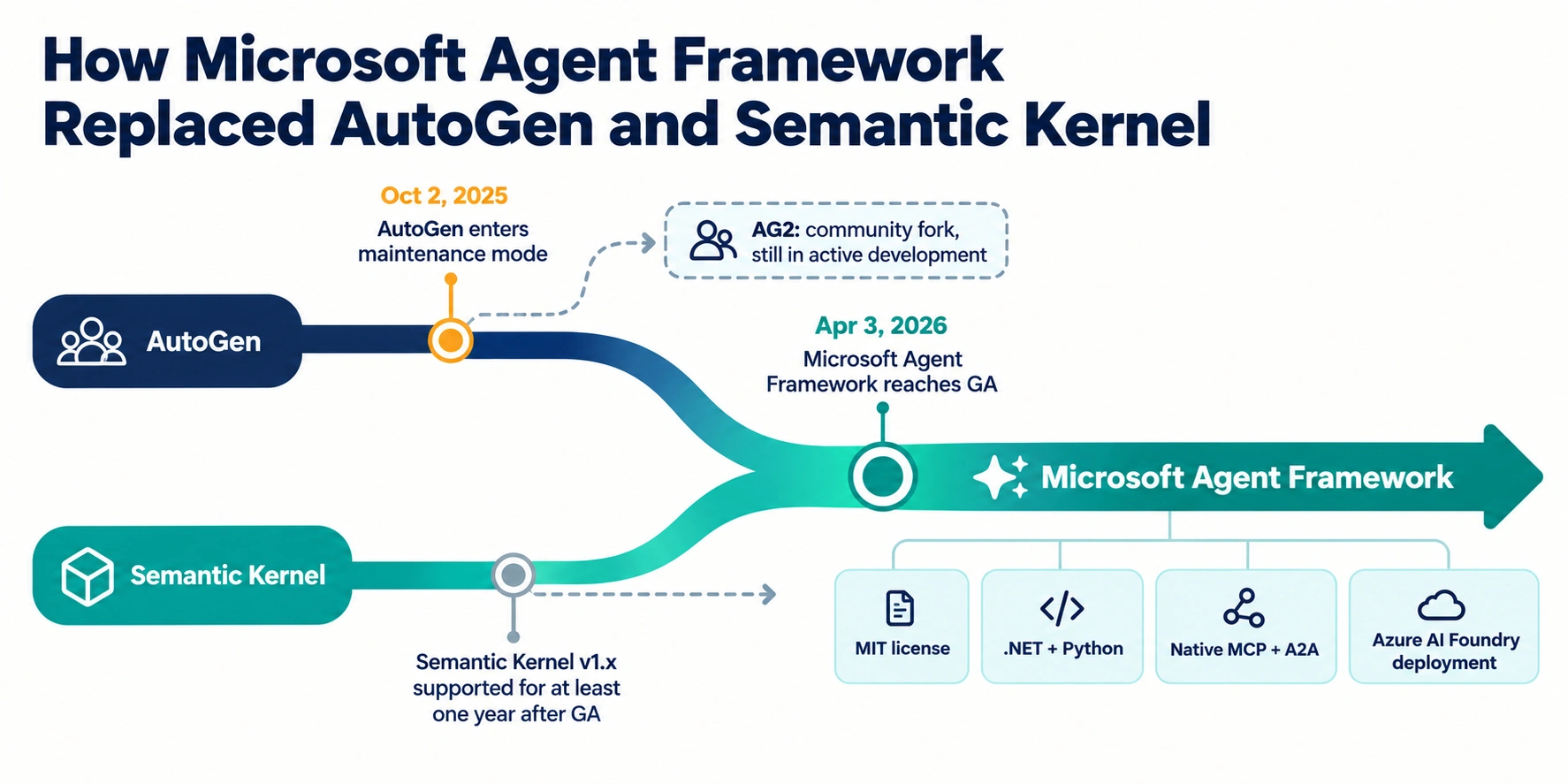
Newest name on this list, and probably the single biggest shift in the category all year. Microsoft folded AutoGen’s multi-agent abstractions and Semantic Kernel’s enterprise-grade state management and telemetry into one SDK, which hit general availability on April 3, 2026 as a production-ready, MIT-licensed package covering both .NET and Python. It also bakes in native support for the Model Context Protocol and the Agent2Agent protocol, two things that are starting to show up by name on enterprise procurement checklists.
Already on Azure, or already a .NET shop? This is probably your answer. One-command deployment into Azure AI Foundry, and a long-term support promise that’s unusually rare this early in a framework’s lifecycle.
Outside that world it’s a harder sell, mostly because the community’s still small next to LangGraph’s or CrewAI’s, and there’s less pull toward it if you’ve got zero Azure footprint.
Cost-wise it’s free and open source. What you’re actually paying for is Azure AI Foundry usage, or whatever model API you’re calling behind it, not the framework.
4. AutoGen / AG2
AutoGen basically invented agents talking to each other to solve a problem, and it’s still one of the most cited names in agentic research. But something changed this year that a lot of older comparison posts haven’t caught up with yet. The original AutoGen has been sitting in maintenance mode since October 2, 2025, with Microsoft routing its actual investment into Microsoft Agent Framework now. AG2 is the community fork still pushing development forward on its own.
In its favor: a massive existing codebase, a genuine research community behind it, zero cost, and a conversational style that’s still useful for exploratory work.
Against it: starting a fresh enterprise build on the original AutoGen in 2026 means betting on something Microsoft has already walked away from. Want this pattern anyway? Check AG2’s current roadmap first, don’t assume it’s identical to what AutoGen used to be.
Price tag: nothing. No managed tier, no license fee.
5. Semantic Kernel
Before “agent framework” was even a phrase people used, Semantic Kernel was Microsoft’s enterprise play for AI integration, built around a plugin and connector model that slots naturally into existing .NET codebases. Microsoft’s committed to keeping Semantic Kernel’s v1.x line supported for at least a year past Microsoft Agent Framework’s GA date</cite>, so nobody running it today is getting left stranded overnight.
Strong points: a mature, genuinely well-documented plugin ecosystem, a natural fit if you’ve already got Semantic Kernel code in production, and solid telemetry built in from day one rather than bolted on later.
The weak point isn’t quality, it’s positioning. It’s the foundation layer underneath Microsoft Agent Framework now, not the forward path, so a brand-new agent project is better served starting directly on MAF.
Price: free, MIT, framework only, same deal as most of this list.
6. Pydantic AI
Same team behind Python’s most-used data validation library built this one, and it shows. Pydantic AI checks every LLM output against a defined schema at runtime, which quietly solves a production headache that’s more common than people admit: an agent returning something almost in the right shape, but not quite, and breaking whatever step comes next.
People reach for it because the API actually feels Pythonic instead of bolted on, dependency injection makes agent code genuinely testable, and the whole thing’s lighter than the bigger orchestration platforms.
What’s thinner: fewer pre-built enterprise connectors and governance tooling out of the box compared to platforms built from day one for large rollouts. Expect to write more of your own glue code here.
The framework’s free under the MIT license, no usage caps, no account needed to run it at all. Pydantic Logfire, their separate observability product, has its own paid tiers if deeper tracing matters to you.
7. LlamaIndex Workflows
LlamaIndex built its reputation on retrieval-augmented generation, and Workflows is its answer to orchestration for document-heavy jobs. Workflows 1.0 shipped June 22, 2026 as an event-driven, async-first layer where every step in an agent’s process is a typed event handler, with state that persists and can replay if something breaks halfway through.
Where it earns its keep: agents digging through large document collections, scattered data sources, or ugly PDFs and tables. Pair it with LlamaParse and the parsing work most other frameworks dump on you gets handled automatically.
Where it falls short: scope. It’s narrower than a general orchestration framework, and if your work isn’t document or data-heavy, LangGraph or CrewAI will probably serve you better.
Core’s open source. LlamaCloud, the managed side, runs on credit-based pricing, a free entry tier plus paid plans that scale with document volume and parsing complexity. Confirm current tiers before you budget anything, credit pricing moves around as usage patterns shift.
Key Factors When Choosing an Enterprise AI Agent Framework
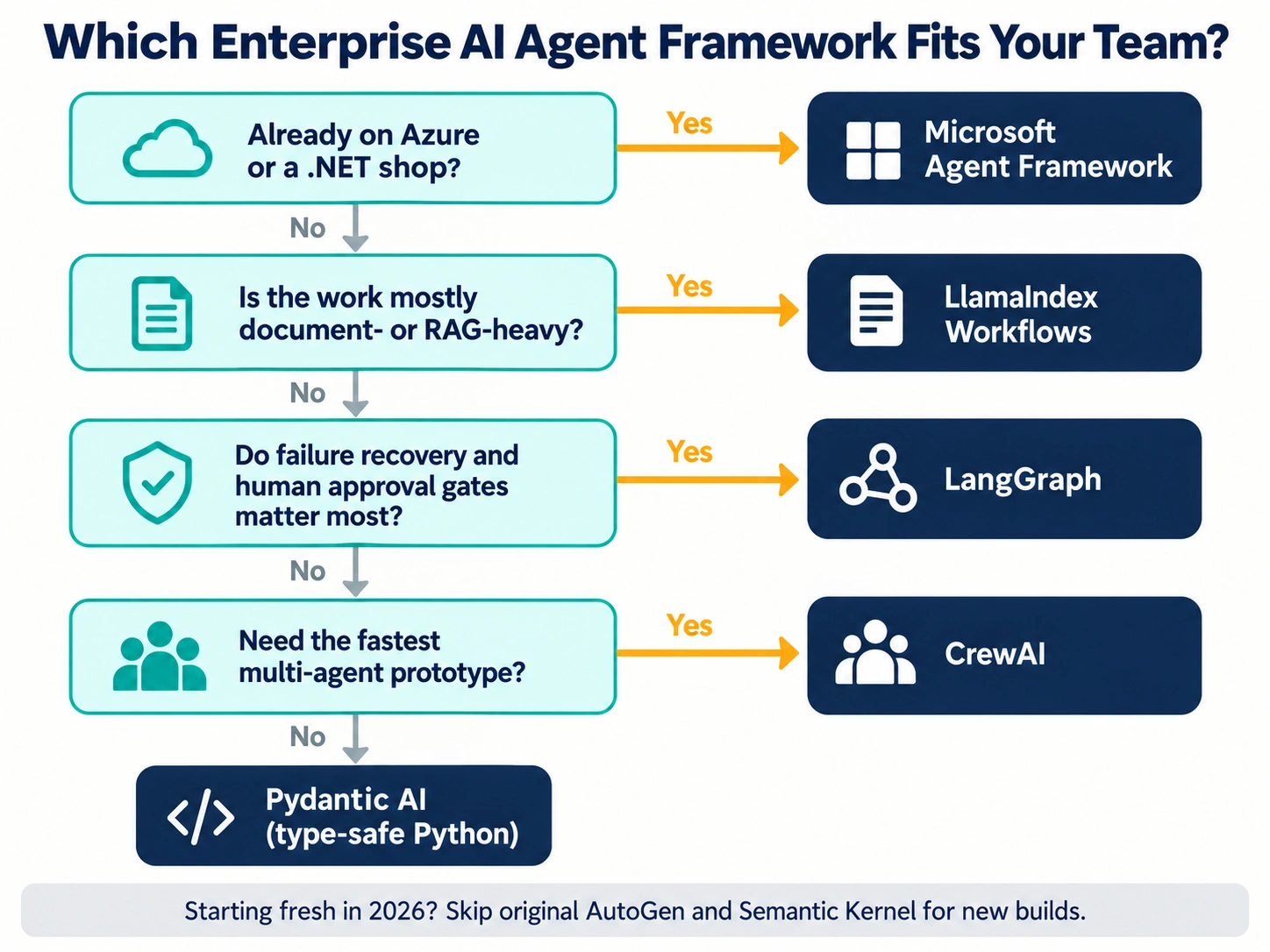
Deciding between python ai agent frameworks and a dotnet enterprise ai agent sdk usually comes down to five questions. Worth answering honestly before anyone opens an IDE.
- What’s already running in your stack? A .NET shop pulls more value from Microsoft Agent Framework or Semantic Kernel than from forcing a Python-first tool into its pipeline.
- Role-based simplicity, or graph-level control? CrewAI’s role based multi agent systems approach wins for speed. LangGraph’s explicit state graph wins once failure modes actually matter.
- Is the work document-heavy? Agents mostly reasoning over internal knowledge bases, contracts, reports? LlamaIndex Workflows saves real engineering time over building retrieval from the ground up yourself.
- How much does human oversight need to matter here? Regulated industries need real human in the loop ai agent framework support, not something added after an incident already happened.
- What’s the actual budget beyond the free tier? Open-source agentic AI frameworks cost nothing to self-host, but observability, managed deployment, and enterprise support climb fast with usage.
Buyer Checklist: Picking the Right Tier
- Confirmed SOC2, SSO, or on-prem deployment options if compliance requires them.
- Confirmed your stack (Python vs .NET) before shortlisting frameworks.
- Priced out the observability layer, not just the framework license.
- Ran a token-cost estimate against your actual workflow, not the vendor’s demo.
- Tested state persistence and failure recovery, not just the happy path.
- Verified MCP or A2A protocol support if procurement requires it.
Frequently Asked Questions
Q. Which is better: LangGraph vs CrewAI vs AutoGen?
A. No clean winner exists. LangGraph takes it on production control and lower token costs for complex work. CrewAI takes it on speed to a working prototype. AutoGen’s conversational pattern still has a home in research-heavy projects, but new enterprise builds should look at AG2 or Microsoft Agent Framework rather than the original, now maintenance-mode AutoGen.
Q. Microsoft Agent Framework vs LangGraph, which one should an enterprise actually pick?
A. Already on Azure, or already running .NET? Microsoft Agent Framework’s native Azure AI Foundry integration and long-term support commitment make it the natural fit. Everyone else, particularly teams comfortable in Python without an Azure dependency, tends to get more out of LangGraph’s broader ecosystem and its longer run in production.
Q. Is AutoGen vs Semantic Kernel still a meaningful comparison in 2026?
A. Not really, not anymore. Both are effectively predecessor technologies at this point, with Microsoft pushing new agent investment toward Microsoft Agent Framework, which absorbs what both of them did. Starting from scratch, build on MAF instead of choosing between two frameworks Microsoft has already moved past.
Q. Are there no-code AI agent platforms for business users who don’t write Python or C#?
A. Yes, but none of the seven frameworks here are built for that audience. These are developer tools, full stop. Teams needing agent automation without engineering resources should look at no-code platforms built on top of these frameworks, and go in expecting a real trade-off in flexibility once the code layer disappears.
Q. Do I actually need an MCP-compatible framework, or is that marketing noise?
A. It’s becoming a real line item in procurement, not just a buzzword. Model Context Protocol gives agents a standard way to reach tools and data, which starts mattering a lot past two or three integrated systems. LangGraph and Microsoft Agent Framework both support it natively as of 2026. Worth checking directly for anything else you’re weighing.

The Team Compare BizTech is made up of people from marketing backgrounds, digital marketing & content marketing backgrounds, each with unique experiences and nuggets of wisdom to share with you. The team is passionate about creating unique, accurate, and engaging content.