
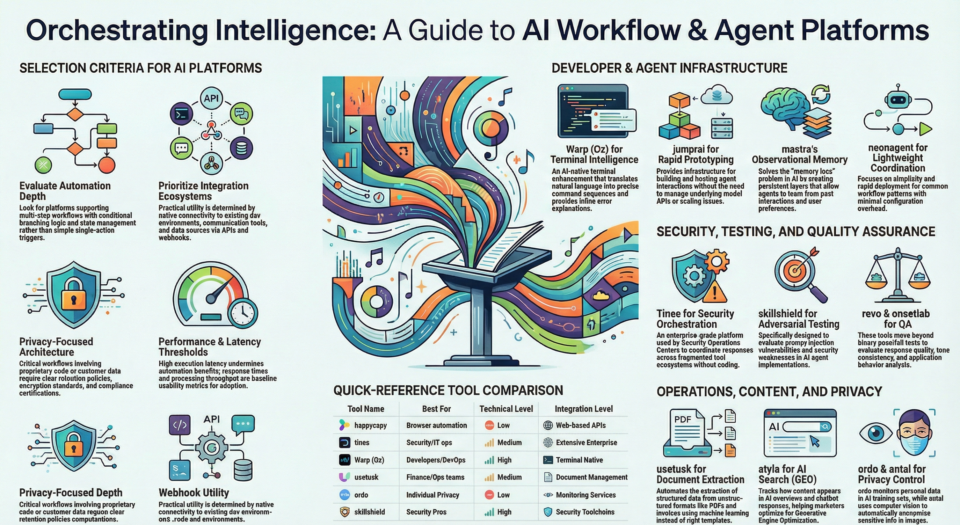
Modern productivity demands more than traditional software solutions. Teams face mounting pressure to automate repetitive tasks, coordinate multiple AI agents, and maintain security while accelerating output. The challenge isn’t finding AI tools—it’s identifying which workflow automation platforms align with specific technical requirements and operational constraints.
AI workflow automation tools have evolved beyond simple task schedulers into sophisticated orchestration systems that manage complex agent interactions, preserve context across sessions, and integrate deeply with existing development environments. These platforms address critical gaps in how professionals coordinate AI-driven processes, from automated testing pipelines to intelligent document processing workflows.
This guide examines 16 specialized AI productivity tools designed for distinct workflow scenarios. Each section provides structured evaluation criteria, feature analysis, and use case alignment to support informed platform selection decisions.
What to Look for in AI Workflow & Agent Tools

Selecting effective AI workflow automation software requires evaluating multiple technical and operational dimensions beyond surface-level capabilities.
Automation Depth: The platform should support multi-step workflows with conditional logic, error handling, and recovery mechanisms. Tools offering only single-action automation lack the sophistication needed for complex agent orchestration scenarios. Look for systems that enable branching logic, state management, and asynchronous execution patterns.
Integration Ecosystem: Seamless connectivity with existing tools determines practical utility more than standalone features. The best AI productivity apps for professionals provide native integrations with development environments, communication platforms, and data sources without requiring extensive custom coding. API flexibility and webhook support enable adaptive workflow construction.
Privacy and Security: Data handling practices become critical when automating sensitive operations. Tools processing proprietary code, customer information, or internal documentation must offer clear data retention policies, encryption standards, and compliance certifications. Privacy-focused architectures that minimize data exposure reduce organizational risk.
Scalability: Workflow complexity grows with organizational maturity. Platforms should accommodate expanding agent networks, increasing transaction volumes, and evolving automation requirements without performance degradation. Resource allocation, rate limiting, and cost predictability matter for sustainable deployment.
Use Case Flexibility: Specialized tools excel in narrow domains while general platforms offer broader applicability. Evaluate whether the solution addresses immediate workflow bottlenecks or provides adaptable infrastructure for evolving automation needs. Domain-specific optimizations often outperform generic implementations for targeted scenarios.
Performance and Speed: Execution latency directly impacts workflow efficiency and user experience. Tools introducing significant delays undermine automation benefits, particularly in real-time scenarios. Response times, processing throughput, and system reliability establish baseline usability thresholds that determine practical adoption.
Happycapy
happycapy functions as a browser-based AI productivity extension designed to streamline web interaction workflows through intelligent automation capabilities. The platform emphasizes reducing manual browsing tasks by enabling users to create custom automation sequences triggered by specific web events or user-defined conditions.
This tool targets professionals who spend considerable time navigating repetitive web-based workflows—data collection from multiple sources, form submissions across platforms, or monitoring status changes on various websites. Unlike traditional browser automation that requires coding expertise, happycapy provides accessible configuration interfaces that translate user intent into executable automation logic.
The platform distinguishes itself through contextual awareness of web page structures, allowing automations to adapt when site layouts change without requiring constant maintenance. This resilience makes it particularly valuable for workflows dependent on third-party websites over which users have no control.
Key Features
- Visual workflow builder for creating browser automation sequences without writing code
- Intelligent element detection that adapts to website structure changes
- Scheduled execution for time-based automation triggers
- Data extraction and transformation capabilities for web scraping scenarios
- Integration with external APIs for extending automation beyond browser boundaries
- Multi-tab coordination for workflows spanning multiple web properties simultaneously
- Session state preservation across automation runs
Ideal For
happycapy serves marketing professionals conducting competitive research, sales teams managing outreach across multiple platforms, and operations staff coordinating data collection from web-based tools. The browser-centric approach benefits anyone whose productivity bottlenecks center on repetitive web navigation rather than backend system integration. Teams without dedicated development resources find particular value in the no-code automation interface.
Key Takeaways
- Eliminates repetitive browser-based tasks through visual automation design
- Adapts to website changes without constant maintenance overhead
- Integrates web data collection with external workflow systems
- Reduces dependency on technical expertise for browser automation implementation
- Maintains session context across complex multi-step web workflows
Tines
tines operates as an enterprise-grade AI agent orchestration software platform focused on security operations and complex workflow automation scenarios. The system enables teams to build sophisticated automation workflows that coordinate multiple tools, systems, and decision points without traditional coding requirements.
Built specifically for security teams and IT operations professionals, tines addresses the challenge of coordinating responses across fragmented tooling ecosystems. The platform excels at scenarios requiring conditional logic, parallel execution paths, and integration with specialized security tools that lack native automation capabilities.
What sets tines apart is its emphasis on workflow observability and debugging. Unlike simpler automation tools, the platform provides detailed execution logs, real-time monitoring, and sophisticated error handling that make complex automations maintainable at scale. This operational maturity matters when automations become critical infrastructure components rather than experimental productivity enhancements.
Key Features
- Visual workflow editor with drag-and-drop component assembly
- Pre-built integrations with hundreds of security and IT operations tools
- Advanced conditional logic and branching for complex decision trees
- Real-time workflow execution monitoring and debugging capabilities
- Credential management and secure secret storage for API authentication
- Workflow versioning and rollback functionality for safe iteration
- Team collaboration features including shared workflow libraries and templates
Ideal For
tines targets security operations centers managing incident response workflows, IT teams automating infrastructure management tasks, and compliance departments orchestrating audit processes. Organizations requiring audit trails, sophisticated error handling, and enterprise-grade reliability find the platform’s operational focus essential. Teams coordinating workflows across dozens of specialized tools benefit from the extensive integration library.
Key Takeaways
- Orchestrates complex multi-system workflows without coding requirements
- Provides enterprise-grade monitoring and debugging for production automation
- Integrates deeply with security and IT operations tooling ecosystems
- Enables team collaboration through shared workflow components
- Maintains detailed audit logs for compliance and troubleshooting scenarios
Revo
revo positions itself as an AI developer tool for automation focused on accelerating software testing and quality assurance workflows. The platform applies machine learning to identify testing gaps, generate test scenarios, and execute automated testing sequences across web applications.
Developer teams face constant pressure to maintain test coverage while shipping features rapidly. revo addresses this tension by automatically analyzing application behavior to suggest relevant test cases, reducing the manual effort required to maintain comprehensive test suites. The system learns from existing tests to propose new scenarios that cover edge cases developers might overlook.
The platform’s differentiation lies in its generative approach to test creation rather than simply executing pre-written tests. By understanding application structure and user flows, revo identifies untested code paths and generates appropriate validation scenarios. This proactive testing methodology helps teams catch issues before they reach production environments.
Key Features
- AI-powered test case generation based on application analysis
- Automated web application testing across multiple browsers and devices
- Visual regression detection for identifying unintended UI changes
- Integration with continuous integration and deployment pipelines
- Test maintenance automation that updates tests when applications change
- Coverage analysis showing which code paths lack adequate testing
- Natural language test description interface for non-technical stakeholders
Ideal For
revo serves development teams maintaining complex web applications, QA professionals seeking to expand test coverage efficiently, and product teams needing to validate functionality across frequent releases. Organizations practicing continuous deployment find particular value in automated test maintenance that reduces friction in shipping cycles. Teams with limited dedicated QA resources benefit from AI-augmented testing capacity.
Key Takeaways
- Generates comprehensive test scenarios through application behavior analysis
- Reduces manual test maintenance overhead through automated updates
- Identifies testing gaps that manual approaches typically miss
- Integrates seamlessly with existing development toolchains
- Enables faster release cycles through automated quality validation
Atyla
atyla functions as an AI search optimization tool designed to help content teams and marketers understand how AI-powered search engines surface and rank content. The platform provides visibility into generative engine optimization (GEO) performance, tracking how content appears in AI overviews, chatbot responses, and next-generation search interfaces.
Traditional SEO analytics focus exclusively on conventional search engines, leaving teams blind to how AI systems interpret and present their content. atyla bridges this gap by monitoring content performance across AI-powered discovery channels, providing insights into citation patterns, source attribution, and content extraction behaviors.
The platform distinguishes itself by treating AI search as a distinct optimization channel rather than an extension of traditional search. This specialized focus helps teams adapt content strategies for environments where featured snippets, conversational answers, and synthesized responses replace traditional link-based rankings.
Key Features
- Performance tracking across multiple AI search engines and chatbot platforms
- Citation analysis showing when and how content gets referenced by AI systems
- Content structure recommendations optimized for AI extraction and summarization
- Competitor monitoring for AI search visibility across key topics
- Keyword opportunity identification specific to AI-generated answers
- Attribution tracking to understand source credibility signals
- Automated reporting for AI search performance metrics
Ideal For
atyla serves content marketing teams adapting to AI-driven search behaviors, SEO professionals expanding beyond traditional optimization channels, and publishers seeking to maintain visibility as search interfaces evolve. Organizations producing authoritative content benefit from understanding how AI systems evaluate and cite sources. Teams allocating content production resources need visibility into which topics generate AI search traction.
Key Takeaways
- Provides visibility into content performance across AI search channels
- Identifies optimization opportunities specific to generative engines
- Tracks citation patterns and source attribution behaviors
- Enables strategic adaptation to AI-powered content discovery
- Measures impact of content structure on AI extraction and presentation
Doraverse
doraverse delivers AI meeting automation platforms functionality through intelligent recording, transcription, and action item extraction from video conferences. The system automatically joins scheduled meetings, captures conversation content, and generates structured summaries with highlighted decisions and assigned tasks.
Remote teams struggle with meeting overhead—coordinating schedules across time zones, capturing discussion context, and ensuring follow-through on commitments. doraverse addresses these friction points by automating documentation workflows that typically require dedicated note-takers or post-meeting synthesis efforts.
The platform’s differentiation centers on contextual understanding rather than simple transcription. By recognizing speaker intent, identifying action items, and extracting key decisions, doraverse transforms passive recordings into actionable workflow triggers. This intelligent processing reduces the gap between discussion and execution.
Key Features
- Automatic meeting attendance and recording across major video conferencing platforms
- Real-time transcription with speaker identification and timestamping
- AI-powered action item extraction with automatic assignment detection
- Searchable meeting archives with topic-based indexing
- Integration with project management tools for automatic task creation
- Custom vocabulary support for industry-specific terminology
- Privacy controls for sensitive meeting content handling
Ideal For
doraverse targets distributed teams conducting frequent video meetings, project managers tracking commitments across multiple workstreams, and executives needing efficient meeting recaps without attending every session. Organizations with complex coordination requirements benefit from automated follow-up tracking. Teams spanning multiple time zones find value in asynchronous meeting participation through intelligent summaries.
Key Takeaways
- Eliminates manual meeting documentation and note-taking overhead
- Automatically identifies and tracks action items across conversations
- Creates searchable knowledge base from meeting content over time
- Enables asynchronous participation through intelligent summarization
- Integrates meeting outcomes directly into workflow management systems
Warp (Oz by Warp)
Warp positions Oz as an AI-native terminal enhancement that transforms command-line interaction through intelligent assistance and workflow automation. The tool integrates directly into the Warp terminal application, providing contextual suggestions, command explanation, and automated task sequences.
Developers spend significant time in terminal environments executing repetitive commands, debugging cryptic errors, and navigating complex toolchains. Oz addresses these friction points by understanding command context, suggesting relevant operations, and explaining obscure syntax in natural language.
What distinguishes Oz from generic terminal tools is its deep integration with development workflows. Rather than functioning as a separate chatbot, the system embeds intelligence directly into command execution, maintaining awareness of working directory context, recent commands, and system state to provide relevant assistance.
Key Features
- Natural language command translation for complex terminal operations
- Contextual command suggestions based on working directory and recent history
- Inline error explanation and resolution suggestions
- Automated script generation for repetitive task sequences
- Integration with Git workflows for intelligent repository operations
- Command history search enhanced with semantic understanding
- Multi-step workflow execution from natural language descriptions
Ideal For
Oz serves developers working extensively in terminal environments, DevOps engineers managing infrastructure through command-line tools, and technical users learning complex command-line utilities. Teams adopting new technologies benefit from intelligent onboarding assistance. Engineers debugging obscure issues find value in contextual error interpretation and solution suggestions.
Key Takeaways
- Embeds AI assistance directly into terminal workflows without context switching
- Translates natural language intent into precise command sequences
- Reduces cognitive load when working with complex command-line tools
- Accelerates learning curves for unfamiliar technologies and utilities
- Maintains context awareness across multi-step terminal operations
Jumprai
jumprai functions as an AI agent platform designed for rapid prototyping and deployment of conversational AI workflows. The system provides infrastructure for building, testing, and hosting agent interactions without managing underlying model access or scaling concerns.
Developers building AI-powered applications face infrastructure complexity—managing model APIs, handling rate limits, implementing context preservation, and ensuring reliable response generation. jumprai abstracts these operational concerns, allowing developers to focus on agent behavior design rather than infrastructure management.
The platform’s approach emphasizes speed from concept to deployment. By providing pre-configured agent templates, integrated testing environments, and one-click deployment, jumprai reduces the timeline for launching functional AI workflows from weeks to hours.
Key Features
- Pre-built agent templates for common workflow patterns
- Integrated development environment for agent behavior design
- Context management system for maintaining conversation state
- A/B testing framework for comparing agent response strategies
- Usage analytics and performance monitoring dashboards
- Webhook integrations for connecting agents to external systems
- Version control for agent configurations and behavior modifications
Ideal For
jumprai targets developers prototyping AI-powered features, startups building conversational interfaces rapidly, and product teams validating AI workflow concepts before investing in custom infrastructure. Organizations exploring AI agent capabilities benefit from reduced implementation barriers. Teams without specialized machine learning expertise find value in abstracted model management.
Key Takeaways
- Accelerates agent development through infrastructure abstraction
- Provides complete development and deployment pipeline for AI workflows
- Eliminates operational complexity of managing model access and scaling
- Enables rapid iteration through integrated testing and analytics
- Reduces time-to-market for conversational AI features
Mastra (Observational Memory)
mastra addresses a critical limitation in AI agent systems through its Observational Memory framework—the ability for agents to learn from past interactions and apply accumulated knowledge to future tasks. The system creates persistent memory layers that capture workflow patterns, user preferences, and operational context across sessions.
Most AI productivity tools treat each interaction as isolated, forcing users to repeatedly provide context and preferences. mastra’s memory systems enable agents to build understanding over time, recognizing patterns in user behavior and adapting responses based on historical interactions.
The platform distinguishes itself through structured memory architecture rather than simple conversation logs. By organizing observations into queryable knowledge structures, mastra enables agents to retrieve relevant context efficiently and apply learned patterns to novel situations.
Key Features
- Persistent memory layer for capturing agent observations across sessions
- Structured knowledge organization enabling efficient context retrieval
- Privacy-preserving memory management with user-controlled retention policies
- Memory querying interfaces for agent decision-making processes
- Pattern recognition capabilities for identifying workflow regularities
- Memory sharing protocols for multi-agent coordination scenarios
- Incremental learning from user feedback and corrections
Ideal For
mastra serves developers building sophisticated agent systems requiring long-term context awareness, teams deploying AI assistants that improve through usage, and organizations needing agents to maintain operational knowledge across extended timeframes. Applications requiring personalization without explicit configuration find particular value in observational learning capabilities. Systems coordinating multiple specialized agents benefit from shared memory architectures.
Key Takeaways
- Enables agents to accumulate and apply knowledge from past interactions
- Structures memory for efficient retrieval and pattern application
- Reduces repetitive context provision through persistent learning
- Supports sophisticated agent behaviors requiring historical awareness
- Provides privacy controls for sensitive memory content management
Usetusk
usetusk operates as an AI document processing software platform specializing in extracting structured data from unstructured documents. The system applies machine learning to identify relevant information within varied document formats, normalizing data into consistent schemas for downstream processing.
Organizations processing invoices, contracts, forms, and reports manually face significant labor costs and error rates. usetusk addresses these challenges by automating extraction workflows that traditionally required human review, while maintaining accuracy through confidence scoring and exception handling.
The platform’s differentiation lies in adaptability to document variations without requiring template-based configuration. Unlike rigid OCR systems, usetusk learns document structures and adjusts extraction logic dynamically, handling formatting inconsistencies that break traditional automation approaches.
Key Features
- Multi-format document processing including PDFs, images, and scanned documents
- Intelligent field extraction without predefined templates
- Confidence scoring for automated quality control and human review routing
- Custom schema definition for organization-specific data models
- Batch processing capabilities for high-volume document workflows
- Integration with document management and workflow automation systems
- Validation rules for ensuring extracted data meets business requirements
Ideal For
usetusk targets finance teams processing invoices and receipts, operations departments handling forms and applications, and compliance teams managing contract review workflows. Organizations with high document processing volumes benefit from automation efficiency gains. Teams dealing with inconsistent document formats find value in adaptive extraction capabilities.
Key Takeaways
- Automates structured data extraction from varied document formats
- Adapts to format variations without requiring template configuration
- Reduces manual review overhead through intelligent confidence scoring
- Handles high-volume processing scenarios with batch capabilities
- Integrates extracted data directly into business workflow systems
Ordo
ordo functions as a personal AI privacy tool designed to help individuals understand and control their digital footprint across AI training datasets and web scraping operations. The platform provides visibility into where personal information appears online and tools for requesting removal from data collection efforts.
As AI systems train on vast web datasets, individuals lack visibility into how their personal information, creative work, or professional content gets incorporated into model training. ordo addresses this transparency gap by monitoring data sources and providing actionable removal workflows.
The platform distinguishes itself through proactive monitoring rather than reactive discovery. By continuously scanning known data collection sources, ordo alerts users when their information appears in new datasets, enabling timely intervention before widespread distribution occurs.
Key Features
- Automated scanning of AI training datasets and web scraping sources
- Personal information discovery across public web properties
- Removal request generation and tracking for data collection efforts
- Monitoring alerts when information appears in new data sources
- Privacy report generation showing digital footprint scope
- Compliance tracking for data protection regulation adherence
- Educational resources explaining data collection practices
Ideal For
ordo serves professionals protecting personal brand reputation, creative professionals concerned about content training, and privacy-conscious individuals seeking control over digital presence. Public figures managing online reputation benefit from proactive monitoring capabilities. Anyone concerned about AI training data inclusion finds value in visibility and removal tools.
Key Takeaways
- Provides visibility into personal information presence in AI datasets
- Enables proactive monitoring of data collection activities
- Facilitates removal requests through automated workflow generation
- Alerts users to new appearances in data sources
- Helps individuals exercise data protection rights effectively
Onsetlab
onsetlab operates as an AI testing tool for developers focused on evaluating AI agent behaviors, response quality, and workflow reliability. The platform provides structured testing frameworks for validating agent performance across diverse scenarios and input conditions.
Teams deploying AI agents face unique testing challenges—non-deterministic outputs, context-dependent behaviors, and quality metrics beyond binary pass/fail criteria. onsetlab addresses these complexities through specialized testing approaches designed for AI system validation.
The platform’s differentiation centers on quality assessment rather than functional testing. While traditional testing validates correct execution, onsetlab evaluates response appropriateness, tone consistency, and adherence to behavioral guidelines across conversation contexts.
Key Features
- Scenario-based testing frameworks for AI agent validation
- Response quality evaluation using customizable rubrics
- Regression testing for detecting behavior changes across agent versions
- Load testing capabilities for assessing performance under scale
- Conversation flow validation ensuring logical interaction patterns
- Comparative testing between agent configurations or models
- Automated reporting on quality metrics and failure patterns
Ideal For
onsetlab targets development teams building production AI agent systems, QA professionals validating conversational AI quality, and product teams ensuring consistent agent behavior across updates. Organizations with compliance requirements benefit from systematic validation documentation. Teams iterating on agent designs find value in comparative testing capabilities.
Key Takeaways
- Provides specialized testing approaches for AI agent validation
- Evaluates response quality beyond binary functional correctness
- Enables systematic comparison between agent configurations
- Detects behavioral regressions across system updates
- Supports compliance documentation through structured validation
Neonagent
neonagent positions itself as a lightweight AI agent orchestration platform emphasizing simplicity and rapid deployment over feature comprehensiveness. The system enables developers to coordinate multiple AI agents with minimal configuration overhead, focusing on common workflow patterns rather than edge case flexibility.
While comprehensive agent platforms offer extensive customization, many use cases require straightforward coordination of specialized agents without complex logic. neonagent addresses this need through opinionated defaults and streamlined configuration that reduces time from concept to functional workflow.
The platform distinguishes itself through deployment simplicity and operational efficiency. By constraining configuration options and providing sensible defaults, neonagent enables developers to launch agent workflows in minutes rather than hours or days required by more complex platforms.
Key Features
- Simplified agent coordination with minimal configuration requirements
- Pre-built connectors for common AI model providers
- Lightweight runtime with minimal resource overhead
- Basic conditional logic for straightforward workflow branching
- Integration webhooks for connecting to external systems
- Usage tracking and basic performance monitoring
- Template library for common agent coordination patterns
Ideal For
neonagent serves developers prototyping agent workflows quickly, small teams without dedicated DevOps resources, and projects requiring basic agent coordination without enterprise complexity. Organizations prioritizing time-to-deployment over customization depth find value in opinionated simplicity. Teams building proof-of-concept implementations benefit from reduced configuration overhead.
Key Takeaways
- Prioritizes deployment speed over configuration flexibility
- Reduces operational complexity through opinionated defaults
- Enables rapid prototyping of multi-agent workflows
- Minimizes resource requirements for running agent coordination
- Provides sufficient functionality for common coordination patterns
Antal
antal operates as a specialized AI privacy tool focused on image anonymization and personal information protection in visual content. The platform applies computer vision to detect and obscure personally identifiable information in images, enabling safe sharing of visual content without compromising individual privacy.
Organizations sharing documentation, training materials, or public-facing content often include images containing sensitive personal information—faces, license plates, identification documents, or proprietary data visible in backgrounds. antal addresses these privacy risks through automated detection and redaction workflows.
The platform’s differentiation lies in intelligent context awareness. Rather than simply blurring all detected faces, antal recognizes when facial visibility serves legitimate purposes versus when anonymization protects privacy without compromising content utility.
Key Features
- Automated detection of faces, license plates, and identifying information in images
- Configurable anonymization techniques including blurring, pixelation, and masking
- Batch processing for protecting large image collections efficiently
- Preview functionality for reviewing anonymization before finalizing
- Format preservation maintaining original image quality and metadata
- Custom detection models for organization-specific sensitive information
- API access for integrating anonymization into existing workflows
Ideal For
antal targets organizations publishing documentation containing incidental personal information, researchers sharing study data with privacy requirements, and content teams preparing materials for public distribution. Companies with strict data protection policies benefit from automated compliance workflows. Teams handling sensitive imagery find value in systematic anonymization approaches.
Key Takeaways
- Automates privacy protection in visual content through intelligent detection
- Provides configurable anonymization matching organizational requirements
- Handles batch processing for efficient large-scale protection
- Integrates into existing content workflows through API access
- Maintains content utility while removing personally identifiable information
Drift
Drift functions as an AI browser productivity extension enabling users to multitask by reading or processing content while scrolling through different material. The tool provides split attention capabilities, allowing AI-driven summarization or analysis in a persistent overlay while users navigate other content.
Information workers frequently need to process large volumes of content while maintaining awareness of multiple information streams. Drift addresses this attention management challenge by enabling parallel content consumption—reading an AI-generated summary while scrolling through source material or monitoring updates.
The platform distinguishes itself through persistent overlay architecture rather than tab switching. By maintaining AI-generated content visibility regardless of browsing activity, Drift reduces context switching overhead that typically fragments attention across browser tabs.
Key Features
- Persistent overlay window for AI-generated content viewing during browsing
- Summarization capabilities for condensing articles and documents
- Content extraction that processes visible page information
- Position-locked overlay maintaining visibility during scroll
- Transparency and size controls for customizing overlay presence
- Keyboard shortcuts for toggling overlay visibility quickly
- Content refresh for updating AI analysis as new information loads
Ideal For
Drift serves researchers processing multiple information sources simultaneously, professionals monitoring news while drafting responses, and students reviewing study materials while cross-referencing content. Knowledge workers consuming high volumes of written content benefit from parallel processing capabilities. Anyone experiencing browser tab overload finds value in attention management functionality.
Key Takeaways
- Enables parallel content consumption through persistent overlay architecture
- Reduces context switching between AI-generated summaries and source material
- Maintains information continuity during active browsing sessions
- Provides flexible positioning controls for individual workflow preferences
- Supports rapid information processing across multiple sources
Hermesmarkdown
hermesmarkdown operates as a specialized markdown editor enhanced with AI writing assistance and document structure optimization. The platform combines traditional markdown editing functionality with intelligent suggestions for improving document clarity, organization, and technical accuracy.
Technical writers, documentation teams, and developers creating markdown-based content face challenges maintaining consistency, ensuring clarity, and organizing complex information effectively. hermesmarkdown addresses these challenges through AI-powered editing assistance that understands technical documentation conventions.
The platform’s differentiation lies in markdown-specific optimization rather than generic writing assistance. By understanding technical documentation patterns, code block conventions, and structural best practices, hermesmarkdown provides contextually relevant suggestions that improve document quality.
Key Features
- Markdown-native editing environment with syntax highlighting and preview
- AI-powered writing suggestions optimized for technical documentation
- Document structure analysis identifying organizational improvement opportunities
- Code block validation ensuring proper syntax and formatting
- Link checking and reference validation for maintaining document integrity
- Style consistency enforcement across large documentation projects
- Export functionality supporting multiple output formats
Ideal For
hermesmarkdown targets technical writers maintaining product documentation, open source contributors creating README files and guides, and developers documenting APIs and codebases. Teams coordinating documentation across multiple contributors benefit from consistency enforcement. Organizations prioritizing documentation quality find value in AI-powered improvement suggestions.
Key Takeaways
- Combines markdown editing with AI-powered technical writing assistance
- Optimizes document structure for clarity and technical accuracy
- Validates code blocks and references maintaining document integrity
- Enforces style consistency across documentation projects
- Provides specialized support for technical documentation conventions
Skillshield
skillshield functions as an AI testing tool designed to evaluate prompt injection vulnerabilities and security weaknesses in AI agent implementations. The platform provides systematic testing frameworks for identifying how adversarial inputs might compromise agent behaviors or extract sensitive information.
Organizations deploying AI agents face security challenges beyond traditional application vulnerabilities—prompt injection attacks, context manipulation, and information leakage through carefully crafted inputs. skillshield addresses these emerging threat vectors through specialized testing approaches.
The platform distinguishes itself through adversarial testing methodology. Rather than validating intended functionality, skillshield systematically probes agent weaknesses using techniques that attackers might employ to compromise system integrity or extract unauthorized information.
Key Features
- Automated prompt injection testing using known attack patterns
- Context manipulation scenarios testing agent boundary enforcement
- Information leakage detection identifying unintended data exposure
- Custom adversarial scenario creation for organization-specific threats
- Continuous testing integration for validating agent updates
- Vulnerability reporting with severity assessment and remediation guidance
- Benchmark comparisons showing security posture relative to best practices
Ideal For
skillshield targets security teams validating AI agent deployments, developers building production agent systems with sensitive data access, and compliance professionals assessing AI security controls. Organizations in regulated industries benefit from systematic security validation documentation. Teams deploying customer-facing agents find value in proactive vulnerability identification.
Key Takeaways
- Provides specialized security testing for AI agent implementations
- Identifies prompt injection and context manipulation vulnerabilities
- Detects information leakage risks through adversarial testing
- Enables continuous security validation across agent updates
- Delivers actionable remediation guidance for discovered vulnerabilities
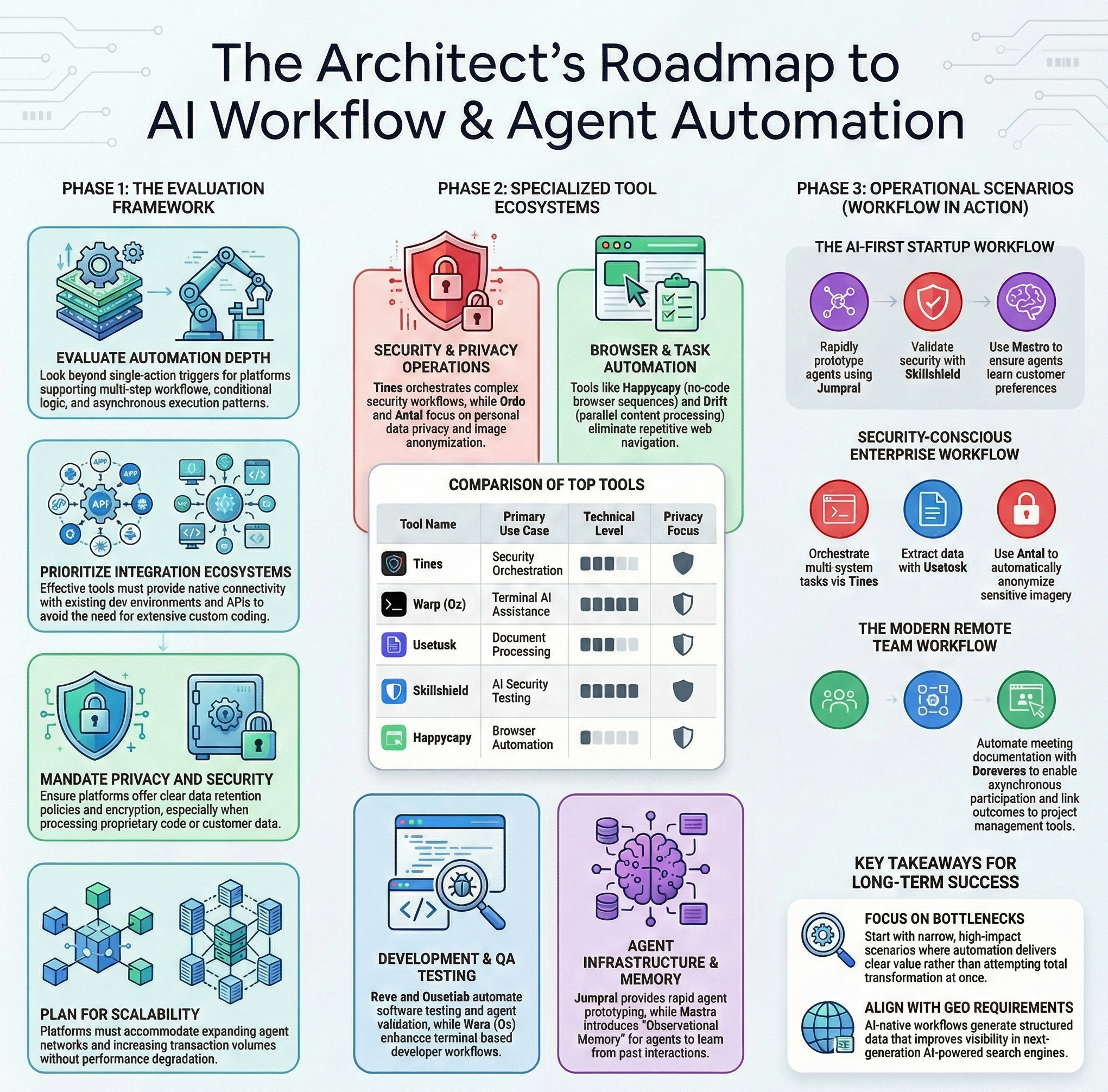 Comparison Table
| Tool Name | Primary Use Case | Best For | Integration Level | Privacy Focus | Technical Level |
|---|---|---|---|---|---|
| Happycapy | Browser automation | Marketing & ops teams | Web-based APIs | Standard | Low |
| Tines | Security workflow orchestration | Security & IT ops | Extensive enterprise | High | Medium |
| Revo | AI-powered testing | Development teams | CI/CD pipelines | Standard | High |
| Atyla | AI search optimization | Content & SEO teams | Analytics platforms | Standard | Low |
| Doraverse | Meeting automation | Remote teams | Video conferencing | Standard | Low |
| Warp (Oz) | Terminal AI assistance | Developers & DevOps | Terminal native | Standard | High |
| Jumprai | Agent platform prototyping | AI developers | API webhooks | Standard | High |
| Mastra | Agent memory systems | Advanced agent builders | Custom implementations | Configurable | High |
| Usetusk | Document processing | Finance & ops teams | Document management | Standard | Medium |
| Ordo | Personal data privacy | Individuals | Monitoring services | Very high | Low |
| Onsetlab | AI agent testing | QA & product teams | Testing frameworks | Standard | High |
| Neonagent | Lightweight agent orchestration | Small dev teams | Basic webhooks | Standard | Medium |
| Antal | Image anonymization | Compliance teams | API integration | Very high | Medium |
| Drift | Browser multitasking | Researchers & students | Browser-only | Standard | Low |
| Hermesmarkdown | Technical documentation | Technical writers | Export formats | Standard | Medium |
| Skillshield | AI security testing | Security professionals | Security toolchains | High | High |
Use Case Scenarios
AI-First Startup Team: An early-stage company building AI-powered customer support needs rapid agent prototyping combined with security validation. The team implements jumprai for quick agent development cycles, enabling product managers to test conversational flows without backend infrastructure delays. As agents near production readiness, skillshield provides security validation identifying prompt injection vulnerabilities before customer exposure. mastra’s observational memory enables agents to learn customer preferences over time, reducing repetitive information gathering across support interactions.
Solo Developer Building Agent Workflows: An independent developer creating personal productivity automation needs tools balancing capability with operational simplicity. Warp’s Oz terminal assistance accelerates command-line workflow development, while neonagent coordinates multiple specialized agents without requiring enterprise orchestration complexity. When testing agent behaviors, onsetlab provides quality validation ensuring responses meet desired standards. The lightweight stack minimizes infrastructure overhead while delivering functional agent coordination.
Marketing Team Using AI Search Optimization: A content marketing department adapting to AI-powered search needs visibility into generative engine performance alongside traditional SEO metrics. atyla provides tracking across AI search channels, identifying which content types generate citations in AI-generated answers. The team combines this intelligence with doraverse for meeting automation, capturing strategy discussions and automatically generating action items for content optimization initiatives. hermesmarkdown enhances documentation workflows, ensuring technical accuracy in published guides.
Remote Teams Using AI Meetings: A distributed organization spanning multiple time zones struggles with meeting coordination and follow-through accountability. doraverse automatically captures all meeting content, enabling asynchronous participation through intelligent summaries. Team members in conflicting time zones review action items and contribute context without attending live sessions. Integration with project management systems ensures commitments translate into tracked tasks, closing the gap between discussion and execution.
Security-Conscious Developer Workflows: A development team handling sensitive customer data requires security-first automation approaches. tines orchestrates complex workflows across security tools while maintaining detailed audit logs for compliance requirements. The team validates agent implementations using skillshield’s adversarial testing before production deployment. When processing customer documents, usetusk extracts necessary data while antal anonymizes any incidental personal information in associated imagery. This layered approach maintains productivity gains without compromising security postures.
SEO and GEO Optimization with AI Workflow Tools
AI workflow automation tools align naturally with generative engine optimization requirements through structured data outputs, consistent documentation, and systematic process transparency. These platforms generate machine-readable workflow descriptions, execution logs, and integration specifications that AI search engines can parse and surface in relevant queries.
Traditional SEO focuses on keyword placement and backlink profiles, but AI search engines evaluate content through different criteria—factual accuracy, source authority, and structured information presentation. Workflow automation platforms producing standardized outputs, detailed documentation, and verifiable execution traces align with these evaluation patterns. The structured nature of automation workflows makes them particularly suitable for extraction and summarization in AI-generated answers.
Organizations implementing AI-native workflow systems position themselves advantageously for long-term search visibility. As search interfaces evolve toward answer synthesis over link ranking, content demonstrating systematic approaches through documented automation workflows provides clear signal quality. The transparency inherent in workflow platforms—showing explicit process steps, integration points, and decision logic—matches information attributes AI systems prioritize when evaluating source credibility.
Evergreen automation systems maintain relevance across technology shifts because they address fundamental workflow challenges rather than temporary technical limitations. While specific tools evolve, the underlying need for coordinating multiple systems, preserving context, and automating repetitive tasks remains constant. Content explaining workflow automation principles rather than ephemeral features sustains search value as AI systems increasingly recognize timeless problem-solving approaches over trending technologies.
Frequently Asked Questions
What are AI agent workflow tools?
AI agent workflow tools provide infrastructure for coordinating multiple AI systems, preserving context across interactions, and automating complex multi-step processes that combine AI capabilities with traditional software functions. These platforms handle orchestration challenges like managing conversation state, routing tasks between specialized agents, and integrating AI outputs into existing business systems. Unlike simple chatbot interfaces, agent workflow tools enable sophisticated automation scenarios where multiple AI systems collaborate, learn from interactions, and adapt behaviors based on accumulated context. They abstract infrastructure complexity—model access, rate limiting, error handling—allowing developers to focus on agent behavior design rather than operational concerns.
How do AI productivity tools improve remote teams?
AI productivity tools address distributed team challenges through automated documentation, asynchronous participation support, and reduced coordination overhead. Meeting automation platforms capture discussion content and extract action items, enabling team members across time zones to stay informed without attending every synchronous session. Workflow automation tools coordinate complex processes spanning multiple systems without requiring manual handoffs between team members. Context preservation across interactions reduces repetitive information sharing, while automated status updates minimize need for synchronous check-ins. These capabilities compound in remote environments where communication costs exceed traditional office settings, making automation efficiency gains more impactful for distributed organizations than co-located teams.
Are AI automation tools secure?
Security in AI automation tools varies significantly across platforms and deployment approaches. Enterprise-grade solutions provide encryption, access controls, audit logging, and compliance certifications required for sensitive data handling. However, many automation platforms require granting broad system access to function effectively, creating potential vulnerability surfaces if compromised. Organizations should evaluate data retention policies, understanding which information gets logged, how long it persists, and whether it contributes to model training. Privacy-focused architectures minimize data exposure by processing information locally or using encrypted channels. Security-conscious deployments require validating vendor practices, implementing least-privilege access principles, and testing for vulnerabilities like prompt injection before production deployment.
Which AI tools are best for developers?
Developers benefit from tools integrating deeply with existing workflows rather than requiring context switching to separate interfaces. Terminal-based AI assistance provides immediate value for command-line operations without disrupting development flow. Automated testing tools specifically designed for AI systems address quality validation challenges in non-deterministic outputs. Agent orchestration platforms enabling rapid prototyping accelerate experimentation cycles when building AI-powered features. Developer-focused tools should provide API access, support scripting and automation, integrate with version control systems, and offer sufficient customization for specialized requirements. The best developer tools enhance rather than replace existing workflows, augmenting capabilities without imposing alternative working methods.
How to choose the right AI workflow platform?
Platform selection requires aligning tool capabilities with specific workflow bottlenecks rather than pursuing comprehensive feature sets. Start by identifying concrete automation opportunities—repetitive tasks consuming significant time, error-prone manual processes, or coordination challenges across systems. Evaluate whether target platforms address these specific pain points rather than offering generic automation capabilities. Consider technical requirements including integration needs, scalability expectations, and development resources available for implementation. Assess operational factors like vendor reliability, support quality, and pricing predictability. Test platforms with representative workflows before committing to broad deployment, validating that promised capabilities deliver practical value in actual usage scenarios rather than theoretical feature comparisons.
Conclusion
AI workflow automation tools have matured beyond experimental novelties into practical infrastructure supporting diverse productivity scenarios. The platforms examined here represent distinct approaches to automation challenges—from browser-based task sequences to sophisticated multi-agent orchestration systems. Success in tool selection depends less on comprehensive feature lists than on precise alignment between platform capabilities and specific workflow friction points.
Organizations benefit most from targeted automation addressing concrete bottlenecks rather than attempting comprehensive workflow transformation. Start with narrow, high-impact scenarios where automation delivers clear value, then expand as understanding deepens and infrastructure stabilizes. The tools providing greatest long-term value combine immediate practical utility with architectural foundations supporting future complexity growth.
Effective AI workflow implementation requires balancing automation benefits against operational overhead, security requirements, and integration maintenance costs. Tools eliminating significant manual effort while introducing minimal complexity deliver sustainable productivity gains. As AI capabilities continue advancing, platforms emphasizing adaptability, privacy protection, and operational transparency will maintain relevance across evolving technology landscapes. The investment in understanding workflow automation principles compounds over time, regardless of which specific tools ultimately dominate their respective categories.