
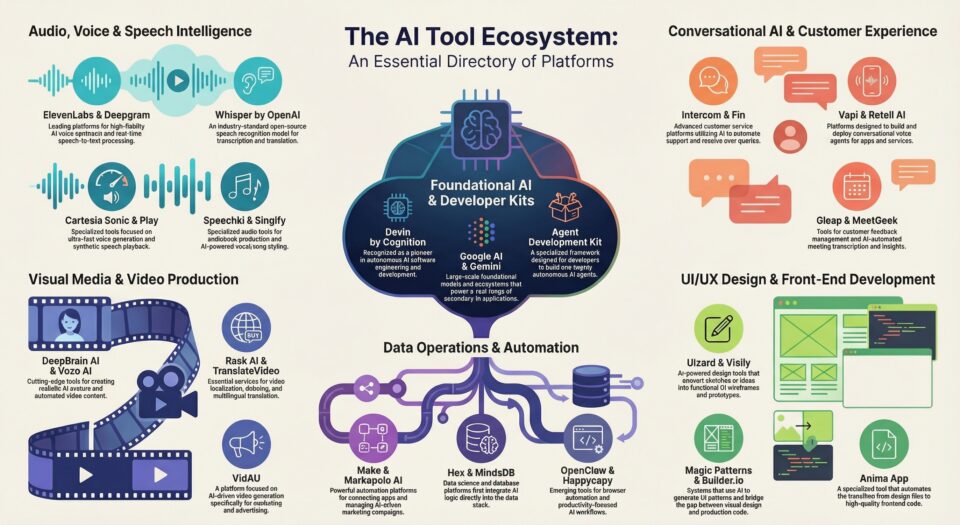
The term artificial intelligence agent gets used loosely across the tech industry, but its meaning has grown sharper and more consequential over the past few years. An AI agent is a software system that perceives its environment, makes decisions, and takes autonomous or semi-autonomous action to complete goals – without requiring a human to approve every step. Unlike a basic chatbot that responds to a prompt and waits, a modern AI agent plans sequences of tasks, calls external tools and APIs, retrieves information, and iterates on its own outputs until a goal is reached.
This shift from reactive to proactive automation is transforming nearly every business function. Sales development representatives are being augmented by AI agents that qualify leads and draft personalized outreach. Engineering teams are deploying autonomous agents to fix bugs and refactor legacy code. Customer support operations are running AI agents that resolve tickets without human intervention. Product designers are using AI to convert sketches into working interfaces in minutes.
The AI agents market was valued at approximately 5.4 billion dollars in 2024 and is projected to grow at a compound annual growth rate of more than 45 percent through 2030. That pace of growth reflects the fact that agents are no longer a laboratory experiment. They are being embedded into production workflows at companies ranging from startups to global financial institutions.
This guide covers every major tool across the AI agents landscape – from voice agents and automation platforms to coding agents and design tools. Each section explains what the tool does, who it is built for, and where it delivers the most value. A side-by-side comparison table is included to help identify the right fit quickly.
Best AI Voice Agents for Developers:
Voice is one of the most demanding frontiers in artificial intelligence. Getting a machine to speak naturally, recognize speech accurately in noisy environments, manage turn-taking in real time, and handle multiple languages without switching platforms requires a stack of specialized technologies working in concert. The tools in this section address different parts of that stack – some own the entire pipeline, others specialize in a single layer.
1. ElevenLabs
ElevenLabs has established itself as the benchmark for text-to-speech quality. The platform offers more than 11,000 voices across 70-plus languages and dialects, with a voice engine capable of achieving sub-100ms latency – faster than most competitors in the space. The technology behind ElevenLabs supports emotional nuance, allowing generated speech to modulate tone and cadence based on punctuation and phrasing cues, making conversations sound less mechanical and more contextually appropriate.
Beyond raw voice generation, ElevenLabs has expanded into conversational AI agents through its Agents platform, which supports HIPAA compliance at the enterprise tier. The platform is widely used as the text-to-speech layer inside other voice agent stacks – including Vapi, Bland, and similar orchestration tools – because its voice quality remains the best available option for most use cases. Developers building customer-facing voice applications where brand tone and audio naturalness are non-negotiable tend to favor ElevenLabs above alternatives.
Ratings and Adoption: Rated 4.9 out of 5 based on 161 reviews. Used by more than 135 connected applications in the ecosystem.
Best For: Teams prioritizing voice quality, emotional nuance, multilingual delivery, and brand-consistent audio at scale.
Key Differentiator: Sub-100ms end-to-end latency with automatic language detection and voice switching mid-conversation, requiring no manual configuration.
Compliance: SOC 2 Type II and GDPR standard; HIPAA available on the Enterprise tier for the Agents platform.
Key Takeaways
- Best-in-class TTS quality with sub-100ms latency makes it the preferred voice layer for production voice agents.
- Supports 70+ languages with automatic voice switching, no manual configuration required.
- Often used as the TTS component inside larger stacks like Vapi, Bland, and PipeCat.
- HIPAA compliance is available but restricted to the Agents platform on Enterprise plans.
2. Deepgram
Where ElevenLabs excels at voice output, Deepgram excels at voice input. The platform is a speech-to-text and voice AI infrastructure provider built for developers who need real-time transcription accuracy in high-noise, high-volume environments. Its Nova-3 model delivers approximately 80ms latency on speech recognition, placing it among the fastest available options for production voice applications.
Deepgram offers self-hosted deployment options for organizations with strict data residency requirements, and provides a Business Associate Agreement for HIPAA-covered entities. Its Voice Agent API bundles transcription, language model integration, and synthesis into a single pricing tier, which eliminates the hidden costs that arise when separate STT, LLM, and TTS providers are billed independently. For teams building custom voice agent pipelines from scratch, Deepgram functions as the transcription layer that feeds into whatever reasoning model they choose.
Ratings and Adoption: Rated 4.9 out of 5 based on 62 reviews. Used by teams building voice agents on Vapi, Daily Bots, and Shortcut among others.
Best For: Developers needing high-accuracy real-time transcription in noisy environments, especially in healthcare, finance, and logistics.
Pricing: Free plan includes 200 dollars in credits for evaluation. Paid plans scale by usage volume.
Key Takeaways
- Industry-leading accuracy for speech recognition in challenging acoustic conditions.
- Self-hosted deployment available for organizations with data sovereignty requirements.
- Nova-3 delivers approximately 80ms STT latency for real-time voice agent pipelines.
- Bundled Voice Agent API eliminates billing surprises from multi-vendor stacks.
3. Vapi
Vapi positions itself as the developer control plane for voice AI. Rather than owning a speech engine outright, Vapi operates as an orchestration layer that connects more than 14 text-to-speech providers, multiple speech-to-text options, and any large language model the developer prefers. This modular architecture is ideal for teams that want to swap individual components without rebuilding their entire agent, or that need to experiment with different LLMs and voice providers to find the right performance and cost balance.
The platform has demonstrated serious production scale, with over 62 million calls processed monthly and a 99.99 percent SLA. It supports a Flow Studio for no-code conversation design, comprehensive analytics dashboards, and multi-agent coordination through its Squads feature. A key consideration for budget-conscious teams is that Vapi’s advertised base rate of 0.05 dollars per minute covers only the orchestration fee. Real production costs typically reach 0.20 to 0.30 dollars per minute once STT, TTS, LLM, and telephony charges are factored in.
Ratings and Adoption: Rated 4.9 out of 5 based on 24 reviews. Used by Markopolo AI, Inworld TTS, and Canonical AI among others.
Best For: Developer teams building custom voice agents who want maximum provider flexibility and modular component control.
Pricing: Base rate of $0.05/min for orchestration. Full production cost typically $0.20-$0.30/min when all components are included.
Key Takeaways
- Modular architecture supports 14+ TTS providers, multiple STT options, and any LLM.
- Proven at scale: 62M+ monthly calls with 99.99% SLA reliability.
- Advertised base price is orchestration only – always calculate total stack cost before committing.
- Multi-agent coordination (Squads) and HIPAA-compliant zero-retention add-on available.
4. Cartesia Sonic
Cartesia Sonic is built around a single obsession: speed. The platform describes itself as the fastest human-like voice API available, with its Flash TTS model delivering approximately 75ms latency. For applications where conversational responsiveness is the primary metric, that latency figure matters considerably. Even small delays in voice response create perceptible awkwardness in real-time conversations, and Cartesia has engineered its entire stack to minimize those pauses.
The platform is used by Daily Bots, Conversational Replicas by Tavus, and other real-time interaction tools that depend on tight response windows. Cartesia also offers capabilities in audio generation beyond simple speech synthesis, positioning it as a platform for developers building next-generation audio experiences rather than just a utility TTS layer.
Ratings and Adoption: Rated 5.0 out of 5 based on 18 reviews. Used by Daily Bots, Conversational Replicas by Tavus, and others.
Best For: Real-time conversational AI where latency is the primary performance criterion.
Key Takeaways
- Flash TTS achieves approximately 75ms latency, making it among the fastest available speech synthesis options.
- Purpose-built for real-time conversation rather than batch or narration use cases.
- Used by leading real-time AI avatar and voice bot platforms.
5. Retell AI
Retell AI describes itself as an AI call center platform – a managed solution for businesses that need to automate inbound and outbound phone conversations without building a custom voice stack from scratch. The platform offers a visual drag-and-drop agent builder that can get a voice agent live in approximately three minutes, which is a significant contrast to developer-first platforms that require extensive configuration before a single call can be made.
Retell’s pricing model has become a competitive talking point. Rather than charging separate fees for orchestration, telephony, STT, TTS, and LLM usage, Retell offers a flat per-minute rate starting at 0.07 dollars per minute for connected calls, with no platform fees layered on top. This transparency has made it a popular alternative for teams that found multi-vendor billing structures difficult to budget against. Healthcare and financial services organizations are among its primary user segments, citing real-time analytics and HIPAA-compliant infrastructure as key factors in their adoption.
Ratings and Adoption: Rated 4.8 out of 5 based on 10 reviews. Used by Cal.ai Phone Agent, Copperlane, and Relyable.
Pricing: $0.07+/min for connected calls with no separate platform fee. Local numbers at $2/month, toll-free at $5/month.
Best For: Businesses automating call center operations who need transparent pricing, HIPAA compliance, and fast no-code setup.
Key Takeaways
- Flat-rate per-minute pricing eliminates the multi-invoice complexity common with modular stacks.
- No-code drag-and-drop builder enables go-live in approximately three minutes.
- Strong compliance story for healthcare and financial services with real-time call analytics.
- Transparent pricing model is a direct contrast to Vapi’s component-based billing.
6. Whisper by OpenAI
Whisper is OpenAI’s open-source speech recognition neural network, trained on 680,000 hours of multilingual and multitask data from the web. It supports over 100 languages and has become a foundational transcription model embedded in hundreds of applications and pipelines. Because it is open source, teams can self-host Whisper on their own infrastructure at zero licensing cost, making it an attractive option for privacy-conscious deployments or high-volume use cases where API-per-minute pricing would become prohibitive.
Whisper is not a real-time streaming solution in its base form – it performs best on batch transcription of audio files rather than live conversation. However, the open-source community has built real-time streaming wrappers around it. For teams that need accurate transcription without real-time requirements, or that want to combine it with other LLMs in a custom pipeline, Whisper provides a powerful and freely available foundation.
Ratings and Adoption: Rated 5.0 out of 5 based on 26 reviews. Used by Voicenotes, TalkTastic, Agentplace, and others.
Best For: Self-hosted, privacy-first transcription pipelines and multilingual applications where API cost is a constraint.
Pricing: Open source and self-hostable at no licensing cost. OpenAI API access priced per usage.
Key Takeaways
- Open source MIT license enables self-hosted deployment with no per-call licensing fees.
- Supports 100+ languages with strong multilingual accuracy from the base model.
- Best suited for batch transcription rather than real-time streaming without community wrappers.
- Foundational transcription option for developers building custom agent pipelines from the ground up.
7. Play
Play takes an ambitious positioning in the text-to-speech space: the platform claims its AI voices surpass human-quality speech in naturalness and expressiveness. While that claim invites scrutiny, Play has built a dedicated following among developers and content creators who find its voice output distinctly more conversational than many alternatives. The platform offers voice cloning capabilities and is available as a web application, making it accessible without deep technical integration work.
Ratings and Adoption: Rated 3.3 out of 5 based on 4 reviews. Used by Hamming AI and Wisebits.
Best For: Content creators and developers seeking highly expressive voice output for web applications and audio content.
Key Takeaways
- Positioned around voice quality and expressiveness as its primary differentiator.
- Voice cloning capability available for brand-consistent audio experiences.
- Web application interface lowers technical barrier compared to API-first platforms.
Submit Your AI Tool on CompareBizTech
Get discovered by founders, marketers, and businesses actively searching for AI tools. Boost visibility, earn backlinks, and drive your first users through a curated software directory.
AI Agent for Customer Support SaaS
8. Intercom
Intercom has repositioned itself as an AI-first customer service platform, with its Fin AI Agent at the center of that transformation. Fin is trained automatically from an organization’s existing knowledge base – help center articles, FAQs, and documentation – without requiring manual Q&A structuring. In independent benchmarks, Fin’s response accuracy rate is reported at 87 percent, compared to a market average of approximately 79 percent.
A key design decision in Fin is its confidence-based escalation logic. When the agent detects uncertainty in its response, it escalates to a human agent rather than generating a potentially incorrect answer. The Custom Answers feature allows support teams to adjust AI responses directly from the inbox without requiring technical intervention, creating a feedback loop that improves accuracy over time without developer dependency. Intercom is particularly well adopted in SaaS and technology companies where the support volume is high and the customer expectation for response speed is demanding.
Ratings and Adoption: Rated 4.6 out of 5 based on 86 reviews. Used by Dodo Payments, Fibery, Inro, and 65+ other products.
Best For: SaaS companies needing AI-powered customer support that integrates with existing help desk content and escalates intelligently.
Key Takeaways
- 87% answer accuracy rate outperforms the reported market average of 79%.
- Confidence-based escalation prevents incorrect AI responses from reaching customers.
- Non-technical support teams can improve AI responses directly from the inbox.
- Works standalone without requiring a specific CRM ecosystem.
9. Gleap
Gleap describes itself as a support intelligence platform, and the distinction from a conventional helpdesk is meaningful. It combines in-app bug reporting with an AI chatbot that can handle first-level support queries, and a knowledge base system that the AI draws on to answer questions. For SaaS product teams, this integration means customer feedback, bug reports, and support interactions all flow through a single tool rather than requiring separate platforms for each function.
Ratings and Adoption: Rated 4.9 out of 5 based on 9 reviews. Used by Crono 2.0 and A-Leads.
Best For: SaaS teams that want to consolidate bug reporting, product feedback, and AI-powered support into one platform.
Key Takeaways
- Unique combination of bug reporting, product feedback, and AI support in one integrated platform.
- High user satisfaction rating reflects strong product-market fit for SaaS teams.
- AI chatbot draws on knowledge base content to handle first-level support queries automatically.
10. MeetGeek
MeetGeek is a meeting intelligence platform that automatically records, transcribes, and summarizes video calls, then extracts and shares key insights with relevant stakeholders. For remote-first teams managing high volumes of calls across multiple time zones, the ability to skip meetings and still receive accurate summaries and action items addresses a real coordination cost.
The platform supports multiple languages and integrates with common productivity tools, making it viable for multinational teams. Its AI summarization extracts the signal from meeting recordings – decisions made, action items assigned, topics discussed – and presents these in a structured format without requiring a human to parse the full recording.
Ratings and Adoption: Rated 4.8 out of 5 based on 27 reviews.
Best For: Remote and hybrid teams managing high meeting volumes who need automated summaries and action item extraction.
Key Takeaways
- Automatic transcription, summarization, and insight sharing eliminates manual meeting notes.
- Multilingual support makes it viable for international teams.
- Integrates with common productivity tools for seamless workflow integration.
11. Markopolo AI
Markopolo AI operates in the AI sales development representative space, offering personalized outreach at a scale that human SDR teams cannot match economically. The platform claims to enable 30 to 40 percent broader customer reach through AI-driven personalization, which applies to email campaigns, follow-up sequences, and targeting logic. It is positioned as an AI SDR tool rather than a general automation platform, meaning the product is vertically focused on the specific workflows that sales development teams run.
Ratings and Adoption: Rated 5.0 out of 5 based on 12 reviews. Used by 10xlaunch and Instant.
Best For: Sales teams seeking to increase outreach volume and personalization without proportionally increasing headcount.
Key Takeaways
- Claims 30-40% improvement in customer reach through AI-driven personalization at scale.
- Vertically focused on SDR workflows rather than horizontal automation.
- Perfect 5.0 rating suggests strong fit for its target user segment.
Open Source Autonomous AI Agent Tools
12. Make (formerly Integromat)
Make is one of the most capable no-code automation platforms available for teams that need to build visually, without writing code. Its scenario editor allows users to create complex workflows with branching logic, conditional filters, and data transformation across thousands of connected applications. Make connects more than 1,000 apps and services, covering everything from CRM and email marketing to databases and payment processors.
The platform has added AI capabilities to its automation layer, allowing scenarios to include AI-powered decision nodes that can interpret content, classify inputs, and generate outputs as part of a broader automated workflow. For teams that need deterministic, predictable automation rather than the probabilistic behavior of a fully autonomous agent, Make provides a strong middle ground: structured workflows with optional AI enhancement where it adds value.
Ratings and Adoption: Rated 4.8 out of 5 based on 43 reviews. Used by Boost.space, Superchat, and mysite.ai, among others.
Best For: Non-technical teams that need powerful visual workflow automation with optional AI enhancement, without writing code.
Pricing: Free tier available. Paid plans begin at approximately $9 per month for basic usage.
Key Takeaways
- Visual scenario builder enables complex multi-step automations without writing code.
- Connects 1,000+ apps with branching logic, filters, and data transformation.
- AI nodes can be added to workflows for content classification and generation steps.
- Stronger determinism than fully autonomous agents – workflows execute predictably every time.
13. OpenClaw
OpenClaw is one of the fastest-growing open-source AI agent frameworks in recent history, accumulating more than 200,000 GitHub stars in approximately three months after launching under the name Clawdbot in late 2025. The project enables developers to build autonomous agents that live on their own hardware, connect to messaging applications like Telegram and WhatsApp, and execute tasks including web browsing, email management, calendar scheduling, and shell command execution – all driven by natural language instructions.
The project’s growth reflects genuine demand for AI that not only answers questions but takes action. Users have demonstrated use cases including automatic grocery ordering, meal planning management, and complex research and synthesis workflows. The platform supports more than 10,700 community-built skills through the ClawHub repository. One important consideration for potential adopters is security: independent researchers have documented vulnerabilities in community-contributed skills, including data exfiltration risks. Teams deploying OpenClaw in production contexts should audit skill sources carefully and consider the security implications of granting an AI agent host-level system access.
Ratings and Adoption: Rated 4.9 out of 5 based on 43 reviews. Used by Cal.com Agents, Skyvern MCP, and Tobira.ai.
Best For: Developers and technical founders who want a privacy-first, self-hosted AI agent with broad automation capabilities and deep customization.
Pricing: Free and open source under MIT license. Infrastructure costs (VPS, API fees) typically run $50-200/month in production.
Key Takeaways
- 200,000+ GitHub stars and 10,700+ community skills reflect exceptional developer adoption velocity.
- Self-hosted architecture provides privacy-first execution that cloud platforms cannot match.
- Community skill auditing is essential – documented vulnerabilities exist in some ClawHub skills.
- Model-agnostic: supports Claude, GPT-4o, Gemini, DeepSeek, and local Ollama models.
14. Happycapy
Happycapy describes itself as an agent-native computer designed for non-technical users. Rather than requiring developers to configure an agent framework, Happycapy provides a desktop environment in which AI agents can operate natively – completing tasks across applications, managing files, and coordinating workflows without the user needing to write prompts or manage integrations manually.
The platform was ranked first in its month of launch, reflecting strong market interest in making agent-native computing accessible to users who are not engineers. It sits in an interesting space between general-purpose automation platforms and fully managed no-code builders, appealing to individuals and small teams who want the power of an autonomous agent without the setup complexity that developer-facing tools typically require.
Ratings and Adoption: Rated 4.8 out of 5 based on 36 reviews. Used by serenities and FirstVersion.
Best For: Non-technical users who want desktop-native AI agent capabilities without configuring a development environment.
Key Takeaways
- Designed specifically for non-technical users rather than developers, lowering adoption barrier.
- Agent-native desktop OS model enables cross-application task execution without manual configuration.
- Strong early reception indicates significant demand for consumer-grade autonomous agent platforms.
Discover Powerful AI Tools for Growth
Explore a curated directory of top-performing AI Tools built for founders, marketers, and operators. Find tools that automate workflows, boost productivity, and scale faster.
AI Agents for Data Science and Analytics
15. Hex
Hex is an agentic analytics platform built for data teams that need to go beyond static dashboards and manual querying. It combines notebook-style data work with AI agents that can interpret natural language requests, execute SQL and Python, visualize results, and iterate on analyses autonomously. For data science teams operating at scale, the ability to direct an AI agent to analyze a dataset, identify anomalies, and present findings without running every query manually represents a significant productivity multiplier.
The platform is collaborative, allowing teams to share and build on each other’s notebooks and AI-generated analyses. Its position as a “powerful agentic analytics platform” distinguishes it from traditional BI tools that require predefined dashboards. Hex is suited to teams comfortable with technical data work who want AI to handle the repetitive execution layer while human analysts focus on interpretation and decision-making.
Ratings and Adoption: Rated 5.0 out of 5 based on 9 reviews. Used by Kitty Points Leaderboard and General Collaboration teams.
Best For: Data science and analytics teams that need agentic AI to automate query execution, visualization, and iterative analysis.
Key Takeaways
- Agentic analytics architecture enables natural language-driven data exploration without manual query writing.
- Notebook collaboration model supports team-based data work at scale.
- Perfect 5.0 rating from a specialist audience suggests strong fit for technical data teams.
16. MindsDB
MindsDB takes an unconventional approach to AI integration in data workflows: it allows teams to use SQL to call AI models, embedding predictions, classifications, and AI-generated outputs directly into database queries. For organizations with existing data infrastructure and SQL-fluent engineering or analytics teams, this model reduces the friction of introducing AI capabilities without requiring a separate AI toolchain or custom API integration work.
The platform is open source with cloud hosting available, making it accessible to startups that want to experiment without infrastructure investment. Its autonomous business intelligence positioning reflects an ambition to move beyond reactive querying toward AI systems that proactively surface insights from data.
Ratings and Adoption: Rated 5.0 out of 5 based on 4 reviews. Used by Hey! and other data-driven applications.
Best For: Data and analytics teams comfortable with SQL who want to embed AI predictions directly into their existing database workflows.
Key Takeaways
- SQL-native AI integration eliminates the need for separate AI toolchains for data teams.
- Open source availability supports zero-cost experimentation before committing to cloud plans.
- Unique architecture for teams that think in database queries rather than API calls.
AI Agents for Video, Audio, and Content Localization
17. Vozo AI – Video Localization
Vozo AI addresses a challenge that content creators and global brands face constantly: video that was produced in one language needs to reach audiences in others, and simply adding subtitles is no longer sufficient. Vozo translates every layer of a video simultaneously – the voice, the subtitles, and on-screen text like graphics, lower thirds, and title cards – into the target language. The result is a localized video where all text and audio elements are consistent, rather than a patchwork of translated subtitles over an untouched original.
Ratings and Adoption: Rated 4.5 out of 5 based on 15 reviews. Used by Surgeflow, Gro, and KnowU.
Best For: Content creators and marketing teams producing video content for multilingual audiences at scale.
Key Feature: Simultaneous translation of voice track, subtitle layer, and on-screen text into target languages.
Key Takeaways
- Translates all three video text and audio layers simultaneously – voice, subtitles, and on-screen graphics.
- Addresses a gap that subtitle-only translation tools leave for brand-consistent multilingual video.
- Ranked among top products at launch, reflecting genuine demand for comprehensive video localization.
18. DeepBrain AI
DeepBrain AI is a text-to-video platform that converts written scripts into videos featuring realistic AI avatar presenters. Its AI Studios product allows users to type a script, select an avatar, and generate a finished presenter video without cameras, studios, or human talent. For corporate training, product explainers, and news-style video content, this approach reduces production costs substantially while maintaining a professional visual format.
The platform supports multiple languages and voices, making it useful for organizations that produce video content across international markets. Its avatar technology focuses on realistic human movement and facial expression, which addresses the uncanny valley problem that plagues earlier generations of AI video generation tools.
Ratings and Adoption: Rated 4.7 out of 5 based on 31 reviews.
Best For: Corporate training departments, eLearning creators, and marketing teams producing avatar-fronted video content at scale.
Key Takeaways
- Converts text scripts into professional presenter videos without any production infrastructure.
- Realistic AI avatar technology reduces the uncanny valley effect compared to earlier video AI tools.
- Multilingual voice and avatar options support global content production workflows.
19. Rask AI
Rask AI is a video repurposing and localization platform that helps creators extend the reach of existing video content through AI-powered dubbing, voice cloning, and subtitle generation. The platform is notable for its voice cloning capability, which can replicate the original speaker’s voice characteristics in translated versions of a video, preserving the personal quality of the original while making it accessible in other languages.
For YouTube creators, online educators, and marketing teams with large back catalogs of video content, Rask AI offers a systematic path to localization that would be economically impractical with human translators and voiceover artists.
Ratings and Adoption: Rated 4.8 out of 5 based on 28 reviews.
Best For: Content creators, online educators, and marketing teams with existing video libraries that need multilingual localization.
Key Takeaways
- Voice cloning in translated videos preserves the original speaker’s vocal identity across languages.
- Systematic localization pipeline makes large back-catalog translation economically viable.
- Combined dubbing, subtitle, and voice clone capabilities reduce the need for separate tools.
20. TranslateVideo
TranslateVideo offers a single-click video translation experience supporting more than 75 languages. Its simplicity is its core value proposition: users upload a video, select a target language, and receive a translated version without configuring complex workflows. For individual creators and small teams that need occasional translation rather than a systematic localization pipeline, this accessibility is more practical than platforms designed for high-volume enterprise workflows.
Ratings and Adoption: Rated 5.0 out of 5 based on 10 reviews.
Best For: Individual creators and small teams needing occasional video translation without complex platform setup.
Key Takeaways
- Single-click translation into 75+ languages minimizes workflow complexity for occasional use.
- Perfect 5.0 rating suggests strong fit for its target audience of individual creators.
- Simpler alternative to enterprise localization platforms for teams without systematic translation needs.
21. Speechki ChatGPT Plugin
Speechki operates as a text-to-audio plugin within the ChatGPT environment, allowing users to convert AI-generated text into audio directly within their ChatGPT workflow without switching to a separate platform. For content creators who use ChatGPT to draft articles, scripts, or other written content and want to produce audio versions, this native integration removes a workflow step. The plugin supports multilingual output and positions itself at the intersection of AI writing assistance and audio production.
Ratings and Adoption: Rated 4.6 out of 5 based on 25 reviews.
Best For: Content creators using ChatGPT who want to convert written outputs to audio without leaving their existing workflow.
Key Takeaways
- Native ChatGPT plugin integration eliminates context switching for text-to-audio conversion.
- Multilingual support extends audio creation capability to international content.
- Positioned at the intersection of AI writing and audio production workflows.
22. Singify by Fineshare
Singify is an AI music cover tool that allows users to generate AI-powered covers in the vocal style of popular artists. The platform has attracted music creators and casual users who want to hear familiar songs reinterpreted through different vocal models. Singify also offers a vocal remover function, which separates instrumental tracks from vocals in uploaded audio – a utility used by musicians, remixers, and content creators working with audio samples.
Ratings and Adoption: Rated 4.6 out of 5 based on 11 reviews. Used by Singify AI Vocal Remover and Lune AI.
Best For: Music creators and enthusiasts wanting to generate AI vocal covers or extract instrumental tracks from audio.
Key Takeaways
- AI vocal cover generation in artist styles opens creative possibilities for music producers.
- Vocal remover function adds practical utility beyond cover generation for remixers and content creators.
- Web-based access reduces the technical barrier for audio AI experimentation.
Close More Deals with AI Sales Tools
Discover the Best AI Sales Tools designed to automate outreach, improve conversions, and drive predictable revenue growth for your business.
AI Agents for Design, Prototyping, and Design-to-Code
23. Magic Patterns
Magic Patterns is an AI design tool that turns product ideas into UI components and interface designs through natural language prompts. Designers and product managers can describe a component – a pricing table, a login screen, a dashboard widget – and receive a working design output without using a traditional design editor. The platform is positioned for rapid ideation and iteration, allowing teams to explore design directions quickly before committing to production-quality implementation.
Ratings and Adoption: Rated 4.9 out of 5 based on 14 reviews. Used by HYBRD, Waydev AI, and iago.
Best For: Product teams and designers who need to rapidly prototype and iterate on UI components from natural language descriptions.
Key Takeaways
- Prompt-to-component generation accelerates UI ideation without traditional design tooling.
- Particularly strong for rapid early-stage prototyping and stakeholder-facing concept presentation.
- Near-perfect rating reflects strong user satisfaction among product and design teams.
24. Visily
Visily is an AI-powered wireframing and prototyping tool designed to make app design accessible to team members who are not professional designers. Its AI can convert screenshots, rough sketches, or text descriptions into structured wireframes, which teams can then refine and share as clickable prototypes. The product is used extensively by teams doing early-stage product planning where the goal is to align on a concept quickly before involving engineering resources.
Ratings and Adoption: Rated 4.7 out of 5 based on 32 reviews. Used by Portia AI, Lock-in, and others.
Best For: Product managers, startup founders, and non-designers who need to produce wireframes and prototypes without design training.
Key Takeaways
- AI sketch-to-wireframe and screenshot-to-design features make prototyping accessible to non-designers.
- Collaborative sharing enables faster stakeholder alignment before engineering investment.
- Broad use across product management and startup workflows indicates versatile positioning.
25. VidAU
VidAU is an AI video ad creation platform focused specifically on performance marketing. It enables marketers to produce video advertisements from product descriptions, URLs, or existing creative assets, without requiring a video production team. The platform is designed around the performance marketing workflow – iterating quickly on multiple ad variations, testing different hooks and calls-to-action, and producing the volume of creative needed to run meaningful split tests.
Ratings and Adoption: Rated 4.5 out of 5 based on 24 reviews. Used by Video Marketer by Memories.ai and Nora.
Best For: Performance marketing teams that need to produce high volumes of video ad variations without a production studio.
Key Takeaways
- End-to-end video ad creation from product descriptions reduces production time significantly.
- Designed specifically for performance marketing volume requirements rather than brand-quality production.
- Ranked top product in its category at launch, signaling strong product-market fit.
26. Uizard
Uizard is an AI-powered interface design tool that helps non-designers create app, web, and UI designs quickly through AI-assisted layout and component generation. Its sketch-to-wireframe feature converts hand-drawn mockups into editable digital designs, while its AI suggestions help users who are not professional designers make layout decisions with guidance rather than guesswork. Uizard has been available for several years and has a broad base of users across product management, startup founding, and early-stage design workflows.
Ratings and Adoption: Rated 4.2 out of 5 based on 12 reviews. Used by Jo and Phonely.
Best For: Non-designer founders and product managers who need to create presentable UI designs for early-stage product validation.
Key Takeaways
- Sketch-to-wireframe AI makes product concept visualization accessible without design expertise.
- Long-standing platform with broad adoption across startup and product management workflows.
- AI design suggestions help non-designers make informed layout decisions at speed.
27. Builder.io
Builder.io positions itself as the first AI agent for the combined domains of product, design, and code. Its platform can take designs from Figma and convert them into production-ready code across multiple frameworks, bridging a gap that has traditionally required significant engineering time. For teams running Agile product development cycles, the ability to move from design to working code with minimal manual translation reduces the handoff friction between design and engineering teams.
Builder.io also operates as a visual CMS and headless page builder, meaning it serves both the conversion of designs to code and the ongoing management of that code through a visual interface. This dual role makes it particularly useful for marketing and product teams that want design control without constantly requesting engineering changes.
Ratings and Adoption: Rated 4.3 out of 5 based on 10 reviews. Used by Madespace and others.
Best For: Product and engineering teams looking to automate Figma-to-code conversion and manage web content visually.
Key Takeaways
- Figma-to-code automation reduces handoff time between design and engineering significantly.
- Dual role as AI agent and visual CMS makes it useful across both conversion and content workflows.
- Supports multiple front-end frameworks, reducing framework lock-in concerns.
28. Anima App
Anima is a UX design agent embedded as a Figma plugin that converts Figma designs into clean, production-ready React and HTML code. For engineering teams that receive finished designs from a design system and need to translate those into code accurately, Anima addresses the manual and error-prone process of hand-coding from a design file. The plugin workflow means it lives inside the tool designers already use, reducing adoption friction for both design and engineering teams.
Ratings and Adoption: Rated 4.1 out of 5 based on 10 reviews. Used by Bolt x Figma.
Best For: Engineering teams that need accurate React and HTML code from Figma design files without manual translation.
Key Takeaways
- Figma plugin integration means zero workflow switching for designers handing off to engineers.
- Generates React and HTML code from design files, reducing translation errors and engineering time.
- Useful for teams running design systems who need consistent, scalable code output.
AI Agents for Software Engineering and Developer Workflows
29. Devin by Cognition
Devin is the product that crystallized the concept of an autonomous AI software engineer for the broader technology industry. Created by Cognition Labs in San Francisco, Devin operates inside a sandboxed cloud environment with a code editor, terminal, and web browser – essentially the complete toolkit of a working software developer. It does not just suggest code; it plans a development approach, writes the code, runs tests, interprets failures, and iterates until the task is complete or escalates with a specific question for the human engineer overseeing it.
Devin 2.0, released in April 2025, dropped the entry price from 500 dollars per month to 20 dollars per month for the Core plan, with pay-as-you-go pricing based on Agent Compute Units. One ACU represents approximately 15 minutes of active Devin compute time, billed at 2.25 dollars. The Team plan provides 250 ACUs per month at a predictable flat rate, while the Enterprise plan adds VPC deployment, SSO integration, and private model support for organizations with compliance requirements. Goldman Sachs has piloted Devin alongside its 12,000 human developers, reporting a target of 20 percent efficiency improvement – a signal of enterprise readiness for specific use cases.
Independent testing reveals a nuanced performance picture. Devin completes complex tasks successfully in approximately 15 to 30 percent of cases when evaluated by third parties outside Cognition’s internal benchmarks. It performs most reliably on well-defined, scoped tasks such as bug fixes, code refactoring, and API integration work. Tasks that require architectural judgment, creative problem-solving, or navigating deeply ambiguous requirements remain challenging for any autonomous agent currently on the market.
Ratings and Adoption: Rated 5.0 out of 5 based on 3 reviews. Used by Basedash and Tana.
Pricing: Core plan from $20/month (pay-as-you-go at $2.25/ACU). Team plan $500/month with 250 ACUs. Enterprise pricing custom.
Best For: Engineering teams with consistent volumes of scoped, repetitive development tasks such as bug fixing, code refactoring, and migration work.
Key Takeaways
- Devin 2.0 reduced entry price from $500 to $20/month, opening autonomous coding to individuals and small teams.
- 83% more tasks completed per ACU in Devin 2.0 versus its predecessor, per internal benchmarks.
- Performs best on well-defined, scoped tasks – complex architectural decisions remain a human domain.
- Goldman Sachs pilot alongside 12,000 developers signals enterprise-grade readiness for specific workflows.
- ACU pricing means costs scale with task complexity – budget predictability requires usage monitoring.
Submit Your AI Tool on CompareBizTech
Get discovered by founders, marketers, and businesses actively searching for AI tools. Boost visibility, earn backlinks, and drive your first users through a curated software directory.
AI Model Infrastructure and Foundational Platforms
30. Google AI
Google AI represents the aggregated AI infrastructure and model layer that powers Google’s products and developer ecosystem. For teams building on top of Google’s platforms, this includes access to Gemini models through Vertex AI, multimodal capabilities spanning text, image, audio, and video understanding, and global cloud infrastructure that brings enterprise-grade scale and compliance. Google’s AI Agent Development Kit (ADK) has attracted more than 17,000 GitHub stars and enables directed graph-based multi-agent workflows that go beyond simpler chain-based patterns.
Ratings and Adoption: Rated 5.0 out of 5 based on 3 reviews. Used by Google Gemini 2.0 and YourMeal.
Best For: Enterprise developers building on Google Cloud infrastructure who need multimodal AI capabilities and global scale.
Key Takeaways
- Gemini multimodal models support text, image, audio, and video understanding in a single architecture.
- Agent Development Kit (ADK) with 17K+ GitHub stars supports stateful multi-agent graph workflows.
- Enterprise compliance and global infrastructure make it suitable for regulated industries.
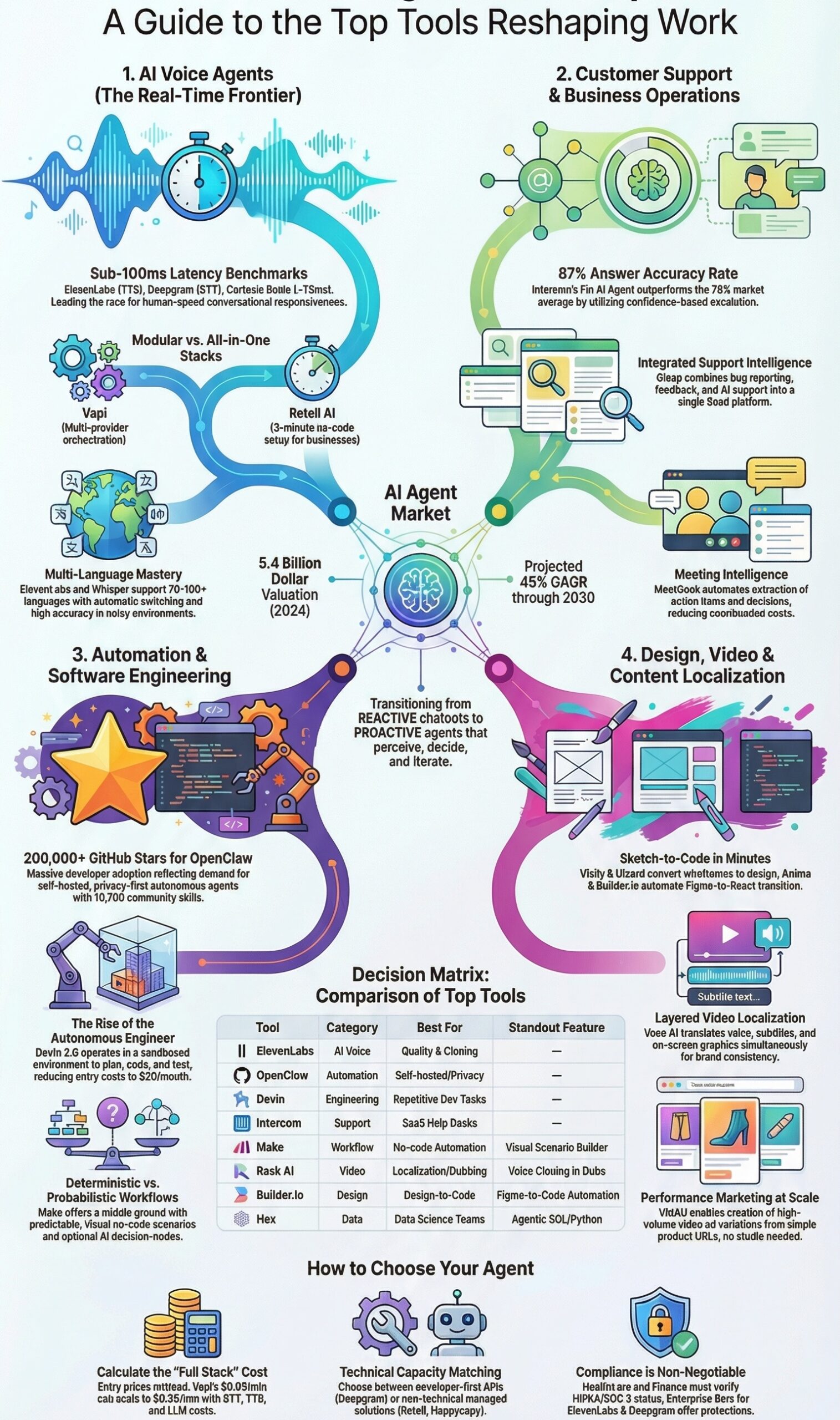 Complete Comparison Table: All AI Agent Tools at a Glance
The table below consolidates all tools covered in this guide into a single reference view. Use the Category, Best For, and Pricing columns to quickly identify candidates that fit the use case and budget. The Standout Feature column highlights the one capability that most distinguishes each tool within its category.
| Tool | Category | Best For | Pricing (entry) | Standout Feature |
| ElevenLabs | AI Voice | Voice quality & cloning | Free tier; paid plans | Sub-100ms latency, 11K+ voices |
| Intercom | Customer Support AI | SaaS customer service | Custom (enterprise) | 87% answer accuracy rate |
| Deepgram | Speech-to-Text | Developers, noisy environments | Free $200 credit | Nova-3 real-time ASR |
| OpenClaw | Autonomous Agent | Open-source automation | Free (MIT license) | 200K+ GitHub stars, 10,700+ skills |
| Whisper (OpenAI) | Transcription | Multilingual transcription | Open source / API pricing | 100+ language support |
| Make | Automation Platform | No-code visual workflows | Free tier; from $9/mo | Visual scenario builder |
| Vapi | Voice AI Dev | Developers building voice agents | $0.05/min base (more w/ add-ons) | Modular multi-provider stack |
| Cartesia Sonic | TTS API | Fast, human-like speech | Usage-based API | ~75ms Flash TTS latency |
| Happycapy | Agent-Native PC | Non-technical automation | Subscription | Desktop-native agent OS |
| Hex | Data Analytics AI | Data science teams | Team plans | Agentic analytics + notebooks |
| Vozo AI | Video Localization | Multilingual video creators | Subscription | Voice + subtitle + on-screen text |
| DeepBrain AI | AI Video / Avatar | Text-to-video creation | Subscription | Realistic AI avatar presenters |
| Rask AI | Video Repurposing | Content localization at scale | Subscription | Voice cloning + dubbing |
| Magic Patterns | AI UI Design | Designers and product teams | Free + paid tiers | Prompt-to-component generation |
| Visily | Wireframing AI | App prototyping, non-designers | Free tier available | AI sketch-to-wireframe |
| VidAU | AI Video Ads | Performance marketers | Subscription | End-to-end ad video creation |
| Retell AI | AI Call Center | Inbound/outbound call automation | $0.07+/min | Transparent flat-rate pricing |
| Uizard | UI/UX Design AI | Quick prototyping | Free tier; paid plans | Sketch-to-UI conversion |
| Builder.io | Design-to-Code AI | Product, design & engineering | Free + enterprise | Figma-to-code automation |
| Singify | AI Music Covers | Music creators and fans | Free + premium | Artist voice model covers |
| Gleap | Support Intelligence | SaaS product teams | Subscription | In-app bug reporting + AI chat |
| Speechki | Text-to-Audio | Content creators / ChatGPT users | Plugin / usage-based | Native ChatGPT audio plugin |
| Markopolo AI | AI SDR / Outreach | Sales development teams | Subscription | 30-40% more customer reach |
| Devin (Cognition) | AI Software Engineer | Dev teams with repetitive tasks | From $20/mo (Core) | 83% more tasks/ACU vs v1 |
| Anima App | Design-to-Code | Figma designers & devs | Free + paid | Figma plugin to React/HTML |
| TranslateVideo | Video Translation | Global content creators | Subscription | 75+ language 1-click translate |
| MeetGeek | Meeting AI | Remote teams | Free tier + paid | Auto-summary + insight sharing |
| Play | AI Voice TTS | Developers, content creators | Usage-based | Human-surpassing speech quality |
| Google AI | AI Infrastructure | Enterprises, developers | Usage-based (Vertex/Gemini) | Gemini multimodal + global scale |
| MindsDB | Autonomous BI | Data and analytics teams | Open source + cloud plans | AI predictions inside SQL |
How to Choose the Right AI Agent Tool for Your Use Case
The 30 tools covered in this guide span more than a dozen distinct categories. Choosing between them requires clarity on a few fundamental questions before evaluating feature lists.
Define the Task Type First
Voice agents, coding agents, design tools, and automation platforms are functionally distinct. A team building a customer-facing phone system should evaluate ElevenLabs, Vapi, Retell AI, and Deepgram. A team automating internal business workflows should look at Make, OpenClaw, and Happycapy. A team reducing engineering workload should evaluate Devin. Mixing categories early in the evaluation process adds confusion without adding insight.
Assess the Technical Capacity of the Team
Developer-first platforms like Vapi, Deepgram, and OpenClaw require engineering resources to configure, integrate, and maintain. Platforms like Retell AI, Make, Visily, and Happycapy are designed for non-technical users or mixed teams where engineering resources are limited. Choosing a developer-first platform when the team cannot maintain it creates adoption failure regardless of the platform’s technical quality.
Calculate the Full Cost, Not the Entry Price
Several platforms in this guide use entry pricing that understates the real production cost. Vapi’s 0.05 dollars per minute base rate becomes 0.20 to 0.30 dollars per minute in practice. Devin’s 20 dollar per month Core plan consumes ACUs quickly on complex tasks. Make’s free tier has task limits that activate paid plans earlier than expected for active teams. Mapping the expected monthly usage against full-stack pricing before committing to a platform prevents budget surprises.
Compliance and Data Residency Requirements
Healthcare, financial services, and organizations operating under GDPR, HIPAA, or CCPA regulations need to verify compliance certifications before selecting any AI agent tool. ElevenLabs offers HIPAA on Enterprise. Deepgram provides self-hosted deployment and BAA availability. Retell AI and Devin Enterprise support HIPAA-relevant configurations. OpenClaw in its community version has no enterprise compliance certification by design.
Start With One Workflow, Not the Entire Stack
The most common adoption failure pattern for AI agent tools is attempting to automate too many workflows simultaneously. The teams that extract the most value from these platforms start with a single, well-defined workflow – a specific customer support tier, a particular code migration task, or a single content localization pipeline – and expand from there after establishing a pattern of successful execution.
Frequently Asked Questions
Q1. What is an AI agent and how is it different from a chatbot?
A chatbot responds to a prompt and waits for the next input. An AI agent plans a sequence of tasks, calls external tools and APIs, retrieves information, and iterates on outputs autonomously until a goal is reached — without requiring a human to approve every individual step. The distinction is reactive versus proactive. A chatbot answers; an agent acts.
Q2. Which AI voice agent has the lowest latency for real-time conversations?
ElevenLabs currently achieves sub-100ms end-to-end latency for text-to-speech. Cartesia Sonic’s Flash TTS model delivers approximately 75ms for speech synthesis specifically. Deepgram’s Scribe v2 achieves approximately 80ms for speech-to-text. For full-pipeline real-time conversation, ElevenLabs’ all-in-one stack is the lowest-latency option when all components are co-located.
Q3. Is OpenClaw safe to use for production business workflows?
OpenClaw is an open-source autonomous agent that requires host-level system access. Independent security researchers, including teams at Cisco and Palo Alto, have documented vulnerabilities in community-contributed skills on ClawHub, including data exfiltration risks. For individual developer experimentation it is powerful and free. For production business workflows with sensitive data, managed platforms like Make, Happycapy, or enterprise tools with SOC 2 and GDPR certification are safer choices.
Q4. How much does Devin AI actually cost for a small engineering team?
Devin 2.0’s Core plan starts at $20 per month with pay-as-you-go pricing at $2.25 per Agent Compute Unit. One ACU represents approximately 15 minutes of active agent compute time. A typical bug fix or small frontend task consumes one to two ACUs, costing roughly $2.25 to $4.50 per task. The Team plan offers 250 ACUs monthly for $500, which works out to $2 per ACU — more predictable for consistent engineering workloads.
Q5. What is the difference between Vapi and Retell AI for building voice agents?
Vapi is a developer-first modular orchestration layer that lets you mix and match speech-to-text, text-to-speech, and LLM providers. Its base rate is $0.05 per minute, but real production costs reach $0.20 to $0.30 per minute once all components are included. Retell AI is a more managed, no-code-friendly platform with transparent flat-rate pricing starting at $0.07 per minute for connected calls, with no separate platform fee. Vapi suits technical teams wanting maximum customization; Retell suits teams prioritizing speed and pricing clarity.
Q6. Can non-technical teams use AI automation platforms without any coding?
Yes. Make (formerly Integromat), Happycapy, Visily, and Retell AI are all designed explicitly for non-technical users. Make provides a visual drag-and-drop workflow builder connecting 1,000+ apps. Happycapy provides a desktop-native agent environment requiring no configuration. Retell AI gets a voice agent live in approximately three minutes without coding. Visily converts sketches to wireframes without design training. The no-code AI tool category has matured significantly and now delivers genuine production-grade capability through visual interfaces.
Q7. Which AI tool converts Figma designs to React code automatically?
Builder.io, Anima, and Magic Patterns all offer Figma-to-code conversion with different approaches. Builder.io works as both a design-to-code converter and a visual CMS, supporting multiple front-end frameworks. Anima is a Figma plugin that generates React and HTML directly inside Figma without context switching. Magic Patterns focuses on component generation from natural language prompts. For teams running an active design system, Anima’s Figma-native workflow typically involves the least friction for engineering handoff.
Q8. What is the best AI tool for multilingual video translation?
Vozo AI, Rask AI, and TranslateVideo each approach multilingual video differently. Vozo AI translates all three layers simultaneously — voice track, subtitle bar, and on-screen text — making it the most comprehensive option for branded video content. Rask AI adds voice cloning so the translated version retains the original speaker’s vocal identity. TranslateVideo is the simplest option with one-click translation into 75+ languages, best suited for individual creators without complex localization requirements.
Q9. Does Intercom’s AI agent require manual question-and-answer setup?
No. Intercom’s Fin AI Agent trains automatically from an organization’s existing knowledge base — help center articles, FAQs, and documentation — without requiring manual Q&A pair creation. The Custom Answers feature allows support teams to adjust AI responses directly from the inbox when they identify errors, without requiring developer involvement. This makes Intercom’s AI setup significantly faster than platforms that require structured knowledge entry before launch.
Q10. Can AI agents completely replace human software engineers?
No, not at the current stage of the technology. Tools like Devin by Cognition perform most reliably on well-defined, scoped tasks — bug fixes, code refactoring, API integration, and repetitive migration work. Independent testing places successful autonomous task completion at 15 to 30 percent for complex, open-ended problems. For creative architectural decisions, deeply ambiguous requirements, and judgment-heavy engineering work, human oversight remains essential. The most productive adoption pattern pairs AI agents with human engineers, using agents to handle the repetitive execution layer while humans focus on design and review.
Q11. What should teams check for compliance before adopting an AI voice agent platform?
Teams in healthcare, finance, and regulated industries should verify four things before committing to any AI voice platform: HIPAA certification and Business Associate Agreement availability; SOC 2 Type II and GDPR compliance documentation; data residency options including self-hosted deployment if required; and whether the platform charges separately for HIPAA compliance features. ElevenLabs provides HIPAA on its Enterprise Agents tier. Deepgram offers self-hosted deployment and BAA availability. Retell AI has built-in HIPAA configuration for healthcare workflows. Always verify current certification status directly with the vendor before contract signature.
Q12. What is the AI agents market size and growth projection?
The global AI agents market was valued at approximately 5.4 billion dollars in 2024 and is projected to grow at a compound annual growth rate of more than 45 percent through 2030, reaching an estimated 236 billion dollars by 2034. This growth is driven by increasing deployment of agents in customer service, software engineering, sales automation, and data analytics across enterprises of all sizes.
Q13. Is Whisper by OpenAI suitable for real-time voice agent transcription?
Whisper in its base form is optimized for batch transcription of audio files rather than real-time streaming. It delivers high accuracy across 100+ languages but introduces latency that makes it unsuitable for live conversation without modification. The open-source community has built real-time streaming wrappers around Whisper that reduce this limitation. For production real-time voice agent pipelines requiring low latency, Deepgram Nova-3 at approximately 80ms is the purpose-built alternative.
Q14. Which AI agent tools are best for startups with limited budgets?
Several platforms on this list offer genuinely useful free tiers or low entry costs. OpenClaw is free and open-source under the MIT license. Whisper by OpenAI is free for self-hosted deployment. Make offers a free tier covering basic workflow automation. Deepgram provides $200 in free evaluation credits. Visily and Uizard both have free wireframing tiers. For paid tools, Devin’s Core plan at $20 per month is accessible for individual developers, and Retell AI’s pay-per-minute model with no platform fee allows startups to scale cost with usage rather than paying flat rates they may not fully utilize.
Q15. How do AI meeting summary tools like MeetGeek handle data privacy?
Meeting AI tools record and process audio, which raises legitimate privacy considerations. Before adopting MeetGeek or any meeting AI tool, teams should verify: whether recordings are stored on the vendor’s servers or their own infrastructure; how long recordings are retained; whether the vendor is GDPR and SOC 2 compliant; and whether all meeting participants are notified that AI recording is active, as consent requirements vary by jurisdiction. Always review the vendor’s current data processing agreement and privacy policy before deploying meeting AI in regulated industries or across international teams.
Final Thoughts: The AI Agent Landscape Is Maturing Quickly
The tools covered in this guide represent a landscape that has shifted from experimental to production-ready within a remarkably short period. ElevenLabs has made voice quality a solved problem for most applications. Vapi and Retell AI have demonstrated that reliable, scalable voice agent infrastructure is accessible at reasonable cost. OpenClaw and Happycapy are bringing autonomous agent capability to non-enterprise users. Devin has shown that software engineering tasks can be delegated to an AI agent in ways that generate measurable business value.
The common thread across every category is that the highest-value AI agent deployments are not those that attempted the most ambitious automation, but those that identified a specific workflow where human time was being spent on predictable, repetitive work and replaced that specific step with a well-configured agent. The platforms exist. The models are capable. The remaining variable is selecting the right tool for the right task and giving it enough structured context to succeed.
The comparison table above, combined with the key takeaways in each section, provides the research foundation needed to make that selection with confidence.