
Somebody on your team has probably said it in a meeting this year: “SEO is dead, we should just focus on AI search.” It’s a punchy thing to say. It’s also wrong, but only in the exact way that makes it worth unpacking rather than dismissing.
Search traffic to a lot of websites really has dropped. AI Overviews really do sit on top of a huge chunk of results now. And yes, a growing share of people asks ChatGPT or Google’s AI Mode a question and never click anything at all. None of that is made up. What’s wrong is the decision people draw from it, that organic search itself is winding down, so why bother investing in it.
What’s actually happening is narrower and more specific: the playbook a lot of businesses have run since roughly 2015, write a keyword-centric blog post, build some links, wait for rankings, collect clicks, that playbook is dying. Search itself is doing something different now, not less.
Is SEO dead?
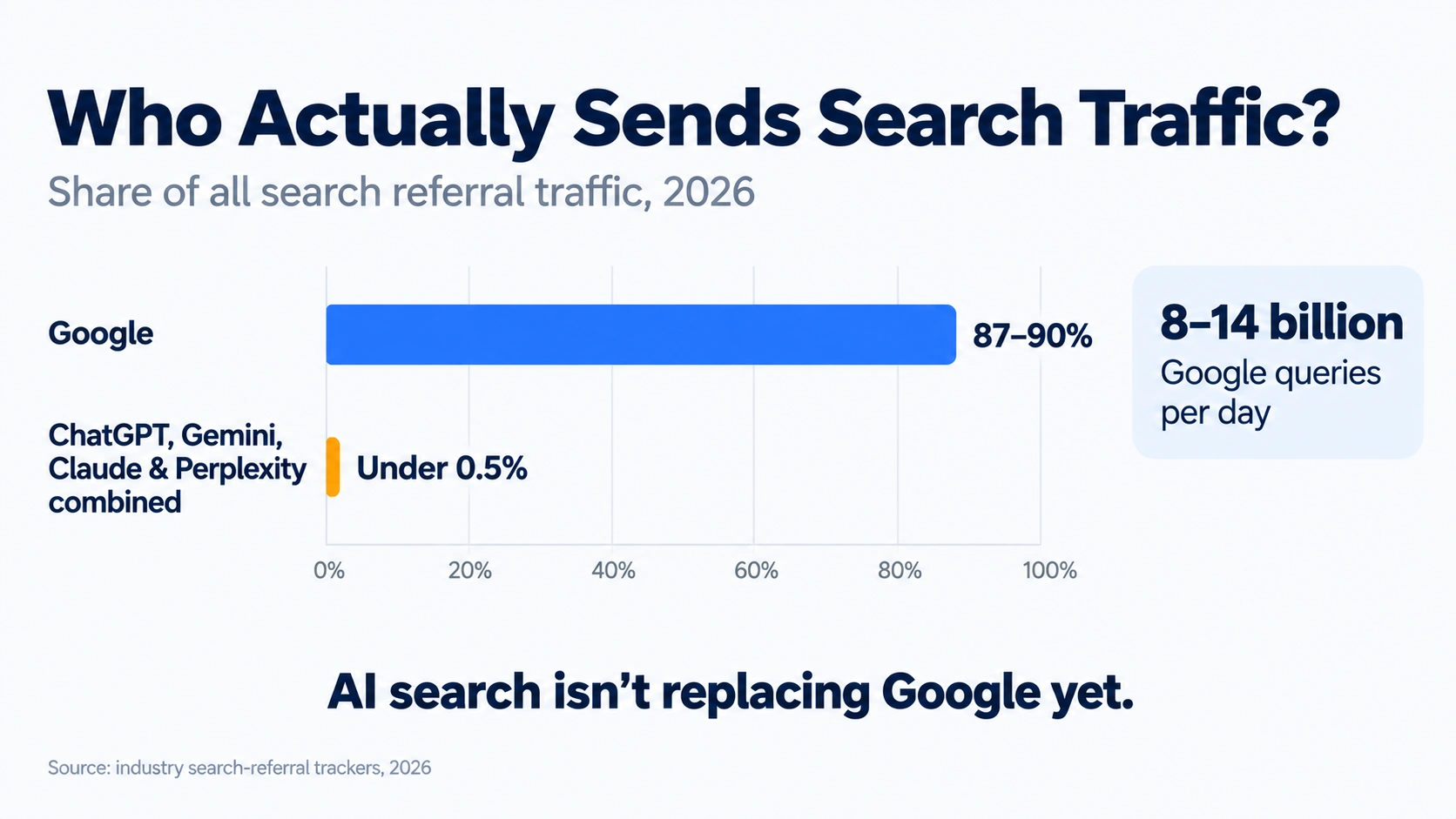
No, and the data doesn’t really support the panic. Google still processes something like 8 to 14 billion queries a day depending on whose estimate you trust, and it still sends the overwhelming majority of all search referral traffic on the internet, somewhere around 87 to 90 percent by most current measurements.
ChatGPT, Gemini, Claude and Perplexity combined send a rounding error by comparison, well under half a percent of total search referrals in most trackers. So, if the fear is “Google is being replaced,” that isn’t the story yet, not even close.
What is true is that Google itself has changed the deal. It’s no longer just a directory that points people at websites. Increasingly, it tries to answer the question directly, on the results page, using content it pulled from your website without you getting a visit for it.
That’s a genuinely different arrangement than SEO people signed up for a decade ago, and it’s fair to be annoyed about it. But annoyed isn’t the same as obsolete. The sites still showing up, still getting cited, still converting traffic, are the ones that adapted to how visibility actually works now. The ones declaring SEO dead tend to be the ones that never adapted and are looking for something else to blame.
What actually changed
Three things happened roughly at once, and it’s worth separating them because they get lumped together constantly.
First, Google started answering more questions itself instead of just linking to who answered them. Second, user behavior shifted alongside that, people got comfortable getting an answer on the page and not clicking through, which then reinforced Google’s incentive to keep answering more questions directly.
Third, a new set of competitors, ChatGPT, Perplexity, Gemini, entered the picture as alternate places people go to ask things, especially research-heavy or comparison-heavy questions where a synthesized answer beats ten blue links.
None of these three things killed search. All three of them broke the assumption that ranking in the top 10 blue links is the same thing as being visible. That assumption held for about fifteen years. It doesn’t hold anymore, and that’s the actual headline, not “SEO is dead.”
AI Overviews, and why the citation game changed underneath everyone
AI Overviews, the box Google shows at the top of a lot of search results summarizing an answer, now appear on somewhere around 43 to 50 percent of tracked US queries, depending on which tracker you check and which month you’re looking at. That’s up from roughly 15 to 31 percent just a year earlier. However you slice the exact number, the direction is not in dispute: it’s climbing fast, and it’s not slowing down.
Here’s the part that should actually worry the old playbook, not the fact that AI Overviews exist, but how loosely they’re connected to your organic ranking. Back in mid-2024, if you ranked in the organic top 10 for a query, you had roughly a 76 percent chance of also being cited inside the AI Overview for that same query. Ranking well and getting cited were basically the same game. By early 2026, that overlap had collapsed to somewhere between 17 and 38 percent depending on the study.
In plain terms: ranking #3 organically used to almost guarantee you’d show up in the AI summary too. Now it barely correlates. Google’s AI Overview is increasingly pulling from a different, wider pool of sources than the traditional top-10 rankings, sources it judges as directly answering the question well, not necessarily the pages that have historically earned the most backlinks or the strongest domain authority.
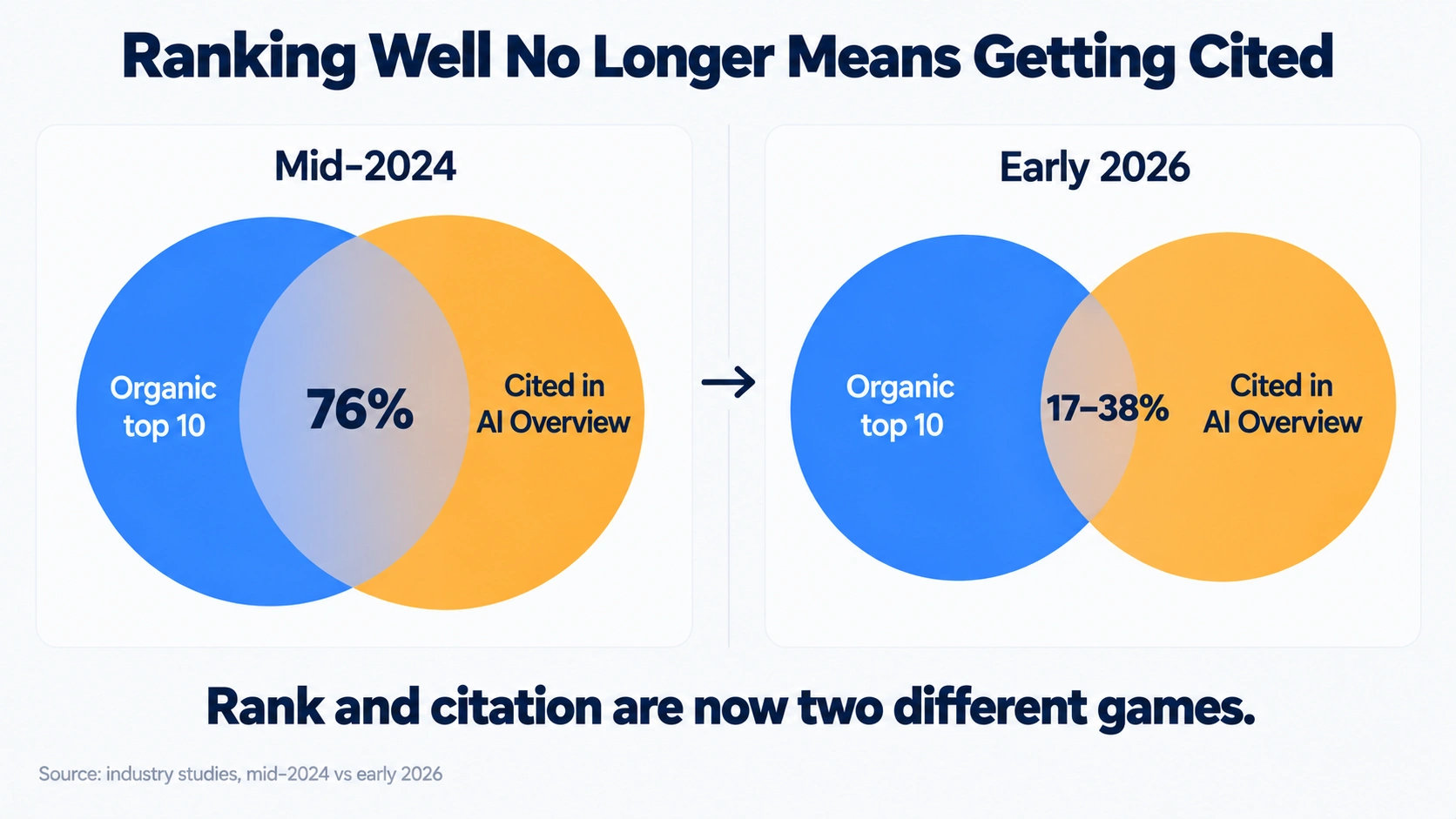
That’s the single biggest reason the old playbook is breaking. You can’t optimize purely for rank position anymore and assume citation and visibility follow automatically. They used to. They mostly don’t now.
Zero-click search is real, and it’s bigger than people think
Depending on the source, somewhere between 60 and 68 percent of US Google searches in early 2026 ended without a single click to any website. SparkToro and Similarweb’s clickstream data puts the number at 68.01 percent for the first four months of the year, up from about 60.45 percent in 2024, which they describe as the fastest two-year jump they’ve ever tracked. Put another way, out of every 1K searches, only around 276 actually send someone to an outside website. The rest resolve entirely inside Google’s own results page.
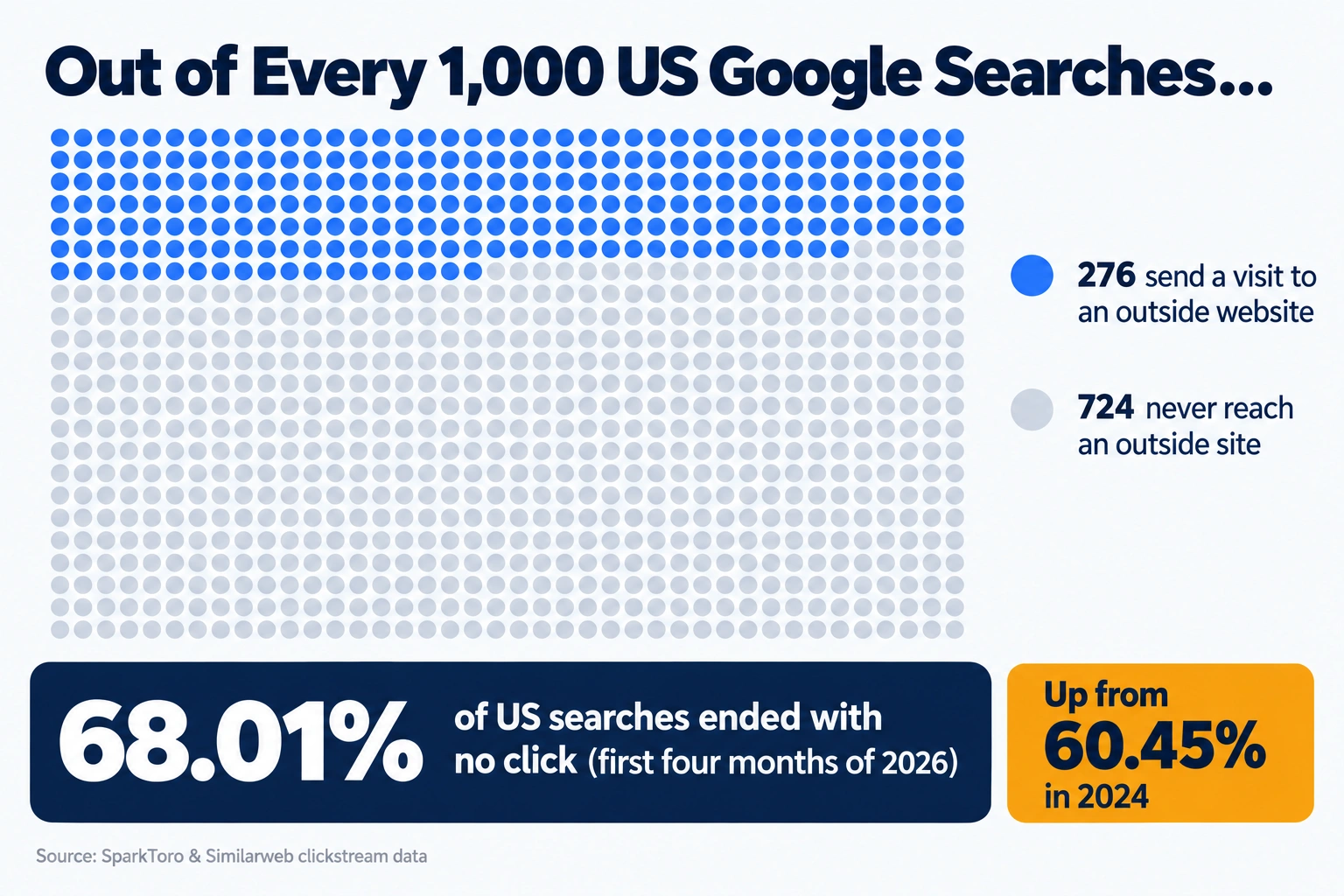
This isn’t purely an AI Overviews story either, it predates generative AI and has been building since featured snippets and knowledge panels matured years ago. AI Overviews accelerated something that was already moving, it didn’t invent the trend from scratch. And mobile is worse than desktop here: mobile zero-click rates run noticeably higher than desktop, partly because people on their phones are more likely to just want the fast answer and move on rather than dig through tabs.
What this does to click-through rate
Here’s where it stops being an abstract trend and starts hitting your traffic numbers directly. When an AI Overview shows up on a search, the click-through rate on the traditional #1 organic result drops somewhere between 34 and 61 percent depending on the study, with most credible trackers landing around 55 to 60 percent. Pew Research found that only about 8 percent of people click through to a website when an AI summary is present, compared to 15 percent when it isn’t, roughly a 47 percent relative drop.
But here’s the twist that actually matters for strategy, and it’s the one thing that should give you hope instead of dread: getting cited inside the AI Overview isn’t nothing. Seer Interactive’s research, spanning millions of tracked queries, found that brands actually cited as a source inside an AI Overview earn somewhere between 35 and 120 percent more organic clicks than brands on the same query that aren’t cited, plus a striking 91 percent more paid clicks.
Being cited functions almost like a trust stamp. People see your name mentioned by Google’s own AI, and they go looking for you specifically, sometimes by typing your brand name directly into a follow-up search rather than clicking the citation link at all.
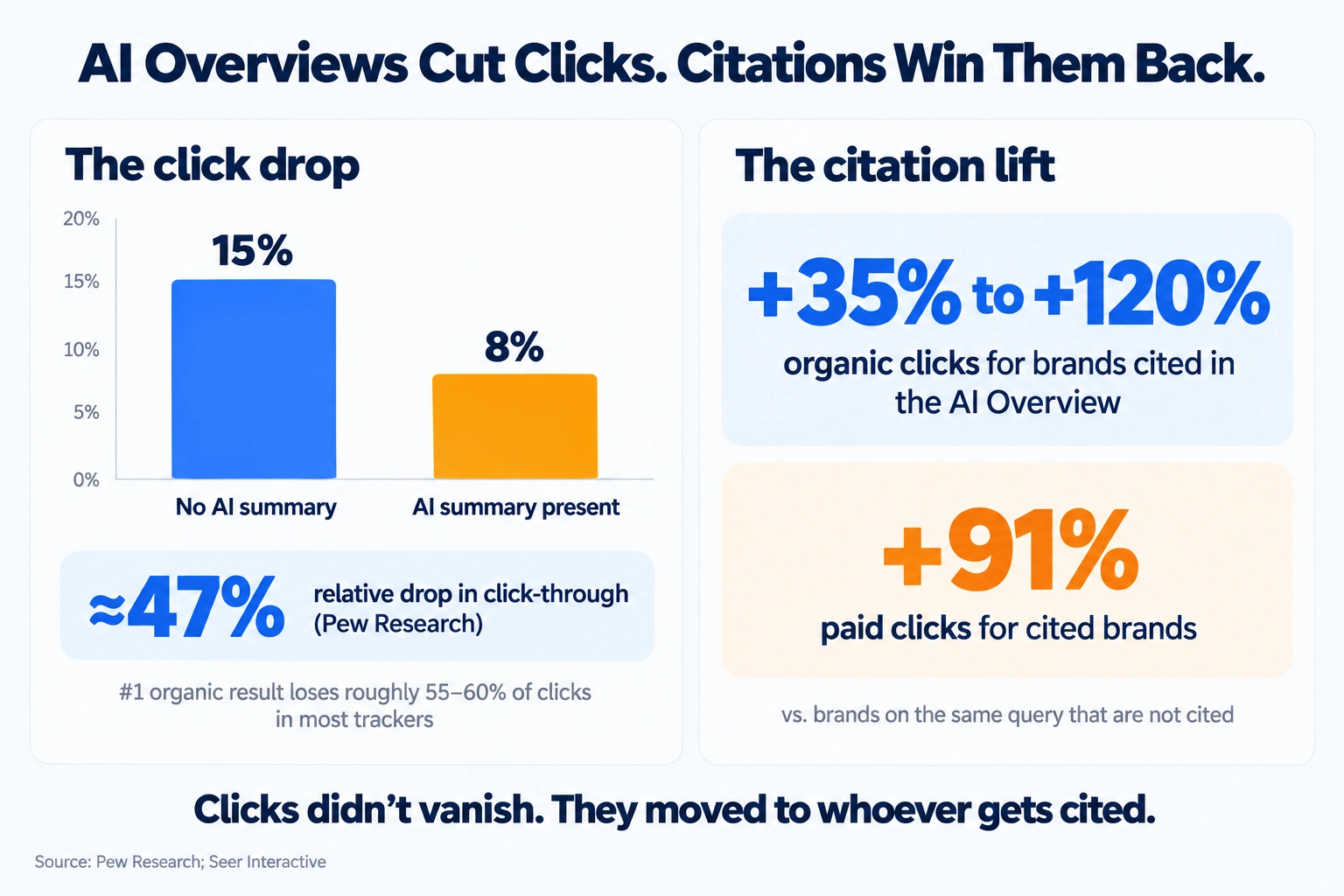
So, clicks didn’t just vanish. They redistributed, hard, toward whoever earns the citation and away from everyone else on the page. That’s a fight worth having. It’s just a different fight than “rank higher for this keyword.”
What still actually works
This is the part that gets buried under all the doom content, so let’s be direct about it. A lot of fundamentals didn’t stop working. They just stopped being sufficient on their own.
Backlinks still matter, arguably more than before, just for a different reason. They used to be mostly a ranking signal you accumulated to climb Google’s algorithm. Now they double as a distribution and citation signal for AI systems too.
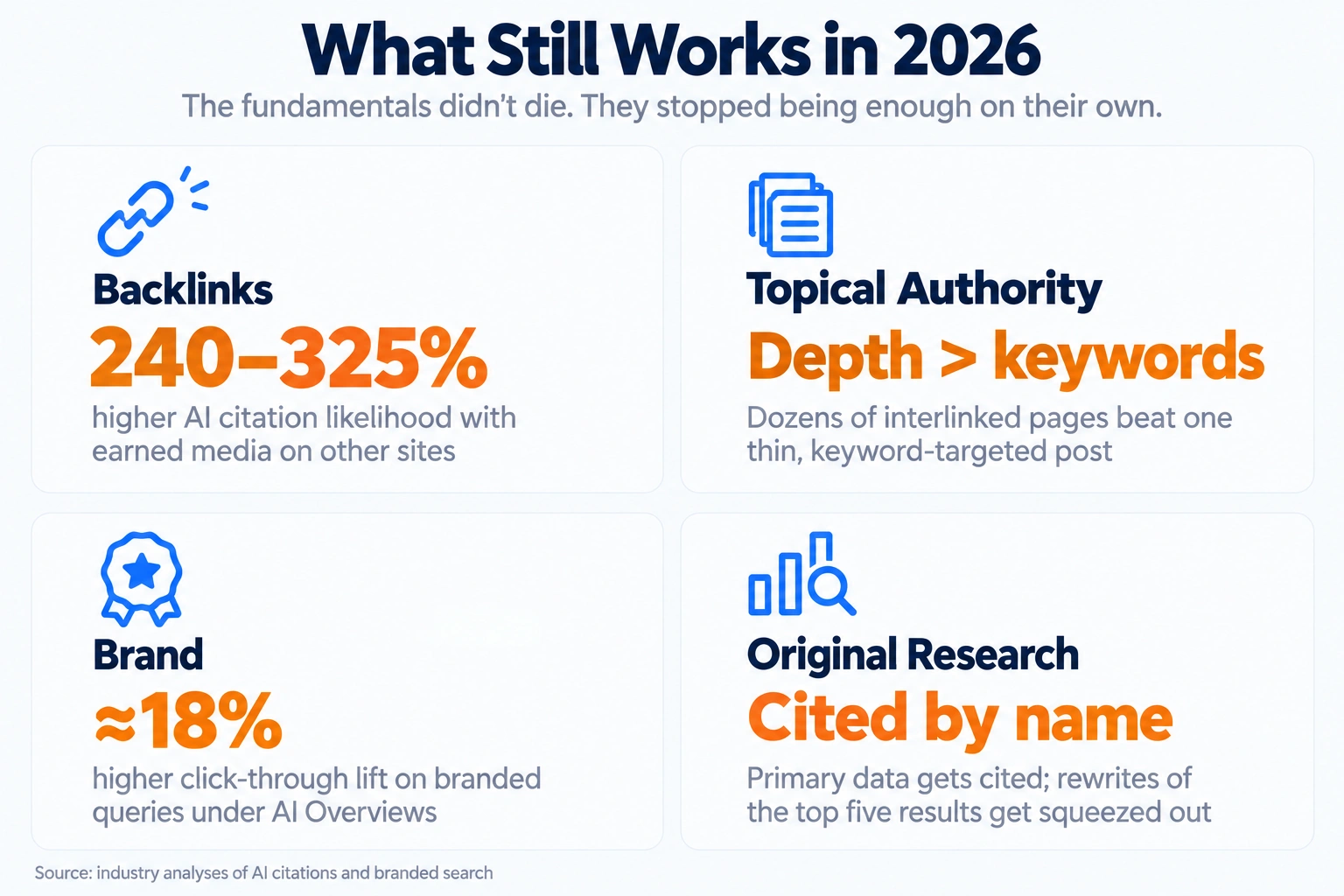
Brands that get written about, linked to, and mentioned across a wide range of third-party sites are measurably more likely to get cited by AI answer engines, one industry analysis found earned media distribution across other sites lifts AI citation likelihood by roughly 240 to 325 percent compared to publishing only on your own domain.
And that tracks with something else the data shows: brands are something like six times more likely to get cited by AI through a third-party mention than through their own website content. If your entire strategy is publishing on your own blog and hoping Google notices, you’re fighting with one hand tied behind your back in 2026.
Topical authority still counts, and arguably counts more than exact-match keyword targeting ever did. Google and the AI systems reading the web are both getting better at understanding whether a site genuinely knows a subject deeply versus whether it published one article that happens to contain the right words.
A site with real depth on a topic, dozens of interlinked, well-researched pages covering the subject from multiple angles, reads as more trustworthy to both traditional ranking algorithms and to the AI models pulling in citations. A single thin post optimized around a keyword phrase, the bread and butter of the old playbook, increasingly just doesn’t compete.
Brand matters more than it used to, not less. Search behavior data consistently shows branded queries hold up far better against AI Overview disruption than generic informational queries do. People searching your company name directly, or a specific product name, keep clicking through at healthy rates even as generic “how does X work” queries get swallowed whole by AI summaries.
Some research puts the click-through lift on branded queries under AI Overviews at close to 18 percent higher than unbranded equivalents. That’s a real incentive to invest in brand awareness outside of search entirely, because it pays off inside search too.
Original research and genuinely new information still travel. AI systems and Google both need something to cite, and they disproportionately favor pages that offer actual primary data, a survey you ran, numbers you collected, a test you did yourself, over pages that just summarize what everyone else already said.
If your content strategy is mostly rewriting the top five existing results in slightly different words, that’s exactly the kind of page getting squeezed out of both rankings and citations right now. If you’re the one who actually ran the study, you’re the one getting cited by name.
SEO and GEO aren’t really two separate disciplines
You’ll see “GEO,” generative engine optimization, thrown around as if it’s some brand new skill set completely separate from SEO. Mostly, it isn’t. The overlap between what makes a page rank well and what makes a page get cited by an AI system is still large, clear technical crawlability, genuine expertise, clean structured data, direct and well-organized answers to the actual question being asked.
Chasing that overlap is just doing SEO properly. The genuinely new pieces are things like paying attention to how your brand gets mentioned across other people’s sites (since AI models read the whole web, not just your domain), writing content that answers a question cleanly and directly rather than burying the answer under three paragraphs of preamble, and tracking whether you’re actually showing up inside AI answers, not just whether you’re ranking on page one.
Call that GEO if the label helps your team prioritize it. Just don’t treat it as a replacement discipline you do instead of SEO. It’s SEO with a wider definition of what visibility means.
The KPIs need to change, even if the work mostly doesn’t
This might be the single most practical shift a business can make this year, and it costs nothing to start doing. If you’re still measuring SEO success purely by organic sessions and keyword rank position, you’re measuring half a picture, and the half that’s shrinking.
A page can be doing genuinely well, driving brand awareness, earning citations, feeding assisted conversions, while showing declining session counts in Google Analytics, because more of its value is happening on the results page itself rather than on your site.
Alongside traditional metrics, track branded search volume over time, as it often increases when AI citations and brand awareness are working, even without direct clicks. Check whether your brand or specific pages are mentioned when you manually review responses from ChatGPT, Perplexity, and Google’s AI Overview for your category.
Monitor assisted conversions and multi-touch attribution rather than relying only on last-click attribution. This is important because many buyers may encounter your brand through zero-click AI results before they ever search for your brand directly. Finally, track your share of voice within AI answers for your core topics by conducting periodic manual checks, as automated tools are still catching up.
The 2026 playbook, in practice
Stop optimizing single pages around single keywords and start building genuine topical depth around the handful of subjects your business actually needs to own. Get your brand and your content mentioned across other credible sites, not just your own domain, because that’s increasingly how both Google’s AI and the standalone AI search engines decide who to trust and cite.
Produce something original once in a while, a survey, a dataset, a real test, rather than another summary of what’s already been said five times over. Answer the actual question directly near the top of the page instead of building suspense through three paragraphs of setup, both readers and AI summarizers reward that now.
And change what you report to your boss or your client: rankings and sessions are still worth watching, but branded search growth, AI citation checks, and assisted conversions tell you more about whether you’re actually winning in 2026.
SEO isn’t dead. It just stopped being a game you could win with keyword density and a link-building spreadsheet. The businesses treating that as bad news are the ones still running the old playbook. The ones treating it as the new baseline are the ones that’ll still be visible, however that visibility gets measured, five years from now.

Prashant Srivastava is a digital marketing leader and AI-powered growth strategist with nearly two decades of experience across SaaS, healthcare, real estate, D2C, and B2B. His expertise spans SEO, paid media, marketing automation, analytics, and Generative Engine Optimization, helping businesses achieve measurable, sustainable growth.