

Build, Deploy, and Scale Intelligent Automation Without Writing a Single Line of Code
A comprehensive comparison of the top platforms reshaping how teams automate work in 2026
Not long ago, deploying an AI agent required a specialized engineering team, months of development, and a budget most small businesses could not justify. That reality has fundamentally changed. A wave of no-code AI agent builders has emerged that puts the same transformative automation power directly in the hands of marketers, operations managers, founders, and customer support leads.
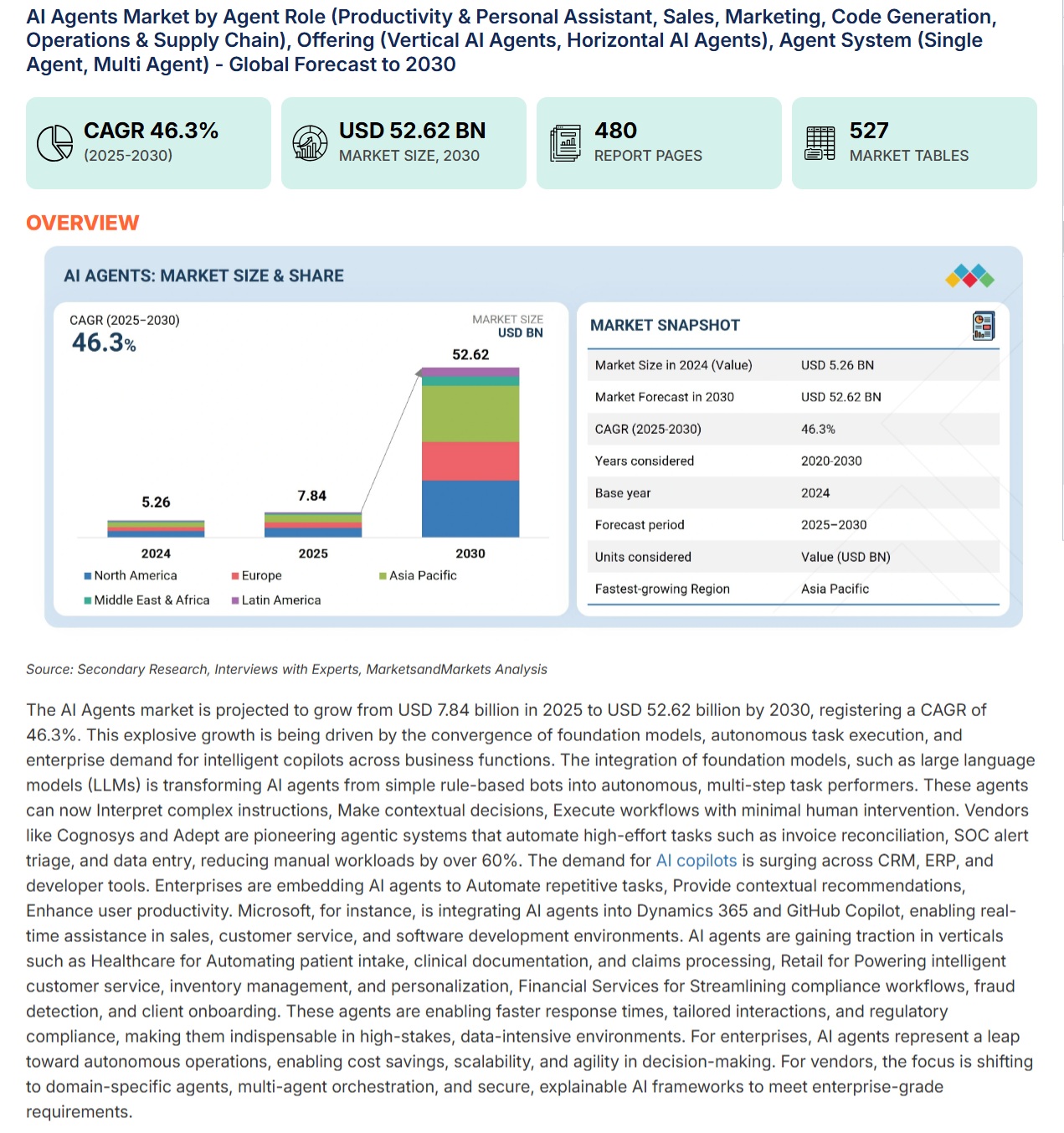
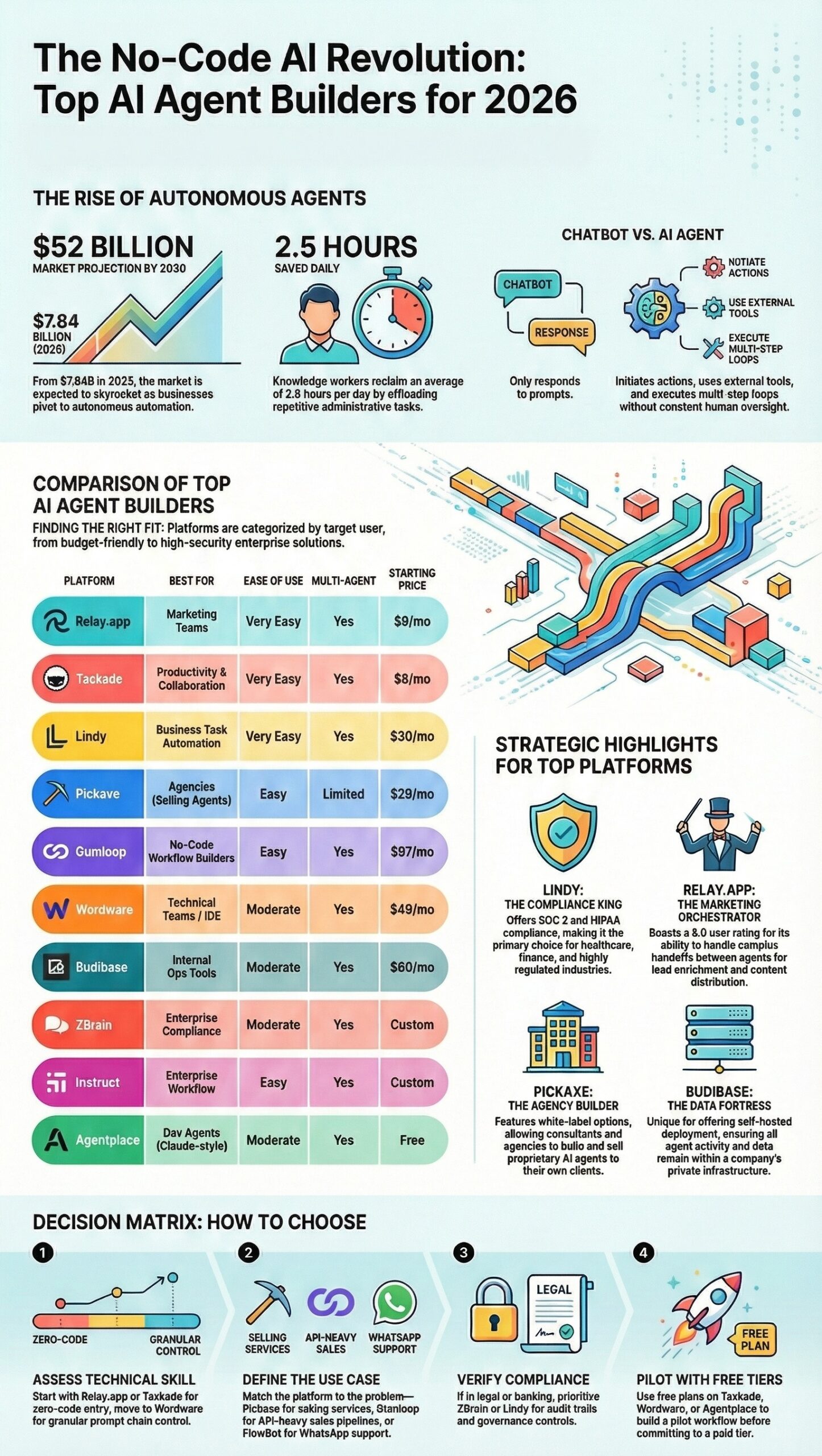
The numbers validate this shift. The AI agent market reached $7.84 billion in 2025 and is projected to exceed $52 billion by 2030. Meanwhile, over 70 percent of new business applications now rely on low-code or no-code platforms, and knowledge workers using AI agents save an average of 2.5 hours per day on administrative tasks.
 This guide covers the best no-code AI agent builders available today, drawn from a mix of highly-rated independent testing and verified user reviews. Whether the goal is to automate customer support, generate leads, process documents, or orchestrate multi-step workflows, there is a platform on this list built for the job.
What Is a No-Code AI Agent Builder?
A no-code AI agent builder is a platform that allows users to create autonomous AI systems capable of reasoning, planning, and executing tasks, all without writing application code. Unlike traditional automation tools that follow rigid if-this-then-that logic, agent builders produce systems that make decisions, adapt to changing conditions, and handle workflows requiring genuine judgment.
Most platforms provide a visual workflow builder or drag-and-drop canvas for designing agent logic, integration with large language models such as GPT-4 or Claude, connections to external tools via APIs, and orchestration capabilities that let multiple agents collaborate on complex tasks.
The distinction from a simple chatbot is critical. A chatbot responds to prompts. An AI agent initiates actions, calls tools, interprets results, and takes further steps based on those results, forming autonomous multi-step execution loops that can operate without constant human oversight.
Key Factors to Evaluate Before Choosing a Platform
Before diving into the individual tools, it helps to understand what separates truly capable platforms from those that simply added the word ‘AI’ to their homepage.
- Ease of setup: The best platforms let non-technical users build functional agents in under an hour, without needing to understand APIs, webhooks, or data schemas.
- Model flexibility: Platforms that support multiple LLMs allow choosing the right model for each task, preventing vendor lock-in.
- Integration depth: Pre-built connectors to major business tools like Salesforce, HubSpot, Slack, and Gmail determine how much value agents actually deliver inside existing workflows.
- Multi-agent support: The most powerful platforms allow specialized agents to collaborate automatically, with one handling lead qualification, another sending follow-ups, and a third updating the CRM.
- Security and compliance: For teams in regulated industries, SOC 2, HIPAA, or GDPR compliance may be non-negotiable.
- Pricing transparency: Avoid platforms with opaque per-task billing that balloons unpredictably. Look for clear pricing that remains economical at scale.
At-a-Glance Comparison: Best No-Code AI Agent Builders for Beginners
The table below provides a side-by-side comparison of the leading platforms covered in this guide, making it easy to identify the best fit before reading the full breakdown.
| Platform | Best For | Ease of Use | Multi-Agent | Free Plan | Starting Price |
| Relay.app | Marketing automation teams | Very Easy | Yes | Yes (limited) | $9/mo |
| Gumloop | No-code workflow builders | Easy | Yes | Yes | $97/mo |
| Lindy | Business task automation | Very Easy | Yes | Free trial | $30/mo |
| Budibase | Internal ops tools | Moderate | Yes | Yes (self-hosted) | $60/mo |
| Wordware | Developers & technical teams | Moderate | Yes | Yes | $49/mo |
| Taskade | Team productivity & collaboration | Very Easy | Yes | Yes | $8/mo |
| Agentplace | Claude Code-style dev agents | Moderate | Yes | Yes | Free |
| Instruct | Enterprise workflow automation | Easy | Yes | No | Custom |
| Pickaxe | Agencies building & selling agents | Easy | Limited | Yes | $29/mo |
| ZBrain | Enterprise compliance workflows | Moderate | Yes | No | Custom |
The Best No-Code AI Agent Builders Reviewed
1. Relay.app
Relay.app positions itself as a platform for building an AI team that works autonomously, and the product largely delivers on that promise. With a 5.0 rating across 43 reviews on Product Hunt and adoption by 16 known companies, it has established itself as one of the most trusted names in AI workflow automation.
The platform combines a visual builder with multi-agent collaboration features, making it easy for non-technical marketing and operations teams to design, test, and deploy complex automations. Users describe it as feeling more like a team orchestration layer than a simple automation tool, which suits businesses that need multiple agents handing off tasks to one another.
Relay.app excels in marketing automation contexts, handling use cases like lead enrichment, content distribution, and CRM updates without manual intervention. Its third-party integration library covers the most common business tools, and new connections are added regularly.
Key Takeaways
- Ideal for marketing and operations teams that need multi-agent workflows
- Strong reputation backed by 43 five-star reviews
- Handles complex handoff logic between agents without code
- Best used alongside tools like HubSpot, Salesforce, and Slack
2. Gumloop
Gumloop markets itself with the tagline ‘Automate Any Workflow with AI’ and holds a 5.0 rating from its user base. The platform appeals to builders who want to go beyond simple trigger-action flows and construct genuinely intelligent pipelines where AI reasoning is embedded at multiple steps.
One of Gumloop’s defining strengths is its support for API integrations, which allows agents to reach into external data sources and write results back without developer involvement. For startups and growth-stage companies building outbound sales or content workflows, the platform reduces what would normally take developer sprints to a matter of hours.
The user interface is clean and the learning curve is manageable, though teams moving into more sophisticated multi-agent architectures may need to invest time in understanding the platform’s data flow conventions. Pricing begins at $97 per month for production-grade plans.
Key Takeaways
- Well-suited for API-heavy workflows that would normally require engineering resources
- Strong for content generation and outbound sales automation pipelines
- Competitive five-star rating among users who build complex automations
- Higher starting price than some alternatives, justified for serious workflow needs
3. Lindy
Lindy’s positioning is refreshingly direct: the platform exists to eliminate the time teams waste on low-value administrative work. With a 4.4 rating and a growing user base, Lindy has found a loyal audience among business operations teams that need agents running with minimal configuration overhead.
The platform supports multi-agent collaboration out of the box, meaning different specialized agents can communicate and pass tasks between one another. It also meets SOC 2 and HIPAA compliance standards, making it viable for healthcare, finance, and other regulated environments where most lighter no-code tools are disqualified.
Lindy’s conversational setup interface stands out. Users describe their agent’s goal in plain language, and Lindy constructs the workflow logic automatically. This approach dramatically reduces the barrier for teams with no automation experience. Pricing starts at $30 per month per agent.
Key Takeaways
- Outstanding ease of use with conversational agent configuration
- SOC 2 and HIPAA compliant, suitable for regulated industries
- Multi-agent collaboration built into the core product architecture
- Strong fit for support triage, lead qualification, and internal ops automation
4. Budibase
Budibase takes a different approach than most tools on this list. Rather than being purely an agent orchestration layer, it combines data management, automation, and AI in a single internal operations platform. The result is a tool that feels closer to a custom application builder, which gives it unique advantages and trade-offs.
Teams that need internal dashboards, approval workflows, and AI-assisted data processing can build all three inside Budibase without context-switching to other platforms. The platform supports AI agents that run operations workflows, and it offers self-hosted deployment for organizations with strict data residency requirements. Paid tiers start at $60 per creator per month.
Its self-hosting capability is a significant differentiator for enterprise teams. Unlike cloud-only tools, Budibase allows organizations to keep all agent activity within their own infrastructure, which addresses data privacy concerns that often block AI automation adoption in larger organizations.
Key Takeaways
- Unique combination of internal tool builder and AI agent capabilities
- Self-hosted deployment available for full data control
- Best for teams managing both data workflows and process automation
- Slightly steeper learning curve than purely no-code alternatives
5. Wordware
Wordware describes itself as a web-hosted IDE for building AI agents, which signals that it sits at the intersection of no-code accessibility and developer-grade power. It earned the number one ranked product of the year for August 2024 on Product Hunt, a significant milestone reflecting both quality and community enthusiasm.
The platform is built for teams and individuals who want fine-grained control over how their agents reason and behave. Users can define prompt chains, control model behavior, and build multi-step reasoning workflows through a structured but accessible interface. Nine companies have listed Wordware as a core part of their stack, including Helicone AI.
Wordware’s positioning suits technical founders, growth engineers, and AI practitioners who want something more capable than drag-and-drop builders but less complex than coding agents from scratch in Python or JavaScript.
Key Takeaways
- Product of the Year recognition reflects exceptional quality and community trust
- Suited for technical users who need granular control over agent behavior
- Bridges the gap between no-code simplicity and developer-grade capability
- Strong for research agents, document processing, and reasoning-heavy workflows
6. Taskade
Taskade earned a Golden Kitty Award at the 2023 Product Hunt annual ceremony and holds an impressive 4.7 rating across 101 reviews, the largest review base of any platform covered here. The product offers one of the most complete visions of an AI-powered workspace: project management, collaborative documents, and automation combined into a single interface.
The platform’s AI agent capabilities are deeply integrated into its team collaboration layer, meaning agents can operate within the same environment where teams plan projects, take notes, and communicate. This integration reduces the friction of deploying automation inside existing team workflows.
Taskade supports no-code app building and website building alongside its agent capabilities, positioning it as a broad productivity platform rather than a narrow automation tool. Its starting price of $8 per month makes it one of the most accessible options for small teams.
Key Takeaways
- Most-reviewed platform on the list with 101 ratings and a 4.7 average
- Deep integration between team collaboration and AI agent automation
- Affordable entry point at $8 per month makes it accessible for small teams
- Best for teams wanting a unified workspace rather than a standalone automation tool
7. Agentplace
Agentplace is one of the newest entrants on this list, having been ranked number one product of the week in March 2026. It targets developers and power users who want to build, iterate on, and improve AI agents in the style of Claude Code, combining agentic workflows with a structured development environment.
The platform differentiates itself by offering an integrated environment where users can build agents, test them in real conditions, and improve them through structured feedback loops, all in one place. This makes it particularly well-suited for teams that view their agents as products requiring ongoing refinement rather than set-and-forget automations.
Agentplace is free to start, which removes the financial barrier to experimentation. For developer-oriented teams that need Claude Code-style agents with more flexibility than cloud-only agent runners provide, it represents a strong option.
Key Takeaways
- Number one ranked product of the week in March 2026, signaling current relevance
- Free tier available, ideal for experimentation and early-stage adoption
- Built for iterative agent improvement with structured feedback loops
- Strong for developer teams building Claude Code-style autonomous agents
8. Instruct
Instruct positions itself as the most capable way to automate complex work, and its 5.0 rating suggests the small but committed user base agrees. The platform ranked number one product of the day in October 2025, and its updated version reached the top three in January 2026.
The platform specializes in enterprise-grade no-code automation where reliability and performance under complex conditions matter most. Two notable companies, including Watchman AI, rely on Instruct as part of their core stack.
Instruct’s user interface prioritizes clarity over visual complexity, which suits operations leaders and business analysts who want automation without a steep technical onboarding process. Pricing is on a custom enterprise basis, reflecting its focus on larger organizational deployments rather than self-serve individual use.
Key Takeaways
- Perfect 5.0 rating from early adopters indicates strong product-market fit
- Enterprise-focused with a reputation for handling complex, high-stakes workflows
- Clean interface designed for business users, not just technical operators
- Custom pricing reflects suitability for larger organizational deployments
9. Pickaxe
Pickaxe takes a unique angle in the no-code AI agent market with its tagline ‘Build agents for anything, Sell them to anyone.’ The platform is specifically designed for agencies, consultants, and SaaS builders who not only want to create AI agents but also want to distribute them as products to clients or end users.
With a 4.9 rating across 17 reviews, Pickaxe has built a loyal niche following among business owners and freelancers who see AI agent creation as a revenue opportunity rather than simply an internal productivity tool. The white-label capabilities allow the platform’s technology to be completely rebranded, so the agent appears as the user’s own proprietary product.
For anyone building an AI services business or embedding agent capabilities into a client product without developer resources, Pickaxe removes significant technical and cost barriers. Starting at $29 per month, it is priced accessibly for independent operators.
Key Takeaways
- Unique focus on building agents to sell, not just deploy internally
- White-label options make it ideal for agencies and freelance AI consultants
- Competitive 4.9 rating reflects strong satisfaction in its niche
- Affordable at $29 per month for individual operators and small agencies
10. ZBrain
ZBrain occupies a distinct space in the enterprise AI segment, focusing on workflow orchestration where compliance, security, and data governance are primary concerns. The platform’s 4.0 rating reflects honest feedback from enterprise users who appreciate its depth but acknowledge its complexity relative to lighter alternatives.
The platform supports agentic workflow orchestration across complex business processes, with built-in provisions for audit trails, access control, and enterprise-grade security. For organizations in banking, healthcare, or legal services where AI activity must be logged and governed, ZBrain addresses requirements that most consumer-grade no-code tools simply cannot meet.
ZBrain’s custom pricing model reflects its position as a serious enterprise solution rather than a self-serve product. Teams evaluating ZBrain typically do so when compliance requirements have already ruled out lighter alternatives.
Key Takeaways
- Enterprise-grade compliance features including audit trails and access controls
- Suited for regulated industries where AI governance is a hard requirement
- More complex setup than consumer tools, but justified by its security capabilities
- Custom pricing reflects a focus on organizational-scale deployments
Emerging Tools Worth Watching
Beyond the ten platforms covered in depth, several newer entrants are gaining momentum that warrant attention for teams evaluating their options over the next six to twelve months.
Tate-A-Tate promises to take users from idea to AI agent in minutes with zero coding, and ranked second on Product Hunt the day of its launch in May 2025. Its simplified onboarding suggests a particular focus on absolute beginners entering automation for the first time.
FlowBot specializes in AI agents for WhatsApp and website customer support, a focused niche that makes it particularly valuable for e-commerce brands and service businesses with high messaging volume across mobile channels.
Synthflow AI brings AI agent creation to voice workflows without requiring coding, enabling businesses to build AI-powered phone agents for customer service, appointment booking, and outbound calling. As voice automation matures, platforms like Synthflow are likely to see rapid adoption.
How to Choose the Right Platform for Your Use Case
With ten strong options and several emerging contenders, the selection process comes down to being honest about four core variables.
First, consider team technical skill. Relay.app, Lindy, and Taskade are the best entry points for non-technical teams. Wordware and Agentplace reward users with more comfort around prompting, logic design, or development environments.
Second, define the primary use case before shopping. Customer support automation has different platform requirements than outbound sales sequencing, internal operations management, or building AI products to sell to clients. Matching a platform to a specific, well-defined problem is far more effective than choosing the most feature-rich option.
Third, consider the compliance environment. For teams in healthcare, finance, or legal services, Lindy’s HIPAA compliance or ZBrain’s enterprise governance controls narrow the shortlist considerably.
Fourth, start with the free tier wherever available. Gumloop, Lindy, Wordware, Taskade, and Agentplace all offer free plans or trials. There is no substitute for building a small pilot workflow to evaluate how a platform handles real-world conditions before committing to a paid subscription.
Final Thoughts
No-code AI agent builders have crossed from experimental curiosity to operational necessity. Teams that adopt them thoughtfully, starting with a specific high-value workflow rather than trying to automate everything at once, consistently report meaningful productivity gains and cost reductions.
The platforms covered in this guide each serve a distinct slice of the market. Relay.app and Gumloop lead for marketing and growth teams. Lindy and Budibase stand out for operations and compliance-sensitive environments. Wordware and Agentplace serve technical builders who want more control. Taskade wins for collaborative teams that want an all-in-one workspace. Pickaxe is the clear choice for anyone building agents as a product. And ZBrain and Instruct serve enterprise customers with complex governance requirements.
The organizations seeing the strongest results are not those that deployed the most agents, but those that identified one critical, time-consuming workflow, built an agent around it, measured the outcome, and used that success to make the case for broader adoption. That disciplined approach, supported by any of the platforms on this list, is the most reliable path from AI experimentation to genuine operational leverage.